- Qwen is Alibaba's AI model family and the leading open-source LLM in the world. How it works, what's new in 2026, how it handles Hebrew, and why Israeli organizations should know it.
Qwen's full name in Chinese is 'Tongyi Qianwen' (通义千问), which means roughly 'a thousand questions of universal understanding.' Qwen is simply a romanized abbreviation of Qianwen, 'a thousand questions.' And that is not just a tagline: by 2026 the Qwen family had become the open model family from which more derivative models have been built than any other in the world, more than Meta's Llama.
What Is Qwen: The Short Answer
Qwen is Alibaba Cloud's family of artificial intelligence models, developed by the Chinese technology giant. The official Chinese name is Tongyi Qianwen (通义千问), and Qwen is its romanized abbreviation. This is not a single model but an entire family: chat, writing, code generation, computer vision (image and video understanding), audio comprehension, an image generator, and a translation engine covering 92 languages. Some of these can be used for free through the website chat.qwen.ai, and for several versions you can also download the model itself and run it on a private server. Here is the most important fact for the Israeli reader: in 2026, Qwen became the most capable open-model family in the world, meaning the highest-quality model you can download, run on your own infrastructure, and guarantee that no data ever leaves your environment. That is precisely why any Israeli organization with privacy, confidentiality, or data-sovereignty concerns needs to know about it, not because its Hebrew is extraordinary (it is usable but not native), but because it delivers serious capability without sacrificing control.
That is the angle almost every Hebrew-language article about Qwen misses. Most describe it as "another Chinese ChatGPT" and compare chat quality, but they miss the point: Qwen's real game is openness and control, not winning a quality contest against Claude. In this guide I will address both things honestly: what Qwen does exceptionally well, and where it falls short, including the truth about its Hebrew and the truth about what "open source" means in 2026, a meaning that shifted significantly this year.
Definition: An "open-weights model" is a model whose developer has publicly released the trained parameters, the "weights," so that anyone can download the file, run the model on their own hardware, and adapt it to their needs, with no dependency on the vendor's servers. This differs from a closed model such as GPT or Claude, which are accessible only through a cloud API the company operates. "Open weights" does not always mean "fully open source." Typically the weights are published but training data and the training process are not. The license on each release matters: some use the permissive Apache 2.0 license, others carry more restrictive terms.
This guide is one piece in a series covering the most important AI tools in depth. If you are trying to understand the broader picture, who leads in each category and when to use what, I recommend also reading the full comparison of leading AI models. And if you are evaluating a Chinese model, it is worth reading alongside it the guide to DeepSeek, Qwen's direct Chinese competitor, to understand the difference between the two.
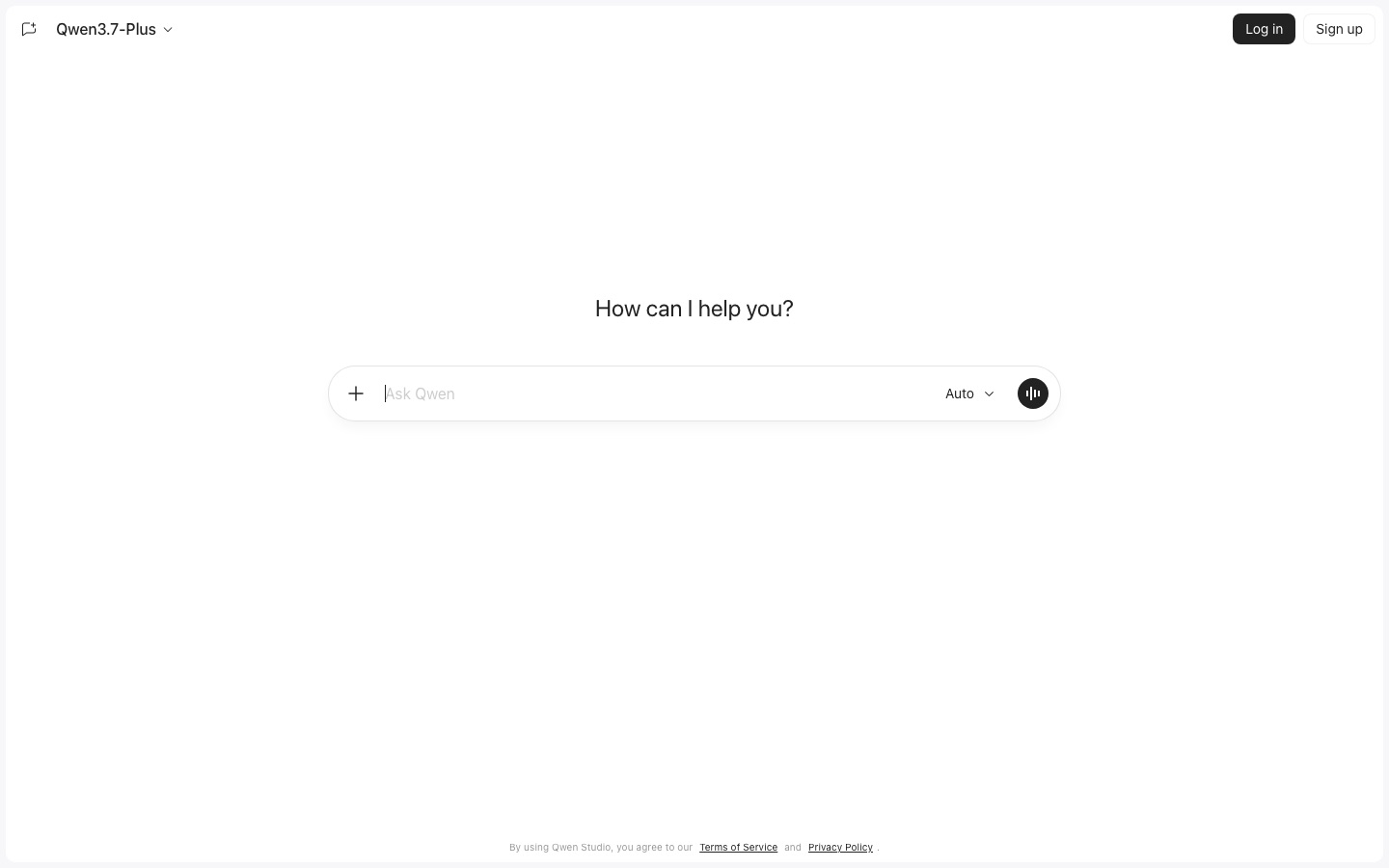 The official Qwen website, photographed in September 2026. Credit: Qwen
Why Everyone Is Talking About Qwen: The Story Behind the Model
To understand Qwen in 2026, you need to understand what Alibaba was trying to achieve. While OpenAI, Google, and Anthropic were fighting over the crown of "smartest closed model," Alibaba chose the opposite strategy: to make Qwen the infrastructure everyone builds on. Over two years it released dozens of open-weights models in an enormous range of sizes, from tiny models that run on a phone to giants on the scale of Western flagships, almost all under the permissive Apache 2.0 license, which permits commercial use as well.
The result was dramatic. Qwen became the model family from which more derivative models have been built than any other in the world, more even than Meta's Llama, which broke the trail for open-source AI. Thousands of companies, researchers, and startups took Qwen as a base, fine-tuned it for their specific needs, and released variants. In that sense, Qwen became the "infrastructure" of the open-source world, the way Linux is the infrastructure of internet servers.
💡 From the field: When an Israeli organization tells me "we cannot send our data to OpenAI's cloud," the conversation almost always arrives at Qwen. That is not a choice about "who is smartest," there are other answers to that question. It is a choice about "who is the most capable among the models I can run within my own walls, without a single bit leaving." And in that category, as of 2026, Qwen is usually the answer. I have seen this at hospitals, defense companies, and law firms. All of them reached the same conclusion from different starting points.
Why did Alibaba choose this strategy? The business logic is smart. Alibaba is first and foremost a cloud company. It profits when businesses run things on its infrastructure. If Qwen becomes the standard the whole world builds on, then even if the model itself is free, a large share of the people running it at scale will do so through Alibaba's cloud services, or at least recognize the brand and come to it. In other words: open source was an engine for marketing and market penetration, not a surrender of profit. That is precisely why the strategy worked so well. It aligned community interest (a powerful free model) with Alibaba's business interest (control of infrastructure and brand).
There is also a geopolitical dimension that cannot be ignored. While American AI companies closed their models and turned them into black boxes, the Chinese companies, Qwen first among them and DeepSeek following, turned openness into a strategic weapon. A powerful open model coming out of China undermines the West's advantage, because it allows the entire world, including developing countries that could not afford the expensive proprietary models, to access high-quality AI for free. In that sense, Qwen is not just a technology product but a move in the global arena.
In 2026, however, that story took a turn that is important to understand, and I will return to it in depth: Alibaba began closing its most powerful flagships behind a paid API, exactly like its Western competitors. The absolute openness of Qwen is no longer a given. That tells a larger story about the entire open-source market: when a model reaches the technological frontier, the temptation to close it and charge for it overwhelms the ideology.
What Is New in Qwen in 2026: The Current State
The model landscape moves fast, so here is an accurate snapshot as of July 2026 (always check the official website for the latest details):
The Closed Flagship: Qwen Max
On July 19, 2026, during the World Artificial Intelligence Conference (WAIC) in Shanghai, Alibaba unveiled a preview of Qwen3.8-Max-Preview, a large multimodal model reported to have approximately 2.4 trillion parameters, ranked in benchmarks as "second only to Fable 5." This is Alibaba's most powerful model to date, but it is closed: currently available only as a preview through chat and the API, with no open weights available for download. Alibaba stated that open weights are "on the way" but gave no date.
The Open Layer: Qwen 3.6
The most recent significant open release was Qwen 3.6, which shipped in two waves in April 2026: first a MoE (Mixture of Experts) variant at 35B-A3B on April 16, then a full dense version at 27B on April 22, both under the Apache 2.0 license. These are the models an organization can download and run today.
The Distinction Worth Internalizing
Between the two sits Qwen3.7, which is, right now, available only via API, with no open weights. The pattern that emerged in 2026 is clear: Alibaba releases a closed version as a preview, then (sometimes) opens the layer one step below the flagship. That means the strongest version of Qwen at any given moment is probably closed, and the strongest openly available version is one or two layers beneath it. That is still an exceptional position in the market (most competitors open nothing), but it is far from the absolute openness of 2024 and 2025.
Qwen's Core Capabilities
Qwen is not one model but a family, and that is one of its greatest advantages. Rather than a single product trying to do everything, Alibaba built a group of specialized models sharing a common DNA. You can choose exactly the right tool for each task instead of compromising on a generalist. Here are the main members of the family:
Chat and Writing (Qwen Chat)
The core: a language model for conversation, writing, summarization, question answering, and reasoning. The newer versions also include a "thinking mode," where the model reasons step by step before responding, which significantly improves performance on mathematical, logical, and coding tasks. Free access is available at chat.qwen.ai.
Code Generation (Qwen Coder)
Alibaba releases dedicated coding versions that compete directly with the leading code models. For developers who want a coding assistant that runs locally (without sending their proprietary code to the cloud), Qwen Coder is one of the most capable options available. It can be connected to various development environments and in some cases to tools such as Claude Code through open protocols.
Computer Vision (Qwen-VL)
Qwen's vision models understand images and even long videos (over 20 minutes), read text from images in multiple languages, analyze charts, and answer questions about video content. This is a particularly strong capability for processing scanned documents, screenshots, and visual materials.
Image Generation
Qwen includes an image generator with an emphasis on relatively good text rendering within generated images, including multi-line layouts. It is not at the level of leading image generators for Hebrew such as Nano Banana, but it is impressive for a model family whose primary focus is language.
Translation (Qwen-MT)
A dedicated translation engine supporting 92 languages and dialects, including Hebrew, with an emphasis on contextually accurate translation. This is one area where Hebrew works reasonably well, because translation is a comparatively well-mapped task.
Audio Understanding
Some Qwen models also accept audio input, covering transcription, conversation analysis, and question answering over recorded content. This opens use cases such as meeting summarization, recording transcription, and building voice interfaces, all within the same model family, with no need to integrate an external tool.
💡 From the field: What many people do not grasp about Qwen is that its value is not just "how smart is the chat" but its breadth. When I build an AI system for an organization, say, a system that reads scanned documents (vision), summarizes them (language), and translates to English (translation), with the Qwen family I can handle all three stages within the same ecosystem, on the same infrastructure, without stitching together three different vendors with three separate accounts and three different privacy contracts. That simplicity is worth a great deal in a real project.
Definition: What is MoE (Mixture of Experts)? It is an architecture in which the model is built from many small "experts," but only a small subset of them, the ones relevant to the query, are activated for each request. The advantage: you get the knowledge of a large model at the computational cost of a much smaller one. The notation "35B-A3B" means: 35 billion total parameters, but only approximately 3 billion are active on any given query. This is why Qwen's MoE models run quickly and cheaply relative to their size, an important point when choosing a model to run locally on limited hardware.
Getting Started with Qwen: Step by Step
There are two very different ways to approach Qwen, and choosing between them is the most important decision you'll make.
Option A: The Free Chat Interface (for general users)
- Go to chat.qwen.ai. This is the simplest entry point: a ChatGPT-style chat interface, free, no technical knowledge required.
- Sign up (Alibaba account or email). Note the privacy implication: in this version, your data passes through Alibaba's servers. Do not upload sensitive or confidential information here.
- Choose a model from the model selector at the top of the screen. Several variants are available (fast / smart / thinking / vision).
- Chat in Hebrew or English. For precision tasks, English will give you smoother results; Hebrew works, but keep your expectations realistic.
- Use the built-in tools: image upload for analysis, image generation, and thinking mode for complex tasks.
Option B: Local Deployment (for organizations and developers)
This is the path that delivers real value to Israeli organizations:
- Download an open model (for example Qwen 3.6) from Hugging Face, the platform that hosts open models.
- Choose a size that fits your hardware. Small variants run on a single powerful workstation; larger ones require a server with GPU cards.
- Run it through a serving framework (such as Ollama, vLLM, or similar), either on an on-premises server or a private cloud you control.
- Connect it to your applications via a local API, and you now have a powerful AI model where not a single bit leaves your organization.
The second path requires technical knowledge (or professional guidance), but it is the only real reason an Israeli organization should choose Qwen over a closed Western model.
Business Use Cases in Israel: Concrete Scenarios
Here is where Qwen genuinely shines in an Israeli context:
- A hospital or clinic that wants an AI assistant for summarizing medical records but cannot send identified medical data to a foreign cloud: run Qwen 3.6 on an internal server. The data never leaves the institution.
- A law firm analyzing contracts and pleadings: local deployment ensures that attorney-client privilege is protected at the infrastructure level, not just at the promise level.
- A fintech or defense company under strict data-sovereignty regulation: a local Qwen deployment delivers powerful AI capability without violating regulatory requirements.
- A cash-strapped startup building an AI-based product: Qwen's API is significantly cheaper than its Western competitors, making development and maintenance possible at a much lower unit cost.
- A development team that wants a code assistant that doesn't send proprietary code outside the organization: local Qwen Coder.
- An academic or research institution that wants a model it can study, fine-tune, and publish papers about: Qwen's openness enables scientific transparency that a closed model simply cannot offer.
- A multinational company that needs broad multilingual support (beyond Hebrew and English): the 92+ language coverage via Qwen-MT is a genuine advantage.
In all of these scenarios, the question is not "Is Qwen smarter than Claude?" (usually, it isn't). The question is "Is Qwen good enough, and does it give me a level of control that no closed model can?" The answer, in many cases, is yes. If you're unsure which model fits your scenario, that is exactly the kind of decision we work through in AI implementation consulting for organizations.
One point many organizations miss: moving to a local Qwen deployment is not purely a technical decision, it is a strategic one. Once the model runs inside your organization, possibilities open up that simply do not exist with a closed cloud model. You can fine-tune the model on your internal data so that it "learns" your specific terminology, procedures, and style, turning it into a domain expert rather than a generic assistant. You can connect it to internal systems (CRM, databases, filing systems) without exposing them to the internet. And you can plan costs in advance, because instead of paying per query, you pay once for the hardware and run as many queries as you like. For an organization running high volumes, that can be the difference between an AI project that makes financial sense and one that burns through budget.
On the other side, there is a common trap here: organizations that fall in love with the idea of "our own private AI" and underestimate the cost of maintenance. A local model requires monitoring, updates, security, and infrastructure. It is not a "set it and forget it" situation. The recommendation in almost every case: start small, with one clear and focused use case, prove value, and only then expand. Do not build a massive infrastructure before you have demonstrated that it solves a real problem.
Qwen vs. Llama: The Battle for Open Source
For years, when someone said "open-source model," they almost always meant Meta's Llama. Llama broke new ground: it was the first powerful model that a major company released with open weights, and it became the foundation of an entire industry. But by 2026 the balance had shifted, and in one specific area Qwen had moved ahead, not necessarily in the absolute quality of its flagship, but in the number of variants derived from it and the pace of releases. Qwen ships new models at a dizzying frequency, across a wider range of sizes, with broader multilingual coverage, and has consequently become the most popular family to build on in the open-source community.
What does that mean in practice? If you are looking for an open model of a specific size, fine-tuned for a particular domain, or in a particular language, there is a good chance someone has already built that variant on a Qwen base and released it for free. The ecosystem around Qwen is an asset in its own right: serving tools support it from day one, tutorials are plentiful, and solutions to common problems are easy to find. That advantage is hard to quantify but you feel it immediately when you start building.
The flip side: the abundance of versions is also confusing. Between Qwen 3.6, 3.7, 3.8, the "regular" releases, the MoE variants, the code variants, and the vision variants, it is easy to get lost. The practical recommendation for most organizations: don't chase the latest version. Pick a stable, well-documented release with a clear license, and focus on that. You can always upgrade later, once the system is running.
It is also worth remembering that the open-source competition is not only between China (Qwen) and the United States (Llama). Europe has its own contender: Mistral, the French company that became the flag-bearer of European digital sovereignty, which built its reputation on exactly this: releasing open models. Anyone considering an open model for local deployment for privacy reasons should compare Qwen against Mistral as well, each has a different regulatory and geopolitical profile.
Hebrew: What Works and What Doesn't, Honestly
This is the point that most deserves candor, because this is where Qwen falls short of the leaders.
What works: You can converse with Qwen entirely in Hebrew. It understands Hebrew questions, answers in Hebrew, summarizes Hebrew texts, and translates well (especially via Qwen-MT). For everyday use, asking a question, getting a draft, summarizing a document, it is perfectly serviceable.
What doesn't work as well: Qwen's Hebrew is not at the native level of Claude or Gemini. In long or formal texts you will sometimes encounter syntax that sounds "translated," unnatural word choices, and subtle grammatical errors, particularly in verb conjugations and gender agreement. The reason is straightforward: Qwen was trained primarily on Chinese and English, and Hebrew is a language with relatively limited training data in the global corpus. The more formal, creative, or lengthy the Hebrew task, the wider the gap from the top-tier models.
Hebrew text inside images: Like almost every image generator that does not specialize in Hebrew, Qwen does not reliably render legible Hebrew text within images. For Hebrew captions, Nano Banana or manual compositing is the better choice.
The bottom line on Hebrew: Do not choose Qwen because of its Hebrew, there are better answers for that. Choose it despite its mediocre Hebrew, because of the openness, the privacy, and the price. If polished Hebrew is your central requirement, Claude or Gemini are preferable. And if you specifically want an open model where Hebrew was built in as a core language rather than bolted on, the address is Jamba by Israeli company AI21.
Comparison with Competitors
| Criterion | Qwen | DeepSeek | Claude / ChatGPT |
|---|---|---|---|
| Open source / local deployment | ✅ Strong open layer; flagship is closed | ✅ Strong open models | ❌ Fully closed |
| Hebrew quality | Acceptable, not native | Acceptable, not native | ✅ Excellent |
| Capability breadth | ✅ Enormous (chat, code, vision, audio, image, translation) | Focused mainly on reasoning and code | ✅ Broad and polished |
| API price | ✅ Very cheap | ✅ Very cheap | More expensive |
| Privacy / data sovereignty | ✅ Possible (local deployment) | ✅ Possible | ❌ Dependent on the vendor's cloud |
| User experience | Good | Good | ✅ Most polished |
How to read this table: If your need is Hebrew quality and experience, go with the Western options. If your need is control, privacy, and cost, Qwen (or DeepSeek) is where the action is. The difference between Qwen and DeepSeek: Qwen is broader (a full family of capabilities), DeepSeek is more focused on reasoning. For most organizations, Qwen's breadth of capabilities is the deciding factor.
Pricing and Plans
Here is the pricing picture as of July 2026 (verify on the official site, prices change):
- The chat interface (chat.qwen.ai): Free for basic use, with different model variants available.
- The open models: Free to download and run. The only cost is the hardware you run them on (server / GPU / cloud).
- The API: Pay per use (billed by token count), priced significantly lower than Western competitors. This is one of Qwen's central advantages for anyone building a product.
- The closed flagships (Max): Available via paid API; current pricing is published on the official site.
The important point: the "real" cost of local deployment is not the price of the model (it's free) but the infrastructure and expertise needed to run it. This is where the "build vs. buy guidance" trade-off comes in, and it is often cheaper for an organization to get one-time professional support than to build internal expertise from scratch.
To give a rough planning figure: to run a mid-sized Qwen variant, an organization will need a server with one or two GPU cards (a one-time purchase or a monthly cloud rental), plus setup and tuning time. Set that against the cloud API cost, which accumulates with usage volume. The simple rule: if you are running low volumes, the API is cheaper and simpler; if you are running consistently high volumes, local deployment pays off in the medium term and adds the privacy advantage as a bonus. The break-even point depends on volume, so it is worth calculating upfront rather than going by gut feel. Many organizations discover they are somewhere in the middle, running a local model for sensitive data and a more powerful cloud model for public-facing tasks that demand maximum quality. That kind of hybrid approach is usually the right one.
Advanced Tips
- English for precision, Hebrew for convenience: For tasks where accuracy is critical (code, logic, analysis), phrase your request in English even if you're working in Hebrew. Qwen is stronger in English, and you can always ask it to translate the answer back.
- Turn on thinking mode for complex tasks (math, code, multi-step reasoning). It slows down the response but dramatically improves quality.
- Start small when running locally: Don't jump straight to the giant version. A mid-size model is usually enough, runs on accessible hardware, and delivers 90% of the value at a fraction of the cost.
- Use Qwen-VL for document processing: If you have scanned documents or screenshots, Qwen's vision model can extract and analyze them.
- Check the license before any commercial use: Not every version is Apache 2.0. Before you build a product on a specific version, confirm that its license permits commercial use at your scale.
Common Mistakes
- Treating Qwen as "Chinese ChatGPT": This is a fundamental misunderstanding. Qwen's value is not being a better chat interface; it is being an open model you can run yourself. Anyone comparing only the chat experience is missing the entire point.
- Assuming everything is open: In 2026, Qwen's strongest models are closed. Do not assume that the model you are chatting with is the one you can download. Usually it is not.
- Expecting Hebrew at Claude's level: You will be disappointed. Calibrate your expectations: usable Hebrew, not perfect Hebrew.
- Uploading sensitive information to the cloud chat: If you are concerned about privacy, the public chat at chat.qwen.ai does not solve the problem. It sends your data to Alibaba. The solution is local deployment, and only local deployment.
- Underestimating infrastructure costs: "The model is free" does not mean "free of charge." Local deployment requires hardware and expertise. Plan for that upfront.
The Limitations: Honestly
Beyond the middling Hebrew, there are a few limitations worth knowing:
- Openness has narrowed: As noted, in 2026 the strongest flagship models are not open. Anyone who built a strategy on "Qwen will always be fully open" needs to update it.
- Geopolitical and uncertainty considerations: Qwen is developed by a Chinese company. Some organizations (especially government or defense institutions) have policies regarding technology from certain origins, even when running it locally. This is a legitimate consideration worth clarifying in advance with your organization's regulatory and security teams.
- Technical expertise required: The biggest advantage (local deployment) demands technical capability that not every organization has. Without it, you are left with the cloud chat, which loses the central advantage entirely.
- A fast-moving target: The Qwen family releases at a dizzying pace. What is true today may change next month. Always check the current state of play.
Who This Is and Is Not For
An excellent fit for:
- Organizations under regulation, confidentiality requirements, or data sovereignty mandates that must run locally.
- Developers and engineering teams who want a code assistant or a cheap, flexible API.
- Startups on a tight budget building an AI-based product.
- Anyone who wants to experiment with or fine-tune a model to their specific needs.
Less suitable for:
- Anyone whose primary need is polished, professional Hebrew writing. Claude or Gemini will serve you better.
- An individual user who just wants the best experience without dealing with infrastructure.
- An organization with no internal technical capability and no outside guidance, one that cannot realize the advantage of local deployment.
Frequently Asked Questions
Does Qwen work in Hebrew? Yes, with a caveat. Qwen supports over 100 languages and Hebrew is among them. You can converse, summarize, and translate, and the results are fully usable. But its Hebrew is not at the native level of Claude or Gemini: you will occasionally see awkward syntax or subtle grammatical errors, especially in long, formal texts. For professional Hebrew work, a Western model is preferable. Qwen's advantages lie elsewhere entirely.
What is the difference between Qwen and DeepSeek? Both are strong, open Chinese models. DeepSeek focused on strong reasoning capability relative to cost. Qwen is a much broader family covering chat, code, vision, audio, image generation, and translation, and it is released at a rapid pace across an enormous range of sizes. That is what has made it the family from which the most derivative models in the world have been built. For breadth of capabilities, Qwen. For a focused reasoning model, it is worth comparing against DeepSeek.
Is Qwen's "open source" actually open in 2026? No longer fully. Through 2025, nearly every Qwen model was released with open weights under Apache 2.0. In 2026, Alibaba moved to a tiered model: the strongest flagships (the Max series and Qwen3.7) are closed and available only via API, while the tier just below the flagship (for example, Qwen 3.6) is still released openly. Always check the license of the specific version you are using.
Can you run Qwen without any data leaving your environment? Yes, and that is its biggest advantage for Israeli organizations. The open models can be downloaded from Hugging Face and run on your own server. When you run them that way, no data leaves your organization. For organizations under regulation or confidentiality requirements, this is the only way to access a powerful model without giving up control.
Is Qwen better than ChatGPT or Claude? It depends on the need. For Hebrew quality, deep reasoning, and a polished experience, Claude and ChatGPT lead. Qwen wins on openness (local deployment), price (cheap API), and flexibility. For everyday Hebrew work, go Western. For projects that require full privacy, data sovereignty, or a tight budget, go Qwen.
How much does Qwen cost? The chat is free for basic use. The open models are free to download (you pay only for the hardware). The API is usage-based and significantly cheaper than Western competitors. The closed flagships are available via a paid API.
How do I get started without technical knowledge? Go to chat.qwen.ai. That is the simplest way: free, no installation required. Just remember that in this version your data passes through Alibaba's servers, so do not upload sensitive information.
A Decision Framework: Is Qwen Right for You?
To cut through the noise, here are three questions that will lead you to the right answer:
Question 1: Can your data leave your environment? If the answer is "no, under any circumstances" (medical, legal, defense, or sensitive customer data under regulation), Qwen running locally is one of the only serious candidates, because powerful Western models like Claude and ChatGPT are cloud-only. If your data can leave (marketing content, general questions, public research), there is no particular reason to choose Qwen over a more polished Western model.
Question 2: How important is Hebrew quality? If you are producing official, marketing, or creative Hebrew content that is meant to read as if written by a human, Claude or Gemini will deliver better results. If Hebrew is an internal tool (summarization, information extraction, Q&A) where "clear and comprehensible" is good enough, Qwen handles that just fine.
Question 3: Do you have technical capability or outside guidance? Qwen's advantage (local deployment) requires expertise. If you have no technical team and no budget for guidance, the advantage remains theoretical and you will be left with the cloud chat, which has lost its differentiator. In that case, a simpler-to-operate Western model may be a better fit.
If you answered "data cannot leave," "Hebrew is an internal tool," and "we have the capability or guidance," Qwen is probably exactly right for you. If you answered the opposite on all three, it probably is not, and a Western model is likely the better choice.
The Bottom Line
Qwen by Alibaba is not "another ChatGPT." It is the closest thing to "a powerful AI model you can hold in your own hands": download it, run it on your own infrastructure, and verify that your data never leaves your organization. That is precisely why it is so relevant in Israel. Not because its Hebrew is impressive (it is average), but because it delivers real power without surrendering control, something no closed Western model offers. But two 2026 realities must accompany every decision: its Hebrew is usable but not native, and "open source" no longer applies to its most powerful flagships.
The practical rule: if you need Hebrew quality and a polished experience, go to Claude or ChatGPT. If you need privacy, data sovereignty, local deployment, or a cheap API, Qwen is most likely the answer. It is worth comparing it against DeepSeek as well, and checking where Grok fits in with its real-time information advantage. And if you are not sure how to choose, or how to deploy an open model inside an organization without falling into infrastructure traps, that is exactly what we do.
Want to understand the AI model landscape in depth and make the right decisions for your organization? Start with the free courses at the Academy, go through the full comparison of leading models, and if you want personal guidance on selection and deployment, a private lesson or organizational implementation consulting will save you months of trial and error. We work with more than 100 organizations in Israel on exactly these decisions, from the first chat session through full deployment.
Frequently asked questions

Yaakov Tzedek
An Israeli AI lecturer, consultant and implementer who has supported 100+ organizations in AI implementation and lectured for 200+. Official content partner of Meta, Google, Canva and TikTok, featured on Israel's Channel 13.
More about Yaakov →