- What Hugging Face is, how to try models free in your browser, which Hebrew models exist (DictaLM), and when an Israeli business actually needs it. Full 2026 guide.
Hugging Face started in 2016 as a social chatbot app for teenagers, which is where the 🤗 emoji in the logo comes from. It only became the infrastructure the entire open AI world runs on after the company open-sourced its Transformers library.
Hugging Face is the world's largest platform for sharing open-source AI models, "the GitHub of models." As of July 2026, it hosts more than two million models, hundreds of thousands of datasets, and nearly one million demo applications you can try for free directly in your browser, without installing anything. For most people it is a playground; for businesses it becomes critical in three specific situations: when you need AI running privately inside your organization, when you want to train a model on your own data, and when you are looking for a cheaper alternative to a closed API.
If ChatGPT, Claude and Gemini are the restaurants, Hugging Face is the wholesale market where everyone buys raw ingredients. In this guide I break the platform down to its components at eye level: what is actually there, how to test models for free without a single line of code, what the situation looks like for Hebrew (including the Israeli models worth knowing), how much it costs, and when, honestly, you are better off not going near it at all and sticking with closed tools.
What Is Hugging Face?
Definition: Hugging Face is a web platform and an American-French company that runs the Hub, a massive public repository of AI models, datasets, and demo applications called Spaces. Anyone, from Google and Meta to a solo student, can upload a model there, and anyone can download, try, and use it. Alongside the repository, the company develops open-source libraries that have become the industry standard, most notably Transformers.
The "GitHub of models" analogy is remarkably accurate, and worth pausing on for a moment. GitHub changed the software world by making code-sharing natural: instead of every company writing everything from scratch, developers build on each other's work. Hugging Face does exactly the same thing for AI models. When Meta releases an open model, when the French startup Mistral ships a new version, when OpenAI releases its open gpt-oss models, and when Israel's Dicta center launches a Hebrew model, everyone uploads to the same place. One place.
One distinction is worth understanding right away, because it is the root of most confusion: Hugging Face is not a chatbot and not "just another model." It is a library. When you pay for ChatGPT you are buying a service. You send a question, you get an answer, and what happens behind the scenes is irrelevant to you. On Hugging Face you receive the model itself, a file (or a collection of files) that you can download, run on your own computer or server, dissect, modify, and retrain. It is the difference between buying a cake and receiving the recipe and the ingredients.
Who is behind it? A company that started in 2016 as a chatbot app for teenagers (seriously, that is where the hugging emoji in the logo comes from), discovered that the internal tools it had built interested the world more than the product itself, open-sourced the code, and became one of the most influential companies in the AI industry, with partnerships across every major tech giant. Its business model is interesting: the core is completely free, and the money comes from premium subscriptions and compute services for enterprises.
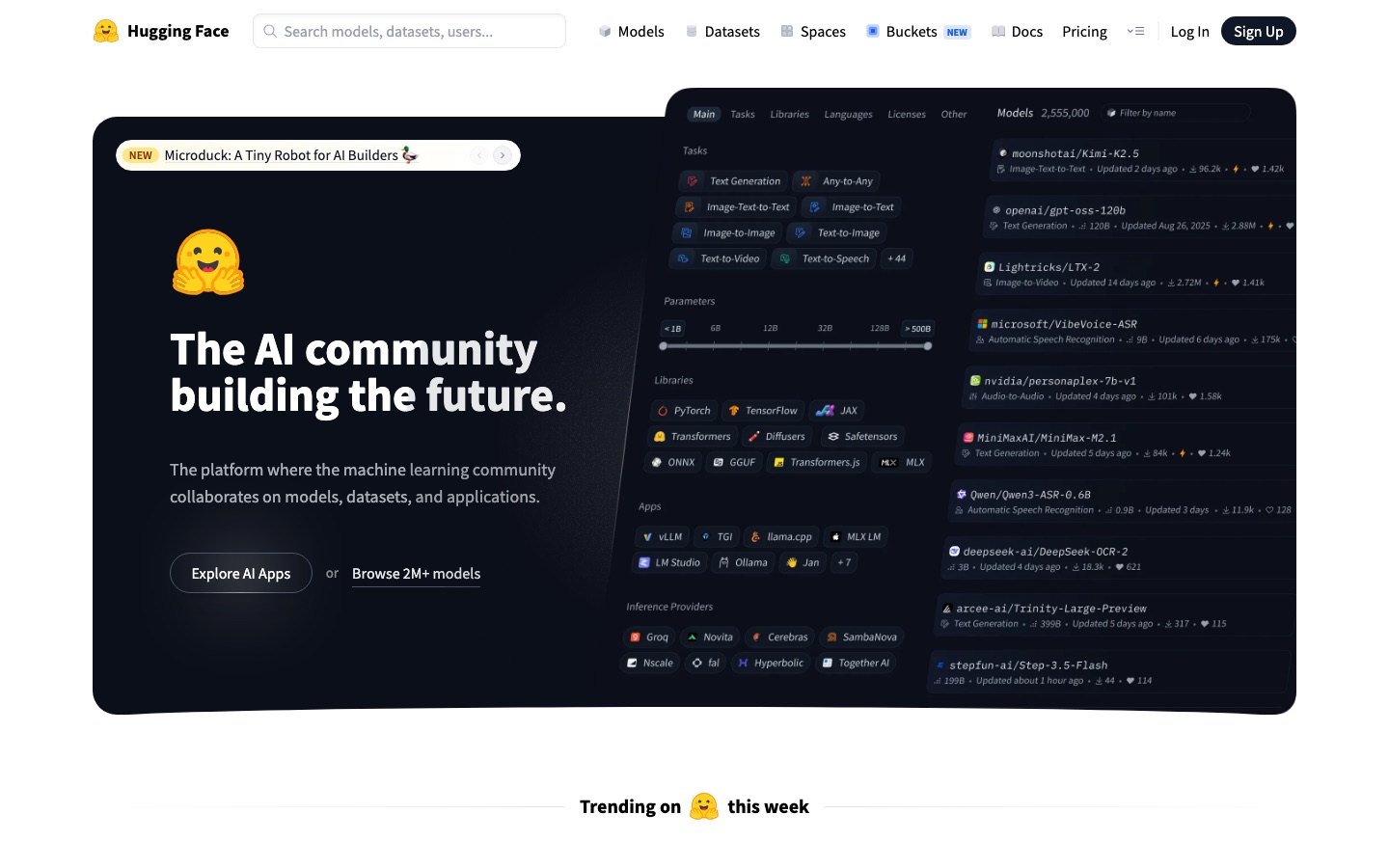 The official Hugging Face website, captured in September 2026. Credit: Hugging Face
Why Everyone Is Talking About This Right Now
Hugging Face has existed for years, but in 2025 and 2026 it jumped from "a tool for researchers" to "a topic that comes up in management meetings." Several factors have converged.
Open models closed the gap. For years a simple truth held: closed models (GPT, Claude, Gemini) were far better, and open models were toys. That is no longer broadly true. Open model families like Meta's Llama, the Chinese Qwen and DeepSeek, Google's Gemma, and OpenAI's gpt-oss deliver performance today that two years ago belonged exclusively to closed models. Not on every task, not at flagship level, but on a large number of everyday business tasks the difference no longer justifies the cost gap. I covered this landscape in detail in our comprehensive AI model comparison.
Regulation and privacy. As organizations, especially in healthcare, finance, security, and the public sector, embed AI deeper into their processes, the question of "where does our data go" has become critical. An open model running on a private server is the only answer that satisfies some information-security departments, and Hugging Face is where you download it.
Technological sovereignty. Countries and organizations around the world (including in Israel) have realized that total dependence on three American API providers is a strategic risk. "Sovereign models," open models that a country or organization controls, are a global trend, and the Hebrew model DictaLM, which I will cover in depth later, is exactly that kind of example.
It simply became accessible. In the past, trying a model from Hugging Face meant knowing Python, setting up an environment, and downloading tens of gigabytes. Today you open the model's page, click on a live browser demo, and that is it. The platform even launched HuggingChat Omni at the end of 2025, a free chat interface that automatically routes each question to the most suitable open model from more than 115 models. In other words, there is now a way to experience the open-source world without being a developer at all.
Core Capabilities: What Is Actually Inside the Platform
Hugging Face is built on three pillars, models, datasets, and Spaces, with a layer of services on top. Let me walk through each one, in plain language.
Models: The Library Itself
This is the heart. More than two million models, covering every type imaginable: language models that hold conversations and write text, image-generation models, transcription models that convert recordings to text, object-recognition models, translation models, sentiment-analysis models, text-to-speech models, and even models that predict protein structures.
Each model gets a "Model Card," a kind of identity document: who trained it, on what data, what the license is (critical for businesses, I will get to this), what the performance looks like, and what the limitations are. You can filter the library by task, language, size, and license, and that matters, because two million models is also two million opportunities to get lost.
From the field: In my training sessions I see the same mistake again and again. People open Hugging Face, feel overwhelmed by the volume, and decide "this is not for me." The secret: nobody needs two million models. In practice, every category has 3 to 5 dominant models that everyone uses, and you sort by downloads or likes to find them in under a minute. Think of it like Spotify: there are a hundred million songs on there, but you listen to a playlist.
Datasets: The Raw Material for Training
Hundreds of thousands of ready-made data repositories: text corpora in dozens of languages, labeled image collections, transcribed recordings, question-and-answer sets, tables. Why does this matter even for non-researchers? Because if you ever want to train a model on your domain (fine-tuning), the dataset is 80% of the work. In the Israeli context, there are Hebrew datasets there too, including corpora from the ivrit.ai project for Hebrew transcription, collected precisely for that purpose.
Spaces: Try Models in Your Browser, Free, No Code
This is the most enjoyable place to start, and the reason this guide is relevant even to someone who has never written a line of code. Spaces are small demo applications that run on Hugging Face's cloud: someone takes a model, wraps it in a simple interface, a text box, an image upload button, and publishes it. You open it in your browser and use it. For free.
There are nearly one million Spaces, and some of them have become viral tools in their own right: image generators, background-removal tools, voice changers, recording noise-removers, models that turn a photo into 3D. The platform even allocates a free daily quota of minutes on powerful GPUs (the ZeroGPU program), so even heavy demos run reasonably well without paying a cent.
HuggingChat Omni: The Free Open-Source Chat
A ChatGPT-style chat interface, but behind it sits not one model but a smart router that automatically picks the most suitable open model for each question from more than 115 models from various providers. For anyone who wants to "taste" what open models can do today without any commitment, this is the fastest entry point. Just note that Hebrew performance depends on which model the router chose, so it is less consistent than what you would get from Claude or Gemini.
Inference: When You Want to Connect a Model to a Real System
When you move from experimenting to working, there are two ways to consume models from the platform without managing servers yourself.
- Inference Providers: a service that lets you call hundreds of open models through a unified API, billed per usage (per token), with requests routed behind the scenes to fast compute providers. Even a free account gets a monthly credit quota for experimentation.
- Inference Endpoints: a dedicated private server running the model you chose, billed hourly. This is the option for a business that needs a model available 24/7 with predictable performance and full isolation.
For anyone working with AI agents: Hugging Face has an official MCP server, meaning you can connect the platform directly to Claude and the Claude Code environment, search for models, run Spaces, and generate images from within a conversation with the agent. Anyone building AI agents gets a complete toolbox here for free.
Code Libraries: The Industry Standard
For completeness: the company's Transformers library is the standard way worldwide to load and run models in Python, alongside Diffusers (image models), PEFT (efficient training using the LoRA method), and AutoTrain, which enables fine-tuning with almost no code. You do not need to know these to get value from the platform, but if you have a developer on your team, these are the tools they will work with.
Getting Started: Step by Step (No Code Required)
The following path takes about half an hour and gives you a real feel for the platform:
- Create a free account at huggingface.co. All you need is an email address. The account unlocks more generous usage quotas in Spaces and in the chat.
- Start with HuggingChat. Go to the chat interface and ask a few questions you'd normally ask ChatGPT, first in English and then in Hebrew. You'll get an immediate sense of where open models stand, including where they still lag behind.
- Browse Spaces. The Spaces page has a Trending list. Try a background-removal tool, an image generator, and a transcription tool. Notice that you're using "real" models, the same models that developers pay for elsewhere.
- Visit one model page. Search for "DictaLM," for example, and open the model page. Don't be intimidated by the technical details: read the description, scroll to Files to see that a model is essentially just a collection of files, and check the license field. Simply understanding that "model equals downloadable files" changes your whole perspective.
- Search by task. On the Models page, filter by Task, such as text-to-speech or translation, and by language. You'll discover entire worlds (speech recognition, image analysis) that you may not have realized were open to you.
- Save favorites. Liking a model or Space saves it to your profile. Within two weeks you'll have built yourself a personal toolbox.
For those who do write code, there's a step 7: install the transformers library, load a small model, and run it locally. Small models (1 or 4 billion parameters) run well today even on a decent laptop, and especially on Macs.
💡 From the field: The tip I give in workshops to people who consider themselves "non-technical": don't start with the question "how does this work," start with the question "what's causing me pain." Do you have a pile of meeting recordings? Find a Spaces transcription tool. A thousand product photos with no consistent background? A background-removal Space. When a tool solves a real problem you have, the motivation to learn the rest comes on its own. That's exactly how I open the free courses at the Academy: starting from the pain, not the technology.
Business Use Cases in Israel: Concrete Scenarios
Let's move from theory to the ground. Here are real scenarios in which Israeli businesses encounter Hugging Face:
A law firm that won't let contracts leave the office. Clients demand confidentiality, the information-security department prohibits uploading documents to the cloud. The solution: download a commercially licensed open language model from Hugging Face, run it on a local server, and build a contract summarization and analysis system that lives entirely within the firm's network. Not a single word leaves. That is exactly the kind of project that starts with a consulting session at our AI consulting service.
A clinic or medical group with Hebrew recordings. Medical information is the most sensitive data there is. Open-source Hebrew transcription models (such as the fine-tuned Whisper versions from the ivrit.ai project) run locally and turn appointment summaries into text without a single second of patient audio ever reaching an external server.
An e-commerce company with 20,000 product images. Background removal, resolution enhancement, and variant generation through pay-per-image services add up to thousands of shekels a month. An open model running on a rented GPU server processes the entire catalog for the cost of a single evening of compute.
A startup suffocating under API costs. A product that performs a narrow, repetitive task, classifying leads, extracting fields from documents, tagging content, doesn't need a flagship model on every request. A small open model that has been fine-tuned on the company's own data often handles that narrow task better, at a tenth of the cost. The smart architecture I recommend: a flagship model like Claude for complex tasks, a small open model for high-volume routine work.
A public-sector or defense organization. Here it isn't even a cost question: classified environments simply aren't connected to the internet. Open models are the only option for bringing AI inside, and Hugging Face is the door they come through.
A marketing team that wants an experimentation lab. Before committing to an annual subscription on a voice, video, or image-generation tool, they test the equivalent open models in Spaces. Sometimes they discover the free version is enough; sometimes they understand exactly what they're paying for in a tool like ElevenLabs. Either way, it's a more informed decision.
Integration into automations. A model from Hugging Face can sit inside an automated workflow, classifying every incoming lead or transcribing every sales call, via a simple API call from an automation in Zapier or Make, or as part of an AI agent you've built with Claude.
Hebrew: What Works and What Doesn't (Including the Israeli Models)
This is probably the most important section of this guide for an Israeli reader, so let's be precise.
The interface: The Hugging Face site itself is English only. There is no Hebrew interface, and it isn't built for right-to-left text. The level of English required for basic navigation is reasonable, nothing academic.
International models: Most of the large open models "know" Hebrew to some degree, because they were exposed to it during training, but it is almost always treated as a second-class citizen. Chinese and American open models produce Hebrew that ranges from acceptable to embarrassing, with gender and register errors. On demanding Hebrew tasks, closed models still lead in most cases.
And then there's Dicta. The central Israeli story on the platform is the DICTA Israel Center for Text Analysis, which publishes the DictaLM family under the organization handle dicta-il: open language models trained specifically on a massive Hebrew corpus.
- DictaLM 2.0 (2024), a 7-billion-parameter model that was a breakthrough: the first open model that genuinely spoke Hebrew well.
- DictaLM 3.0 (the current generation, as of July 2026), a collection of "sovereign" Hebrew models with open weights: a 24-billion-parameter version (based on Mistral) and a compact 1.7-billion-parameter version (based on Qwen3), including chat variants and "Thinking" variants that reason step by step. The models set a new bar for Hebrew in their weight classes, available for free download and unlimited use, including commercial use.
The practical implications are enormous: an Israeli organization can now run, on its own servers, a model that speaks good Hebrew, without sending any data to any cloud. In sensitive sectors, this is a leap forward that simply didn't exist two years ago.
Beyond language models: Dicta also publishes Hebrew BERT models for semantic analysis and search (DictaBERT); the ivrit.ai project maintains Hebrew transcription models based on Whisper with significantly higher accuracy than the original version; and there are Hebrew models for vocalization, named-entity recognition, and sentiment analysis.
The bottom line on Hebrew: For everyday Hebrew chat, the closed tools are still more convenient and produce better results. For building a private Hebrew system inside an organization, Hugging Face with DictaLM is not just an option, it is the option.
💡 From the field: During a training session at a large financial organization, someone asked me: "So why use DictaLM at all if Claude writes better Hebrew?" I answered with a question: "Will your cyber department approve sending client files to a server in the United States?" Silence in the room. That's the whole story. The open model isn't competing with the closed one on quality; it's competing on trust. In places where the data cannot leave, an open Hebrew model that handles 90% of the capability is worth more than a perfect closed model that you're not allowed to use.
When a Business Actually Needs This: The Three Triggers
After hundreds of consulting conversations, I can reduce the decision to three triggers. If none of them applies to you, skip Hugging Face for now, honestly.
Trigger 1: Privacy and regulation. Your data cannot leave the building, due to regulation (healthcare, finance, law), confidentiality agreements, or organizational policy. An open model on your own infrastructure is the only solution that gives you full data sovereignty.
Trigger 2: Deep customization (fine-tuning). You need a model that speaks the language of your domain, that knows your legal terminology, your brand's writing style, the structure of your internal documents. Closed models offer limited customization; an open model can be retrained on your data to produce an "employee" who knows the company from the inside. Tools like AutoTrain and techniques like LoRA have turned this from a research project into a project measured in weeks.
Trigger 3: Volume economics. You're running millions of calls for a narrow, repetitive task. The difference between paying per-token for a flagship model and running a small open model on a fixed server can amount to tens of percentage points of your AI budget, and at scale that's real money.
An equally important rule of thumb in the other direction: if you're a five-person team with no developer, no sensitive data, and normal usage volumes, a subscription to Claude or Gemini will give you more value with less headache. Hugging Face isn't competing with those tools for the single-user scenario.
Comparison with Competitors and Alternatives
| Hugging Face | Closed API (Claude / OpenAI / Gemini) | GitHub | Ollama | Replicate | |
|---|---|---|---|---|---|
| What it is | Model, data, and demo repository plus inference services | Cloud service for a closed model | Code repository (not models) | Running open models locally on your machine | Running open models in the cloud, pay per use |
| Data control | Full: you can run everything on your own infrastructure | Data passes through the vendor's servers | - | Full: everything is local | Data passes through the cloud |
| Maximum quality | Depends on the model; the best open models are close to the top | The highest in the market | - | Limited by your hardware | Depends on the model |
| Ease of use | Moderate (Spaces are easy, integration requires knowledge) | The highest | - | Easy for developers | Easy for developers |
| Hebrew | Depends on the model; DictaLM is purpose-built for Hebrew | Very good | - | Depends on the model | Depends on the model |
| Cost | Mostly free; compute billed by usage | Per-token or subscription | Mostly free | Free (your own hardware) | Per second of compute |
| Best for | Experimentation, privacy, fine-tuning, high volumes | Most businesses, most of the time | Code management | Individual developers, local privacy | Startups that want open models without managing infrastructure |
One point worth internalizing: these aren't really "competitors," they're different layers. A technically mature business uses several of them in parallel: Claude for reasoning and writing, an open model from Hugging Face for high-volume or sensitive tasks, and Ollama for local experimentation. The development tools we teach, such as Cursor and Claude Code, can work with both worlds.
Pricing and Plans: What It Actually Costs
As of July 2026, the pricing structure is especially generous at the free end:
- Free: Browse the entire repository, download models and datasets, use public Spaces (including a daily GPU minutes quota via ZeroGPU), HuggingChat, generous public storage, and a monthly API credit allowance for experiments. For 90% of readers, this is all you will ever need.
- PRO: A personal subscription at a low monthly cost (roughly the price of a movie ticket) that significantly expands GPU quotas, private storage, and API credits. Worth it for anyone running heavy Spaces regularly.
- Team and Enterprise: Plans for organizations with permissions management, SSO, audit logs, and support, priced per user (Team) or by custom agreement (Enterprise).
- Pay-as-you-go compute: This is where the real money lives. A dedicated model server (Inference Endpoint) is priced by the hour and by hardware, from a few cents per hour on a standard CPU up to tens of dollars per hour on powerful GPU clusters. API calls through Inference Providers are priced per token at provider rates, with no added markup.
The key principle: on Hugging Face you do not pay for software, you pay for electricity and hardware. The models themselves are free; the cost is the compute that runs them. The economic comparison against a closed API therefore depends entirely on volume: at low volumes a closed API is cheaper (no base cost), at high volumes the open model wins. That exact calculation is what I work through with clients in consulting.
Advanced Tips
- Sort by Trending, not just by Downloads. Cumulative download counts are skewed toward older models. Trending reveals what the community is adopting right now, and the turnover at the top is striking.
- Read the license before you fall in love. Not every "open source" model allows commercial use. Look for Apache 2.0 or MIT licenses for full freedom; some vendors' "community" licenses include restrictions. The license field appears on every model page, 30 seconds that can save a legal headache.
- Start with the smallest model that gets the job done. The instinct is to reach for the biggest. In practice, a well-tuned 4B model beats a generic 70B on a narrow task, and runs at a tenth of the cost. Always test small first.
- Use Collections. You can organize models, datasets, and Spaces into themed collections and share them with your team, a tidy organizational toolkit instead of links buried in a WhatsApp group.
- Check the Community tab on every model page. The discussion tab is the arena of truth: that is where you will find the bugs, the tricks, and the known issues before you run into them yourself.
- Connect via MCP to Claude. Hugging Face's official MCP server turns Claude into a gateway to the platform: search for models, run Spaces, and generate media from within a conversation. Anyone who has learned how to work with Claude Code will have this wired up in fifteen minutes.
- Follow organizations, not just models. Following dicta-il, meta-llama, mistralai, and similar accounts puts every new release straight into your feed, the cheapest way to stay current.
- Use the datasets even without training. Repositories of question-answer pairs and labeled examples are gold for writing better prompts and for building test suites for your AI systems.
Common Mistakes
Comparing HuggingChat to ChatGPT and writing off the whole thing. The free chat is a showroom, not the product. Judging the open-source world by a general-purpose chat interface is like judging a wholesale market by its sample counter.
Downloading a 70B model on day one. Large models require expensive hardware. Start small, prove value, and scale up only then.
Ignoring the license. Built a product on a model whose license prohibits your use case? Congratulations, you have a problem. Checking the license is a first step, not an afterthought.
Thinking "open" means "safe". The opposite can be true: malicious models and files have been uploaded to the platform in the past. Download models from recognized, verified organizations, prefer the safe file format (safetensors), and do not run a stranger's code with your eyes closed.
Building infrastructure before there is a problem. I have seen organizations rent GPU servers "to be ready" with no defined use case. That is burning money. First prove a business scenario on a free Space or an API, then build infrastructure.
Neglecting updates. The open-model world turns over at a dizzying pace. The model you chose a year ago is probably no longer the right choice. Schedule a quarterly review.
The Limitations: Honestly
A guide that sells you only the attractive side is not worth reading, so here is the other side:
- The learning curve is real. Spaces and chat are accessible to everyone, but the deep business value, self-hosting, fine-tuning, embedding, requires a developer or a technical partner. Without a technical hand on the team, you will stay at the sample layer.
- No warranty and no SLA for the vast majority. A model you download is like open-source code: if something breaks, there is no support hotline. Enterprise services provide partial coverage, but it is not the service contract you get from a major cloud vendor.
- Quality is conspicuously uneven. Alongside gems, the platform hosts masses of abandoned, broken, or simply poor models, and documentation that ranges from excellent to nonexistent. Judgment is required.
- Hebrew performance is still behind. Even with the excellent DictaLM, on open-ended and complex Hebrew tasks the leading closed models are ahead as of July 2026. The gap is closing but it exists.
- Compute costs can surprise you. "The model is free" is half the truth. A GPU server running 24/7 costs hundreds to thousands of dollars per month. Without careful management, the savings versus a closed API can evaporate.
- Dependence on a frantic market pace. What was SOTA six months ago looks average today. Choosing a model is not a one-time decision but an ongoing process, and that is an operational overhead that needs to be priced in.
- The interface is in English and geared toward technical users. Despite enormous improvements in accessibility, this is still a platform built by engineers for engineers. Do not expect a consumer-product experience.
Who This Is Right For, and Who It Is Not
A strong fit:
- Organizations with privacy or regulatory requirements that block use of external cloud services: healthcare, legal, finance, defense, and the public sector
- Companies with developers who want to cut API costs at high volumes
- Anyone who needs a model deeply adapted to a domain (fine-tuning on internal data)
- Entrepreneurs and startups building AI products who want control over the model layer
- Curious learners and students, there is no richer free playground for understanding the AI world
- Israeli organizations that want Hebrew AI kept in-house, thanks to DictaLM
Less of a fit:
- A small business without a technical person who wants the AI to "just work," a Claude or ChatGPT subscription will deliver more with less
- Anyone who needs maximum Hebrew quality for writing and conversation, the closed models still win there
- Organizations looking for a single vendor with full accountability and a tight SLA contract across the board
- Anyone without a defined business problem, the platform rewards focus and punishes wandering
Frequently Asked Questions
Can I use Hugging Face without knowing how to code?
Yes, at the first layer. Spaces (browser-based demos) and HuggingChat require no code at all, and through them you can transcribe, generate images, remove backgrounds, and try language models. The second layer, downloading models, self-hosting, and training, requires technical knowledge or a developer alongside you. The right framing: non-technical users decide the "what," technical users execute the "how."
What is the difference between an "open" model and "open weights"?
An important nuance: most of the prominent models on the platform are "open weights," meaning you can download and run the model, but the training data and full code are not necessarily published, and the license sometimes restricts uses. Full open source is rarer. For most business use cases the distinction is not critical; what is critical is what the specific license actually says.
Are Hugging Face models safe for business use?
With conditions: download from reputable sources (verified organizations such as Meta, Google, Mistral, and Dicta), prefer safetensors files, check the license, and scan as you would any external software. The platform runs automated security scans, but final responsibility, as with all open-source code, lies with you.
How much does it cost to run a DictaLM model ourselves?
It depends on size and load. The compact version (1.7B) runs on modest hardware and even a powerful laptop, at essentially zero cost. The 24B version requires a serious GPU server: cloud rental starts in the range of hundreds of dollars per month for full availability, as of July 2026. Hence the rule: start with the small version and move up only if the quality is insufficient.
Does Hugging Face replace ChatGPT or Claude for me?
For everyday personal use, no, and do not try to force it. Those are polished consumer products; Hugging Face is infrastructure for building. The substitution is relevant only at the organizational level, when one of the three triggers (privacy, customization, volume) applies, and even then it is usually a complement to the closed tools, not a full replacement.
What is fine-tuning, exactly, and when is it worth it?
Fine-tuning means taking an existing model and training it a bit further on examples from your domain, so that it adopts your style, terminology, and formats. It is worth it when you have at least hundreds of thousands of quality examples and a recurring, well-defined task. It is not worth it as a magic fix for bad prompts; in most cases I encounter, improving the prompt and retrieval-augmented generation (RAG) solve the problem at a tenth of the effort.
I have heard about "sovereign models." What is the connection to Israel?
A sovereign model is one that a country or community controls entirely: the weights, the data, and the infrastructure, rather than depending on a foreign vendor. DictaLM 3.0 is explicitly defined as such for Hebrew. It is open, freely downloadable and usable without restriction, and ensures that Hebrew AI capabilities are not dependent on the commercial decisions of foreign companies. For government bodies and sensitive organizations in Israel this is a strategic point, not merely a technical one.
How does Hugging Face connect to the world of agents and automation?
In three ways: an official MCP server that connects the platform to Claude and to agents (model search and running Spaces from within a conversation); API calls to open models from inside automations; and agent-specific models published on the platform. Anyone building agents seriously will find both the building blocks and the learning materials there, and you will find the complete guide to AI agents on this site as well.
The bottom line
Hugging Face is not just another AI tool. It is the infrastructure of the open half of the revolution. For the curious, it is the richest free playground in the world: chat, image generators, transcription, and demos without spending a cent. For businesses, it is a strategic decision anchored in three clear triggers: privacy, deep customization, and volume economics. And for Israel specifically, combining the platform with DictaLM models opens, for the first time, a genuine possibility for Hebrew AI that lives entirely in-house.
My practical advice: stop asking "should I use Hugging Face," and start asking "what problem do I have that an open model solves better." Open a free account, spend an hour playing in Spaces, try HuggingChat in both Hebrew and English, and take a look at the DictaLM page. If any one of the three triggers lights up for you, it is time for a serious conversation.
Want to go deeper? The free courses at our academy will build your AI foundations, the advanced courses will teach you to build real systems, and if you want close personal guidance, a one-on-one private lesson will save you months of trial and error. For organizations considering open models, data privacy, or in-house Hebrew AI, our AI workshops and business AI consulting are exactly the right place to start.
Frequently asked questions

Yaakov Tzedek
An Israeli AI lecturer, consultant and implementer who has supported 100+ organizations in AI implementation and lectured for 200+. Official content partner of Meta, Google, Canva and TikTok, featured on Israel's Channel 13.
More about Yaakov →