- Alibaba's Wan 3.0 generates 30 seconds of 1080p video with audio at one-fifth the cost of Seedance 2.5. We fact-checked the viral comparison and built a full per-second pricing table for 11 models: Kling 4.0, Veo 3.1, Gemini Omni, MiniMax H3, Runway, Grok Imagine, and more.
There is a Hugging Face repository called wan-3-0-video that looks like it might contain Wan 3.0 weights, but it has nothing to do with Alibaba and holds only a README file. The latest open weights Alibaba has actually released are for Wan 2.2 (July 2025, Apache 2.0 license). Wan 3.0 is available via API only.
A Viking battle, the same prompt, two models. One cost $5.81, the other $0.81, and the cheaper one looked better. This comparison between ByteDance's Seedance 2.5 and Alibaba's Wan 3.0 made the rounds in every AI group this week. The numbers in it are perfectly reasonable. The conclusion most people draw from them is less so.
In short:
- Wan 3.0 from Alibaba reached full availability on August 24, 2026: up to 30 seconds, up to 1080p, with audio, at $0.20 per second at 1080p. It is not open source.
- The viral comparison: The prices in it match a third-party platform's rate card. Buying directly from ByteDance, the gap shrinks from roughly 7x to about 3x at 1080p, and 2.3x at 720p.
- One prompt is not a benchmark. In structured tests, each model won on different things: Wan on drama and speed, Seedance on motion control and continuous takes.
- What's recommended: For most businesses, Google Flow (Veo 3.1 and Gemini Omni) on a subscription; for volume, Wan 3.0; for control and long takes, Seedance 2.5 or Kling 4.0.
- Sora is gone: The app shut down in April 2026 and the API on September 24, 2026.
What is Wan 3.0, and what changed?
Wan 3.0 is Alibaba's video model, and it jumped from 15 seconds to 30 seconds in a single generation. According to the official Alibaba Cloud blog, the beta opened on August 6, 2026, and full availability arrived on August 24, one day after a $10 billion stock offering Alibaba raised specifically to fund the AI race.
What's new compared to Wan 2.7, according to Alibaba:
- Up to 30 seconds in a single generation (compared to 2 to 15 seconds before).
- 480p, 720p, or 1080p, with audio generated alongside the video (can be disabled).
- Any input type: text, image, video, audio, and also documents: PDFs, presentations, spreadsheets, and Markdown. Feed it a presentation, get a video.
- Consistency of characters, props, and space throughout the clip, plus editing of existing video.
What it is not: Alibaba released Wan 3.0 as a closed model, available via API only. I checked on Hugging Face: the official Wan-AI account has not published weights for Wan 3.0, and the repository called wan-3-0-video does not belong to Alibaba and contains only a README file. Anyone who built on Wan because it was open source is, for now, stuck with Wan 2.2.
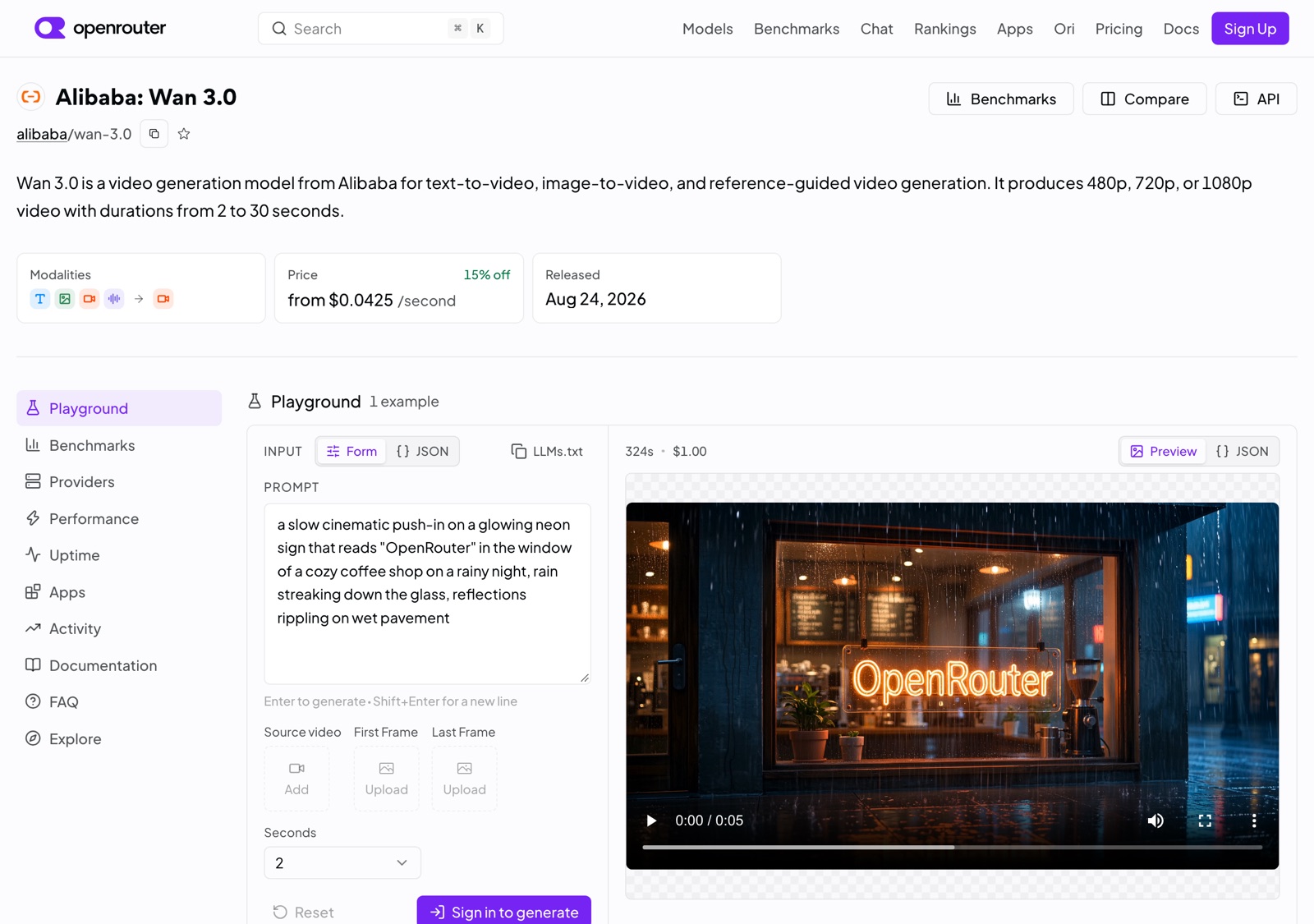
Screenshot: Alibaba: Wan 3.0 model page on OpenRouter, November 5, 2026
How much does Wan 3.0 cost?
$0.05 per second at 480p, $0.10 at 720p, and $0.20 at 1080p. Those are the prices on Alibaba's model page in the Singapore region, and they are identical on OpenRouter and fal. In other Model Studio regions (Frankfurt, Virginia, Tokyo, and others) the price is about 17% lower: roughly $0.165 per second at 1080p. OpenRouter currently also offers a 15% discount.
In practice: a 5-second clip at 1080p costs about one dollar, and a full 30 seconds at 1080p costs about $6. There is also Wan 3.0 Prime, the same model with a faster queue, priced at 1.4x the base rate ($0.28 per second at 1080p).
Is the viral comparison fair?
The numbers are real. The comparison is less so. I could not track down the original image, so I checked the numbers in it against the official rate cards.
What checks out: $5.81 is exactly the price of 5 seconds of Seedance 2.5 at 1080p on fal (about $5.82 according to fal itself). $0.81 matches 5 seconds of Wan 3.0 at 1080p in Alibaba's cheaper regions (about $0.83), or 8 seconds at 720p. In other words, it is very likely a real comparison.
What is misleading:
- The price depends on where you buy. fal charges roughly double for Seedance 2.5 compared to what ByteDance itself charges on BytePlus ModelArk. Buying directly from the provider, 5 seconds of Seedance at 1080p costs about $2.84, not $5.81. The gap versus Wan drops from 7x to about 3x.
- At 720p, where most Reels are actually produced, the gap is even smaller: about $0.23 per second for Seedance versus $0.10 for Wan. That is 2.3x.
- One prompt is not a benchmark. A Viking battle is exactly the scenario where Wan excels: a dramatic scene, lots of fire and movement, no need for a precise camera path. At Krea, they ran both models on the same inputs: Wan won on verbal and dramatic execution and on speed (an 8-second clip in about 2 minutes, versus 4 minutes for Seedance). Seedance won when the prompt specified a particular direction of movement, and on a continuous 20-second take that Wan cut mid-clip with a hard cut at second 13.6.
- A single draw. Every video model produces a different result on every run. You compare across 5 to 10 generations, not one.
The bottom line: Wan 3.0 is genuinely significantly cheaper and genuinely good. That does not mean it replaces Seedance for every task.
What this means in shekels, for a real Reel
In our Reels production work for clients, a 6-second clip in Seedance 2.5 through OpenRouter comes out to about 5 ILS, which is exactly the 720p price (roughly $1.39). The same 6 seconds in Wan 3.0 at 720p would cost about $0.60, meaning roughly 2 ILS. In most cases we start with Google Flow anyway, where the credits are already included in the subscription, and only move to a paid model when the take there didn't come out right. For that reason we wrote the guide to Google Flow.
Comparison table: leading video models, November 2026
All prices in dollars per second of video, official rate cards, checked on November 5, 2026. The source is noted in each row. Prices change, and third-party platforms sometimes charge 2x, so check before you decide.
| Model | Provider | Max length and resolution | Audio | Price per second (source) | Best for |
|---|---|---|---|---|---|
| Wan 3.0 | Alibaba | 30 sec, 1080p | Yes | $0.05 (480p) / $0.10 (720p) / $0.20 (1080p), Alibaba and OpenRouter | Volume, long clips on a budget, video from documents |
| Seedance 2.5 | ByteDance | 30 sec, 1080p | Yes | ~$0.10 / $0.23 / $0.57, BytePlus ModelArk; on fal ~$0.22 / $0.47 / $1.16 | Long continuous takes, motion control, many reference images |
| Kling 4.0 | Kuaishou | 30 sec, 1080p (announcement mentions 4K) | Yes, stereo | $0.157 (720p) / $0.235 (1080p), fal; Flash ~$0.094 | Cinematic camera moves, action |
| Veo 3.1 | 8 sec, up to 4K | Yes | $0.40 with audio ($0.20 without), Fast ~$0.10 to $0.12, Lite ~$0.05 to $0.08, OpenRouter | Talking product, short realistic dialogue | |
| Gemini Omni Flash 1.1 | 10 sec, 720p on API | Yes | ~$0.10 (720p), based on Gemini API token pricing | Conversational editing, free in Google Vids and YouTube Shorts | |
| MiniMax H3 (Hailuo 3) | MiniMax | 15 sec, up to 2K | Yes, stereo | $0.13, OpenRouter | 2K at a low price, open weights |
| Grok Imagine Video 1.5 | xAI | 15 sec, 1080p | Yes | $0.08 / $0.14 / $0.25; Lite from $0.02, OpenRouter | Fast and cheap drafts |
| Runway Gen-4.5 | Runway | 10 sec, 720p | No | $0.12, OpenRouter (12 credits per second on the site) | Director and camera control, editing with Aleph |
| Luma Ray3.14 | Luma AI | Native 1080p, HDR | No | 80 credits per second at 1080p, per subscription | HDR color, professional post work |
| Midjourney Video | Midjourney | 5 sec, extendable to 21 sec | No | Included in Midjourney subscription | Animating Midjourney images in style |
| Sora 2 | OpenAI | Closed | App closed April 26, 2026, API September 24, 2026 | Not available |
Two notes on the table: Pika is still active as an app for effects and lip sync, but I could not find a current API price that can be verified, so it is not in the table. And Seedance 2.5 on OpenRouter is currently limited to 720p; for 1080p you go through ModelArk, fal, or ByteDance's own apps.
What is recommended for what?
There is no single model that wins at everything. There is a right model for each task. Here is how I would choose today:
Reels and ads for a business
Google Flow, and if the take doesn't work out, Seedance 2.5. With a Google AI Pro subscription ($19.99 per month) you get 1,000 credits in Flow, and with Veo 3.1 Lite or Fast that is enough for dozens of short clips without counting every second. For an ad where the product needs to move along a specific path, or for a continuous take of 15 to 30 seconds, Seedance 2.5 holds the staging better. If the Reel is built from an actual photo of the business, we have a guide to choosing a source image in Seedance.
A talking product or character
Veo 3.1. For clips up to 8 seconds with dialogue, Veo's lip sync and audio are still the most reliable. Gemini Omni Flash, Google's new model from I/O 2026, adds conversational editing ("replace the background," "slow down the camera"), and is also available free in Google Vids.
Cinematic and action
Kling 4.0 or Seedance 2.5. Kling 4.0, released on October 15, 2026, reaches 30 seconds, supports 15 reference inputs and multiple keyframes, and is especially strong on complex camera moves. And at 1080p it is significantly cheaper than Seedance: $0.235 per second on fal, versus about $0.57 directly from ByteDance. For anyone already working with Kling, the Kling guide is still relevant for the interface.
Lots of videos on a budget
Wan 3.0. A catalog of 200 products, A/B test versions, an explainer video from an existing presentation: this is where a 2x to 3x price difference adds up fast. Start at 480p to test a concept ($0.05 per second), and render at 1080p only what worked. For especially quick drafts it is also worth checking out Grok Imagine 1.5 Lite.
Open source and running on your own server
MiniMax H3 or Wan 2.2. MiniMax published the H3 weights (it is Hailuo 3) on Hugging Face in July 2026, under a community license worth reading before commercial use. Wan 2.2 is older, but under the fully open Apache 2.0 license. Wan 3.0, as noted, is not open. More on MiniMax in the Hailuo guide.
Hebrew text inside the video
No model, not yet. I have not found a model that reliably renders correct Hebrew on screen, and Alibaba itself writes that on-screen text rendering in Wan 3.0 "is still maturing." The solution that works: generate without text, then add Hebrew titles and subtitles in editing. Hebrew voiceover is also better recorded or generated with a dedicated voice tool, rather than relying on the audio the model produces.
Where to try each model
The easiest option is a single platform that hosts many models. The choices:
- Google Flow: Veo 3.1 and Gemini Omni Flash, with a Google AI subscription (there is also a limited free tier at 720p).
- OpenRouter: One API for Wan 3.0, Seedance 2.5, Veo 3.1, Kling 3.0, MiniMax H3, Runway, and Grok Imagine, with pay-as-you-go pricing. A good fit for anyone connecting this to an agent or an automation.
- fal.ai: Kling 4.0 is already available via API here, alongside Wan 3.0 and Seedance 2.5. Note that the Seedance price is higher than the direct price.
- Directly from the vendor: Alibaba Cloud Model Studio for Wan, BytePlus ModelArk for Seedance, hailuoai.video for MiniMax, and Runway, Luma, and Midjourney on their own sites.
- Higgsfield: A platform that centralises several dozen models in one interface, from $19 per month (Seedance 2.5 from the $59 plan). Convenient for anyone who does not want to open an account everywhere, and there is a full Higgsfield guide.
For anyone looking for the broader picture of video tools, including editing and avatar tools, there is the AI video creation tools overview.
📬 This article was included in the weekly "This Week in AI" roundup for November 6, 2026, together with all the guides and articles published on the site that week.
Want an agent to produce videos for you?
This comparison was written from day-to-day work: we use an AI agent that writes the prompt, sends it to the model via OpenRouter, checks the result, and passes it for approval. Once it runs like that, switching from Seedance to Wan is a one-line change, not a project.
That is exactly what you learn in the AI Agents Bundle: a Claude Code video course and a Grok Bot video course, plus a SocialFlow course as a gift. The price: 297 ILS + VAT (350.46 ILS including VAT), until November 12 at 23:59.
Sources
All sources were verified on November 5, 2026. Prices and capabilities change, so check the official site before making a decision.
- Alibaba Cloud Model Studio, wan3.0-video model page (length, resolutions, price per second by region): https://www.alibabacloud.com/help/en/model-studio/wan3-0-video
- Alibaba Cloud Blog, Wan3.0 general availability (dates, capabilities, prices): https://www.alibabacloud.com/blog/603505
- U.S. News, Wan3.0 launch following the share sale: https://money.usnews.com/investing/news/articles/2026-08-24/alibaba-launches-wan3-0-ai-video-model-after-10-billion-share-sale
- OpenRouter, list of video models and prices (Wan 3.0, Wan 3.0 Prime, Seedance 2.5, Veo 3.1, Kling 3.0, MiniMax H3, Runway, Grok Imagine): https://openrouter.ai/api/v1/videos/models
- fal, Wan 3 vs. Seedance 2.5 comparison (price per second, 5 seconds at 1080p): https://fal.ai/learn/devs/wan-3-vs-seedance-2-5
- fal, Kling 4.0 page (price per second): https://fal.ai/models/kling/v4/text-to-video
- Krea, Seedance 2.5 vs. Wan 3.0 test on identical inputs: https://www.krea.ai/blog/seedance-2-5-vs-wan-3-0
- Seedance 2.5 pricing on BytePlus ModelArk (token formula analysis): https://thesfstack.substack.com/p/seedance-25-pricing-runs-52-above
- TechNode, Seedance 2.5 launch: https://technode.com/2026/07/31/bytedance-launches-seedance-2-5-video-generation-model/
- MarketScreener, Kling 4.0 launch on October 15, 2026: https://www.marketscreener.com/news/kuaishou-technology-launches-next-generation-kling-4-0-video-generation-model-of-kling-ai-ce785cdade8dff24
- The Next Web, Gemini Omni Flash: https://thenextweb.com/news/google-gemini-omni-flash-video-model-io-2026
- Hugging Face, MiniMax H3 (weights and license): https://huggingface.co/MiniMaxAI/MiniMax-H3
- Hugging Face, official Wan-AI account (no Wan 3.0 weights): https://huggingface.co/Wan-AI
- OpenAI, video generation guide (Sora 2 shutdown announcement): https://developers.openai.com/api/docs/guides/video-generation
Frequently asked questions

Yaakov Tzedek
An Israeli AI lecturer, consultant and implementer who has supported 100+ organizations in AI implementation and lectured for 200+. Official content partner of Meta, Google, Canva and TikTok, featured on Israel's Channel 13.
More about Yaakov →