Grok is Elon Musk's AI chat assistant, built by xAI, which SpaceX acquired in 2026. Three things set it apart from every competitor: a real-time connection to X (formerly Twitter) that gives it a pulse on what is happening right now, a fast image and video generator called Grok Imagine, and a deliberately less filtered tone. As of November 2026 the flagship model is Grok 4.7, released in September 2026, while the much-discussed Grok 5 still has not shipped.
This guide covers everything: what Grok is, how to access it (inside X, in the app and on the web), what is really free and what needs a subscription, whether Grok Imagine is worth it, how it handles languages other than English, and, honestly, where it beats ChatGPT, Claude and Gemini, where it loses, and why it attracts so much controversy.
Updated November 17, 2026: The current model is now Grok 4.7 (September 2026), after Grok 4.6 in August. Grok 5 is still unreleased. In the ChatGPT comparison, custom GPTs are replaced by plugins, because OpenAI is retiring custom GPTs on December 11, 2026.
Grok at a Glance
Quick answer: Grok is xAI's AI assistant, and xAI is now part of SpaceX. The current model is Grok 4.7. The easiest way in is grok.com or the Grok app, and the advantage no competitor has is live data from X. It is fine for conversation, current-events questions and summaries, but for polished marketing copy, Claude still leads.
| Question | Short answer |
|---|---|
| What is Grok? | A conversational AI assistant from xAI (now SpaceX). It answers, writes, codes, analyzes images and documents, and generates media in Grok Imagine. Its edge: a live connection to X. |
| Does it handle other languages? | Yes, fluently enough for summaries and current-events questions. For polished marketing copy or nuanced wording, Claude is still more precise. |
| What do you get for free? | A limited daily message allowance and very little Grok Imagine. SuperGrok (about $30 per month) unlocks heavy use, DeepSearch and higher media limits. |
| Grok 4.7 vs Claude and ChatGPT? | Grok has narrowed the quality gap and wins on live information and fast media. For writing and complex code, Claude; for broad general use, ChatGPT. |
| How do I get started? | Go to grok.com with an X account or download the Grok app and start typing. Inside X you can also tag @grok in a reply to any post and get an instant answer. |
The bottom line before we dive in: Grok is strongest in a defined role (monitoring, trends and fast media) alongside your main work tool.
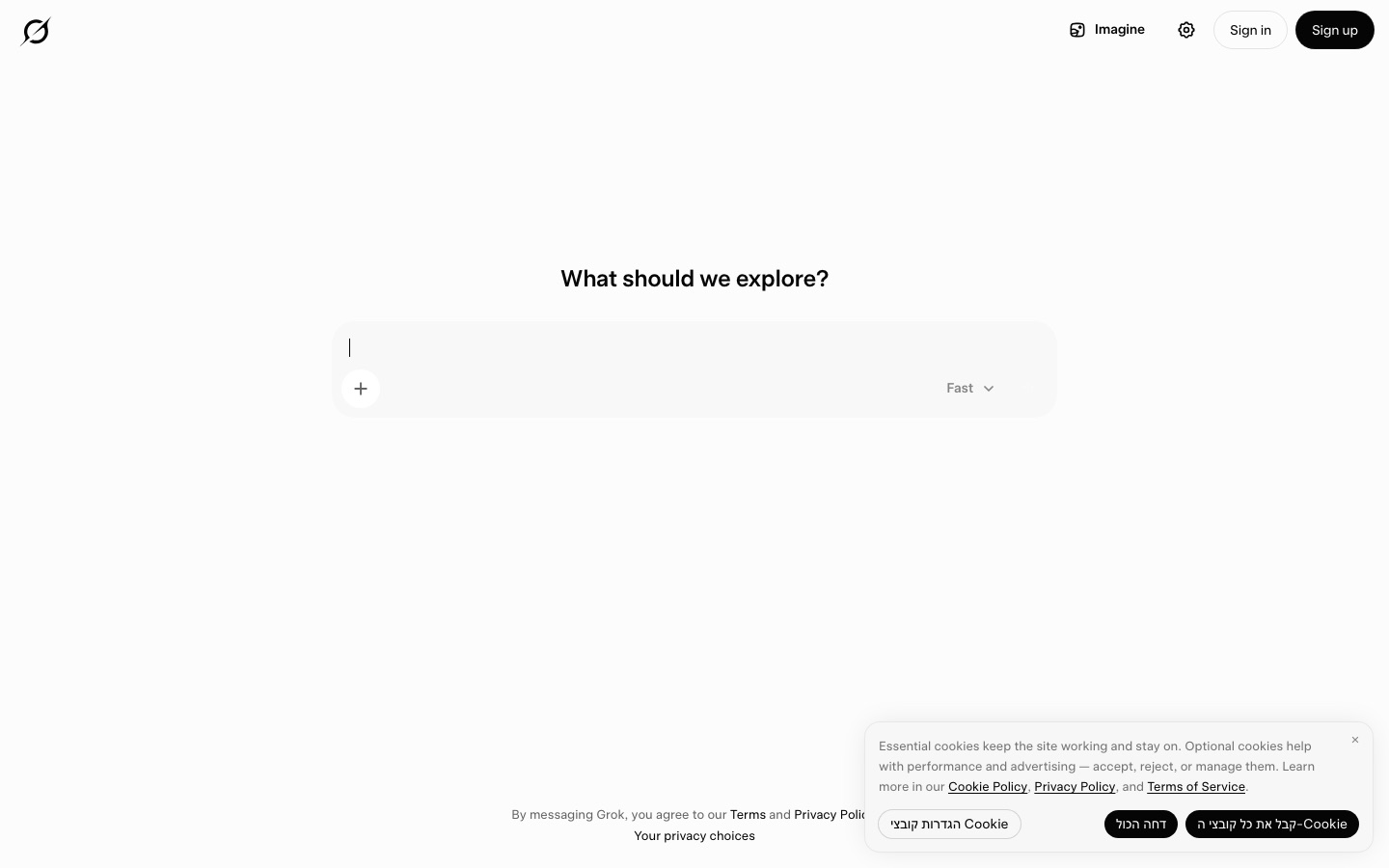 The official Grok website, captured September 2026. Credit: Grok
What Is Grok?
Definition: Grok is a conversational AI assistant from xAI, the AI company Elon Musk founded in 2023 and that SpaceX acquired in 2026. It answers questions, writes, codes, analyzes images and documents, generates images and video (Grok Imagine) and, most importantly, pulls information from X in real time.
The name "Grok" comes from Robert Heinlein's science fiction novel Stranger in a Strange Land, where it means to understand something deeply and intuitively. People also search for "Grok chat" or "xAI Grok"; they all mean the same product, and the company's official address is x.ai.
Unlike ChatGPT, which was born as a standalone product, Grok was born inside a social network. That shapes its whole character: it is built to answer "what is happening now", react to posts, summarize heated discussions and catch trends as they emerge. Over time it expanded to a standalone app, the grok.com website, a developer API and even Tesla vehicles.
How big is it? According to SpaceX's IPO filing, Grok had about 117 million monthly active users as of March 2026. It is still behind ChatGPT and Gemini, but it is no longer "Musk's toy".
Why Everyone Is Talking About Grok in 2026
2026 has been the most dramatic year in Grok's history:
- The SpaceX deal: in February 2026 SpaceX announced an all-stock acquisition of xAI, valuing the combined company at about $1.25 trillion. SpaceX then listed on Nasdaq in June 2026 in the largest IPO in history, with Grok as its consumer AI growth engine.
- A rapid release cadence: Grok 4.5 shipped on July 8, 2026 (Musk called it an "Opus-class" model), Grok 4.6 followed in August, and Grok 4.7 arrived in September at the same price. Grok 4.5 was developed in collaboration with Cursor and is aimed mainly at code and agent tasks.
- Grok Imagine exploded: the image and video generator became one of the most-used tools of its kind, with billions of images and videos per month according to reporting on SpaceX's filing. That brought a huge wave of use, and a huge wave of criticism (more below).
- The wait for Grok 5: Musk has been promising a giant new model for months. It is still not here, but the anticipation keeps Grok in the headlines.
The @grok tag has become a phenomenon of its own: people tag the bot under posts and ask it to "explain", "check if this is true" or "draw this". It is probably the most common way people use Grok, and we will cover it in a moment.
From the field: in my lectures I ask who has tried Grok. A year ago two or three hands went up. Today it is close to half the room, and almost everyone met it through the @grok tag on X, not the app. That is an important lesson in distribution: Grok did not win because it is the smartest model, but because it sits where people already spend their time. When an organization asks me "which tool should we roll out?", my answer always starts with "where are your people already working?"
Current Models: Grok 4.7, and What About Grok 5?
"Grok 5" is one of the most common searches, so let's sort out the versions as of November 2026:
- Grok 4 (2025) was xAI's big leap: a reasoning model that reached the top of the benchmarks for the first time, alongside Grok 4 Heavy for demanding tasks.
- Grok 4.5 (July 8, 2026): focused on code, science, engineering and math, developed in collaboration with the Cursor code editor. Musk compared it to Anthropic's Opus models, "but much faster".
- Grok 4.6 (August 2026) and Grok 4.7 (September 2026): larger base models at the same price. xAI's documentation describes Grok 4.7 as the most capable model it has built, with a 500K-token context window. On the API, Grok 4.5 through 4.7 are all priced at $2 per million input tokens and $6 per million output tokens (double above 200K tokens of prompt), noticeably cheaper than rivals in the same class. Independent benchmarks still put it behind the top Claude and OpenAI models.
- Grok 5: not released as of mid-November 2026, and xAI has not announced a date. Musk's earlier windows (late 2025, then the first half of 2026) passed without a launch. xAI has said it is training on the Colossus 2 supercomputer. Musk, as usual, promises it will be "AGI or close to it", which is worth taking with a large grain of salt, like most of his timelines.
What does that mean for an ordinary user? When you open Grok today, you are talking to the Grok 4.x family (the exact model depends on your plan and mode), and every "Grok 5 is coming" headline is still anticipation, not a product.
Where to Use Grok: Three Ways In
1. Grok inside X, and the magic of @grok
Most people meet Grok inside X itself, in two forms:
- The chat window: tap the Grok icon in the sidebar (in the app or on x.com) and a regular chat opens, like ChatGPT, just inside the network.
- The @grok tag: this is the real phenomenon. Under any post you can reply and tag
@grokwith a question ("is this true?", "explain the joke", "translate", "what is the context?") and the bot answers publicly in the thread. It has become the network's unofficial (and not always accurate!) fact checker. People also ask it to generate images and animations right in the replies.
Keep in mind: @grok answers are public, fast and sometimes wrong with total confidence. They are great as a starting point for context and poor as a final source. There were plenty of cases in 2025 and 2026 where Grok's answers in political threads became scandals in their own right.
2. The Grok app and grok.com
Alongside X there is a standalone Grok app for iOS and Android and the grok.com website, which offer the full experience: chat history, deep-thinking modes, file uploads, Grok Imagine and projects. If you plan to use Grok as a work tool rather than a feed gimmick, this is where to go. You can sign up with an X account or a separate account.
3. Tesla, the API and the wider ecosystem
Grok is built into Tesla vehicles as a voice assistant and is available to developers through the xAI API, so businesses can build products on it. Musk's strategy is clear: Grok everywhere there is a Musk product. For serious automation, though, the Grok API is just one option. In my workshops I teach how to connect models to work tools through MCP, mostly around Claude; our guide to the best MCP servers is a good place to start.
Grok's Core Capabilities
Real-time information from X: the advantage no one else has
This is the heart of it. Every other model "knows" things up to its training date and fills gaps with web search. Grok has something no competitor has: direct access to the stream of posts on X right now. Ask "what are people saying right now about Apple's launch?" or "what happened in crypto this morning and how did people react?", and Grok will pull posts, quotes and trends from the last few minutes. For news, reputation, trends and "what's hot", there is no real substitute.
DeepSearch and thinking modes
Grok includes a deep research mode (DeepSearch / DeeperSearch) that scans the web and X, cross-checks sources and returns a structured summary, conceptually similar to competitors' Deep Research, plus a Think mode for slower, more careful reasoning on hard questions. It is good, but honestly, for research with clean citations, Perplexity still offers a cleaner and more reliable experience.
Code and agent tasks
Starting with Grok 4.5, developed with Cursor, xAI is aiming squarely at developers: the models are strong at writing code, fixing bugs and long agent tasks, at a low API price. Developers working in Cursor can select Grok as a model. Still, for everyday agentic coding work, the industry standard is Claude Code (see our guide to Claude Code skills), and the difference shows mainly on large, multi-file projects.
Grok Imagine: images and video
Grok's media generator has become a huge product in its own right, so it gets its own section below.
File, image and voice analysis
Like its competitors, Grok can take images and documents and analyze them, and the app has a voice conversation mode. These capabilities exist and are reasonable, but they are not a reason to choose Grok; ChatGPT and Gemini are more mature here.
Grok Imagine: The Image and Video Generator
Grok Imagine is one of the big growth stories of 2026: it creates images from text, animates images into short videos with sound, and does it fast, in seconds. According to reporting on SpaceX's IPO filing, it averaged roughly 10 billion images and 2 billion videos per month in the first quarter of 2026. Those numbers are not only about quality; they come from a combination of speed, availability inside X and an especially permissive content policy (more on the dark side in the controversy section).
What matters in practice, as of November 2026:
- Video is no longer free: since March 2026, video generation in Grok Imagine requires a paid plan (SuperGrok, or X Premium/Premium+). The days when everyone made videos for free are over.
- Free images have shrunk too: in 2026 there were waves of complaints about drastic cuts to free allowances, up to new accounts hitting an "upgrade to SuperGrok" wall. Allowances change often, so do not count on a fixed number.
- Quality: for quick creation, memes, sketches and animating a still image, it is excellent. For polished, brand-consistent output, Midjourney still leads on aesthetics, and for precise text-based image editing, Google's Nano Banana is worth knowing. Our guide to the best AI image tools compares the options.
From the field: a small business asked me how to make short product videos cheaply. My answer had two steps: a polished product image in a serious image tool, then animating it in Grok Imagine or a dedicated video tool. The common mistake is trying to get both precision and motion out of one tool. A short tool chain almost always beats a single tool that "does everything".
How to Get Started with Grok: Step by Step
- Pick your way in: for a first try, the Grok icon inside X. For real work, grok.com or the app.
- Sign in: with an existing X account or a new one. Check which plan you are on; the limits differ a lot between free and paid.
- Start with a real-time question: that is the unique strength, so test it first: "What are the hot topics on X right now in my industry?" or "Summarize the reactions to today's X event."
- Try the depth modes: for a complex question, turn on Think or DeepSearch and compare with a regular answer.
- Test Imagine: create an image from text and, if you have a subscription, animate it into a video.
- Tag @grok in your feed: reply to a post with a question for the bot to understand the public experience (and remember the answer is visible to everyone).
- Give it a job: after a week of experiments, decide what Grok does for you (monitoring and trends? fast media?) and what stays with other tools.
Tip: phrase real-time questions specifically ("what are people writing today about…", "what is the split of opinions on…"). That is how you really use the X connection. A general question gets a general answer.
What Is Free and What Is Paid? Plans as of November 2026
Access to Grok comes in several tiers, and they change often:
| Plan | Price | What you get |
|---|---|---|
| Free | $0 | Basic chat on X and grok.com with a daily message limit and a small (sometimes zero) image allowance. No video. |
| X Premium / Premium+ | X subscription | Higher Grok limits inside X, priority access to stronger models, Imagine access. |
| SuperGrok | ~$30/month | xAI's dedicated plan: high limits, full access to the current Grok 4.x models, Imagine video, depth modes. |
| SuperGrok Heavy | ~$300/month | For heavy users: the strongest model configurations and early access to new features. |
| API | Per token | Grok 4.5 to 4.7 at $2 / $6 per million input / output tokens; aggressive pricing for the performance. |
My practical rule: do not pay for Grok "because you heard it is good". Start free, check whether its unique strengths (real time, Imagine) actually serve you, and only then upgrade. If you already pay for ChatGPT or Claude, Grok is a complement, not a replacement. Check grok.com for current prices in your region.
Real Business Use Cases
Where Grok actually creates value for a business, in scenarios I see in practice:
- Reputation and brand monitoring: "What are people writing about our company / our competitor / our category on X this week?" Grok does in a minute what expensive social listening dashboards do. For a small business, that is gold.
- An internal news desk: marketing and content teams use Grok for "what happened overnight in our field", a morning summary of trends, launches and relevant discussions as the basis for daily content.
- Newsjacking: catch a trend in real time and ride it with a post. Grok both spots the trend and drafts the post. Its speed is a real competitive edge here.
- Fast competitor research: "How did people react to our competitor's launch? What was the main criticism?" An answer based on real posts, not a model's guess.
- Fast social media: short images and demo videos in Grok Imagine for posts, without a photographer or studio. Not campaign quality, but great for a daily publishing pace.
- Public-facing support: brands active on X use Grok to monitor threads where they are mentioned and respond before a small issue becomes a crisis.
- Recruiting and audience understanding: recruiters and community managers check what candidates and professionals in a field are talking about: which tools are hot, which employers are praised, what language the audience uses.
- Testing an idea before launch: before investing in a campaign or product, ask Grok what has already been said online about similar ideas, what objections came up, what worked for competitors and what got mocked. Ten minutes of this can save a month in the wrong direction.
Notice the common thread: every scenario relies on real time and speed, not depth, accuracy or polished writing. Knowledge management, documents, proposals and internal automations stay with Claude and ChatGPT. That is exactly the split I build with organizations in AI consulting: the right tool for each task instead of "one tool for everything".
Sample Prompts
Starting points that work well in Grok and play to its strengths:
- Monitoring: "Scan X over the last 24 hours and find what people are writing about [brand/product]. Split into positive, negative and neutral reactions, and quote 3 notable posts of each type."
- Trends: "What are the 5 hottest topics right now in the [field] conversation on X? For each, one sentence of explanation and why it took off today."
- Newsjacking: "Identify a trend rising right now on X that is relevant to a business selling [product]. Suggest 3 post ideas that connect to it, with full copy for one of them."
- Context check: "I saw a claim that [claim]. Where does it come from, what are people saying about it on X, and are there rebuttals? State your level of confidence."
- Imagine: "Create a photorealistic image of [product] on a clean background with studio lighting, 1:1 ratio, no text in the image."
- Thread summary: reply under a long thread: "@grok summarize this discussion. What are the main arguments on each side?"
Languages: What Works and What Doesn't
What works: Grok understands many languages well, answers fluently, and its X connection works on non-English content too. It can pull and summarize local-language posts, which is very useful for monitoring conversations in your market. Everyday questions, translation and summaries are perfectly reasonable.
What works less well: long, polished writing outside English is not its strength. In professional documents you may notice "translated-sounding" text, English word order, unstable register and occasional grammar errors. Grok Imagine, like most generators, also struggles with non-Latin text inside images. And Grok's "loose" tone sometimes comes across as simply unprofessional in other languages.
In practice, for business writing (emails, proposals, articles), Claude gives the most natural results in my experience and in the experience of the hundreds of people in my workshops. Grok is a gathering and summarizing tool, not a writing tool.
From the field: an exercise I run in workshops: ask Grok to summarize the X conversation on a hot local topic, then pass that summary to Claude with the instruction "turn this into a natural-sounding LinkedIn post". The gap between Grok's draft and the final result shows participants, better than any theory, why a team needs more than one tool, and why the right split is by strengths, not by habit.
Grok vs ChatGPT, Claude and Gemini
| Dimension | Grok | ChatGPT | Claude | Gemini |
|---|---|---|---|---|
| Real-time information | Best on the market, direct X connection | Good web search | Web search | Search + Google ecosystem |
| Current model family (11/2026) | Grok 4.7 | GPT series | Opus / Sonnet series | Gemini series |
| Non-English writing | Reasonable, "translated" feel | Good | Best on the market | Good |
| Code and agents | Strong and cheap (with Cursor) | Strong | Leader (Claude Code) | Strong |
| Images / video | Imagine: fast, permissive | Built-in image and video generation | No built-in generator | Imagen / Veo, high quality |
| Enterprise maturity | Young, controversial | The most mature | Strong in enterprises | Strong (Workspace) |
| Tone and moderation | Lightly filtered, by design | Conservative | Conservative and careful | Conservative |
| Best for | Trends, monitoring, fast media | Broad general use, plugins | Writing, code, depth | Google ecosystem, video |
The summary: Grok does not replace your main tool; it adds to it in a defined role. For a broader look at models and AI tools, see the best AI image tools and GitHub Copilot.
Controversy and Moderation, Unvarnished
You cannot write a fair guide to Grok without this section, because it matters to any business considering it:
- A deliberately permissive content policy: xAI built Grok to be "less censored" than competitors. In practice, according to reports based partly on SpaceX's IPO filing, a large share of Grok Imagine use in 2026 was adult content, at enormous scale. That is part of the business model, and worth knowing when you attach your brand to the tool.
- Deepfakes and regulation: Grok's image and video capabilities were at the center of repeated deepfake scandals, leading to investigations and regulatory steps in several countries, including a criminal investigation in France after a raid on X's Paris offices in early 2026. SpaceX's IPO filing reportedly set aside hundreds of millions of dollars for potential litigation and warned that investigations into abusive AI imagery could cost it access to some markets.
- Incidents involving the bot itself: throughout 2025 and 2026 there were documented cases of Grok producing disturbing or biased answers in public threads, fixed after the fact. When a bot answers publicly under millions of posts, every glitch is a public glitch.
- The question of bias: Grok ultimately answers to Elon Musk's vision (and temperament), and there have been episodes where changes to its system prompt noticeably altered its behavior. If you use it for political or news questions, remember that this product line is flexible.
The practical takeaway for a business: use Grok for monitoring, research and media, yes. Connect it to sensitive processes, legal, medical or financial content, or let it speak for your brand without human review, no. And for organizations with information security requirements: check the terms of use and data handling before entering internal information, as with any cloud tool.
Advanced Tips
- Separate knowledge questions from real-time questions. On general knowledge Grok answers from memory like any model; the magic happens when you say "now", "today" or "this week", which triggers the X connection.
- Ask for sources and posts. "Quote the posts you are relying on" turns a general answer into one you can verify. If it has no posts to show, that is a red flag.
- Use Think for hard questions. Reasoning mode is slower but noticeably more accurate on logic, calculations and analysis.
- In Imagine, iterate fast. A short English prompt plus three or four quick variations beats one carefully crafted prompt. Imagine's speed is the feature, so use it.
- Build a monitoring routine. Once a day, the same fixed monitoring prompt (brand + competitors + category). You can pipe the result to email or chat through an automation tool such as Zapier or Make.
- Connect the outputs to your other tools. A workflow that works very well: Grok gathers (what is happening now) → Claude drafts (post, email, document) → you approve.
Common Mistakes with Grok
- Treating an @grok answer as fact. The bot answers confidently even when wrong, and its public answers have repeatedly caused confusion themselves. Always cross-check.
- Expecting it to write a polished professional document. That is not its job. Gathering: Grok. Writing: Claude.
- Paying for SuperGrok without a real need. If you do not create video and are not a heavy user, the free version plus the tools you already have are enough.
- Forgetting the source is X. What "everyone is saying" on X is what X users are saying: a specific audience with specific biases. It is a sample, not the truth.
- Entering sensitive data without checking the policy. As with any consumer AI tool, what goes into the chat may be used for training, depending on your settings and plan.
- Publishing Imagine output without review. In a permissive environment, the legal and brand responsibility for what you publish is yours.
The Limitations, Honestly
- Mediocre factual reliability: Grok is fast and current, but its hallucination rate on real-time answers is higher than more cautious competitors. It summarizes rumors with the same confidence as facts.
- Gathering yes, polished writing no: as covered above, there are better tools for professional writing.
- Product instability: limits, plans and features change frequently and sometimes without notice (see the 2026 Imagine cuts). It is hard to build a stable business process on it.
- Reputation risk: the scandals around content and deepfakes are part of the product's current DNA. Conservative brands should weigh that.
- Dependence on one person: product direction, tone and even system instructions shift with Musk's decisions. That is a level of uncertainty other major vendors do not carry.
- A young enterprise ecosystem: it does not yet have the depth of admin tools, integrations and compliance that OpenAI, Anthropic and Google offer enterprises.
Who Grok Is For, and Who It Isn't
A great fit for:
- Marketing, content and PR people who live on the pulse of the network and need to know "what is happening now".
- Active X users: the tool is already there, free, one tap away.
- Small businesses that want brand monitoring and fast media without a budget for dedicated tools.
- Developers looking for a strong coding model at a low API price.
- Curious users who want a less polished, more direct tone.
Less of a fit for:
- Anyone who needs professional writing: go with Claude.
- Organizations with regulatory, security and conservative branding requirements.
- Anyone looking for structured academic research with sources: Perplexity does this better.
- Anyone already paying for ChatGPT or Claude who does not need real time or video: no reason for another subscription.
- People who are not on X at all: half of Grok's value simply does not apply to them.
Not sure which combination of tools is right for your organization? That is exactly what I work through with clients in AI consulting, and in lectures and workshops for teams.
Frequently Asked Questions
What is Grok, in short?
Elon Musk's AI chat assistant (xAI, now part of SpaceX), connected in real time to X. It answers, writes, codes and generates images and video, and its unique strength is current information and trends.
Is Grok free?
Partly. Basic chat is free with daily limits on X and grok.com. Video generation in Grok Imagine has required a paid plan since March 2026, and free image allowances were cut sharply during 2026. Serious use means a subscription.
What is @grok and how do I use it?
Tagging the bot in replies on X: reply to any post with @grok and a question ("is this true?", "explain", "summarize") and it answers publicly in the thread. Very handy for quick context, but the answers are public and not always accurate, so do not rely on them as a source.
What is "Grok chat" and what is grok.com?
"Grok chat" is simply Grok's conversation interface, the same product. grok.com is the dedicated website (there are also iOS and Android apps) with the full experience: history, thinking modes, files and Grok Imagine, without going through X.
When is Grok 5 coming out, and what is known about it?
As of mid-November 2026 it has not been released and has no official date. The windows Musk pointed to earlier passed, and xAI shipped Grok 4.5, 4.6 and 4.7 in the meantime. It has been reported to be training on Colossus 2. For now the flagship is Grok 4.7 (September 2026).
Is Grok good in languages other than English?
It understands and answers well and scans non-English posts on X, which makes it great for monitoring local conversations. Long, professional writing is its weak spot; Claude is usually better there.
Can I trust Grok as a source of information?
Carefully. Its strength is speed and freshness, not accuracy, and it summarizes rumors too. Ask it to quote the posts it relies on, and cross-check any critical fact with another source before using it for business.
Who owns Grok today?
SpaceX. xAI, which Musk founded in 2023, was acquired by SpaceX in an all-stock deal announced in February 2026, and SpaceX went public on Nasdaq in June 2026. Grok is the group's consumer AI product, alongside its integration in Tesla and X.
Bottom Line
In 2026 Grok is no longer a curiosity. It is a first-tier AI assistant with two advantages no competitor has: a real-time pulse on X and an especially fast media generator. The Grok 4.x releases have narrowed the quality gap with the leaders, API pricing is aggressive, and the wait for Grok 5 keeps it in the headlines. On the other hand: mediocre professional writing outside English, factual reliability that requires verification, a product that changes without notice, and a trail of controversy a brand needs to factor in.
My recommendation is simple: adopt Grok in a defined role (monitoring, trends and fast media) alongside another main work tool, and do not try to make it something it is not. If your organization wants to adopt AI in a structured way, take a look at AI implementation and courses.
Further reading: beyond chat, xAI has also launched an autonomous agent product, Grok Bot: digital coworkers with their own cloud computer that keep working when your laptop is closed. The guide explains what it is, what it costs and what still breaks.
Sources
- x.ai, official site: product announcements and Grok models.
- xAI API documentation, models and pricing: current model list (Grok 4.5 to 4.7) and API prices.
- grok.com: the tool itself, Grok Imagine, plans and current limits.
- TechCrunch, Grok 4.5 launch coverage: model details and competitor comparisons.
- Decrypt, Grok 4.7 launch coverage: the September 2026 release.
- Calcalist Tech, Grok Imagine allowance cuts: changes to free access in 2026.
- X: Grok inside the network and the @grok phenomenon, the source of its real-time advantage.
This guide is written and maintained by Yaakov Tzedek, an AI lecturer, consultant and implementer for organizations.
Frequently asked questions
What is Grok?
Grok is the AI chat assistant developed by xAI, Elon Musk's AI company, which SpaceX acquired in 2026. What sets it apart: a real-time connection to X (formerly Twitter), an image and video generator called Grok Imagine, and a deliberately less filtered tone than its competitors. As of November 2026, the flagship model is Grok 4.7.
Is Grok free?
Partly. Basic chat with Grok is free on X and grok.com with daily usage limits. Since March 2026, video generation in Grok Imagine requires a paid plan (SuperGrok, about $30 per month, or X Premium), and free image allowances have shrunk sharply. Serious use needs a subscription.
What is the difference between Grok and ChatGPT?
Grok's standout advantage is its real-time link to X: a pulse on news, trends and what people are saying right now, plus fast video generation in Grok Imagine. ChatGPT is more mature as a work product, with a broader ecosystem, memory, plugins and enterprise reliability. For polished professional writing, many people prefer Claude.
When is Grok 5 coming out?
As of mid-November 2026 it has not been released, and xAI has not published a date. Musk has repeatedly said it would arrive in 2026. In the meantime xAI shipped Grok 4.5 (July), Grok 4.6 (August) and Grok 4.7 (September 2026). Grok 5 has been reported to be training on the Colossus 2 supercomputer.
Does Grok work in languages other than English?
Yes. Grok understands and answers in many languages, and its X connection works on posts in those languages too. Long, polished writing in languages other than English is not its strongest side, though; for professional writing, Claude usually gives a better result.