
- On November 5, 2026, Meta began rolling out real-time voice chat and an expressive avatar to the Muse app: voice-only, avatar-beside-chat, or full-screen face-to-face, hundreds of voices, and background task handling. Currently US only. Plus: Perplexity Teammates.
According to Meta's research blog, the Muse avatar and voice are not generated separately and then synced. The voice model produces a single stream that carries both what is said and how it is said, and the avatar model consumes that exact same stream. That is how lip movements and facial expressions stay coordinated with speech, with roughly 870 milliseconds from the end of your sentence to the start of the response.
Meta's agent now speaks. It has a face too, and that face reacts to what you say. But the face isn't actually the most important thing here.
On November 5, 2026, Meta began rolling out real-time voice conversation and an expressive avatar in its Muse app, the company's personal agent: a character that listens, nods, and shifts its expression to match the tone of the conversation. We saw demonstrations of this technology back in October. What changed overnight is that this is no longer research; it's a product arriving on phones. For now, only in the United States.
In short:
- What launched: Real-time voice conversation with Muse, including the ability to interrupt mid-sentence, and an avatar that responds with expressions and movement.
- Three modes: Voice only, a small figure alongside the conversation, or a full-screen face-to-face view.
- Hundreds of voices, each with its own character. Switch at any moment.
- Background operation: Tell the agent what to do while you're walking around, and it handles it during the conversation.
- Availability: United States, on mobile, web, and Mac. Meta's AI glasses and Muse Charm to follow. No date for Israel.
- Also today: Perplexity launched Teammates, persistent agents with a defined role, memory, and Slack integration.
What exactly did Meta launch?
Two new layers on top of the same agent: voice and a face. According to Meta's official announcement, "Give Your Muse a Voice," you tap the phone icon in the top-right corner of the app and talk to Muse like a person. The response comes immediately, and you can cut it off mid-sentence without breaking the conversation.
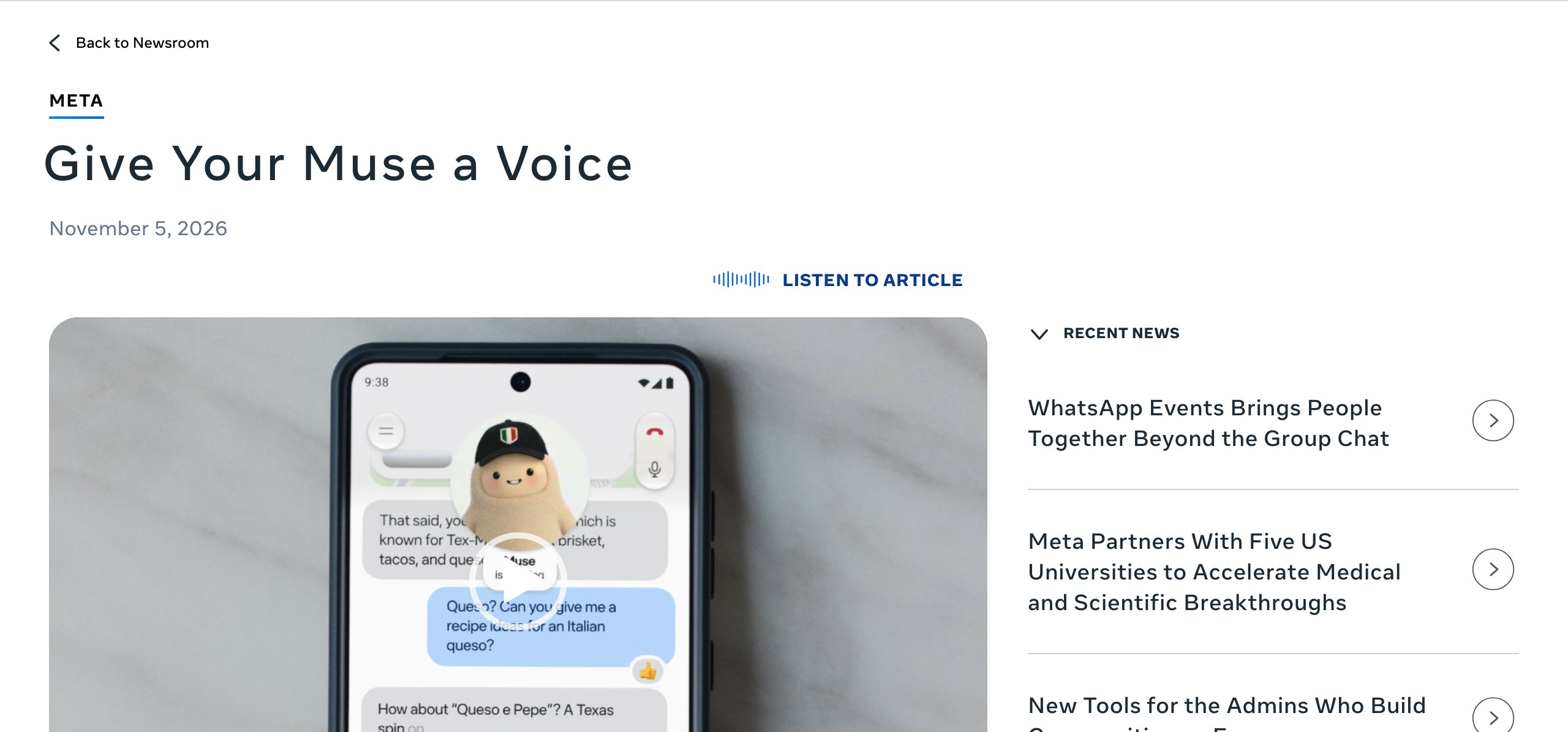
Screenshot: Meta's official Newsroom (about.fb.com), 5.11.2026
The avatar is what catches the eye. According to Meta, it responds with subtle expressions and movements that match the tone, even while you're speaking, so you can see it's following along. You choose how much presence to give it: voice only, a small figure beside the conversation, or full screen.
Behind this sit two technologies Meta calls Muse Realtime Voice and Muse Realtime Avatar. In a research blog published as far back as September 23, Meta describes a response latency of around 870 milliseconds from the end of your sentence to the start of the reply, and an invisible watermark (Meta Video Seal) on every video the avatar generates. In that same post, Meta notes that Muse is intended for users 18 and older.
Why does the voice matter more than the face?
Because it takes the agent off the keyboard. The most interesting sentence in Meta's announcement isn't about the avatar. It's about the fact that you can tell Muse what needs to be done while you're walking or when your hands are full, and it handles it in the background while you keep talking.
That's the difference between an assistant that answers questions and an agent that executes tasks. Until now, giving an agent a task meant sitting in front of a screen and typing. When talking is enough, the agent enters moments when no one opens a laptop: commuting, between meetings, in a warehouse.
Meta itself highlights another use: thinking out loud. Brainstorming, planning a trip, rehearsing a job interview or a presentation. For business owners, this means something simple: practice a sales conversation with a character that responds, before calling a real customer.
Is this available in Israel yet?
No. According to Meta, the rollout starts in the United States on mobile, web, and Mac, with Meta's AI glasses and Muse Charm to follow. There is no announcement for Israel, and no announcement about Hebrew in the voice interface.
What is available here: Meta AI in Hebrew on WhatsApp and at meta.ai. Anyone who wants to understand the full family, from the model to the agent, will find the complete picture in the Muse Spark guide. It's also worth remembering the context: back in September, when Meta released Muse Spark 1.3, the company stated explicitly that it was building a personal agent that works for you around the clock. The voice and the face are the interface for that agent.
What does this mean for your business?
Your customers will get used to talking to agents, not typing to them. When Meta, which owns WhatsApp and Instagram, gives its agent a voice and a face, customer expectations shift. Someone who got used to talking to Muse in the morning will expect your business to respond quickly too, in natural language and without a "press 1" menu.
Three things you can do this week, even without access to Muse:
- Find where customers are waiting. Unanswered phone calls, WhatsApp messages that get replies hours later. That's where a voice agent or messaging agent will deliver the first return. The voice agents guide covers the options that already work today in Hebrew.
- Practice sales with AI. In ChatGPT's voice mode, Gemini, or Meta AI you can already ask right now: "Be a customer who thinks we're too expensive." Ten minutes of practice like that before an important call is worth a lot.
- Decide in advance what an agent doesn't do on its own. An agent that works in the background while you talk to it is convenient, and also risky without limits. The AI agent safety rules have a short list to start from.
Also today in leading tools
Perplexity Teammates: agents that get a role, not a question
Perplexity launched Teammates, persistent agents for ongoing work. According to the company's official blog, Teammates plan and coordinate projects, adjust course when priorities change, and present results for review. They track open work and act on their own when something changes, without waiting for a new prompt, and they remember project goals, task history, and shared files between runs.
Perplexity's examples are organized by role: marketing (posts, campaigns, and performance tracking), sales (identifying opportunities and preparing outreach), service (summarizing complaints and flagging edge cases), and operations (tracking deadlines and sending reminders 72 hours in advance). You can add a Teammate to a Slack channel, where colleagues request work or updates from it, and Teammates know how to hand tasks off to each other.
The entry price is not cheap: Teammates require a Perplexity Max subscription, which according to Perplexity's help center costs $200 per month or $2,000 per year. Currently web only, with iOS to follow. The announcement does not mention any country restrictions. For a small business in Israel, that price is mainly a directional signal: agents are moving from "answer me" to "own this domain." Anyone using Perplexity today can start with the Perplexity guide and Perplexity Computer running locally on Mac. The official announcement on Perplexity's blog.
📬 This article was included in the weekly "This Week in AI" roundup for November 6, 2026, along with all the guides and articles published on the site that week.
Want an agent working for you before Meta arrives here?
Muse and Teammates show where the market is heading: an agent that receives a task, works in the background, and returns a result. You don't need to wait for a rollout in Israel or pay $200 a month to work that way. The agents bundle teaches you how to give an agent a real task, set its limits, and check what it did, using tools that work here today.
The AI agents bundle includes the Claude Code video course and the Grok Bot video course, plus the SocialFlow course as a gift. Price: 297 ILS + VAT (350.46 ILS including VAT), until November 12 at 23:59.
Sources
Frequently asked questions

Yaakov Tzedek
An Israeli AI lecturer, consultant and implementer who has supported 100+ organizations in AI implementation and lectured for 200+. Official content partner of Meta, Google, Canva and TikTok, featured on Israel's Channel 13.
More about Yaakov →