
- What it is: AI-powered phone answering that holds a free-flowing conversation, not a "press 1" menu.
- How it works: Three models chained together on every sentence: speech to text, a language model that decides, text to speech. Plus telephony that connects everything to a phone number.
- Hebrew: Retell AI, Synthflow, and ElevenLabs (with the v3 model) explicitly list Hebrew; Vapi supports Hebrew transcription through Deepgram according to the documentation. Real-world quality: only a live test on actual calls will tell.
A conversation with a voice agent is actually a chain of three models running one after the other on every sentence: one converts speech to text, one decides what to say, and one converts the answer back to speech. Most platforms price each of them separately, so the "price per minute" shown on a website is almost always just one of three or four cost components.
An AI voice agent is software that answers your business phone calls, understands what the customer says in Hebrew, decides how to respond and what actions to take (check availability, book an appointment, transfer to a human agent), and speaks back in a natural voice. It answers within a second, 24 hours a day, and according to the official pricing pages of the leading platforms, a minute of conversation starts at a few cents. That is not even the interesting part. The interesting part is what happens when a customer says "two" and the agent has to figure out whether that means a time, a quantity, or a date, and how you build an agent that knows when to stop and hand off to a human when it is not sure.
In short
- What it is: AI-powered phone answering that holds a free-flowing conversation, not a "press 1" menu.
- How it works: Three models chained together on every sentence: speech to text, a language model that decides, text to speech. Plus telephony that connects everything to a phone number.
- Hebrew: Retell AI, Synthflow, and ElevenLabs (with the v3 model) explicitly list Hebrew; Vapi supports Hebrew transcription through Deepgram according to the documentation. Real-world quality: only a live test on actual calls will tell.
- Price: According to pricing pages as of September 2026: Vapi $0.05 per minute for hosting plus providers at cost; Retell $0.055 per minute for the voice engine plus model and telephony; ElevenLabs $0.08 per additional minute beyond the plan. Synthflow: enterprise contracts from $30,000 per year.
- The law: A party to a call is permitted to record it; storing those recordings is subject to the Privacy Protection Law. Consult a lawyer before going live.
- Who it is for: A business that is losing calls after hours or during peak load, and an organization that wants to free up agents from repeat questions.
What is an AI voice agent?
Definition: A voice agent is an artificial intelligence system that manages a phone call in real time. It listens, converts speech to text, understands intent through a language model, executes actions in the business's systems (calendar, CRM, inventory, payment) through defined tools, and responds in a synthetic voice. It can answer inbound calls, initiate outbound calls, and transfer the call to a human according to rules.
The difference from the old telephone bot (IVR, menu system) comes down to two things: the customer speaks freely instead of choosing from a menu, and the agent can take actions rather than just routing. The difference from a text chatbot is timing: in chat, a two-second wait is reasonable; on the phone, two seconds of silence feels like a dropped call. That is why the entire voice-agent industry is built around one word: latency. Retell AI, for example, presents its product as "latency-optimized," and an independent review by the comparison site fewertools measured no-code platforms running 200 to 400 milliseconds slower than developer-focused platforms.
How does a voice agent answer a phone call?
The same chain fires on every sentence the customer speaks, usually in under a second:
| Step | What happens | Who does it (examples) |
|---|---|---|
| 1. Telephony | The call arrives at a virtual number and is streamed to the platform as audio | Twilio, Telnyx, Vonage, or the platform's built-in telephony |
| 2. Speech to text (STT) | Audio is converted to text in real time, including detecting when the customer has finished speaking | Deepgram, Google, Azure, Gladia, ElevenLabs Scribe |
| 3. Language model (LLM) | Receives the transcript, instructions, and tools, and decides what to reply or which action to trigger | Models from OpenAI, Anthropic, Google |
| 4. Tools | A call to an external system: check the calendar, create a lead, send a WhatsApp message | Webhooks, the business's API, Make or n8n |
| 5. Text to speech (TTS) | The response is converted to voice and streamed so the customer hears the first word immediately | ElevenLabs, Azure, OpenAI, PlayHT |
Three things are important to understand from this table. First, the "price per minute" on a platform's website is almost always just one or two of the five steps. Second, Hebrew quality is determined mostly at steps 2 and 5: if the transcription hears "two" as an English word, or the voice stresses the wrong syllable, no language model will save the call. Third, the part that turns the agent from a toy into an employee is step 4, the tools. An agent that cannot check a calendar and book an appointment is an expensive answering machine.
Which platforms exist, and what does each one claim about Hebrew?
The four platforms that appear in nearly every market comparison, and what each one says about Hebrew according to its own documentation (checked September 20, 2026):
| Platform | What it is | What is stated about Hebrew |
|---|---|---|
| Retell AI | A platform for developers and businesses, marketed as low-latency, with an agent builder, telephony, and built-in models | A dedicated page titled "Talk to Your Customers in Hebrew," and Hebrew (he-IL) appears in the transcription and speech tables in the documentation |
| Synthflow | A no-code platform with a flow builder, currently focused on enterprise | Hebrew appears in the language list in the official documentation |
| ElevenLabs Agents | Conversational agents from the voice company ElevenLabs, built on its own voices and models | According to the documentation, agents can use any language supported by the v3 and Flash v2.5 models. Hebrew appears in the Eleven v3 language list and not in the Flash v2.5 list of 32 languages |
| Vapi | A developer platform, "voice agents for builders," with the freedom to choose any provider for each step | The Deepgram transcriber documentation in Vapi lists Hebrew (he); the platform itself does not publish a single language list |
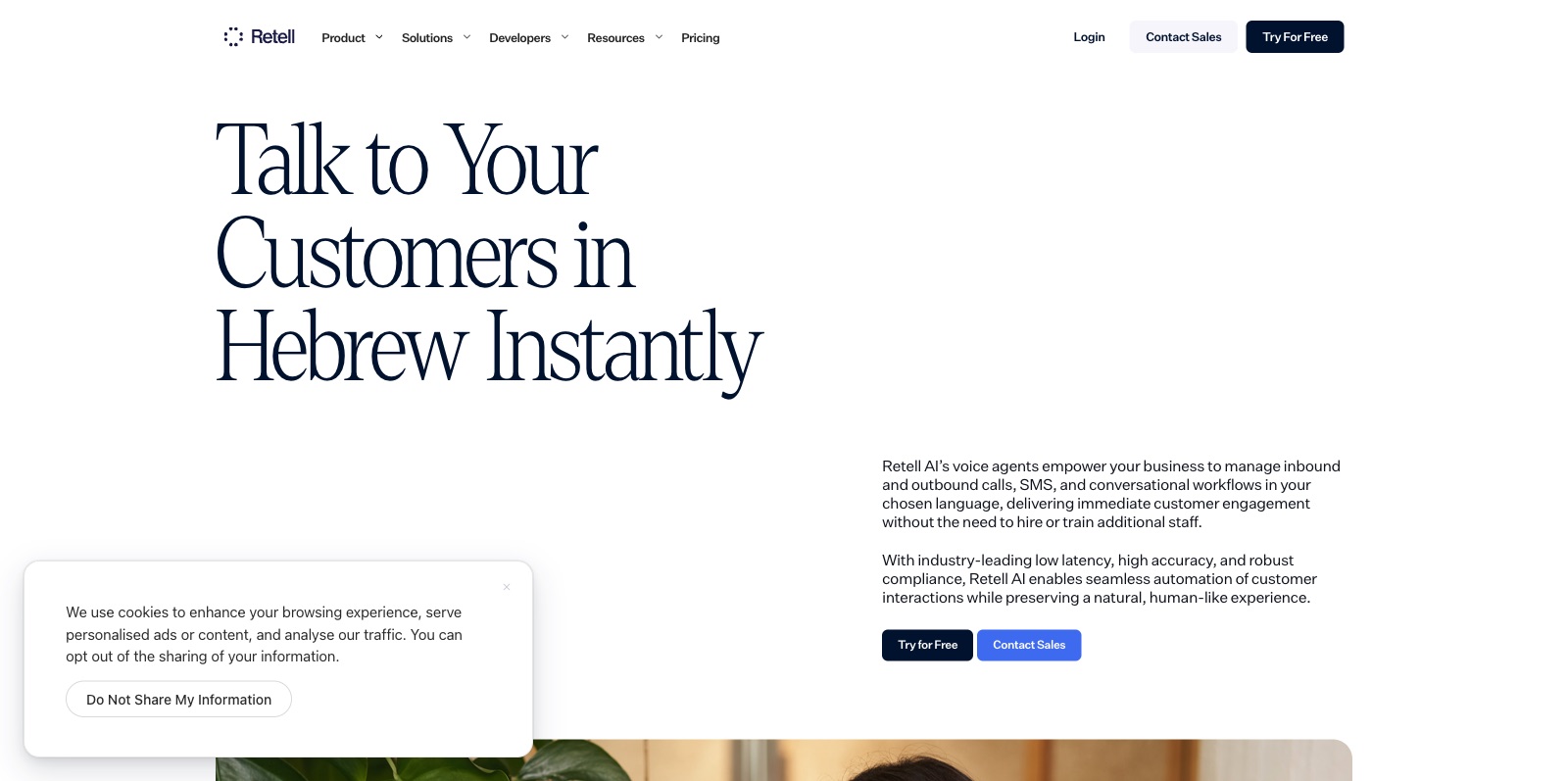 Retell AI's "Talk to Your Customers in Hebrew" page, captured September 20, 2026. Credit: Retell AI
What is intentionally missing from the table: a Hebrew accuracy figure. None of the four publishes a transcription accuracy percentage for Hebrew, so every "Hebrew supported" means "you can select Hebrew from the menu," not "it works well with Israeli customers calling from a mobile phone on a noisy street." That gap closes only through testing, which I will cover later.
How much does a minute of conversation with a voice agent cost?
The short answer: according to official pricing pages as of September 2026, the platform component alone costs $0.05 to $0.08 per minute, and the language model, transcription, voice, and telephony are added on top. The breakdown, in dollars, as each provider publishes it:
| Provider | What is published on the pricing page (September 2026) |
|---|---|
| Vapi | $0.05 per minute for "Vapi hosting"; providers pass through at cost: Deepgram transcription $0.0095 to $0.0099 per minute, OpenAI model $0.0077 to $0.0452 per minute, ElevenLabs voice $0.0146 to $0.0238 per minute; telephony varies by provider; $5 starting credit; Pro plan with a minimum of $999 per month |
| Retell AI | $0.055 per minute for the voice engine; language model by choice, e.g. $0.048 per minute (Gemini 3.5 Flash), $0.064 (GPT 5.6 Terra or Claude 5 Sonnet), up to $0.16 to $0.32 per minute for large models; telephony $0.015 per minute (varies by country); $10 starting credit |
| ElevenLabs Agents | Conversation minutes included in plan: Free 15, Starter ($6) 75, Creator ($22) 275, Pro ($99) 1,238, Scale ($299) 3,738, Business ($990) 12,375; additional minute $0.08, and $0.16 when exceeding the concurrent-call quota; language model and telephony billed separately |
| Synthflow | The pricing page shows only "enterprise contracts starting at $30,000 per year," with no per-minute price |
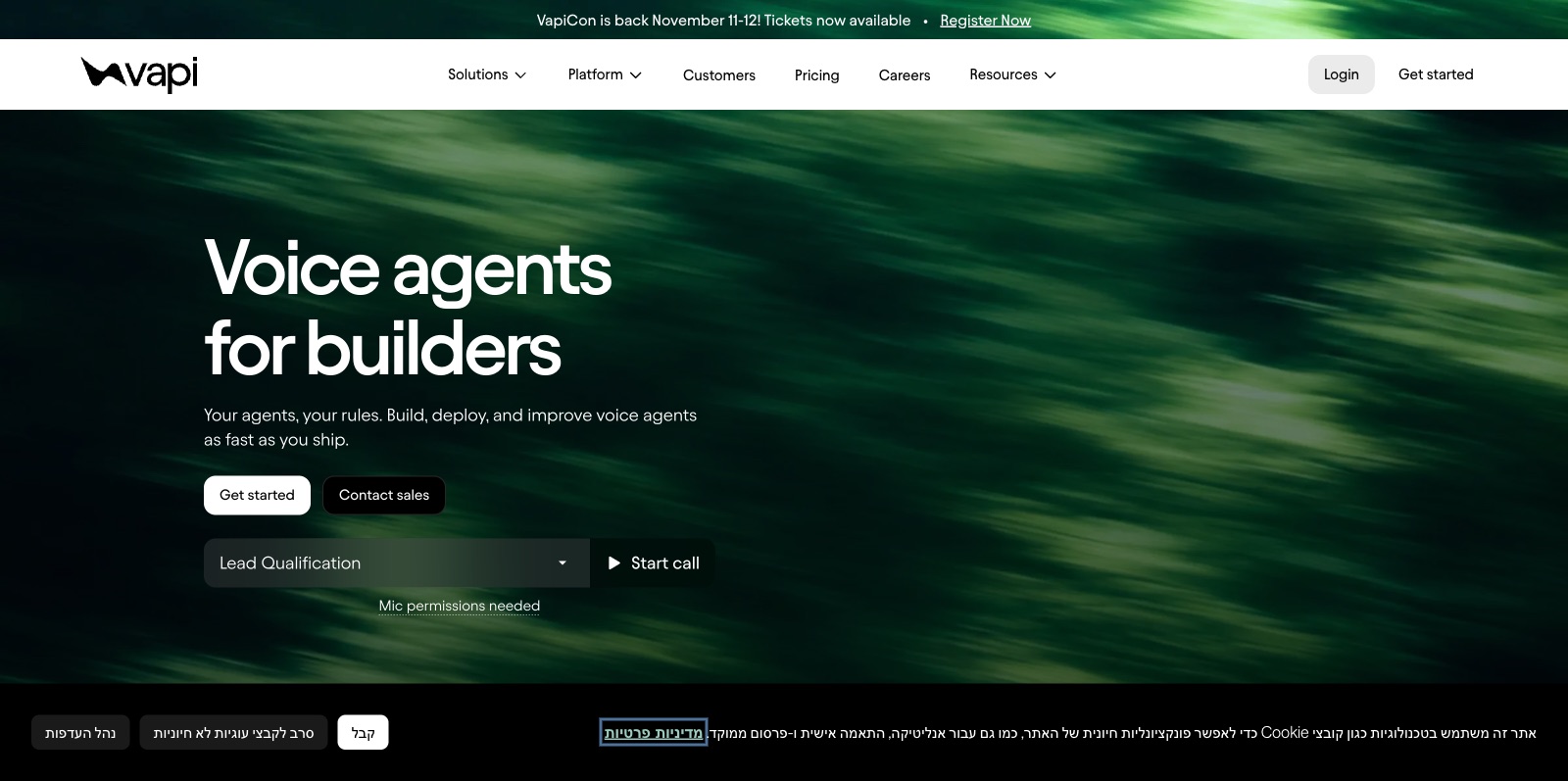 Vapi's homepage, captured September 20, 2026. Credit: Vapi
To translate this into ILS for a real business: a business that takes 30 calls a day averaging 3 minutes each consumes about 2,700 minutes per month. At an all-in cost of $0.10 per minute (a reasonable estimate for a combination of platform, mid-range model, and telephony, not a figure anyone publishes) that is $270 per month, roughly 1,000 ILS. An independent comparison by fewertools arrived at a similar range: about $0.07 per minute on Vapi, $0.10 on Retell, and $0.13 on Synthflow when all components are added together. These numbers shift depending on which model you choose, so the rule is: before you sign anything, run 100 trial minutes and read the invoice, not the pricing page.
What should you test in Hebrew before choosing a platform?
The short answer: a test of 20 real calls, on a mobile phone, with people who talk the way your customers talk. Here are the seven tests that most Hebrew voice agents fail:
- Numbers, times, and dates. "At two," "twenty-two," "next Tuesday." The transcription has to produce correct digits, and the model has to ask for clarification when there is ambiguity.
- Hebrew-English code-switching. "I need an appointment for Botox." A typical Israeli conversation switches languages mid-sentence. Test whether the transcription breaks down.
- First names and street names. "Yossi Ben-Hamo from Jabotinsky Street." Check whether the agent repeats the name correctly.
- The voice. Read the agent a sentence containing words with two possible stress patterns and listen. A voice that stresses incorrectly sounds foreign, and the customer hangs up.
- Interruptions. Break in while the agent is mid-sentence. A good agent stops and listens; a bad one keeps talking.
- Background noise. Call from a street, a car, a supermarket. If the transcription falls apart, it is not your agent.
- The path to a human. Say "I want to talk to a real person." The agent must transfer or take a callback, not argue.
And one operational check: an Israeli number. Verify that the platform or its telephony provider supplies an Israeli number (or allows you to forward calls from your existing number), and find out what a minute costs for a call to Israel. Retell, for example, states that telephony is priced "by country."
How do you set up a voice agent in five steps?
Step 1: Script the calls that repeat. Take your last 50 calls and note what was asked, what was answered, and what was decided. In most businesses, 5 to 8 call types cover the bulk of volume: opening hours, pricing, booking an appointment, changing an appointment, "where is my order." The first agent handles only those.
Step 2: Choose a platform based on the Hebrew test. Set up the same agent on two platforms (for example Retell and ElevenLabs, both of which offer starting credit or trial minutes) and run the seven tests from the previous section. Choose based on the results, not the marketing page.
Step 3: Connect the tools. Calendar (Google Calendar, Calendly), CRM, WhatsApp for confirmation messages. The rule: every action the agent takes should be simple, reversible, or approved by a human. Booking an appointment: yes. Charging a credit card: not in version one.
Step 4: Write the instructions and limits. Who the agent is, what it helps with, and what it does not. The opening line announces that this is an AI assistant and that the call is being recorded (more on that in the next section). And the most important rule: when in doubt, ask or transfer to a human. Never invent a price.
Step 5: Roll out gradually and measure. Week one: the agent answers only outside business hours. Listen to every recording. Fix phrasing. Week two: during peak load too. The metric to watch: how many calls ended with the action the customer wanted (appointment booked, detail recorded), and how many were transferred to a human. Not how many minutes were consumed.
What Are the Risks, and What Does Israeli Law Say About Recording Calls?
The short answer: the technological risk is misunderstanding; the legal risk is what you do with the recordings and the personal data. Both are manageable, and the second one you check with a lawyer.
Technological risks. An agent that heard "Thursday" instead of "Tuesday" and booked an appointment on the wrong day; an agent that invented a price because no price list was defined; an agent that kept talking to an angry customer past the point of no return. The fix is similar in all cases: tools instead of general knowledge (the price comes from a system, not from the model), voice confirmation of critical details ("I booked you for Tuesday at two, correct?"), and a transfer path to a human that the agent uses freely.
Israeli law, in principle only. Under Israel's Wiretap Law, the general principle is that a party to a conversation may record it, while listening to or recording a conversation by someone who is not a party to it is an offense. The voice agent acts on behalf of the business, and the business is a party to the conversation. But that is where the second part begins: the recordings and transcripts are personal data, so the Privacy Protection Law and its Amendment 13 apply, requiring, among other things, a retention policy, data security, and transparency toward the customer. We covered the amendment in depth in our guide on Amendment 13 to the Privacy Protection Law and what it means for AI in business.
Three rules of thumb worth adopting regardless, and confirming with a lawyer: announce at the start of the call that this is an AI assistant and that the call is being recorded; define how long recordings are kept and delete them afterward; and verify where the platform stores the audio and transcript, and whether it uses them for training. This is not legal advice. The field is evolving, and the specific definitions of your business (healthcare, finance, minors) can change the picture entirely.
What This Means for Your Business
Before you start, three one-minute questions:
1. How many calls are you losing today? Calls that went unanswered after 6 p.m., on Saturday, or while every agent was busy. If the number is in the dozens per week, a voice agent pays for itself on those calls alone, before it touches a single call that was already being answered.
2. What is your single most repeated call type? If 40 percent of calls are "when are you open" and "do you have availability tomorrow," that is your first agent. If most calls involve complex negotiation, the agent should be a filter and appointment-setter, not a deal-closer.
3. Who is listening to the recordings? A voice agent with nobody listening to 10 calls a day in the first month does not improve. That is the new role this creates, and it is worth filling it before you go live.
At tzedek.me we build voice agents and AI systems for organizations, including calendar integration, CRM, and WhatsApp connections, Hebrew testing, and recording policies. You can read about our implementations or reach out for a scoping call. And for anyone who wants to build it themselves, step by step, we have an interactive Hebrew course on voice agents for business, where you build the script, the Hebrew test, the tools, and the human-transfer policy.
Frequently Asked Questions
Does a voice agent replace a secretary or a service rep? It replaces the repetitive part: first response, FAQs, appointment scheduling, data collection. Complex, sensitive, and angry calls it needs to transfer to a human. In most businesses the result is not fewer people, but people handling the calls that actually require them.
Which platform should you start with? For a business without a developer, ElevenLabs Agents or Retell AI offer an agent builder with trial credits or minutes, and both explicitly support Hebrew. For someone with a developer who wants full control over every component, Vapi. The final decision comes after the Hebrew test, not before it.
Do you need a new phone number? Not necessarily. You can forward your existing number to the agent (fully, or only when the call goes unanswered), or get a virtual number from the platform or your telephony provider. Check in advance that an Israeli number is available and what the per-minute cost to Israel is.
What happens when the agent does not understand? A well-configured agent asks for clarification once, and if still uncertain, offers to transfer to a human or to take down details for a callback. The rule in the instructions: never guess, never invent.
Can the agent also call customers outbound? Yes, all four platforms support outbound calls (appointment reminders, booking confirmations, surveys). Here the legal dimension is more significant (telemarketing rules, permitted hours, consent), and you check with a lawyer before running any outbound campaign.
How long does setup take? A prototype in a day. An agent connected to a calendar and CRM, with a Hebrew test, an Israeli number, and a recording policy: two weeks to a month, with most of that time going toward listening to calls and refining the wording.
The Bottom Line
A Hebrew-language voice agent is no longer a promise, it is an off-the-shelf product: Retell, Synthflow, and ElevenLabs explicitly list Hebrew support, Vapi handles Hebrew transcription through Deepgram, and platform pricing starts at a few cents per minute. What is not yet off the shelf is the quality in real Hebrew conversations, and that you measure yourself across 20 calls before you sign anything. The right setup starts from the calls that keep repeating, continues with tools instead of general knowledge, and ends with a clear path to a human and a recording policy a lawyer has approved.
Sources: Vapi pricing page · Deepgram documentation in Vapi (language list) · Retell AI pricing page · Hebrew voice agents, Retell AI · Language support in Retell documentation · Synthflow pricing page · Supported languages in Synthflow documentation · ElevenLabs Agents pricing · Models and languages in ElevenLabs documentation · Which languages can I use with ElevenAgents · Independent comparison: Vapi vs. Retell vs. Synthflow vs. Bland (fewertools) · On call recording and wiretapping in Israel (Hahn Law Firm). All prices in USD, accurate as of September 20, 2026, and subject to change.
Yaakov Tzedek is an AI lecturer, consultant, and enterprise AI implementer, and leads Israel's largest Claude Code community.
Frequently asked questions

Yaakov Tzedek
An Israeli AI lecturer, consultant and implementer who has supported 100+ organizations in AI implementation and lectured for 200+. Official content partner of Meta, Google, Canva and TikTok, featured on Israel's Channel 13.
More about Yaakov →