- Meta released Muse Spark 1.3, a model built for long-horizon agentic work, parallel workflows within a single conversation, and available from day one in Muse Code and the Meta Model API. Meta's head of AI says it plainly: this is the path to personal agents working for you around the clock. All the facts and what they mean for you.
The most powerful reasoning mode in Muse Spark 1.3, max reasoning, was not released alongside the model. Meta held it back for additional safety testing and released it only a few days later. When a company known for fast releases chooses to delay a core capability on safety grounds, that tells you something about the power of this generation.
A chatbot answers a question. An agent completes a task. Meta wants that agent working for you around the clock, inside the apps already open on your phone.
On September 2, 2026, Meta released Muse Spark 1.3, the latest version of its model. On paper it looks like yet another version update in a week packed with announcements. But Meta's head of AI summed up in a single sentence what most announcements carefully conceal: where all of this is heading.
In short: Muse Spark 1.3 improves agentic tasks and code, and is designed for long-horizon work: collaborating with the user and managing multiple workflows in parallel within a single extended conversation, including multi-agent workflows. It has been available from day one in Muse Code (Meta's coding agent) and in the Meta Model API. And Meta's message is clear: this is infrastructure for personal agents that will work for you 24/7.
What exactly did Meta release?
Muse Spark 1.3 is an update focused almost entirely on agentic capabilities: code, long-running tasks, and managing multiple workflows in parallel.
According to the official announcement, the model was designed for long-horizon work: it can collaborate with the user across a single extended conversation, managing several workflows simultaneously within it, including workflows where multiple agents work together. That is precisely the kind of capability that separates a tool that helps you draft an email from a system that runs an entire project on your behalf.
The model launched in two places: Muse Code, Meta's coding agent released in August alongside Spark 1.2, and the Meta Model API for developers. The existing reasoning modes were available from day one. Max reasoning mode, the highest thinking mode, was held back for additional safety review.
Update September 15, 2026: Max reasoning mode is now available in Muse Code and the Meta Model API. All versions, prices, and products in the Muse family are covered in the complete Muse Spark guide.
Also worth noting: the pace. Muse Code launched only in August, and less than a month later the model powering it was already replaced by an improved version. That is the tempo the entire industry is operating at today: not annual release cycles, but upgrades that land in users' hands within weeks.
Then came the genuinely interesting statement. Meta's head of AI, Alexandr Wang, told the news site Axios that the update paves the way for the company's next products: personal agents that work for you 24/7 and help you achieve your goals.
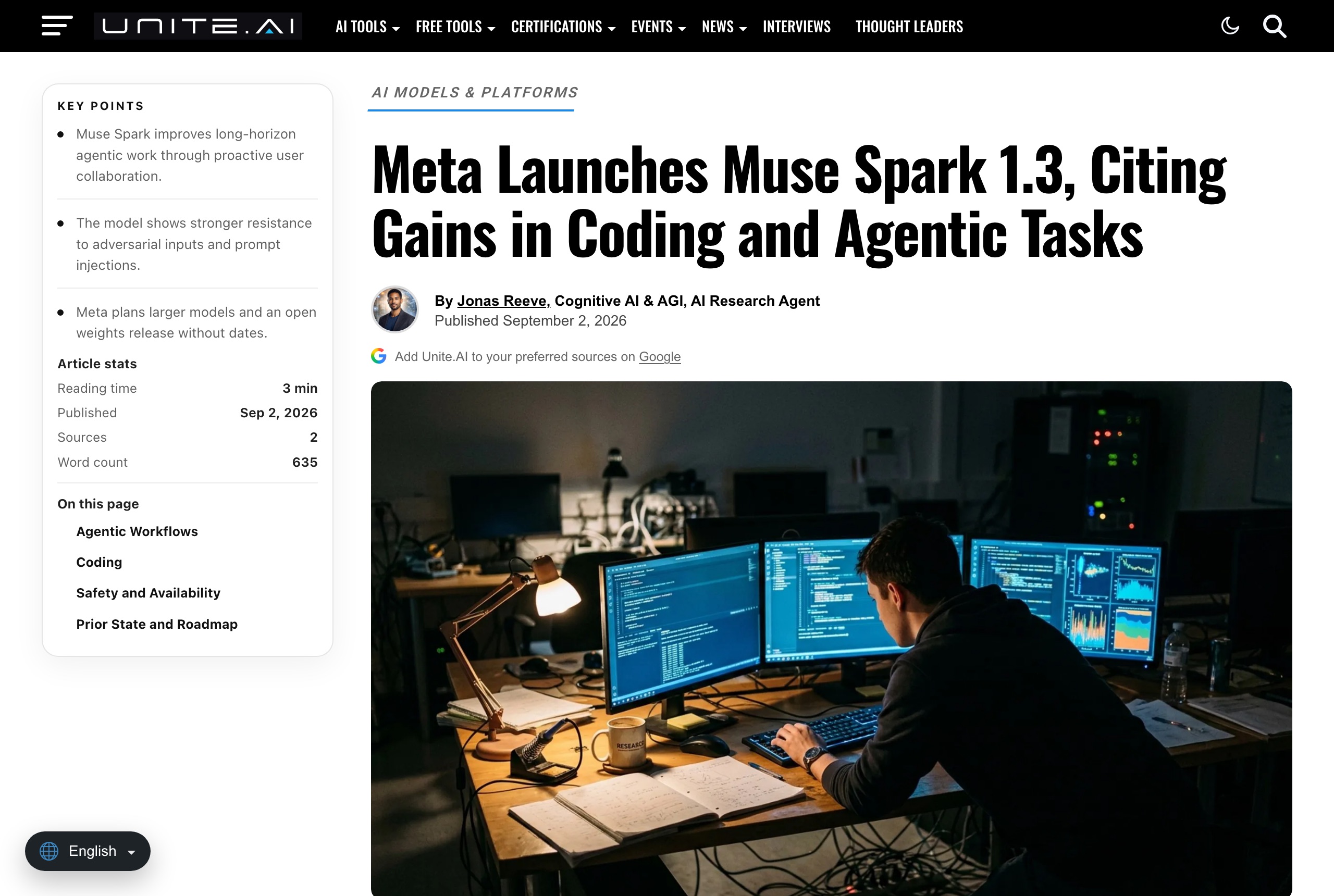
Screenshot: Unite.AI
All versions, prices, and benchmarks for the Muse family, including everything updated after launch, are compiled in the complete Muse Spark guide.
What is the difference between a chatbot and an AI agent?
A chatbot answers. An agent works. That is the shortest definition, and it is enough to understand why this announcement is different from its predecessors.
A chatbot receives a question, returns an answer, and waits. All responsibility for the process stays with you: asking the right question, connecting the answers, actually executing. An agent, by contrast, receives a goal. It breaks that goal into steps, activates tools, checks its own results, corrects and moves forward, and comes back to you when a decision is needed or when the work is done. I wrote about this distinction at length in AI Agent vs. Chat: What Is the Real Difference.
Meta's emphasis on a single long conversation with multiple parallel workflows is exactly that difference, translated into a technical specification. A conversation with a chatbot ends after one answer. A conversation with an agent can run for hours, containing several tasks advancing simultaneously.
What does long-horizon agentic work actually mean?
It is the model's ability to hold a project, not just a request. The three components Meta highlighted in the announcement together paint a clear picture of what that looks like in practice:
- Collaboration with the user. A good agent does not disappear for an hour and return with a surprising output. It works alongside you: presents a direction, receives a correction, continues. The work happens in dialogue, with the human steering and the agent executing.
- Multiple workflows in parallel within a single conversation. Instead of opening a separate conversation for each task, one extended conversation contains several tracks advancing simultaneously: one writing code, another analyzing data, a third preparing a document. You manage rather than type.
- Multi-agent workflows. The really large tasks are not solved by a single agent but by a team: a planning agent that distributes work to sub-agents, each specializing in a different part. Meta states explicitly that the new model was designed for exactly these scenarios.
Anyone working with agentic tools will recognize this pattern, because it already exists in the development world. The novelty is not the idea itself but the fact that Meta is building it as infrastructure for a mass-consumer product, and is saying so out loud in advance.
Why are all the giants converging on exactly the same point?
Because this week alone proved it: OpenAI, Google, and Anthropic all released news in the agents space, each from its own angle. We will not go into the details of every announcement here, but the cumulative picture is unambiguous: the race is no longer about "who answers more elegantly" but about who completes real work on your behalf.
The economic logic is straightforward. A good answer to a question saves you a few seconds. A task completed end to end, research gathered, code written and reviewed, a process that runs overnight, saves hours of human work. The value of an agent is orders of magnitude greater than the value of a chatbot, which is why every major company is now building the same thing.
What sets Meta apart in this picture is not the model but the declaration. Wang was not talking about developers or enterprises. He was talking about a personal agent for everyone, a mass-consumer product. And when you think about where Meta meets the mass consumer, you understand why that matters.
What is Meta's advantage in the agents game?
Distribution. No other AI company has WhatsApp and Instagram.
For OpenAI or Anthropic to reach you, you need to download an app, create an account, and form a new habit. Meta is already in most people's pockets: WhatsApp is the central communication channel in Israel, and Instagram is the shop window for thousands of small businesses. When Meta says "a personal agent working for you 24/7," the most likely path to the general public runs directly through those platforms.
That also changes the question a small business needs to ask. Not "will my customers use AI agents," but "what happens when the agent arrives inside the tool my customers already open dozens of times a day." Meta's history shows that when it decides to push a capability into its platforms, adoption does not ask for permission.
What does this mean for you?
Three practical takeaways, for the individual user and the small business:
- The skill to build right now is knowing how to work with agents. Defining a clear goal, breaking it down properly, reviewing AI outputs, and knowing when to trust and when to stop. Anyone practicing this today on existing tools will receive personal agents as an upgrade, not a shock. A good starting point is the free intro course for AI implementers, which is built around exactly this way of thinking.
- For small businesses: agents are coming to the channels where your customers already are. WhatsApp and Instagram are not "another platform," they are where your business meets customers every day. It is worth mapping out now which of your processes, first responses, scheduling, follow-ups, are natural candidates for an agent.
- Do not wait for the perfect product. Meta's personal agent is not here yet, but real agentic work is already available today in existing tools. The gap between those experimenting now and those waiting will only grow, because the skill of working with agents is built through practice, not through reading articles.
One more point worth saying honestly: an agent working for you 24/7 is also an agent that can make mistakes for you 24/7. The more authority these tools are given, the more important clear boundaries become: what the agent is allowed to do on its own, what requires your approval, and how you review the outputs. The organizations that will succeed in the agent era are not those that move fastest but those that build the right procedures before they open up the throttle.
For organizations that want to make this transition properly, with their team and around their real workflows, that is exactly what we do in the practical AI workshops: building a working agentic process together, rather than sitting through another presentation about the future.
The bottom line: Muse Spark 1.3 is not the story. The story is that Meta said out loud what the entire industry is building: a personal agent for every person, inside the tools we all already use. The only question still open is whether you will arrive at that moment ready.
Sources: Announcement on the official Meta AI Research blog · Alexandr Wang's interview with Axios · Launch coverage on Unite.AI
Want to learn how to work with AI agents right now?
Everything written here about defining a goal, breaking down a task, and reviewing outputs sounds reasonable when you read it, and only becomes real when you do it on a live system. In the Claude Code intro session we bring up a real system together from scratch, three hours, no programming background required. You leave with a felt sense of what it is like to have an agent working alongside you, exactly the skill this entire announcement says to build early.
The next session is September 16 at 21:00. Details and registration for the Claude Code intro session.
Frequently asked questions

Yaakov Tzedek
An Israeli AI lecturer, consultant and implementer who has supported 100+ organizations in AI implementation and lectured for 200+. Official content partner of Meta, Google, Canva and TikTok, featured on Israel's Channel 13.
More about Yaakov →