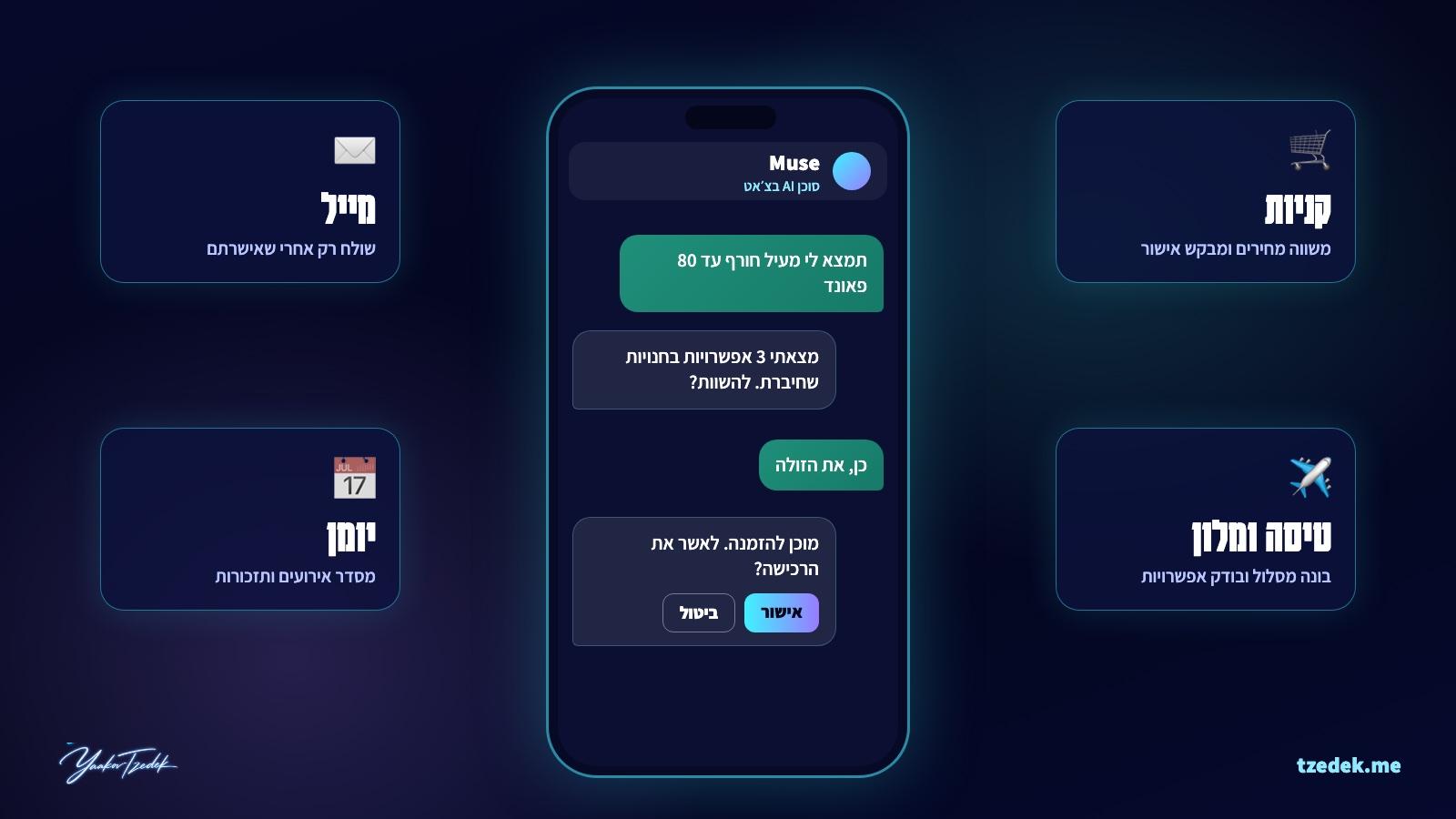
- Meta launched Muse in the UK: an AI agent that works inside WhatsApp, connects to email and calendar, and shops and books with the user's approval. It is not available in Israel yet.
According to Meta, Muse has a separate security agent that checks every action against the permissions you granted, and it ignores one-time codes and password reset links that arrive in a connected inbox.
This is not another bot that tells you what to buy. You send it a WhatsApp message, and it opens websites, checks options, connects to your email and calendar, and asks for approval right before it actually does something.
On November 23, 2026, Meta launched Muse to the general public in the UK. It is not available in Israel yet, but it is worth understanding now: this is where WhatsApp assistants are heading.
Fact check (as of 25.11.2026):
- Availability: UK, ages 18 and over, from 23.11.2026.
- Where: WhatsApp, iOS, Android and muse.ai.
- Israel: not officially available.
- Price: free with usage limits, plus optional subscription plans. No prices published.
- Hebrew: not verified.
- Sensitive actions: need your approval, according to Meta.
What just happened?
Meta announced that Muse is available from now on to anyone aged 18 and over in the UK, inside WhatsApp, in its apps and on the web. This is not a closed test: the launch comes with a long list of UK partners, including ASOS, Currys, Sainsbury's, Trainline and easyJet, plus Spotify and OpenTable globally.
According to Meta, everyday use is free with limits, and people who want more can subscribe. Meta also says the agent will come to its AI glasses later on.
 Screenshot: the official announcement on Meta's newsroom (about.fb.com), November 23, 2026.
Why is this not just another chatbot?
The difference is between something that answers and something that acts. Here is what that looks like in practice:
| A regular chatbot | Meta Muse |
|---|---|
| Answers a question | Takes a task and carries it out |
| Recommends a product | Opens stores and compares options |
| Writes a draft email | Sends the email after you approve |
| Suggests a trip itinerary | Connects to bookings and builds the itinerary |
| Stops when the chat closes | Can keep working on a task |
We break down the difference between a chat and an agent in depth in our complete Muse Spark guide (in Hebrew).
What can you ask it to do?
The examples Meta itself gives are very everyday:
- Turn a recipe Reel you saved on Instagram into a shopping list.
- Keep up with the school calendar and put it in your diary.
- Look for a cheaper energy deal.
- Plan a trip, and turn saved travel Reels into a holiday itinerary.
- Find a product, compare, and ask for approval before buying.
- Chase a refund, draft emails and remind you about things.
How does it carry out tasks?
Two mechanisms do the work. The first is connectors: email, calendar, Instagram, websites and retailer apps. You choose what to connect and what access to give, for example reading email without sending, and you can change or disconnect any service whenever you like.
The second is a virtual computer in the cloud. According to Meta, every Muse gets its own computer where logins are stored, and it browses websites there on your behalf. You can watch it work and take over at any point. It also keeps working after you close the app, and comes back when something changes or when it needs your approval.
What is it not allowed to do on its own?
According to Meta, sending an email and making a purchase require your approval, and purchases require it every time. A separate security agent checks every action against the permissions you granted. Meta also says Muse has no visibility into passwords or payment methods, and that conversations are not shared with its advertising systems.
To be precise: these are Meta's statements, not our own testing. One thing worth knowing up front: according to Meta, using your conversations to train its AI is on by default, and you can turn it off in Settings under data controls.
Is Meta Muse available in Israel?
Not officially, as of November 25, 2026. Meta has not announced a date for Israel and has not confirmed Hebrew support. It is worth watching, because WhatsApp is the main work tool for most businesses in Israel, so when it arrives, people will feel it immediately.
The big question is not whether it can, but whether we will give it access
The convenience is real. An agent that finds the coat, compares prices and waits only for your tap saves time. But to work, it needs access to your email, your calendar and your store accounts, and that is a lot of trust in one company.
The UK regulator noticed too. On November 24, 2026, the Competition and Markets Authority (CMA) said it is watching Muse from a consumer protection angle, in coordination with the data protection regulator. According to the statement, after talks with the CMA, Meta changed some of its terms to make them fairer for consumers, although the CMA did not say exactly what changed.
There is background here: Meta employees have already raised privacy concerns about Muse, and Amazon blocked Meta's agent from its site (both in Hebrew). The fight over shopping agents is just beginning, and we explained what it looks like at OpenAI in our piece on ChatGPT Wallet and Poppy.
The rule that works with any agent: the agent prepares, and you approve whatever is hard to undo. We spelled it out in our safety rules for working with AI agents (in Hebrew).
Want to understand AI agents before they reach your WhatsApp?
An agent that carries out tasks is only worth something if you know how to give it a clear task, grant it exactly the access it needs and check what it returns. The AI agents video course teaches this step by step, with no coding background.
Go to the AI agents video course
Sources: Meta's announcement of Muse in the UK, Meta: Muse does the work, you stay in control, the CMA statement.
Frequently asked questions

Yaakov Tzedek
An Israeli AI lecturer, consultant and implementer who has supported 100+ organizations in AI implementation and lectured for 200+. Official content partner of Meta, Google, Canva and TikTok, featured on Israel's Channel 13.
More about Yaakov →