- What it is: Videos with a talking avatar generated from text, a personal avatar of yourself, and translation and dubbing of existing videos.
- Price: Free (3 videos per month, up to one minute), Creator $29/month, Pro $49, Business $149, Enterprise custom.
- Hebrew: Supported for dubbing and translation on paid plans (175+ languages). Test pronunciation on a 30-second clip before committing to a full library.
On HeyGen's free plan you can produce three videos a month of up to one minute each, with one custom avatar. That is enough to test whether the avatar speaks Hebrew at a quality you would put in front of clients, before spending a single shekel.
One training video, five versions a year, coordinating a camera operator, studio, and presenter every single time. That's not even the interesting part.
The interesting part is what happens when the procedure changes for the sixth time. With HeyGen you update two lines of text, click produce, and the avatar delivers the new version in the same face and the same voice, with no one in a studio. That's the shift that turns a training video from a project into maintenance.
This guide is built from HeyGen's official pricing page (checked September 14, 2026) and from our hands-on experience deploying it inside organizations: what the tool does, what each plan costs, what works in Hebrew, and where the limits are.
In short
- What it is: Videos with a talking avatar generated from text, a personal avatar of yourself, and translation and dubbing of existing videos.
- Price: Free (3 videos per month, up to one minute), Creator $29/month, Pro $49, Business $149, Enterprise custom.
- Hebrew: Supported for dubbing and translation on paid plans (175+ languages). Test pronunciation on a 30-second clip before committing to a full library.
- The limit: An avatar of a real person requires consent, transparency with your audience is required, and sensitive content follows HeyGen's policy.
- Who it's for: Training and onboarding, marketing and product, localization into additional languages.
What can HeyGen do?
HeyGen is an AI tool that produces a video of a digital character reading your text aloud. According to the product and pricing pages, these are its capabilities:
- Avatar from text: Choose a character from more than 500 stock avatars, type a script, and receive a video with lip sync and facial expressions.
- Personal avatar: A digital character created from you. One custom avatar on the free plan, five on Business.
- Avatar IV: The latest generation of avatars, available on all paid plans.
- Photo Avatar: A talking character generated from a still image, unlimited from Creator onward.
- Video translation and dubbing: An existing video is exported in another language with lip sync. 30+ languages on the free plan, 175+ on paid plans, with translation script editing from Pro.
- Voice cloning: Available from Creator.
- Interactive video, SCORM, and LMS: Available on Business, for organizations embedding videos into a training system.
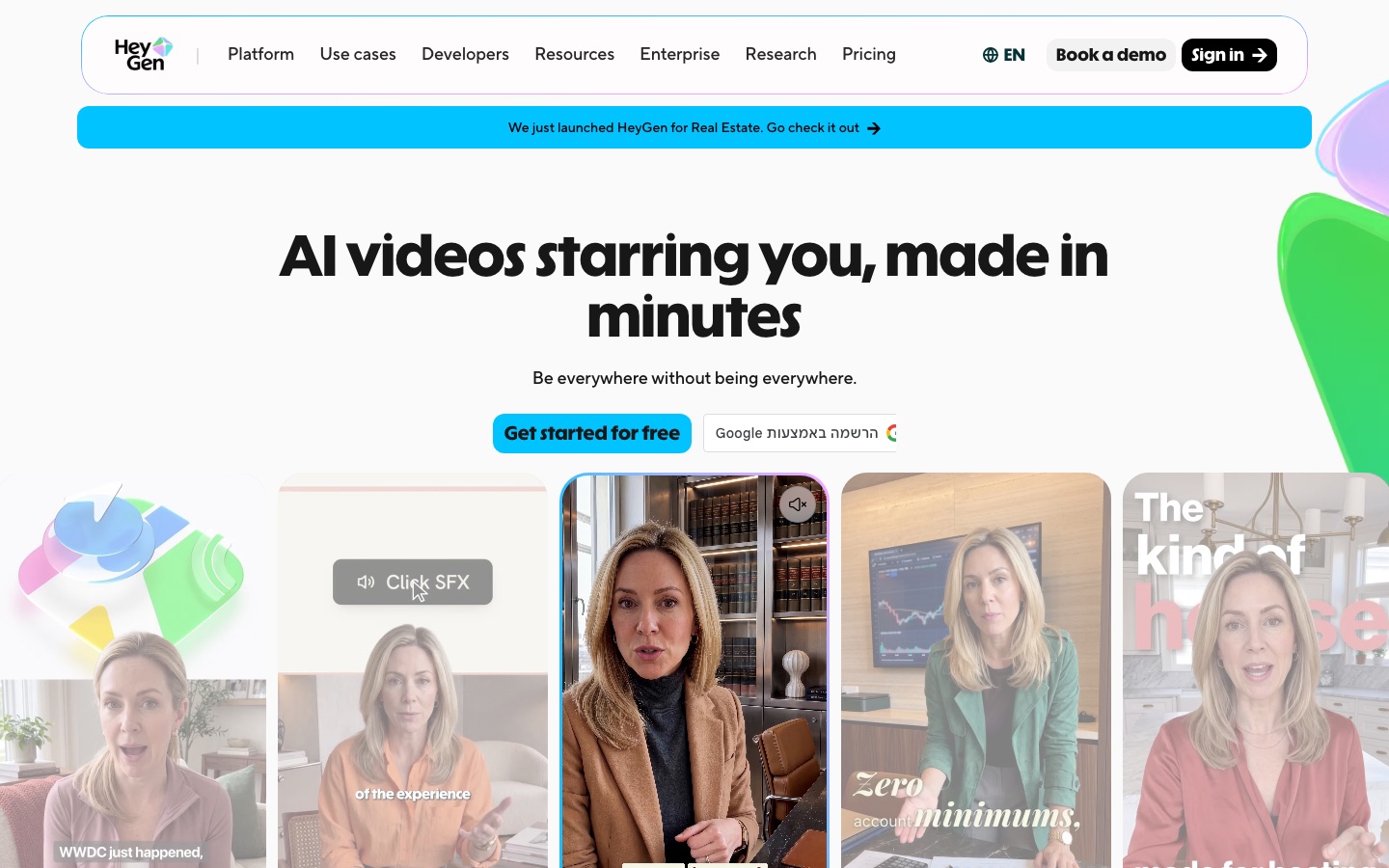 The official HeyGen website, photographed in September 2026. Credit: HeyGen
What it costs: every plan from the official site
| Plan | Monthly price | Credits | What's unlocked |
|---|---|---|---|
| Free | $0 | Not specified | 3 videos per month, up to 1 minute, 1 custom avatar, 30+ languages, 500+ avatars |
| Creator | $29 ($24 annual) | 600 | Videos up to 30 minutes, 1080p, voice cloning, 175+ languages, unlimited photo avatars, no watermark |
| Pro | $49 | 1,000 | 4K export, all advanced models, translation script editing |
| Business | $149 (+$20 per additional seat) | 1,500 | Videos up to 60 minutes, 5 custom avatars, team features, SCORM and LMS, interactive video |
| Enterprise | On request | Flexible | Unlimited length, success manager, enterprise security |
Prices are from the official pricing page as of September 14, 2026, and are subject to change. The watermark is removed from Creator onward, so any video intended for publication requires a paid plan. Credits are the quota from which minutes and features are drawn; check the page for the conversion rate.
Hebrew: what works and what to test
Hebrew is included in the dubbing and translation languages on paid plans. Three things to check on a 30-second script before producing an entire library: pronunciation of proper names and professional terms, numbers and dates, and speaking pace. Short sentences with clear punctuation improve results, and any word that is mispronounced can be written out phonetically.
How to get started: step by step
- Free account at heygen.com. Three videos per month is enough to evaluate the tool.
- A script of 30 to 60 seconds in Hebrew, short sentences, clear punctuation.
- Choose an avatar and voice from the library, and listen to the voice before producing.
- Produce and watch critically: lip sync, pronunciation, pace.
- One real deliverable: an onboarding video or a product explainer.
- Then scale: a personal avatar (Creator), dubbing into a second language, and on Business, SCORM integration.
Five use cases for a business in Israel
- Employee onboarding: A series of short videos that update whenever the procedure changes, without reshooting.
- Product explainers: A video for every feature, in both a Hebrew and an English version from the same script.
- Customer service: Recorded answers to recurring questions, delivered by the company's avatar.
- Social media marketing: "Tip to camera" videos without standing in front of a camera.
- Localization: An existing Hebrew video exported in English, Russian, and Arabic for different audiences within Israel.
What about the webinars and long lectures that have already been recorded? That's where OpusClip comes in, cutting them into short clips with a virality score, complementing avatar videos with real field content. And when a video doesn't need a presenter at all, just a script, stock footage, and narration from a single prompt, it's worth getting to know the InVideo guide.
Limitations and permissions
- Consent. A personal avatar can only be made of yourself or of someone who has signed off. Creating an avatar of another person without consent is prohibited and may violate their privacy.
- Transparency. When facing customers, disclose that the speaker is an avatar. People forgive a clearly identified avatar; they don't forgive one that impersonates.
- The uncanny valley. A near-realistic avatar can sometimes be more off-putting than an illustration. Choose a character and script that fit your audience.
- Sensitive content. Internal organizational information that policy prohibits storing in the cloud does not go in. Enterprise includes enterprise-grade security.
- Not for every video. A brand video that requires genuine human emotion is still shot with a camera.
The bottom line
HeyGen solves one big problem: video that stays current. If you produce one video a year, you don't need it. If you maintain dozens of training videos, product explainers, and multilingual content, you get a studio that runs from a script for $29 a month. The first test is free, and a 30-second Hebrew script will tell you within ten minutes whether this is for you.
If your need is different, animating a single image or illustration rather than creating an avatar from footage, or building an interactive visual agent that speaks in real time, it's also worth knowing the Israeli alternative D-ID, in the full guide.
Further reading: ElevenLabs: AI voice in Hebrew · D-ID: talking avatars and visual agents · CapCut: the complete guide · AI video tools in 2026 · AI agent for customer service
Sources: HeyGen official pricing page, checked September 14, 2026.
Yaakov Tzedek, AI lecturer, consultant, and organizational AI implementer, and leader of the daily AI tip community. Join the WhatsApp group.
Frequently asked questions

Yaakov Tzedek
An Israeli AI lecturer, consultant and implementer who has supported 100+ organizations in AI implementation and lectured for 200+. Official content partner of Meta, Google, Canva and TikTok, featured on Israel's Channel 13.
More about Yaakov →