- Google launched a preview of Connected Apps Platform on October 28, 2026: developers build an MCP server or Android MCP with AppFunctions, register in Google Connected Console, and choose whether to appear in Gemini, Search, or both. Over 50 apps are already connected, including Adobe, Experian, Localiza, and Peloton. What this means for your business, and what to prepare now.
According to Google's official documentation, every app on the platform must use OAuth 2.1 for user authentication. The practical implication: a user links their account once, and from that point Gemini and Search can act within your service on their behalf, within the permissions they approved.
Google has opened the door to Gemini for developers. And behind that door sits Google Search too. More than 50 apps are already connected, from Adobe to Peloton, and as of yesterday any developer can register to join. The big news isn't the partner list; it's the technology underneath: MCP, the same standard already connecting services to Claude and ChatGPT.
In short:
- What launched: A Preview of the Connected Apps Platform, on October 28, 2026: one place to build and manage apps that work inside Gemini and Google Search.
- What it's built on: A cloud MCP (Model Context Protocol) server, or Android MCP via AppFunctions. User authentication through OAuth 2.1.
- Who's already there: More than 50 apps across Search and Gemini. Adobe, Experian, Localiza and Peloton are live in Gemini and will reach Search in the coming weeks, while Calm will launch in both.
- Availability: Developer access is opening in stages. Google hasn't published a list of countries, and we found no confirmation of availability in Israel.
- For your business: Anyone with a digital service needs to start thinking about "AI connectivity" the way they once thought about a mobile app or a mobile-friendly website.
What exactly did Google launch?
Google launched a developer platform, not a new user feature. Connected Apps have existed in Gemini for a while: type @ in the chat, pick an app, and Gemini acts inside it on your behalf. The October 28 announcement, written by product managers from Search and the Gemini app, opens that capability to more developers through a single structured process.
According to the announcement, the platform lets you "build once" and reach high-intent users in both Search and Gemini. Before an app goes through Google's review, the developer chooses whether it will appear in Search, Gemini, or both.
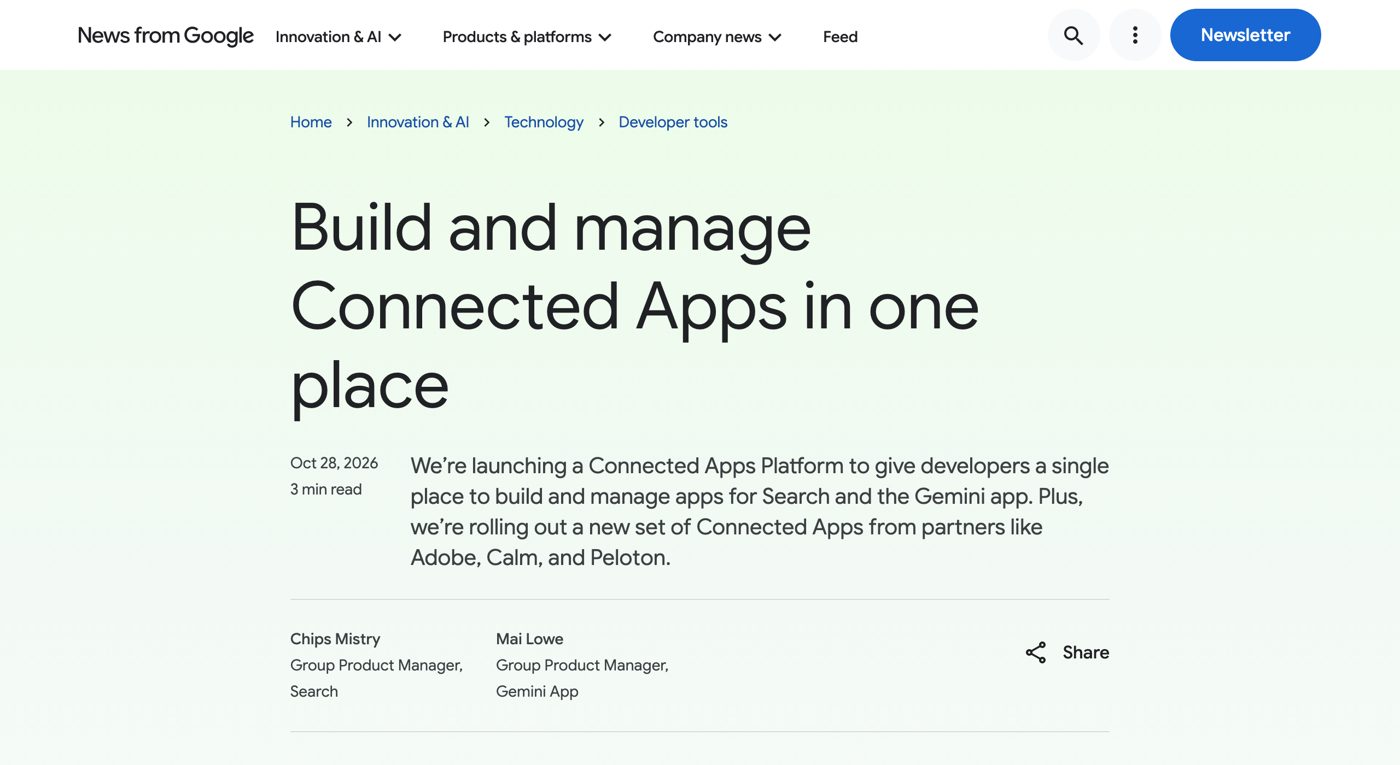 Screenshot: Google's official blog (blog.google)
Is this really built on MCP?
Yes, and that's the most important part of the announcement. According to Google, developers connect to the platform in one of two ways:
- Cloud MCP server. Your service exposes actions and data via MCP (Model Context Protocol), the open protocol that has become the common language between AI agents and external tools. If you're not familiar with it, a good starting point is our plain-language explanation of MCP.
- Android MCP with AppFunctions. An on-device solution: an Android app exposes its capabilities to assistants like Gemini using the Jetpack AppFunctions library.
The official documentation adds two details that matter for builders. First: you can build rich in-conversation interfaces using MCP Apps, the extension that lets a server return a form, card or dashboard rather than plain text. Second: user authentication requires OAuth 2.1, meaning a one-time secure account link, after which actions are performed on the user's behalf within the scope they approved.
What does it look like for the user?
The user types a normal request, tags the app with @, and Gemini connects to it and returns results from inside that service. In Google's demo video, a user asks for EDM-style running workouts ahead of a marathon and tags Peloton. Gemini connects to the service and surfaces real classes from the catalog, complete with cards, images and follow-up suggestions.
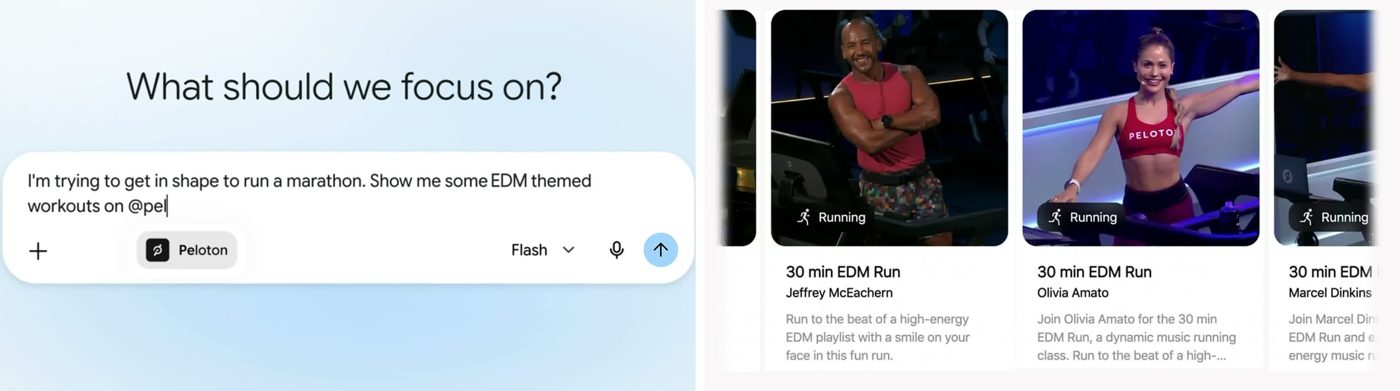 Screenshot: Google's official demo video, from the blog announcement
According to Gemini's help page, the connection requires user approval, and the apps that appear in settings vary by Gemini app, device, country and other factors. Work and school accounts follow separate guidelines.
Who's already connected, and what's confirmed?
According to Google, more than 50 connected apps have already launched across Search and Gemini, spanning categories like productivity, event ticketing, health and fitness. The partners named in the announcement:
- Live now in Gemini: Adobe, Experian, Localiza (a Brazilian car rental company) and Peloton. According to Google, they will also reach Search in the coming weeks.
- Coming soon: Calm, the meditation app, will launch in both Search and Gemini.
This announcement builds on an earlier wave. On September 23, 2026, 14 third-party services were added to Gemini, including Airtable, Linear, Zoho, Squarespace, Webflow, SeatGeek and monday.com, according to PPC Land's report. And in Search, the connections inside AI Mode began on July 16, 2026, with Instacart, Canva and YouTube Music, in the United States and in English only.
Is this available in Israel?
Google has not published a list of countries, either for the developer platform or for the new partners. What is known: developer access is opening in stages, and Google writes that it will add developers, markets and products over the coming months. Gemini's help page explicitly states that available apps vary by country.
We found no official confirmation that Adobe, Peloton or Calm are available in Gemini for users in Israel, nor that the Search connections have expanded beyond the United States. The simple check: open Gemini on a personal account, type @ and see which apps appear.
How does this differ from what ChatGPT and Claude offer?
The idea is the same; the reach is different. Claude already has connectors that link the chat to Gmail, Calendar and other tools, and both ChatGPT and Claude support MCP Apps, as we covered in our analysis of WebMCP and MCP Apps in ChatGPT. The business implication: one well-built MCP server can serve as the foundation for multiple platforms, with no need to build each integration from scratch.
Google's differentiator is where the user is standing. A Connected Apps integration can surface in Search, at the exact moment someone is already looking for a solution. That's also why Google frames this as reaching users "with high intent."
What this means for your business
If you run a digital service, the question is shifting from "how do people find us on Google" to "how does Google's AI act on our behalf." A customer who asks Gemini to book, check a status or find a product will get an answer from whichever service is connected. If you're not connected, you're simply not in the conversation.
Things to prepare now, even before access opens to everyone:
- An action list. What do your customers do most often? Booking, availability checks, shipment tracking, appointment scheduling. Three to five focused actions are worth more than connecting your entire system.
- A clean API. An MCP server sits on top of an existing interface. If you don't have a clean API, that's the first step, and it's also the path to connecting AI to your business systems.
- Secure authentication. OAuth 2.1 is a requirement, not a recommendation. Check now whether your user management system supports it.
- Action boundaries. Which actions can the AI take autonomously, and which require customer approval. A useful rule of thumb: reads are free, writes need confirmation, and payments or deletions need explicit approval.
- Register for the Preview. At developers.google.com/connected-apps. Registration is non-binding, and access is granted in stages.
Once an app is live, Google gives the developer visibility into traffic, response times and error rates, and lets them control brand identity, including a verified logo. In other words, it's a measurable channel, not a black box.
What's still unknown
- Countries and languages. No list has been published, and it's unclear when the platform will open to developers outside the United States.
- Review criteria. Google mentions a review process before publication, but hasn't detailed what gets reviewed or how long it takes.
- Business model. There's no mention of costs, commissions or in-conversation payments.
The related story from today
Google launched several moves today that fit together. Alongside the Connected Apps platform came Gemini 4 Carbon, Google's new advanced model, and improved autofill in Chrome that pulls details from Gmail. Anyone who wants the full picture of how Gemini already works with external tools will find it in the guide to Gemini Spark.
The bottom line
Google didn't just add more apps to Gemini. It chose MCP as the official path into both of its flagship products. For businesses, that means an investment in a single MCP server now touches not only Anthropic's and OpenAI's chat products, but also Google Search. Anyone who prepares an action list, an API and OAuth today will be ready when the door opens in their market too.
Want your service to be ready to work with AI agents?
The AI agent development service for businesses covers planning the actions AI will perform, building the connection to your systems, and setting permissions and approval points from day one. Those who prefer to build independently will find four hands-on sessions in the building AI agents with Claude Code workshop, including MCP work. And for anyone who wants to understand the foundations first, there's a comprehensive MCP guide in Hebrew.
Sources:
- Google's official blog: Build and manage Connected Apps in one place
- Google for Developers: Connected Apps Platform
- Gemini Apps Help: Connected Apps in Gemini
- PPC Land: Gemini gains 14 third-party apps including Experian and Adobe
- Search Engine Journal: Google starts rolling out connected apps in AI Mode
Frequently asked questions

Yaakov Tzedek
An Israeli AI lecturer, consultant and implementer who has supported 100+ organizations in AI implementation and lectured for 200+. Official content partner of Meta, Google, Canva and TikTok, featured on Israel's Channel 13.
More about Yaakov →