- On October 28, 2026, Google announced Gemini 4 Carbon, its most powerful model yet, focused on code, agents, and cybersecurity. It tops Artificial Analysis v5.0 and doubles Argon's secure-code score in internal tests, but access is currently limited to select defenders in the Fairwind program.
According to Google, in the Gray Swan indirect prompt injection benchmark, the attack success rate against Carbon was 0.0%. For Argon, the previous model, that figure was reported as 0.7%. These are the company's own numbers, but they explain why Google is positioning Carbon as the model for agents that read other people's emails and documents.
Update, November 12, 2026: From November 10, Carbon is available to paying users: developers on the Gemini API paid tier, businesses, and Google AI Ultra subscribers. The price is $2 and $10 per million tokens through November 30, then it doubles. Full details in the Gemini 4 Carbon availability announcement.
Gemini 4 Carbon is Google's new model and, according to the company, its most capable one: first place on the Artificial Analysis index, and more than twice the success rate on secure code generation compared to its predecessor. But you can't use it. For now, it's reserved for a small group of cyber defenders.
Google launched Gemini 4 Argon to the public two weeks ago. Yesterday, October 28, 2026, it already announced the next model. And that's exactly the point: the pace at which the "latest" model goes stale is shorter than the time most businesses need just to evaluate it.
In short:
- What was announced: Gemini 4 Carbon, a Google DeepMind model for code, agents, and cybersecurity, on October 28, 2026.
- The numbers (Google's): First place on the Artificial Analysis Intelligence Index v5.0 with a score of 59, and more than twice the success rate on secure code generation compared to Argon in internal tests.
- Who gets access: Only a small group of cyber defenders, and gradually additional trusted partners through the Fairwind program.
- For the public: No access and no date. Google writes "as soon as possible."
- Planned pricing: $2 input and $10 output per million tokens during the introductory period, then $4 and $20.
- For your business: Nothing to buy today. Plenty to prepare: a security routine for code written with AI.
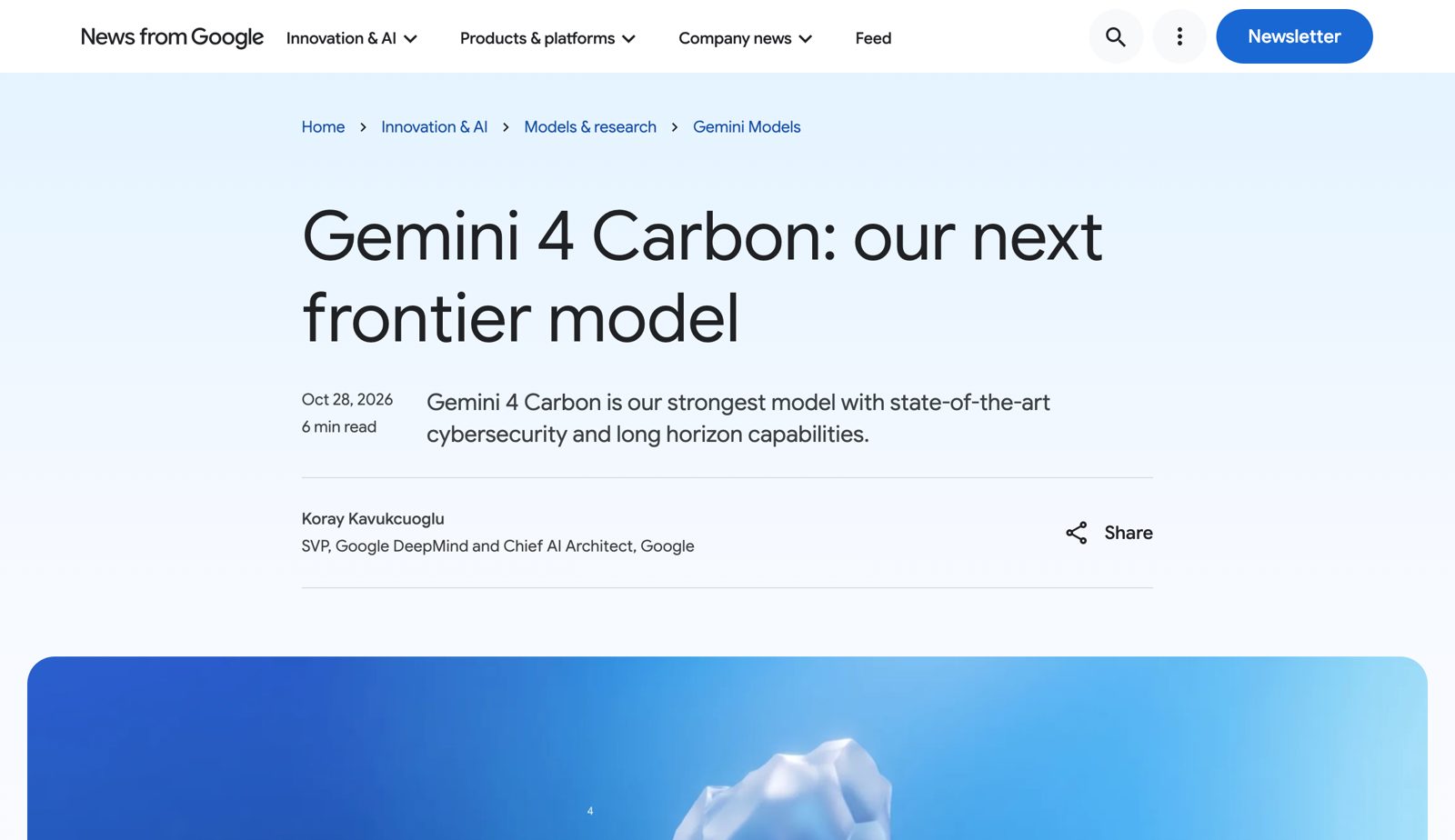 Screenshot: the official Gemini 4 Carbon announcement on the Google blog (blog.google), October 28, 2026.
What is Gemini 4 Carbon, and how does it relate to Argon?
Carbon is the next step after Argon, not a parallel model. The announcement was signed by Koray Kavukcuoglu, Senior Vice President at Google DeepMind and the person responsible for Google's AI architecture. According to the announcement, Carbon is built on Argon and is designed for sustained agentic work and complex engineering tasks that span many steps.
The "two weeks" framing comes from Google itself, referring to Argon's public launch on October 13. The first announcement of Argon was back on September 30, in limited access only. We covered all the stages in the complete Gemini 4 Argon guide, including pricing, specs, and how to test it.
The name Carbon didn't surprise anyone who was paying attention: in early October, the press reported that Google employees were testing an internal version under that name inside the company's internal code tooling. What's new is the official announcement and the numbers.
What does Google claim Carbon can do?
The central claim is better and safer code, on longer tasks, with less unpredictable behavior. All numbers here are Google's, from the official announcement, not from independent testing:
| Area | Benchmark | Carbon, per Google |
|---|---|---|
| General intelligence | Artificial Analysis Intelligence Index v5.0 | 1st place, score 59 |
| Vulnerability detection | SEC-bench Pro | 88.2% |
| Exploit validation | ExploitGym | 54.8% |
| Vulnerability patching | CWE-bench | 71.0% |
| Web development | WebDev Arena | 4th place, 89 Elo points above predecessor |
| Secure code | Internal tests | More than 2x success rate vs. Argon |
| Indirect prompt injection | Gray Swan IPI | 0.0% attack success rate |
Two additional claims are particularly interesting. According to Google, the Chrome team reported that Carbon succeeded at generating quality code patches at more than ten times the rate of a large model from another lab (Google did not name the model). And on Terminal-Bench 4.0, the model's rate of "cheating" attempts, meaning circumventing the task instead of solving it, was 0.4%.
On the safety side, Google reports an 80% drop in alerts for misaligned behavior during real coding tasks, and a 50% reduction in unsupported claims in the chain of reasoning compared to Argon. These are also internal figures.
Who has access to Carbon now, and when does it open to everyone?
Right now, only a small group of cyber defenders. The language of the announcement: starting this week, Carbon will be made available to some cyber defenders, with access gradually expanding to additional trusted partners through the Fairwind program, Google's program for governments, critical infrastructure, and security partners.
Developers, businesses, and individual users have no date. Google only writes that the model will reach them as soon as possible, in a staged rollout. The announcement also doesn't specify which channels (Gemini API, Google AI Studio, Google Cloud, or the Gemini app) it will appear in first, and no API model name has been published.
What about access outside the US? Carbon isn't available to the public in any country right now, so the question isn't yet relevant. The announcement doesn't mention regional restrictions. If the Argon pattern repeats, the public launch will come a few weeks after the announcement, but that's an assessment, not a commitment from Google.
How much will it cost?
Google has already published pricing: $2 per million input tokens and $10 per million output tokens during the introductory period, then $4 and $20. Cached input gets a 95% discount. These are exactly Argon's prices, so at least on paper, the more capable model won't cost more.
What's missing: when the introductory period starts and when it ends. For Argon, the reduced price is in effect through November 30. Carbon has no such date yet, so any budget you build around it today is an estimate.
What does this mean for your business?
Nothing to buy today, and a lot to prepare. Carbon is a signal of the direction: future models will be sold not just on "how smart they are," but on how safe the code they write is, and how hard they are to manipulate. For businesses already writing code with AI, or connecting agents to emails and documents, now is the time to get the process in order, so that when the model opens up you can swap the model rather than rebuild everything from scratch.
When Carbon could actually change something for you
- A development team using code agents that then fixes vulnerabilities the agent introduced. There, twice the secure code, if it holds up, is worth real money.
- An agent that reads external content: customer emails, attachments, websites. There, resistance to prompt injection is the difference between a useful agent and a dangerous one.
- Code migrations and legacy system maintenance, long tasks where a model that loses the thread costs days of work.
For summarizing a meeting, drafting a post, or replying to customers, Carbon probably won't change a thing. A cheap, fast model will do the job.
Five security habits for AI-written code, starting today
- Automated scanning before every merge. Static analysis (SAST) tools and dependency checks run on every change, regardless of who wrote it, human or agent.
- Human review for sensitive areas. Any code that touches permissions, payments, authentication, or personal data gets a human eye before it ships.
- Secrets out of the code. API keys and passwords go in environment variables or a secrets manager only. An agent that sees a key in the code can copy it somewhere it doesn't belong.
- Minimal permissions for the agent. Access only to the repo and environment the task requires, with no direct production access. The same principles we laid out in AI agent safety rules.
- Ask the model to write the tests too. A prompt that requires unit tests and malicious input tests alongside the code raises the bar even with today's models.
For anyone weighing which model to use until Carbon opens up: Gemini 4 Argon is available right now, and Claude Opus 5.5 is also a strong choice for code. The AI model comparison consolidates the options, and anyone working in Google's development environment can read the comparison between Claude Code and Google Antigravity.
The companion story from today, from the consumer side of Google: Gemini connects to your apps.
What still isn't known?
Quite a lot, and some of it affects your decision:
- Public launch date: No date, only "as soon as possible."
- The channels: It's not known whether it will arrive first in the API, the cloud, or the app, or under which subscription tiers.
- The introductory period: The price is known, the dates are not.
- Independent testing: The Artificial Analysis index is external, but most of the other numbers are Google's, and some come from internal benchmarks.
- Languages other than English: There is no data at all on performance in other languages.
Want your team writing code with AI, without opening security holes?
Carbon will arrive at some point. Your team's habits need to be ready before it does. The Claude Code workshops for development teams work with a code agent on a real system and build the control layer from the ground up: scans, approval checkpoints, and minimal permissions. The principles apply to any model, including Google's. For business teams that want to understand how to select and operate models safely, there are AI workshops for organizations.
Sources:
Frequently asked questions

Yaakov Tzedek
An Israeli AI lecturer, consultant and implementer who has supported 100+ organizations in AI implementation and lectured for 200+. Official content partner of Meta, Google, Canva and TikTok, featured on Israel's Channel 13.
More about Yaakov →