- On November 10, 2026, Google opened Gemini 4 Carbon to developers, businesses, and Google AI Ultra subscribers. API pricing is $2 input and $10 output per million tokens through November 30, then doubles on December 1.
According to Google's pricing page, Carbon and Argon cost exactly the same per token, on every plan. The difference in your bill comes from token volume: Google itself notes that Carbon uses more tokens than Argon, so the same task will cost more on Carbon even at an identical per-token rate.
Two weeks ago, Gemini 4 Carbon couldn't be bought at any price. As of yesterday, any paying developer can run it. And the price you see today is half of what you'll pay in 19 days.
On November 10, 2026, Google opened its most advanced model to developers, businesses, and Google AI Ultra subscribers. When we covered the Carbon announcement on October 28, it was reserved exclusively for cyber defenders. Now the question is no longer "when" but which tasks are actually worth paying for.
In short:
- What happened: Google opened Gemini 4 Carbon to paying users on November 10, 2026.
- Who gets it: Developers on a paid Gemini API tier, businesses through Gemini for business, and Google AI Ultra subscribers in the app, in AI Mode, and in Antigravity.
- Who doesn't: Free-tier users, Pro subscribers (they stay on Argon), and the free API tier.
- API pricing: $2 input and $10 output per million tokens through November 30, then exactly double from December 1: $4 and $20.
- What to do: Run a comparison test against Argon on your hardest tasks now, while the experiment is cheap.
Update November 13, 2026: Two days later, Google launched Gemini 4 Hydrogen, the fastest and most affordable model in the series: $1.50 input and $7.50 output per million tokens, available in Search for all users. For everyday tasks, it's worth testing before Carbon. Full details on Gemini 4 Hydrogen.
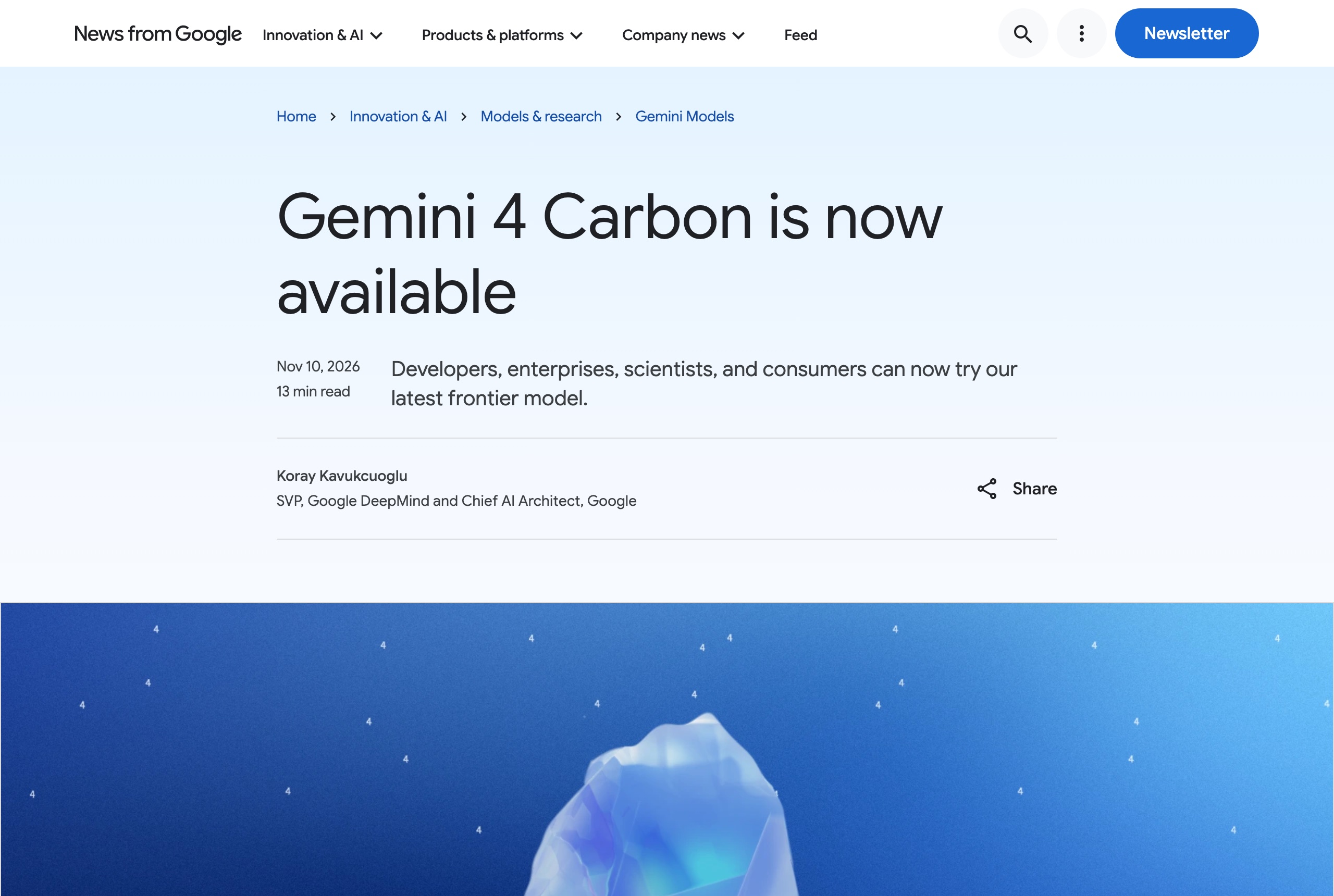 Screenshot: the official Gemini 4 Carbon availability announcement on the Google blog (blog.google), November 10, 2026.
What exactly opened up, and where can you use it?
Carbon is now available in four places, and all of them require payment. The announcement was signed by Koray Kavukcuoglu, Senior Vice President at Google DeepMind and Google's chief AI architect, and the breakdown is as follows:
- The Gemini app and AI Mode in Search: Google AI Ultra subscribers only.
- Google Antigravity (Google's agentic development environment): Ultra subscribers, along with a new preview command,
/swarm, that turns a single prompt into a coordinated agent team you can follow in real time. - Gemini API: On the paid tier, through AI Studio and Android Studio, using the model name
gemini-4-carbon. - Businesses: Through Gemini for business, via the API or the model selector, and also in CodeMender, Google's code security agent.
According to 9to5Google, the app's model selector now shows two models: 4 Argon for code and analysis, and 4 Carbon for "the most complex work." The site also reports that Gemini 3.1 Pro was removed from the app at launch. Google doesn't mention this in its announcement.
What does it cost, and why does December 1 matter?
Through November 30, 2026, the price is $2 per million input tokens and $10 per million output tokens. From December 1 it doubles to $4 and $20. This is stated on the official Gemini API pricing page, which defines the current period as an introductory period.
Three details worth knowing before you start:
- No free tier. Google explicitly states that Carbon is not available on the free tier.
- Thinking tokens are billed. The time the model spends "thinking" counts as output in your bill.
- Batch and Flex at half price: $1 and $5 now, $2 and $10 from December. For tasks that don't need an immediate response, like overnight document processing, that's the difference between an expensive experiment and a reasonable one.
And the detail that gets the least attention: Carbon and Argon cost the same per token, on every tier. But Google itself states that Carbon uses more tokens than Argon. Meaning the same task will cost more. Anyone who swaps Argon for Carbon across the board without measuring will find out in their December bill.
What does Google claim Carbon does better?
The main claims relate to agents, code, and security, and all of them come from Google and its partners. According to the announcement, Carbon ranks first on CursorBench 4.0 (Cursor's coding benchmark), on Perplexity's WANDR, and on Zapier's AutomationBench, with a cost per task more than twice lower than the next external model.
On the security side, Google reports that the model blocked 99% of attack attempts from an automated adversarial agent, and that on Gray Swan's indirect prompt injection benchmark (Indirect Prompt Injection, meaning malicious instructions hidden inside a document or email the agent reads) the attack success rate was 0%. And yet Google itself adds a caveat: resistance to prompt injection "remains an area for ongoing improvement." That's a sentence worth remembering before you give an agent access to your business inbox.
Also worth noting: a small discrepancy. On a new benchmark called MKA, Google's announcement states that Carbon placed second, while 9to5Google quoted a version saying it placed first. The text may have been updated. I'm going by what currently appears on the official blog.
Carbon or Argon: what does this mean for your business?
In most cases, Argon remains the right model. That's not my analysis, it's Google's own framing: Argon "remains the ideal choice for most software engineering and knowledge work tasks," and Carbon is designed for the hardest tasks. If you haven't gotten deeply familiar with Argon yet, the complete guide to Gemini 4 Argon is a good starting point.
Here's what to do now, in three steps:
- Pick 10 to 20 tasks that are failing or struggling today. An agent that loses the thread after many steps, analysis of a long contract, a security review of code. Not tasks that are already working.
- Run them on both Argon and Carbon, and measure two things: whether the result is better, and how many tokens were consumed. Through November 30, this experiment costs half as much.
- Route based on results. Only the tasks where Carbon clearly wins move over to it. Everything else stays on Argon, and it's worth setting a budget alert in your Google Cloud account before December 1.
For individual users the picture is simpler: if you're on a Pro subscription, nothing changed for you today. Ultra is only worth the price if you're genuinely hitting the ceiling of Argon. And if you're still learning how to get the most out of Gemini, the complete Gemini guide will save you a lot of trial and error.
Also today in the leading tools
ChatGPT is retiring the old voice modes on December 11
OpenAI announced on November 10 that it is retiring Advanced Voice and Standard Voice in ChatGPT on December 11, 2026. According to the company, voice usage has nearly doubled, and almost everyone who talks to ChatGPT is already using GPT-Live, the voice model launched in July. My recommendation: if you've built a habit or workflow around the old voice, test that same workflow in GPT-Live now, not on the day the old voice disappears. We covered the model in the GPT-Live guide.
The important exception: live video and screen sharing will continue running on Advanced Voice until GPT-Live supports them, and OpenAI hasn't given a date for that. Source: ChatGPT release notes.
Gemini is coming to Apple CarPlay
On November 11, Google began rolling out the Gemini app for CarPlay, worldwide and in every language where Gemini Live is supported. While driving, you can hold a free-form voice conversation, ask for a summary of unread Gmail messages, check what's on your calendar, and compose a reply by voice. Conversations are saved in the Gemini app on your iPhone so you can return to them after parking.
To make it work you need the latest version of Gemini on iPhone, microphone permission, and at least one prior use of Gemini Live on the phone. Personal features like the daily briefing are not available in European Union countries or for users under 18. Source: Google's announcement.
Want to work with Gemini the right way?
A new model is only worth something if you know how to put it to work on your actual tasks. The Gemini video course in Hebrew includes 54 short lessons covering research, emails, documents, personal assistant use, and working with Google's tools, step by step and with no technical background required.
Sources: Google's announcement on Gemini 4 Carbon availability, Gemini API pricing page, 9to5Google.
Frequently asked questions

Yaakov Tzedek
An Israeli AI lecturer, consultant and implementer who has supported 100+ organizations in AI implementation and lectured for 200+. Official content partner of Meta, Google, Canva and TikTok, featured on Israel's Channel 13.
More about Yaakov →