
- What it is: OpenAI's voice model, built on a full-duplex architecture: listens and speaks simultaneously.
- When: In ChatGPT Voice from July 8, 2026; in the API from September 10, 2026.
- Price: 5 cents per minute for the voice layer, billed per second. The background model and tools are billed separately.
GPT-Live-1 itself is only the conversation layer. When deep reasoning, search, or tool execution is needed, it hands the work off to a background model such as GPT-6 Astra and keeps talking to you while that work runs. That is why the 5-cents-per-minute price is only part of the bill.
Most voice assistants work like this: they wait for you to finish speaking, guess that you're done, and only then start thinking. On September 10, 2026, OpenAI gave developers a model that doesn't wait.
GPT-Live-1 listens and speaks at the same moment. You can interrupt it mid-sentence, pause to think without it jumping in, change direction, and keep going as if there's a real person on the other end. It launched in ChatGPT Voice back in July, and now it's available in the API at 5 cents per minute.
This guide covers everything I've verified against official sources and independent testing: how the architecture works, what the numbers mean, what it actually costs, how to connect it to a phone, and what's still unresolved.
In short
- What it is: OpenAI's voice model, built on a full-duplex architecture: listens and speaks simultaneously.
- When: In ChatGPT Voice from July 8, 2026; in the API from September 10, 2026.
- Price: 5 cents per minute for the voice layer, billed per second. The background model and tools are billed separately.
- The core innovation: Deep reasoning, search, and tool execution are offloaded to a separate background model while the conversation continues.
- The numbers: 30 percentage points above GPT-Realtime-2.1 on Full Duplex Bench, 0.8-second response time, first place on Tau3 with GPT-6 Astra.
- Voices: 12 new ones, in various accents and languages.
- Connections: WebRTC for browsers, WebSockets for servers, SIP for telephony.
- Hebrew: No official statement. Test it yourself before you build.
What is GPT-Live-1?
GPT-Live-1 is OpenAI's voice model that processes incoming and outgoing audio continuously, rather than in turns, which means it can listen and speak at the same time. It handles the conversation itself: pacing, interruptions, pauses, listening affirmations. When it needs to reason deeply, search, or run a tool, it hands the task to a background model and keeps talking in the meantime.
This is a conversational-layer model, not an intelligence model. That distinction is the key to everything else: the pricing, the architecture, and what it can't do on its own.
Three generations of AI voice, in two minutes
To understand why this is new, it helps to see what came before. OpenAI itself describes three approaches:
| Generation | How it works | The problem |
|---|---|---|
| Cascaded | Speech recognition, then a language model, then speech synthesis | Every handoff adds latency and loses information. Responses are slow and fragmented |
| Turn-based | One model processes and generates audio, but in separate turns | It has to wait for you to go silent. A short pause or background noise counts as "end of turn," and it cuts in at the wrong moment |
| Full-duplex (GPT-Live) | One model processes input and generates output continuously | It makes decisions multiple times per second: speak, listen, pause, interrupt, run a tool |
The original ChatGPT Voice was cascaded. Advanced Voice Mode was turn-based. GPT-Live is the third generation.
From ChatGPT to the API: the timeline
July 8, 2026: OpenAI launched GPT-Live in ChatGPT Voice, in two versions: GPT-Live-1 and GPT-Live-1 mini. According to the company, more than 150 million people speak with ChatGPT every week through voice and dictation. At the same time, users received three reasoning levels: immediate, medium, and high, with GPT-5.5 running behind the scenes.
July 31, 2026: Audio generated with GPT-Live received a SynthID watermark, with a public verification tool and an API for checking origin.
September 10, 2026: The API launch, with capabilities built for developers: routing reasoning to a model of your choice, controlling tone and pace through the system prompt, built-in transcription, keyword boosting, turn detection for those who need it, and telephony.
Watch the official videos
Building with ChatGPT Voice
OpenAI · July 23, 2026
OpenAI gave ME early access to the new ChatGPT voice model (GPT-Live-1)
FatherPhi · July 8, 2026
BREAKING: GPT-Live-1 Is in the API at 5¢ a Minute, I Interrupted It Mid-Call
Hyperautomation Labs · September 11, 2026
The architecture: a voice layer and a background model
The central idea in the API is a separation between two layers. The front layer is GPT-Live-1: it listens, speaks, and decides when to hand off work. The back layer is the model and tools you choose: that's where reasoning, search, and tool execution happen.
According to OpenAI, you can pair a fast, inexpensive model for high-volume tasks like appointment coordination and order updates, and a reasoning model like GPT-6 Astra for complex problems. You can also connect a model from a third-party provider. The handoff happens through two paths: managed by OpenAI (Responses delegation), or managed on your side (client delegation), where your application receives the context, runs whatever is needed, and returns a response to the voice layer.
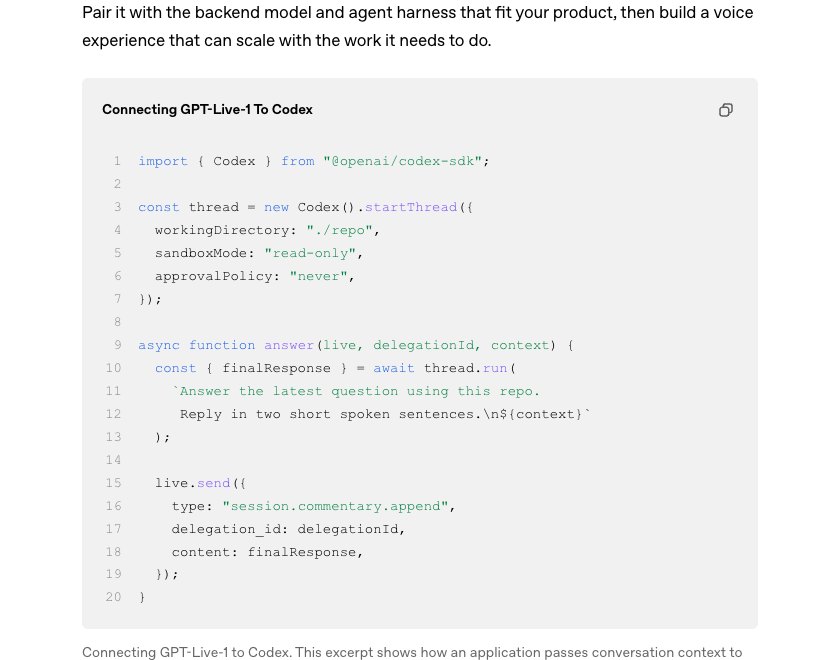
Credit: OpenAI
The business outcome of this separation appeared in a quote from the CTO of a healthcare company, Tony Stoyanov, in the launch announcement: switching from a cascaded architecture to GPT-Live-1 "simplified the codebase by 80% and removed 23,000 lines of code."
The numbers: GPT-Live-1 vs. GPT-Realtime-2.1
OpenAI published benchmarks comparing the new model to GPT-Realtime-2.1 and GPT-Realtime-2. These are the vendor's own launch metrics, so treat them as a starting point rather than a final verdict.
| Benchmark | What it measures | GPT-Live-1 | GPT-Realtime-2.1 |
|---|---|---|---|
| Tau3 (Voice) Intelligence | Spoken customer-service tasks in aviation, retail, and telecom, with GPT-6 Astra as the background model | 86.2% | 45.7% |
| Full Duplex Bench v1.5 Interactivity | Responding to background speech, speech directed at another person, listening affirmations, and interruptions | 80.1% | 45.4% |
| Turn-taking latency | How quickly the agent begins responding after the user finishes speaking | 0.798 seconds | 1.41 seconds |
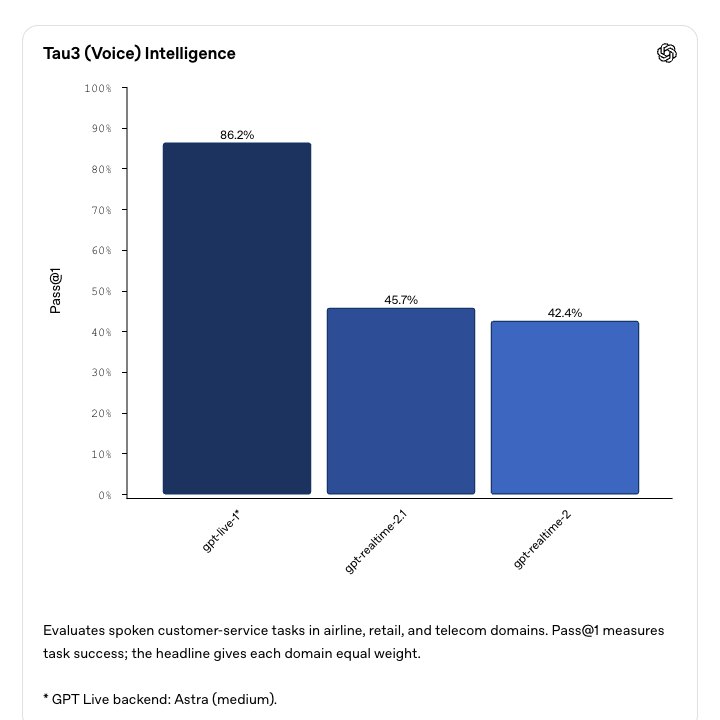
Credit: OpenAI
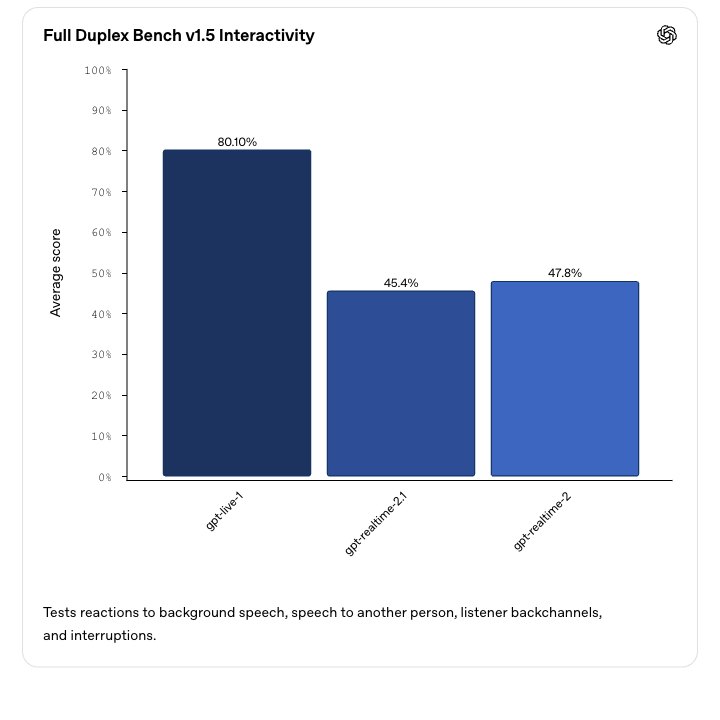
Credit: OpenAI
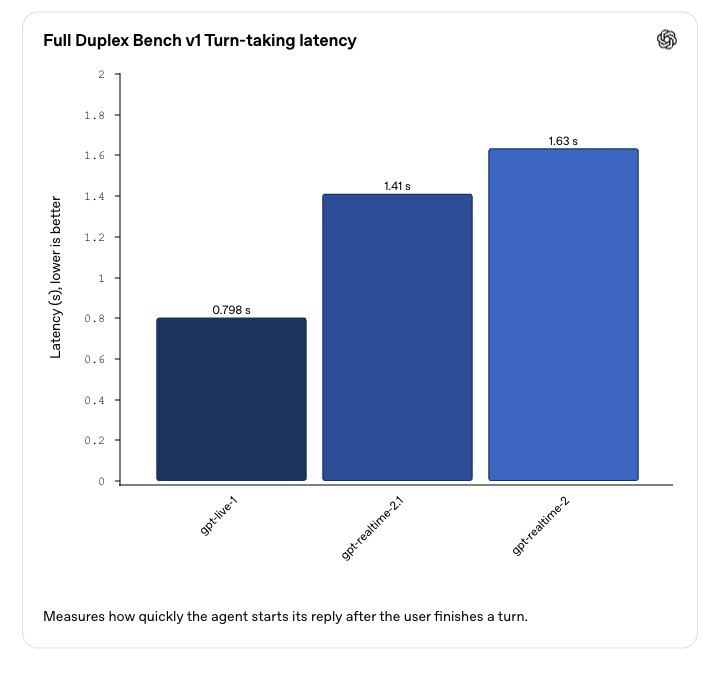
Credit: OpenAI
On the tool-calling benchmark (Full Duplex Bench v3), which tests spoken requests with pauses and self-corrections, OpenAI reports 87% success on tool call ordering.
Note the asterisk at the bottom of the Tau3 benchmark: the result is achieved with GPT-6 Astra at medium reasoning in the background. The voice model alone doesn't get there, and that's precisely the point.
What early customers are reporting
- Speak, the language-learning app, found in early evaluations that the model gives learners more time to think before the tutor responds, and that interruptions dropped by nearly 80% compared to the previous turn-based system.
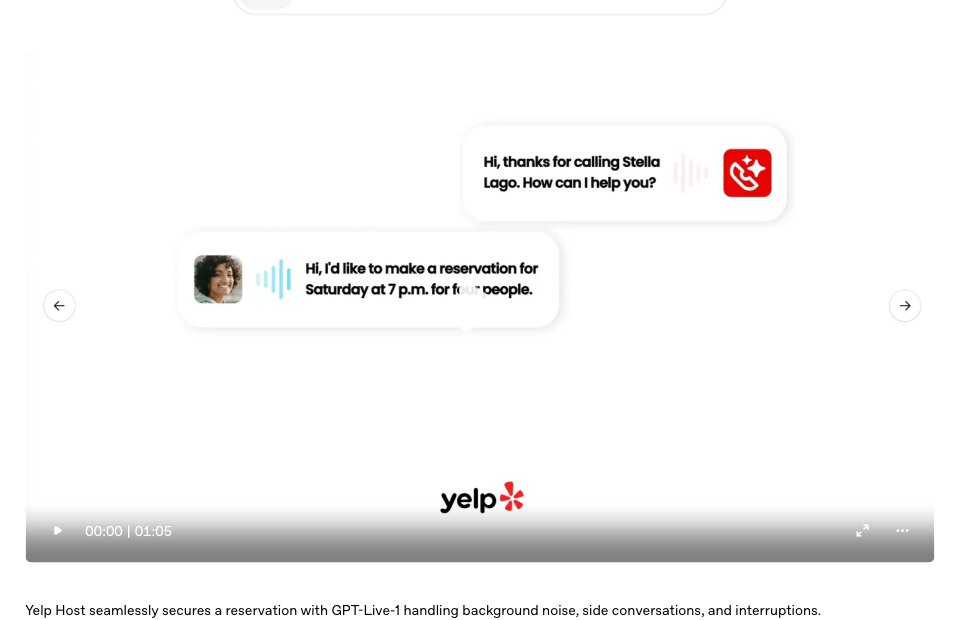
- Yelp Host, which answers phone calls for restaurant and venue reservations, reported according to CTO Alex Levy an improvement in call handling, with callers speaking in fuller, more natural sentences.
- Intercom's Fin and Cognition's Devin also appear on the list of early users, alongside Picsart and HeyGen.
Credit: OpenAI, Yelp
12 new voices
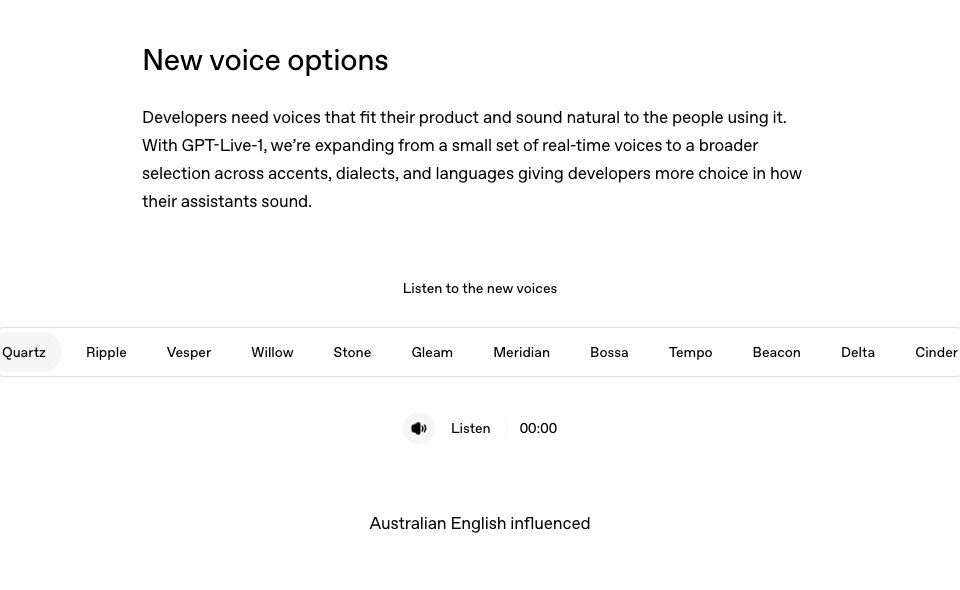
Until now the API offered only a small number of real-time voices. With GPT-Live-1, OpenAI expanded the selection to 12 voices in various accents, dialects, and languages: Quartz, Ripple, Vesper, Willow, Stone, Gleam, Meridian, Bossa, Tempo, Beacon, Delta, and Cinder. According to the company, voice and language options will continue to expand in the coming months. Custom brand voices are available through the sales team only.
Credit: OpenAI
How to connect: browser, server, and phone
According to the documentation, the model works through a dedicated endpoint, v1/live/sessions, not through Chat Completions or Responses. Three connection methods:
- WebRTC for browser applications: media channels carry the audio, and a data channel carries the events.
- WebSockets for server-side integrations.
- SIP and telephony for agents that answer phone calls.
A basic session configuration includes the model name gpt-live-1, the modality (audio and text), and the conversation prompt, where you define style, tone, pace, and when to hand work off to the background model.
The concurrent session limit depends on your account tier: 25 for tier 1, 50 for tier 2, 200 for tier 3, 300 for tier 4, and 500 for tier 5. The model's knowledge cutoff date: July 31, 2025.
Credit: OpenAI
What it actually costs
5 cents per minute covers the voice layer only. Billing is per second, with no rounding up to the nearest whole minute, which is good for short calls. But every reasoning call made in the background model, every search, and every tool execution is billed separately, based on that model's token pricing.
A sample calculation for a small contact center:
- 1,000 calls per month, 4 minutes average: 4,000 minutes.
- Voice layer: $200.
- Background model: depends on how many calls require reasoning, and which model you use. An order confirmation call costs almost nothing. A call that requires searching a knowledge base and three tool executions costs more.
An independent review published this week raised a point worth keeping in mind for customer service: billing is by call duration, not by resolved issue. An agent that stretches conversations drives up your monthly bill, even if it's very pleasant to talk to.
What independent testing found
The official announcement tells half the story. Here's what came up in developer and reviewer testing in the first few days:
What worked:
- Turn management genuinely changed. One reviewer wrote that this is the first voice model where he stopped consciously managing when to speak and when to listen.
- Switching languages mid-response worked well in one test, during French language practice.
- Code savings: teams that replaced a cascaded architecture report meaningful reductions in codebase size.
What didn't:
- Without a background model, responses can be shallow. One commenter summed it up: the model isn't particularly smart on its own, it needs to offload the thinking.
- Too many filler sounds. Users reported excessive "hmm" and "uh-huh," and a habit of restating what you just said after every response, which gets tiring over time.
- No built-in business context. The model doesn't know your return policy or your ticketing system. Everything comes through the background model and tools.
GPT-Live-1 and Hebrew
OpenAI has not published a list of supported languages for the API. Regarding GPT-Live in general, the company states that the model has been optimized for the languages most commonly used in ChatGPT, and that some languages may have an unnatural accent or fluency gaps that OpenAI is working to improve.
Before building a voice agent in Hebrew, here are four tests I recommend running on real conversations:
- Names and numbers: ID numbers, order numbers, addresses. The model offers "keyword boosting" precisely for this.
- Background noise: A call from a car or an open-plan office.
- Interruptions: Does it actually stop when interrupted in Hebrew, not only in English.
- Accent: Does the voice sound like a Hebrew speaker, or like a tourist.
Who This Is Right For, and Who It Isn't
| A good fit | Less suitable |
|---|---|
| Phone agents for scheduling, orders, and status updates | Scenarios where every second of conversation costs money and there is no way to shorten it |
| Language learning and conversation practice | Agents that require deep business knowledge without building a background layer |
| In-app and in-software voice assistants | Organizations that need a branded voice without going through the sales team |
| Replacing an existing chained architecture that suffers from latency | Languages that have not yet been tested on real conversations |
What This Means for Your Business
The gap between "voice assistant" and "voice agent" closed this week, and anyone running a call center, even a small one, needs to ask one question: which of our calls are repetitive, short, and based on known information? Appointment confirmations, order status, opening hours, routing. Those are the first calls worth testing on this model, because that is where the cost is low and the risk is small.
The right order: first a background layer that knows the business (a knowledge base, tools, policy rules), and only then the voice layer. Anyone who starts with the voice gets an agent that sounds great and knows nothing. A practical guide to building that layer in Hebrew: AI customer service agent in Hebrew. And anyone who wants to understand the background model behind the best numbers will find it in the GPT-6 Astra guide.
The Bottom Line
GPT-Live-1 did not make AI smarter. It made conversations with it more natural, and moved the reasoning somewhere else. That is the right separation, and it is also the reason the price of 5 cents per minute is only the beginning of the bill. Someone who builds correctly, with a background model that knows the business, gets for the first time a phone agent that can be interrupted mid-sentence. Someone who connects only the voice layer gets a very pleasant conversation with someone who knows nothing.
Sources
- API launch announcement: Build more natural voice experiences with GPT-Live-1 in the API, OpenAI, September 10, 2026
- Introducing GPT-Live, OpenAI, July 8, 2026
- Model page in the developer documentation: gpt-live-1
- Announcement in the OpenAI developer community
- Independent review: GPT-Live-1 review, eesel AI
Frequently asked questions

Yaakov Tzedek
An Israeli AI lecturer, consultant and implementer who has supported 100+ organizations in AI implementation and lectured for 200+. Official content partner of Meta, Google, Canva and TikTok, featured on Israel's Channel 13.
More about Yaakov →