- Google launched Gemini 4 Hydrogen on November 12, 2026: a fast, affordable model for everyday tasks and agents, now live in Google Search, the Gemini app, and the API at $1.50 input / $7.50 output per million tokens.
According to Google, Hydrogen beats Gemini 4 Argon on the Artificial Analysis Intelligence Index (51 vs. 50) at default settings, and reaches 54 at the highest thinking setting. In other words, the new 'fast and affordable' model scores at the level of last month's flagship.
Google's new model isn't its most powerful. It's the one most people will encounter this week, often without realizing it. As of yesterday, everyone searching on Google is getting answers from it.
On November 12, 2026, Google launched Gemini 4 Hydrogen, the fast and affordable model in the Gemini 4 lineup. While Gemini 4 Carbon is built for the hardest tasks and priced accordingly, Hydrogen was designed for everyday work: questions, code, spreadsheets, and agents. And it didn't stay in the lab: on day one it went live in Search, the app, and the API.
In short:
- What happened: Google launched Gemini 4 Hydrogen on November 12, 2026, a fast, cost-efficient model for everyday work and agents.
- Where: In Google Search for all users worldwide, in the Gemini app, in the API and AI Studio, in Antigravity, and in Google Sheets for Pro and Ultra subscribers.
- Pricing: $1.50 input and $7.50 output per million tokens, with a one-million-token context window.
- What Google claims: 2.5x faster than Gemini 3.8 Flash, over 5x fewer hallucinations, and a score on an independent benchmark above Argon.
- What to do: Run your everyday tasks on it, the ones you're currently paying for with a more expensive model, and audit your site's content against the new Search experience.
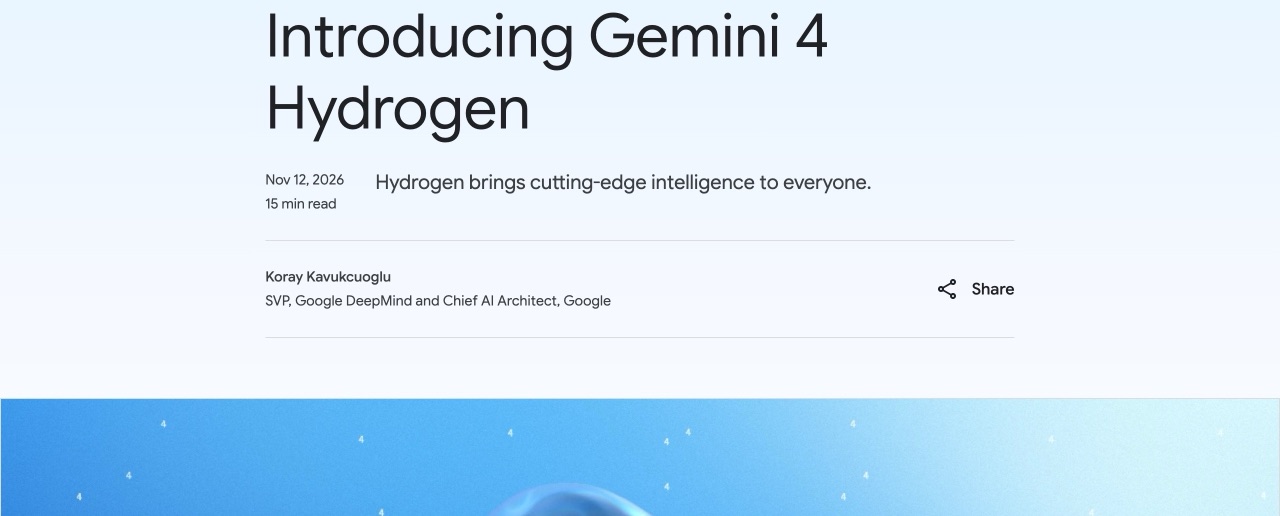 Screenshot: the official Gemini 4 Hydrogen announcement on the Google blog (blog.google), November 12, 2026.
What exactly did Google launch, and where is it already running?
Hydrogen is the workhorse of the Gemini 4 family. In the official announcement, Koray Kavukcuoglu, Senior Vice President at Google DeepMind and Google's chief AI architect, describes it as a model that brings "advanced intelligence to everyone," with the speed and efficiency needed for code and agents. Carbon and Argon remain the models for deep, long-form reasoning. Hydrogen was built to move fast.
Availability at launch is broader than usual:
- Google Search: for all users, worldwide, in every language where AI Mode is supported.
- Gemini app: in the model picker. Free users will receive it via automatic model selection, when the system decides it fits the query.
- Developers: Gemini API and Google AI Studio across all tiers, plus Android Studio.
- Businesses: Gemini for business, via the API or the model picker.
- Google AI Pro and Ultra subscribers: in Antigravity, Google's agent development environment, and in Gemini in Google Sheets.
What does it cost, and why does that number matter?
$1.50 per million input tokens and $7.50 per million output tokens, at a flat rate across the full context window. The window itself is massive: one million tokens on input and up to one million tokens on output. There are four thinking levels: low, medium, high (the default), and a new level called xhigh.
The interesting comparison is with Carbon. As I wrote yesterday, Carbon is priced at $2 and $10 through the end of November, then $4 and $20 from December 1 onward. That means from December, Hydrogen is roughly 2.7x cheaper than Carbon, on both input and output. If you have an automated pipeline running thousands of times a day, that difference is what separates an experiment from a product that pays for itself.
What does Google claim it does better?
All of these numbers come from Google, and independent benchmarks at scale don't exist yet. That said, a few figures are worth knowing:
- Speed: completes tasks 2.5x faster than Gemini 3.8 Flash at default settings.
- Accuracy: more than 5x fewer hallucinations compared to 3.8 Flash.
- Terminal code: 57% on Terminal-Bench 4.1, versus 18.2% for 3.8 Flash.
- General level: 51 on the Artificial Analysis Intelligence Index versus 50 for Gemini 4 Argon, and 54 at the highest thinking level.
- With partners: 2x to 2.8x faster, with 12% to 23% fewer tokens, compared to 3.8 Flash.
- In Google Sheets: over 30% faster than previous models.
The bottom line: if the numbers hold up, a model from the affordable tier is reaching the level of last month's flagship. Test it on your own tasks, not on Google's charts. A full comparison of leading models is available in the guide to top AI models.
What changes in Google Search?
Google is calling this "the biggest model upgrade to Search to date." That's how Robby Stein, Vice President of Product for Google Search, put it. Search now handles multi-part questions, typos, and highly specific requests better than before, and returns more images, comparison tables, and tools built specifically for the query.
The change that matters most for site owners is called query fan-out: the model breaks a question into sub-topics and runs searches on them in parallel. According to Google, Hydrogen strengthens this approach and connects users to "a wider range of links," including sites they wouldn't have reached before.
What does this mean for your business?
If you have a website: a page that tries to answer everything loses to a page that answers one sub-question extremely well. Identify the five questions your customers ask most often and make sure each one has a clear, direct answer somewhere on your site. That's exactly what the GEO guide covers, and this week it became more urgent.
If you run automations or agents: take your recurring tasks (summaries, inbox triage, data extraction, minor code updates) and run them side by side on Hydrogen and on whatever model you're using today. If the output is comparable, the savings are immediate.
If you develop in Antigravity: there's a new option in the picker called Orchestrator. Carbon plans, Hydrogen writes and runs tests, and returns to Carbon only when it gets stuck. According to Google, this achieves a success rate close to Carbon's, with 24% less quota consumption and 19% faster completion. Ultra subscribers get Orchestrator with Carbon and Argon; Pro subscribers get it with Argon only. I covered the differences between Antigravity and Claude Code here.
Also today in the leading tools
Claude Meetings opens in beta, currently Google Meet only
Two days ago I wrote that Claude Meetings was "coming soon." On November 12, Anthropic announced it is rolling out in beta for Team and Enterprise plans. Claude joins the call as a visible participant, announces itself in the meeting chat, saves a transcript, a summary, and a description of what was shown on screen (no audio recording), and builds documents and whiteboards during the meeting. By default it doesn't join calls that include guests from outside the organization, and it leaves if such a guest joins mid-call.
Only Google Meet is supported for now, with more platforms "coming soon." On Team it's active by default; on Enterprise an admin enables it. Notes and transcripts are free during beta, and documents and whiteboards created in a meeting are free through February 10, 2027. It's not available in beta for organizations with ZDR, HIPAA, or CMEK. Source: the Anthropic announcement. For the whiteboards and sheets it builds, see the guide to Claude Whiteboards and Sheets.
Claude for Manufacturing: a plugin with 17 skills for factories
On the same day, Anthropic launched Claude for Manufacturing, a plugin with 17 skills and four connectors: Autodesk Fusion, Infor, Microsoft 365, and Oracle NetSuite. It drafts quotes, quality reports, and corrective actions; diagnoses faults from sensor data, maintenance notes, and images; and compares supplier bids. Every skill ends with a human review, and the company is explicit that it does not operate equipment.
It's available for Team and Enterprise plans: install the plugin and tell Claude "Set us up." For an Israeli manufacturer working with NetSuite or Microsoft 365, this is a ready-made entry point rather than building from scratch. Source: the Anthropic announcement. How plugins and connectors work in general is explained in the guide to Claude plugins and connectors.
Claude Managed Agents can now run on your own servers
Anthropic's agent-hosting service, Claude Managed Agents, opened on November 12 in a self-hosted version as well, in private beta. The organization runs the server, the database, and the environments where agents operate, and credentials and history stay on-premise. The model itself still runs at Anthropic or at a provider of your choice, such as Amazon Bedrock or Microsoft Foundry.
This is primarily relevant for banks, insurers, and organizations whose security policies don't permit cloud-hosted agents with a third-party vendor. Scheduling and webhooks are not yet available, and nothing carries over from the managed version. Access is requested through the Anthropic account team. Source: the Anthropic announcement.
Want to get the most out of Gemini?
A faster model is only worth something if you know how to put it to work on your actual tasks. The Gemini video course in Hebrew includes 54 short lessons covering research, emails, documents, personal assistant use cases, and working with Google's tools, step by step, no technical background required. For more on the tool itself, see the complete Gemini guide.
Sources: Google's Gemini 4 Hydrogen announcement, the Google Search upgrade, Hydrogen and Orchestrator in Antigravity, Claude Meetings, Claude for Manufacturing, Self-hosted Claude Managed Agents.
Frequently asked questions

Yaakov Tzedek
An Israeli AI lecturer, consultant and implementer who has supported 100+ organizations in AI implementation and lectured for 200+. Official content partner of Meta, Google, Canva and TikTok, featured on Israel's Channel 13.
More about Yaakov →