- Google announced Gemini 4 Argon on September 30, 2026, and opened it to the Gemini app, the API, and Google Cloud in mid-October. Who gets access, what it costs ($2 input and $10 output per million tokens through November 30), what the specs are, and how to test it on your own tasks.
Argon can generate up to one million tokens of output in a single response, in a mode Google calls long decode. In standard mode the ceiling is 65,536 tokens, the same as most models. That's the difference between a model that summarizes a codebase and one that can rewrite it in a single run.
Gemini 4 Argon is Google's advanced reasoning model, and since mid-October 2026 it is no longer limited to a closed group: Google AI Pro and Ultra subscribers get it in the Gemini app, while developers and organizations get it through the API and Google Cloud. The discounted price of $2 per million input tokens and $10 per million output tokens is valid through November 30.
Google announced Argon on September 30. Two weeks later it moved from a select group of cyber defenders to all Pro subscribers. That is not the interesting part. The interesting part is that the price doubles in five weeks, and anyone who wants to know whether Argon is worth it for their business needs to test it now.
Update October 29, 2026: On October 28, Google announced the next model, Gemini 4 Carbon, built on top of Argon and presented as stronger in code and cybersecurity. Carbon is not yet publicly available: access for now is limited to selected cyber defenders in the Fairwind program, so Argon remains Google's most advanced model you can actually use today. Full details in the article on Gemini 4 Carbon.
In short:
- What it is: Google's advanced model for complex code, mathematics and science, and autonomous agents.
- Announced: September 30, 2026, initially only through the Fairwind program for cyber defenders.
- Available from October 13: The Gemini app (Pro and Ultra), the paid Gemini API, AI Studio, Android Studio, and Antigravity.
- Available from October 14: Google Cloud, including Gemini for Business and Gemini Enterprise.
- API pricing: $2 input and $10 output per million tokens through November 30, then $4 and $20.
- Standout feature: Output of up to one million tokens in a single response (long decode).
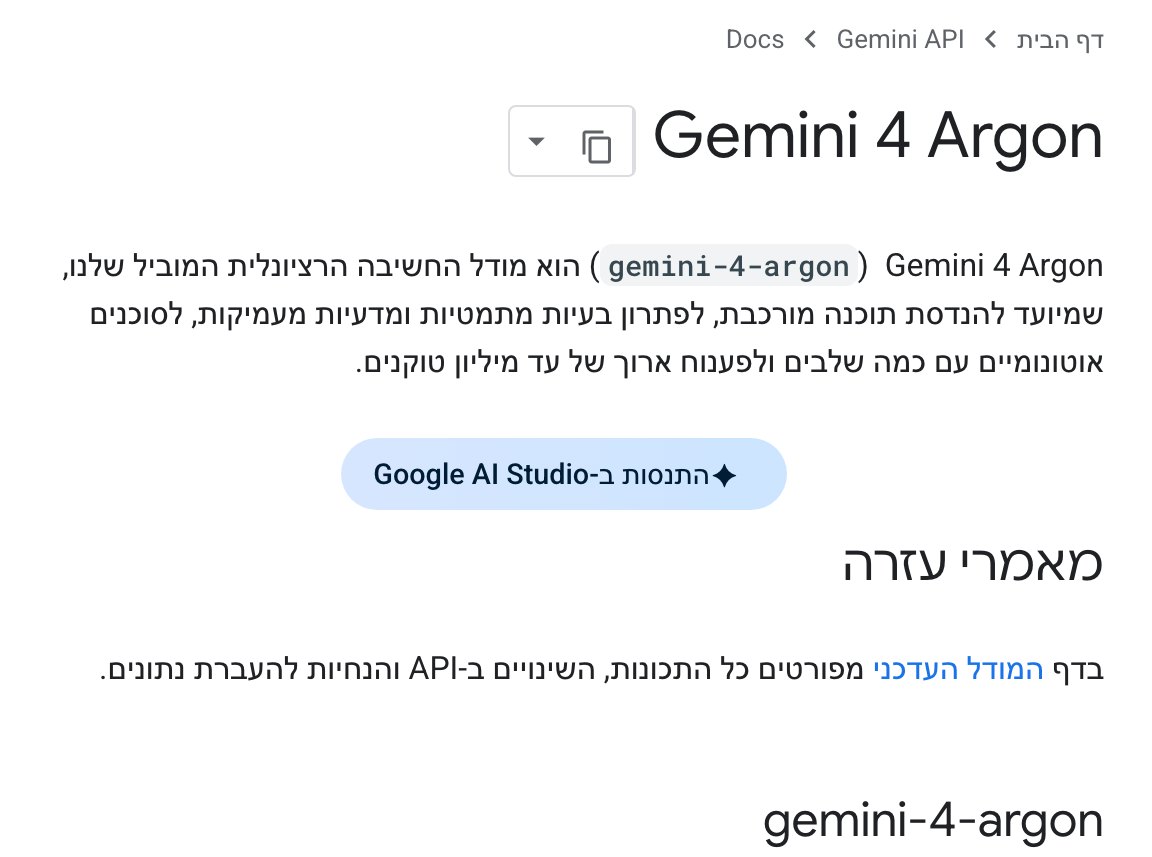 Screenshot: The Gemini 4 Argon model page in Google's Gemini API documentation (ai.google.dev), shown in Google's Hebrew translation.
What is Gemini 4 Argon?
Argon is the model Google built for long, complex work, not for quick conversation. According to the official model page, it is designed for complex software engineering, deep mathematics and science problems, and autonomous agents operating across multiple steps. The launch announcement adds enterprise knowledge work and cyber defense.
Technical specifications from the documentation:
| Feature | Gemini 4 Argon |
|---|---|
| API name | gemini-4-argon |
| Context window | 1,048,576 tokens |
| Standard output | Up to 65,536 tokens |
| Output with long decode | Up to 1,048,576 tokens |
| Input | Text, image, video, audio, PDF |
| Output | Text only |
| Thinking levels | low / medium / high |
| Tools | Function calling, code execution, search, Google Maps, computer use (preview) |
Two things are absent: no image or audio generation, and no Live API. Caching also works only automatically (implicit), with no option to manage it manually.
What does Google claim it can do?
The main claim is sustained long-form work without losing the thread. In the launch announcement, Google reports 77.9% on DeepSWE v1.1 (real-world software engineering tasks), 51.3% on AutomationBench (end-to-end business process execution), and 91.7% on LVBench (long video understanding). On CWE-bench v1, which tests security vulnerability patching, it reports 68% and a shared first place.
The internal examples are more interesting than the numbers. According to Google, Argon helped migrate more than 800,000 lines of Fuchsia OS kernel code to Rust and reclaim more than 300 terabytes of memory across its data centers. These are figures from the company itself, not independent verification.
On the security side, Google Cloud reports that the success rate of indirect prompt injection attacks against Argon is just 0.7%, measured on the Gray Swan benchmark. For anyone connecting an agent to customer emails or documents, that is the number to keep in mind.
Who can use Argon today, and how?
The path depends on who you are: an individual user, a developer, or an organization. Here is the picture as of October 23, 2026:
- Gemini app: From October 13, for Google AI Pro and Ultra subscribers. Select the model from the model picker. According to Google, responses are more direct, with fewer hedges and less repetition.
- Developers: From October 13, in the paid tier of the Gemini API, through Google AI Studio, Android Studio, and Google Antigravity (Google's agentic development environment). Ultra subscribers can also work with it in AI Studio.
- Organizations: From October 14, in Google Cloud: Gemini for Business (web, desktop, and mobile) and the Gemini Enterprise platform via the API.
- Cyber defenders: A version without cyber restrictions, reserved for approved entities in the Fairwind program (governments, critical infrastructure, and security partners). In the standard version, the model blocks offensive tasks such as penetration testing and vulnerability exploitation.
If you are new to Gemini, the complete Gemini guide explains the subscription plans, the app, and the differences between models.
How much does it cost, and why does November 30 matter?
Through November 30, 2026, Argon costs $2 per million input tokens and $10 per million output tokens. From December 1 the price doubles: $4 input and $20 output. Cached input gets a 95% discount, so an agent that repeatedly reads the same instructions and the same codebase pays significantly less.
This is already the second story this year where Google's price doubles after an introductory period. In the Gemini 3.8 Flash story, the rate doubles on January 1, 2027. In other words, any budget you build on today's pricing will go stale fast.
In the app there is no separate charge: Argon is included in the Pro or Ultra subscription.
How does Argon compare to GPT-6.1 Sol and Claude Opus 5.5?
On price and specs, comparison is straightforward. On quality, proceed with caution. The table is based on official figures each company published, as summarized in our reviews of GPT-6.1 Sol and Claude Opus 5.5:
| Gemini 4 Argon | GPT-6.1 Sol | Claude Opus 5.5 | |
|---|---|---|---|
| Input per million tokens | $2 (through 30.11), then $4 | $2 | $4 |
| Output per million tokens | $10 (through 30.11), then $20 | $10 | $20 |
| Context window | 1,048,576 | ~1,050,000 | See review |
| Max output | 65,536, up to one million with long decode | 128,000 | See review |
At the introductory price, Argon costs exactly the same as Sol. After November 30 it will cost exactly the same as Opus 5.5.
On quality: according to an Engadget report, Argon matches GPT-6 Astra on an aggregate intelligence benchmark, edges out GPT-6.1 Sol by one point, and shows a significantly lower measured hallucination rate. These are external benchmarks reported in the press, not our own testing. What actually matters is how it performs on your tasks.
What does this mean for your business or organization?
Argon is worth the price only when the task is long, multi-step, and costly to get wrong. Code migration, analysis of lengthy legal or financial documents, an agent working an hour on a process, research that requires deep reasoning. For meeting summaries, customer replies, or drafting a post, a fast and cheap model will do the job at a fraction of the cost.
A three-step evaluation plan
- Choose three real tasks. One routine, one complex, and one that your current model fails on. Not examples from the internet, tasks from your actual work.
- Run them on Argon and on the model you use today. Same prompt, same files. Record quality, time, and token cost. AI Studio shows the token count for every run.
- Calculate the cost at December pricing, not today's. If Argon only justifies itself at the introductory price, it does not justify itself.
Questions about data and privacy
Before feeding in client documents, clarify three things:
- Which channel are you using? The consumer app, the paid API, and Google Cloud are subject to different terms regarding data use. Read the terms for the channel you choose.
- Where is the data processed? Google Cloud lists the region as Global. If you have a data-residency requirement for Israel or Europe, check with the Google team before you start.
- Who in your organization approves what goes into the model? An agent with access to emails and documents needs clear rules, even when the model is more resistant to prompt injection.
And on the same day Google opened Argon in its cloud, it also started offering competitor models there. That is the companion story from that day: OpenAI models on Google Cloud.
What is still unknown?
Several important things have not been published yet, or have only been published in part:
- Usage limits in the app: Google did not state in the announcement how many Argon queries a Pro subscriber gets versus an Ultra subscriber.
- Knowledge cutoff date: The model page does not specify how recent the model's knowledge is.
- Performance in Hebrew: No official data exists, which makes testing on your own Hebrew-language tasks especially important.
- Full independent evaluation: Most published benchmarks come from Google itself, and external benchmarks have only been reported in the press.
- Future pricing: Only the post-November 30 price is known.
Want to learn how to choose and deploy models like this in your organization?
Argon is a tool, not a strategy. Deciding which model runs which task, what it costs, and how to work with it safely, that is the real work. In my workshops we do exactly that, on your team's actual tasks: in AI workshops for organizations for business teams, and in Claude Code workshops for development teams that want to work with agents on real code. If you prefer hands-on guidance, there is also AI consulting and implementation.
Frequently asked questions

Yaakov Tzedek
An Israeli AI lecturer, consultant and implementer who has supported 100+ organizations in AI implementation and lectured for 200+. Official content partner of Meta, Google, Canva and TikTok, featured on Israel's Channel 13.
More about Yaakov →