- Google DeepMind announced Genie 4 on October 27, 2026: a world model that generates real-time interactive environments with built-in sound, letting you change weather, camera angle, and characters mid-simulation using plain text commands. Currently a preview for authorized testers only, with a waitlist.
According to the official Google DeepMind post, while Genie 4 generates the world, a separate model, Gemini 3.8 Flash, watches the scene, breaks goals into steps, and checks every frame to confirm each step succeeded. In other words, there is a kind of internal director inside the simulation, making sure the world does not fall apart between one command and the next.
Google showed a Japanese train station from the 1980s, and someone simply walked into it. He strolled along the platform, turned the camera, typed "announce the next train," and the inspector standing in front of him started speaking. This was not a pre-generated video. It was a world built in real time, responding to whoever was inside it.
In short:
- What was announced: Genie 4, a new world model from Google DeepMind, on October 27, 2026.
- What it does: Generates a navigable world in real time using keyboard controls, with sound produced alongside the image, including character speech.
- The core innovation: You can modify the simulation mid-session with a text command: weather, camera angle, a new character or object.
- Availability: Research preview for authorized testers only. Later, for Google AI Ultra subscribers via Project Genie and early-access Gemini API partners. No date.
- The limitation worth knowing: Consistency holds up well in short sessions and degrades in longer simulations.
What is Genie 4, and how is it different from an AI video?
Genie 4 is a "world model": a model that does not produce a finished video clip, but simulates a world and responds to what you do inside it. According to DeepMind's official post, users in the demos navigate with standard keyboard keys, control the camera, and type text commands that direct the scene as it unfolds.
The difference from a video generator like Google's Veo is straightforward: in Veo you write a description and receive a clip of a few seconds that is fixed from beginning to end. In Genie 4 there is no fixed ending. What happens in the next second depends on what you do right now.
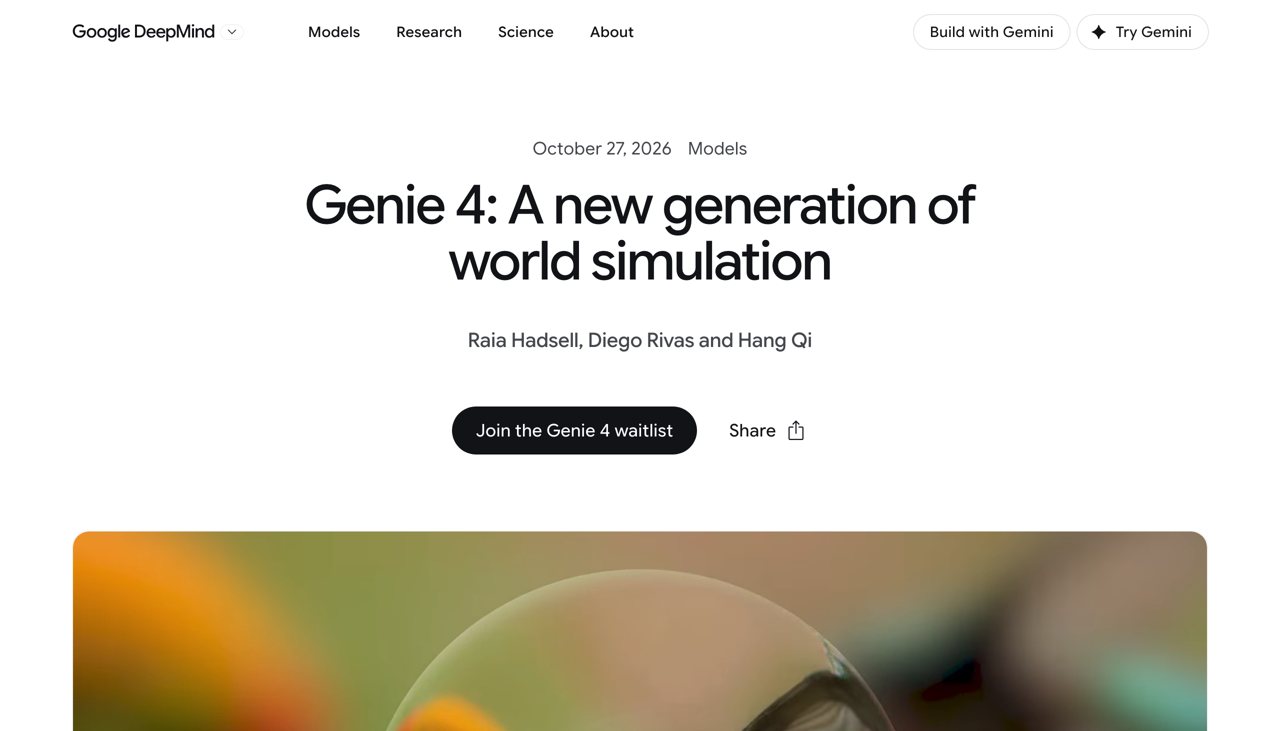 Screenshot: the official Google DeepMind post about Genie 4, October 27, 2026
The idea of world models is not new. We wrote about it when Runway introduced Solaris, and Google itself unveiled Genie 3 in August 2025. What changed in Genie 4 is the level of realism, the sound, and the ability to reshape the world with words without stopping it.
What four new capabilities is DeepMind presenting?
DeepMind divides its progress into four areas. All of them are demonstrated in the post through recordings of real usage in real time, with the keyboard interface visible in the corner of the screen:
- Editing the world in real time. You type in natural language "change the weather," "move the camera," or "add a new character," and Gemini maps the command onto the existing scene. Between commands, Gemini also monitors the world to keep it advancing consistently.
- More realistic physics and people. According to the company, the model simulates physical scenarios including aerodynamics and collisions. The biggest leap, they say, is in people: characters that move naturally, respond to their surroundings, and can be directed on the fly.
- Built-in sound. This is DeepMind's first world model that generates its own sound in real time: wind, waves, music, and dialogue. Characters speak and respond to what you type.
- Complex events with Gemini. While Genie 4 generates the world, Gemini 3.8 Flash acts as a guiding agent: it breaks a goal into steps, watches the frames, and checks that each step succeeded.
 Credit: Google DeepMind. Frame from an official demo: a text command typed while the simulation is running
 Credit: Google DeepMind. Short clip from an official demo
In a comparison the company published between Genie 3 and Genie 4 on the same scene, the difference in realism is visible to the eye, especially in lighting and detail:
 Credit: Google DeepMind. Genie 3 on the left, Genie 4 on the right
What is behind it: Gemini inside the world
Genie 4 does not work alone. According to DeepMind, it relies on the Gemini family in two ways: Gemini Omni grounds the simulations in the appearance and behavior of the real world, and other Gemini models supply the reasoning required to maintain continuity.
The most interesting example in the post is robotics. DeepMind combines Gemini 4 Argon with Genie 4: Argon breaks a task into steps and sends them as text instructions to Genie while the simulation runs. In the demo, they simulate an Apptronik humanoid robot playing checkers, one step at a time.
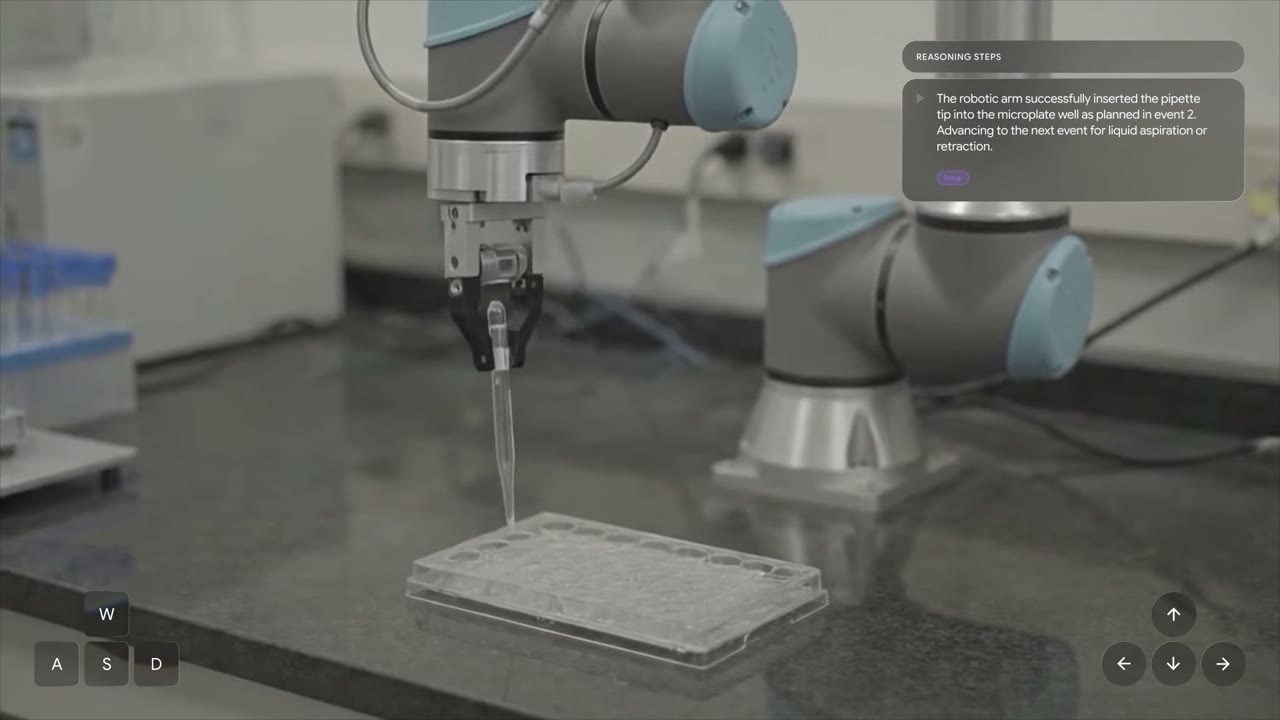 Credit: Google DeepMind. Frame from an official robotics demo, with Gemini's thinking-steps window
Why does this matter? Because training a robot or an AI agent in the real world is expensive, slow, and sometimes dangerous. A simulation you can generate in seconds and reshape with words is a nearly infinite training environment. DeepMind itself writes that this is one of the central goals.
When can you try Genie 4, and who can?
Right now, almost no one. Genie 4 has opened as a research preview for authorized (trusted) testers only. According to DeepMind, the next stage is Google AI Ultra subscribers inside Project Genie and early-access partners on the Gemini API and Google AI Studio. The company says "soon," with no date.
Three things worth knowing before making any plans:
- There is a waitlist. The official post includes a "Join the Genie 4 waitlist" button leading to a Google sign-up form.
- Project Genie itself is limited. When the service launched in January 2026 based on Genie 3, it was available, according to reports, only to AI Ultra subscribers in the United States aged 18 and older, with sessions of around 60 seconds. We found no official confirmation that it is open in Israel.
- The subscription is not cheap. Google AI Ultra costs around 250 dollars per month in the United States. This is not a tool you buy just to try.
What are the limitations, according to DeepMind itself?
DeepMind openly states that Genie 4 is still an early, experimental model. It maintains a consistent environment in short sessions, but visual details and "object permanence" (an object you saw staying in place when you return to it) can drift over time. This happens especially in longer simulations, after many command edits, or when you move around extensively inside the scene.
The areas the company identifies as still in development:
- Complex physical interactions
- Real-time sound accuracy
- Readable text inside the world (signs, menus)
- Spatial accuracy and long-term consistency
On the safety side, there is also an important detail for businesses: every video and sound generated in Genie 4 will carry SynthID, Google's invisible digital watermark that makes it possible to identify AI-generated content.
What does this mean for your business?
The right question is not "how do we use this tomorrow," but "where would rapid simulation save us money." The early testers, according to DeepMind, came from creative industries, journalism, education, gaming, and engineering. Based on what they describe, and on what we see in organizations, these are the practical directions:
- Training and work simulations. Retail chains, factories, and service centers invest heavily in training scenarios. A world where a new employee faces an angry customer or a production-line fault, and where you can change the scenario with a single sentence, is exactly what this technology is aimed at.
- Prototyping an experience or a game. DeepMind reports that game developers are exploring how to go from concept to a walkable prototype in seconds, before writing a single line of code in an engine. Anyone already building a game with Claude Code can think of Genie as the sketch phase that comes first.
- Marketing and creative work. Directors are testing it as a "draft mode": entering a scene and running several "takes" with different angles, lighting, and dialogue. For agencies and marketing teams, it is a way to pressure-test a concept before committing to production.
- Real estate and product: with caution. A virtual tour of a development sounds appealing, but "spatial accuracy" appearing on the limitations list means the world is not faithful to actual measurements. Right now it works for atmosphere and concept, not for presenting a real apartment. For what works today, see the guide from a floor plan to an AI visualization video.
- Robotics and agents. For companies developing robots or AI agents, this may be the biggest promise: infinite training environments instead of expensive test facilities.
What to do right now?
There is nothing to buy. There is plenty to prepare. Here are three steps that cost nothing:
- Sign up for the waitlist via the button in DeepMind's official post. It does not guarantee access, but it is the only path the company has published.
- Choose one process to test. Not "we will use AI for simulations," but a defined scenario: a simulation of a difficult customer call, or a sketch of an in-store experience. That way, when access opens, you will know what to measure.
- Practice with the tools available today. Writing a scene description, camera angle, and atmosphere is exactly the same skill. In Google Flow and in Veo you can practice it right now, and in the comparison of AI video creation tools you will find the other options.
What is still unknown
- When and for whom. No date, no separate price, and no commitment to availability outside the United States.
- Session length. DeepMind has not published how long you can stay in a single world in Genie 4.
- API. The company mentions the Gemini API and Google AI Studio for early-access partners, but has not published documentation or pricing.
- Usage rights. It is not yet clear what commercial use of a world or clip generated in Genie 4 is permitted.
The bottom line
AI video technology has moved in two years from clips of a few seconds to full videos with sound. Genie 4 marks the next step: not watching a scene, but standing inside it and reshaping it with a sentence. This is still research, and the limitations are real. But whoever learns now to think in scenes, angles, and scenarios will be ready when the door opens.
Want to master AI video tools right now?
Genie 4 is still closed, but Veo, Flow and the rest of the available AI video tools are already changing the way businesses produce content. The Hebrew AI video courses teach these tools step by step, at your own pace. For organizations that want to train their marketing, training or creative teams to work with AI, there are AI workshops for organizations built around your own workflows.
Sources:
Frequently asked questions

Yaakov Tzedek
An Israeli AI lecturer, consultant and implementer who has supported 100+ organizations in AI implementation and lectured for 200+. Official content partner of Meta, Google, Canva and TikTok, featured on Israel's Channel 13.
More about Yaakov →