
- Runway's Solaris is the first Interface World Model: it generates interactive user interfaces as real-time video, frame by frame, responding to every click. Full breakdown inside.
In Runway's research, when leading language models were asked to reconstruct a UI from a screenshot into code, information loss increased consistently as the interface grew more complex. That is precisely Solaris's core argument: code itself is the bottleneck between what designers intend and what users actually get.
On August 31, 2026, Runway, the company behind the Gen series of video models, published an announcement that sounds like science fiction: Project Solaris, a model that generates complete, interactive user interfaces, not through code, but as a live video stream produced frame by frame in response to your actions.
You click on a shirt in a virtual store and it appears on the character. You drag a chair across a living room and it moves with natural shadows and physics. There is no DOM behind any of it, no CSS, no components. There is a model imagining the next frame of the screen, thirty times per second.
 A moment from the live demo: everything you see here is video generated in real time, with no code behind the screen. Credit: Runway
This is the first time a demo of this kind has appeared at genuine quality, and it comes with structured research, concrete numbers, and stated limitations. In this guide I break the announcement down piece by piece: exactly what was shown, how it works under the hood, what the numbers actually say, where it breaks down, and what it means for people building products and running organizations. No hype, sources included.
What is Solaris? The 30-second definition
Solaris is what Runway calls an Interface World Model: an AI system that generates a user interface as a continuous real-time video stream. User actions, clicks and drags, serve as conditioning signals for generating the next frame, so the interface responds live without a single line of code ever being written or executed behind it. In Runway's own words: the entire frame is the interface.
To understand why this is different from anything we have seen before, it helps to step back for a moment and look at how software has always been built.
Wait, what is a "world model" anyway?
Before diving into Solaris itself, it is worth pausing on the term at the heart of the announcement, because it is going to follow us for years to come.
A world model is a model that has learned to predict the next frame of reality: given a current state and an action, what happens next. Unlike a language model that predicts the next word, a world model predicts the next world, including physics, lighting, object persistence, and cause and effect.
The idea is not new. The major video models of the past two years, from OpenAI's Sora to Google DeepMind's Genie series, have gradually advanced the argument that generating high-quality video requires genuine world understanding: you cannot produce a convincingly bouncing ball without encoding something that behaves like gravity somewhere inside. Genie went further still and turned video into interactive game worlds you could actually "walk through."
What Runway did with Solaris is a sharp pivot of that same capability: instead of asking "what happens in the world if I move the character," it asks "what happens in the interface if the user clicks here." A screen is, in this sense, simply another small world with its own rules: a pressed button depresses, an opening menu slides out, an item dragged into a cart stays there. A model that has learned to respect physical laws can learn to respect interface laws too.
This is also where Runway has a strategic edge. It is not a language-model company trying to draw; it is a video company trying to think. Years of building models for filmmakers, with an obsessive focus on frame-to-frame consistency of characters, lighting, and motion, are precisely the foundation a live video interface demands. Solaris is a bet that the road to new interfaces runs through deep image understanding, not through more code.
The problem Solaris attacks: code as bottleneck
Every interface you have ever used follows the same path: someone designs an experience, someone else translates it into code, and the code renders what you see. Even the newest AI tools, the ones that generate apps from a prompt, follow the exact same path. They just write the code faster.
And that path leaks. Before building Solaris, Runway ran an interesting experiment: it took the world's leading language models, including Claude, GPT, and Gemini, and asked them to reconstruct interfaces from screenshots across 30 examples at varying levels of complexity. The finding was consistent: the more visually rich the interface, the more information is lost in translation to code. The exact gradient, the spacing that creates a feeling, the small animation, all of it gets flattened into a generic version of itself.
This is, incidentally, exactly the feeling everyone recognizes from "build me a site" tools: the result works, but looks like every other result. The reason runs deeper than the model having bad taste. It is built into the path itself. Code is a middleware layer that abstracts, and in that abstraction the distinctiveness is lost.
Solaris's move is radical: eliminate the middleware. If the model knows how to generate photorealistic video, why not have it generate directly what the user sees, with no code in the way at all?
How it works: a world model meets a language model
Behind the demos sits a dual architecture, and this is the part most worth understanding.
1. The language model is the brain. It handles logic and behavior: what should happen when the user clicks this button, what is the context of the scene, where the flow goes next. Thinking, not drawing.
2. The world model is the hand that draws. This is where Runway's historical expertise enters. Solaris is built on Gen-4.5, its flagship video model. A world model has learned not just how things look but how they behave: how light falls, how fabric folds, how an object moves when pushed. Solaris uses that knowledge so a chair dragged across a living room moves like a chair, not like a PNG.
3. Your click is part of the input. Unlike a standard video model that takes a prompt and produces a clip, Solaris continuously receives user actions as conditioning signals. Each new frame is generated in light of what you just did. That is what turns video into an interface.
4. All of this in real time. Standard diffusion models are too slow to respond to a click. Runway describes two technical moves that solved this: a shift to autoregressive frame generation (frame by frame rather than a full clip at once), and distillation of the denoising process to single steps. The result is a 720p stream that responds at interactive latency and, according to Runway, is significantly cheaper to run than a standard diffusion model.
What was actually demonstrated
Runway presented five demos, each illustrating a different capability.
- Virtual clothing store with try-on: select an item and it appears on the character. A demonstration of a complete commercial interface with no backend system behind it.
- Interactive educational content: knowledge scenes you can "touch," such as a nighttime tour of the Eiffel Tower with live data, and a combustion experiment that responds to the user. Education where the simulation is generated on the fly rather than pre-programmed.
- Scene design: dragging furniture and swapping colors in a room, with physics and lighting that behave correctly.
- Assembling a salad from ingredients: an interface built from the objects themselves rather than from menus and buttons.
- Objects as tools: clicking an object in a scene (such as a diver's helmet in an aquarium) causes the cursor to adopt its properties and the scene to change. An interaction concept that simply does not exist in the world of code.
 The educational demo: a live scene with data, generated and responsive in real time. Credit: Runway
 An interface without menus: the ingredients themselves are the buttons. Credit: Runway
 Objects as tools: adding an object to the scene with a click, and the world rearranges itself around it. Credit: Runway
Two of these are worth pausing on, because each teaches a principle that will define the whole field.
The virtual store is the business demo. Think about what it takes today to build a virtual try-on experience: a 3D team, a modeled product library, a rendering engine, months of development. In Solaris, that experience starts from a single visual reference and a model that knows how clothing behaves. The long-term implication: experiences that were reserved for large companies with multi-million-dollar development budgets become a matter of good description. That is exactly the same pattern we saw in writing, design, and code: capability spreads downward, from giants to everyone.
And the "objects as tools" demo is the conceptual demo. You click an object in the scene and the cursor takes on its properties. It sounds like a gimmick, but notice what is absent: no tool menu, no icon bar, no "edit mode." The language of interaction emerges from the world itself. Decades of interface conventions, menus, windows, buttons, were born from the constraint that someone has to program every interaction in advance. When that constraint disappears, questions that seemed closed can be asked again. That is what makes Solaris more than an interesting product. It is an important research document.
Notice the common thread: none of the demos is "a form with buttons." All of them are experiences where the boundary between content and interface dissolves, and that is precisely the terrain where this approach has a built-in advantage.
The numbers: what the research actually found
AI announcements are full of promises. To its credit, Runway attached measurements. Two of them matter.
Reconstruction experiment (30 examples): As described above, leading language models consistently lost information when translating interfaces from screenshots to code, and the loss grew with visual complexity. This is the empirical justification for eliminating the code layer.
User research (250 participants): Runway put Solaris head to head against interfaces written in code by a top-tier language model and measured preferences. The result: Solaris was preferred in 61% of cases on instruction following, and in 71% on natural behavior within scenes.
A professional caveat is required here: these numbers come from demo scenarios, visually rich scenes and open-ended interactions, the home turf of a video model. Nobody measured tax-form completion or a financial data table, and in those contexts the picture is almost certainly reversed. 61% and 71% are genuine signals that the approach works within its domain. They are not a declaration of victory over all software.
The Impressive Admission: Where It Breaks
The part of the announcement that actually builds the most trust is the list of limitations Runway published themselves. Four of them, and every one is substantive:
1. Text. Generating stable, readable text inside a generated video is an open problem. An interface where the menu flickers or changes spelling between frames is unusable. Runway itself suggests a direction of hybrid approaches, meaning: a "real" text layer on top of the video. Notice what that means: a bit of code sneaking back in through the rear entrance.
2. Trust and accuracy. A Runway formulation worth carving in stone: a convincing wrong answer is worse than no answer at all. An interface generated from a model's imagination can display a price that does not exist, or information that looks reliable but is not. The proposed solution, grounding in reference sources, is exactly the same challenge we know from the chatbot world, except this time the hallucination might be a button.
3. Long sessions. Maintaining semantic coherence across an extended interaction, the shop remembering what you put in your cart ten minutes ago, is still in the realm of research.
4. Accessibility. A video interface has no DOM, so a screen reader has nothing to work with. Until there is an answer to this, public or government use of such technology is simply illegal in most of the Western world, including Israel.
The Hard Questions the Announcement Has Not Yet Answered
Beyond the four limitations Runway identifies themselves, there are four more questions that anyone who lives in product worlds has to ask, and they remain completely open:
How do you test an interface that never exists twice? The entire QA discipline is built on determinism: same action, same result, and you can write a test. A generated interface is probabilistic by nature. Two users clicking the same button may get different experiences, and that is both the magic and the nightmare. The software industry will need to reinvent the concept of testing: instead of "is the screen correct," ask "is the behavior within bounds." Anyone following the agents space will recognize the pattern. It is exactly the same problem we have today with testing AI agents.
What does this do to security and phishing? If a model can generate a live interface for a shop, it can generate a live interface for a bank. A world where a "trustworthy-looking screen" can be produced in real time demands a rethink of how users verify they are talking to who they think they are. Signatures, verified sources and identity layers will become critical at exactly the moment the eye stops being a witness.
Who is responsible when the interface is wrong? When a hard-coded button performs the wrong action, there is a line of code, a commit, a responsible party. When a generated frame displays the wrong price and a customer relied on it, the chain of responsibility blurs: the model? whoever trained it? whoever defined the scene? These questions will reach regulators and courts long before the technology matures, and organizations that adopt early need contractual answers before the pilot even begins.
And what about the environmental and economic cost at scale? Rendering an HTML page costs fractions of a cent; continuous video generation for every user, even after all optimizations, is more expensive by orders of magnitude. Runway notes that Solaris is significantly cheaper than a standard diffusion model, but "cheaper than very expensive" is not "cheap." This simple calculation will determine which experiences actually move to a generated interface: probably first the ones with high value-per-minute (a fitting before an expensive purchase, critical onboarding) and not the everyday feed.
So What Does This Mean? Three Shifts Worth Taking Seriously
Even with all the caveats, the direction Solaris points to is worth thinking through, because it aligns with other signals in the industry:
1. The end of the app catalog era. Runway's vision: instead of searching for an app from a fixed catalog, the interface you need is simply generated, tailored to you, at the moment of need. That sounds distant, but think about how many apps on your phone are really just a static interface on top of data.
2. Living brand experiences. A brand's website does not have to be the same pages for everyone; it can be an environment that adapts itself in real time to each visitor. For the marketing and commerce world, this is the category Solaris is closest to even today.
3. Truly adaptive learning. Training that responds to the specific learner's progress, simulations generated around the mistake they just made. Solaris's education demo is the strongest hint toward the early application direction.
Where This Will Reach You First: An Industry-by-Industry View
The technology will mature at different rates in different industries, and the order is fairly predictable if you judge by the current limitations: it will arrive first in places where the visual is the product and textual precision is secondary.
Commerce and fashion, first in line. Virtual fitting, product visualization in the customer's home, responsive catalogs. Runway's demos here are already nearly a product, and brands' willingness to pay for a differentiating experience is high. If you work in this space, this is the sector to watch for the first pilots.
Real estate and interior design. The furniture-dragging demo is exactly an apartment tour with real-time changes: "show me this living room with hardwood floors," and the living room changes, with correct shadows and lighting. An industry that already pays a lot for static renders will pay for live ones.
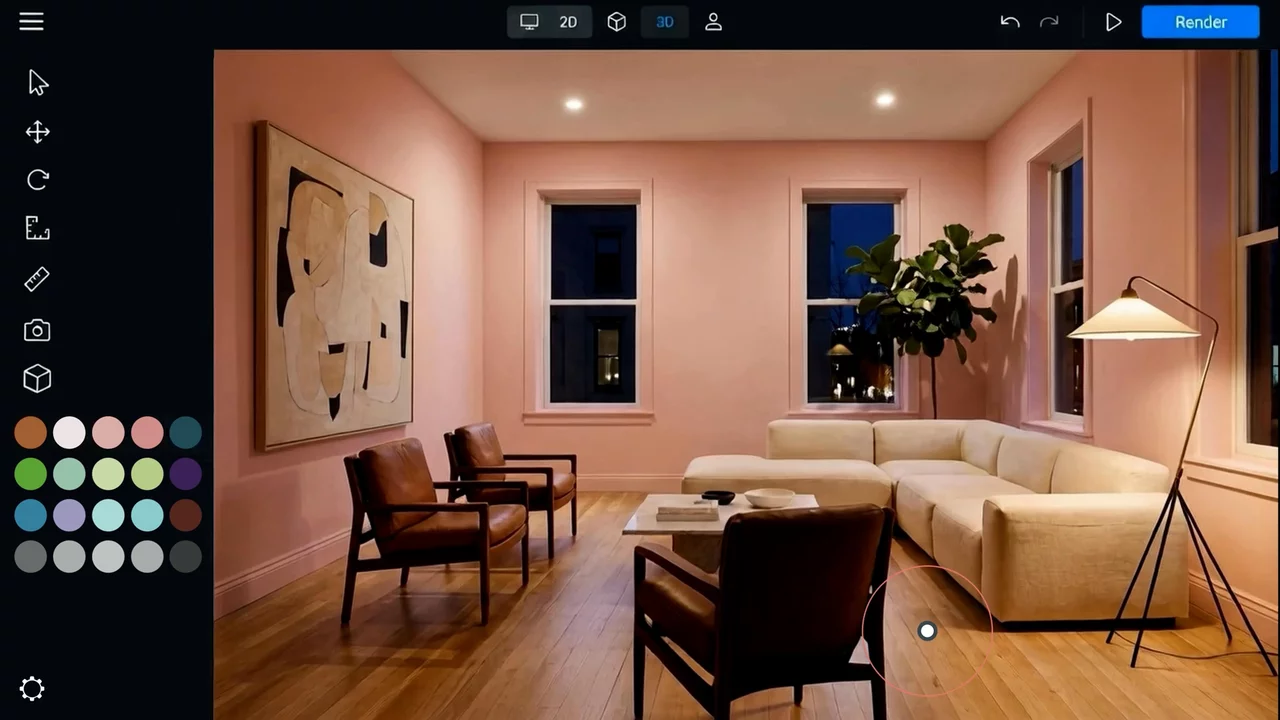 The interior design demo: what looks like design software is a live video responding to your choices. Credit: Runway
Education and training. Simulations generated around the learner rather than pre-programmed. Solaris's chemistry experiment is just the beginning; imagine a safety training that generates the scenario around the mistake the employee just made. The barrier here is content reliability, so this will come after commerce, with grounding mechanisms in place.
Gaming and entertainment. Perhaps the biggest quiet revolution of all: game worlds built not from pre-planned maps but generated around the player. DeepMind already demonstrated the direction with Genie, and Solaris shows that even the interface layer of the experience can be generated.
And who is last? Everything regulatory. Banking, healthcare, government. Those domains have requirements for precision, accessibility and audit trails that map exactly onto the four open limitations of the technology. Give it years.
What This Means for Three Specific People
Beyond industries, it is worth going down to the role level, because the question "what do I do with this" is completely different for each person:
If you are a UX/UI designer: this direction does not erase you, it changes what you produce. In a world of generated interfaces, what you design is not screens but a world: rules of behavior, visual language, boundaries of what is allowed to happen. Think about the difference between drawing every frame of an animation and directing a scene. Someone who knows how to define an experience in words and principles, not just pixels, becomes more valuable, not less.
If you are a developer: the UI layer is the least defensible part of your work, and that was true even before Solaris, thanks to generative code tools. What is actually getting more defensible: data architecture, integrations, security, and the ability to manage systems that generate things on their own. The right investment today is to master the generative tools rather than compete with them, and to go deeper into the layers they depend on.
If you run an organization or a product: do not buy anything yet, but update your mental roadmap. Every long-term decision about customer experience, a new website, a new app, a training system, is worth examining through the question "what of this survives in a world where the interface is generated." The answer is almost always: the data, the logic and the brand survive; the screens themselves, less so. Plan your investment accordingly.
What This Does Not Mean: Staying Calm for Anyone Building Products
Now the other side, because announcements about "the death of code" are already circulating around this release, and they are premature by several good years:
- Operational systems stay in code. Invoices, inventory, permissions, regulation, everything that demands absolute precision and an audit trail will keep running on databases and explicit logic. The video layer does not know how to do that and does not need to.
- This is research, not a product. There is no pricing, no public API, there is an early-access form and work with select partners. Between a stunning demo and a product you can build a business on, there are usually one to two years of road, if it gets there at all.
- And the economic question is open. Even if running it is cheaper than a standard diffusion model, continuous video generation for every user is more expensive by orders of magnitude than rendering HTML. The economics will dictate where this actually makes sense.
The right frame, in my view: just as language models did not eliminate the need for databases but completely changed the conversational layer with the computer, world models will not eliminate code, but they are beginning to change the screen layer. Anyone building products needs to know this the way they needed to know GPT in 2023: not to throw everything out, but to follow closely.
The Bigger Picture: The Long Road to a Generated Interface
To understand how unusual this demo is, it is worth remembering how many times the industry has tried to solve the "generic interface problem," and along which paths:
The first wave: website builders and templates. Wix, WordPress and their peers made building interfaces accessible, at the cost of uniformity. Everyone got the same templates, and the term "template site" was born as an insult.
The second wave: design systems and components. Figma, design systems and component libraries made building fast and consistent, but actually deepened the genericity: when everyone builds from the same Lego bricks, everything looks the same. There is a reason every SaaS app in 2025 looks like its sister.
The third wave, the one we are in the middle of: generative code. Tools that produce entire applications from conversation. They are dramatic in their productivity, but, and this is the finding from Runway's reconstruction experiment, they still translate intent into code, and the translation leaks. The "generic AI feel" of AI-generated interfaces is exactly the fingerprint of that leak.
Solaris proposes a fourth wave: not to improve the translation but to eliminate it. And the history of technology teaches that when someone eliminates a middle layer that everyone assumed was necessary, from the compiler to the cloud, the eventual change is larger than the first demo suggests. That does not guarantee that Solaris itself will win; it does mean that the question it is asking will stay.
Solaris Versus the Tools Already Building Apps for You
It is important to position Solaris correctly against the current wave of AI-powered build tools:
| Generative code tools (Claude Code, v0, Lovable) | Solaris | |
|---|---|---|
| What is produced | Real code: a normal application | A video stream that is the interface |
| Maturity | Production, today | Research and demos |
| Accurate text and data | Strong | The central weak point |
| Live visuals and physics | Limited | The built-in advantage |
| Accessibility and regulation | Full | Does not exist yet |
| When relevant for your business | Now | Watch it, do not build on it |
In other words: these are not competitors, they are two stages on the same axis. Today you build real systems with generative code tools, which already get a working product out of a conversation. Solaris hints at what will happen to the visual layer of those same systems a few years from now.
How to try it, and what to do right now
To try Solaris: Early access registration is open on Runway's official announcement page, where you can also find all the full demo videos in original quality (the frames in this article are taken from them, courtesy of Runway). Runway also publishes the full video demonstrations there, and it's worth watching them with your own eyes before forming an opinion.
For anyone managing a product or an organization, here are three practical actions that don't require waiting:
- Invest in the layers that won't be replaced. Clean data, well-defined business logic, and a sharp brand identity: these are the assets that every future interface layer, whether coded or generated, will depend on.
- Start working generatively where it's already mature. The gap between "I've heard about AI" and "I've built with AI" closes today with existing coding tools, not by waiting for Solaris.
- Track the right metrics: solving the text problem, opening a public API, and pricing per minute of interaction. Those three will tell you when this technology moves from demo to tool.
How to read an announcement like this without falling for the hype: a five-step method
The Solaris announcement is also a good opportunity to practice a skill every decision-maker needs in 2026: reading an AI announcement and knowing what to do with it. The method I teach, using this exact example:
- Separate demo from product. Is there an impressive video? Great. Is there an API, pricing, and paying customers? Here: no. The practical conclusion comes from the second line, not the first.
- Look for measurable claims. A serious announcement brings numbers that can be scrutinized. Here there are: 30 replay examples, 250 participants, 61% and 71%. That lifts the announcement from "pretty video" to "research worth discussing."
- Read the limitations section first. A company that publishes where its own product breaks (as here: text, trust, accessibility) is more credible than one that promises everything. The absence of a limitations section is a red flag in itself.
- Ask "what has to be true for this to work for me." In our case: a text solution, data grounding, accessibility, and price per minute. Four testable conditions instead of gut feeling.
- Translate to staged action: what to do today (nothing to buy, yes to follow), what the trigger for the next action is (public API plus pricing), and what preparation already pays off in every scenario (mastering existing generative tools, getting your data in order).
These five steps work on any announcement, from the next GPT to the next gadget, and they're the difference between an organization that gets swept along with every headline and one that capitalizes on them.
The experiment I recommend doing this week
You can't try Solaris yet, but you can, and should, experiment with the idea behind it. Here's a half-hour exercise I give in workshops, and it genuinely shifts your intuition:
- Take one process from your business that has a fixed interface: an order form, a report, a training screen.
- Open a conversation with an advanced AI tool and ask it to run that same process as a free-form conversation, without the interface: "You are my ordering system, take an order from me."
- Notice what happened: where was the conversation better than the form (flexibility, follow-up questions, edge cases) and where was the form better than the conversation (speed, certainty, required fields)?
The insight that emerges almost every time: the fixed interface wins in the standard scenario and loses on every exception. Generated interfaces, in code today and in video tomorrow, promise to close exactly that gap: the reliability of a form with the flexibility of a conversation. Someone who has felt that in their gut, through an exercise like this, will know when the technology is truly mature and won't need to wait to be told.
The bottom line
Solaris is not the product that will transform your business tomorrow morning, and its limitations are real: text, accuracy, accessibility, and cost. But it is the moment when an idea that sounded like science fiction, an interface that is generated rather than written, received its first quality demonstration, structured research, and real numbers. These moments are worth noting, because in hindsight they always look like the starting point.
And while that future simmers, the way to be ready for it is to master the generative tools that already work: a practical AI workshop for your organization, where your team learns to work with these tools on real tasks, or the live Claude Code intro session on 16.9, three hours after which you're no longer reading about the future, you're building in it.
A guided thought experiment: the day this reaches the average Israeli business
To bring all of this down from the clouds, let's imagine an average clinic or studio in Israel, three years from now, in a world where this technology is mature:
A customer enters the website. There is no "website" in the sense of fixed pages; there is an environment that is generated around her. She's interested in a particular service, and the space shifts to present exactly that, with a live demonstration generated according to her profile: age, history, what she searched for before. She asks a question, and the answer doesn't arrive as text in a chat window but as a change in the environment itself, the demonstration adapts. The appointment she books at the end is the only "code-based" action in the entire visit: a row in a database, with an interface generated around it that then disappears.
What in this picture is already possible today? The smart conversation and automated coordination parts, those are being built right now with agents and generative coding tools, and that's exactly what I teach. What isn't yet? The live visual layer, and that's precisely what Solaris demonstrates. The gap between the two is the roadmap for the years ahead.
And now the important part: what determines who will profit from that world when it arrives? Not whoever has the prettiest website today. But whoever has: organized data about their customers and services (which the generated environment will rely on), a brand with a clear identity (which the model will know how to preserve), and working digital processes (which the generated interface will connect to). All three are built today, with today's tools, and every investment in them holds up in every future scenario. That's why the most practical advice from this entire announcement is almost mundanely boring: get your digital house in order. The remarkable future will be built on exactly that.
A short glossary of terms you'll keep encountering
The five terms from the announcement that are worth knowing, because they're going to appear in every discussion about the future of interfaces:
- World Model: A model that predicts the next state of an environment given a current state and an action. The foundation for simulation, robotics, and now interfaces as well.
- Interface World Model: The term Runway coined in the announcement: a world model whose environment is a user interface and whose actions are clicks and drags.
- Autoregressive generation: Creating content piece by piece, where each piece is conditioned on the previous ones. In language models, word by word; in Solaris, frame by frame. This is what enables real-time response instead of generating a full clip in advance.
- Distillation: Compressing the expensive process of a large model into a fast, cheap process that attempts to preserve the quality. In Solaris: reducing dozens of denoising steps to just a few, in order to achieve interactive speed.
- Grounding: Tying generated content to an external source of truth, so that a price shown in a generated interface comes from the database rather than from the model's imagination. The key to solving the trust problem, in chatbots and here alike.
The timeline: where to look from here
- August 31, 2026: The announcement, the demos, and the opening of early access registration. We are here.
- The coming quarters: Pilots with selected partners. The signal that will interest us: the first consumer brand to launch a Solaris-based experience publicly, most likely in e-commerce or fashion.
- The critical juncture: Solving the text problem. The moment a generated interface can display a stable, readable menu, the door opens to many categories at once. Until then, it stays in the realm of visual experiences.
- And the big question of 2027: Whether the major players, Google with Genie and OpenAI with its video capabilities, will enter the same arena of generated interfaces. If they do, the category Solaris opened will become a race, and that's the stage at which things usually accelerate wildly.
Update October 28, 2026: Google has already entered the arena. Google DeepMind announced Genie 4 on October 27, a world model that generates a real-time world with sound and lets you change weather, camera angle, and characters mid-experience with a text command. It is currently in preview for authorized testers only. Full details: Google unveiled a world you can enter and reshape with words.
Sources: Runway's official announcement of Solaris · The announcement on Runway's X account · Crypto Briefing review
Frequently asked questions

Yaakov Tzedek
An Israeli AI lecturer, consultant and implementer who has supported 100+ organizations in AI implementation and lectured for 200+. Official content partner of Meta, Google, Canva and TikTok, featured on Israel's Channel 13.
More about Yaakov →