- On October 21, 2026, OpenAI and Google Cloud announced that GPT-6 Astra, GPT-6.1 Sol, and GPT-6 Luna are joining Model Garden, with Codex also connecting to the Google Cloud platform. Usage bills to your Google Cloud invoice and counts against existing committed spend. Everything known, what is still unclear, and the questions to ask before you begin.
According to the Google Cloud blog, after this announcement Google is the only major cloud provider offering access to all three leading closed large language models (Google's, Anthropic's, and OpenAI's) alongside more than 200 additional models, all on a single enterprise platform and a single invoice.
Starting October 21, 2026, OpenAI's most advanced models are available for purchase through Google Cloud. GPT-6 Astra, GPT-6.1 Sol, and GPT-6 Luna are entering Model Garden, the model catalog of Google's enterprise platform (widely known as Vertex AI), and Codex, OpenAI's coding agent, can now run on Google's infrastructure. At this stage, access is limited to a private preview for select enterprise customers.
OpenAI and Google compete head to head for the AI model market. And now Google is selling its competitor's models, on the same invoice and from the same cloud budget. But the real story here is not the competition. It's your procurement department.
In short:
- What was announced: Three OpenAI models in Google Cloud's Model Garden, plus Codex CLI and Codex Desktop integration with Google's platform.
- How you pay: Through Google Cloud Marketplace, on a single Google invoice, offset against existing cloud commitments.
- Security: Data is not used for training, unified permissions and audit logs. Zero data retention is coming "soon."
- Availability: Private preview for select customers, expanding in the coming weeks. Google Antigravity and Gemini for Business will follow.
- The significance: For the first time, according to reports, OpenAI models are being sold directly across all three major US cloud providers.
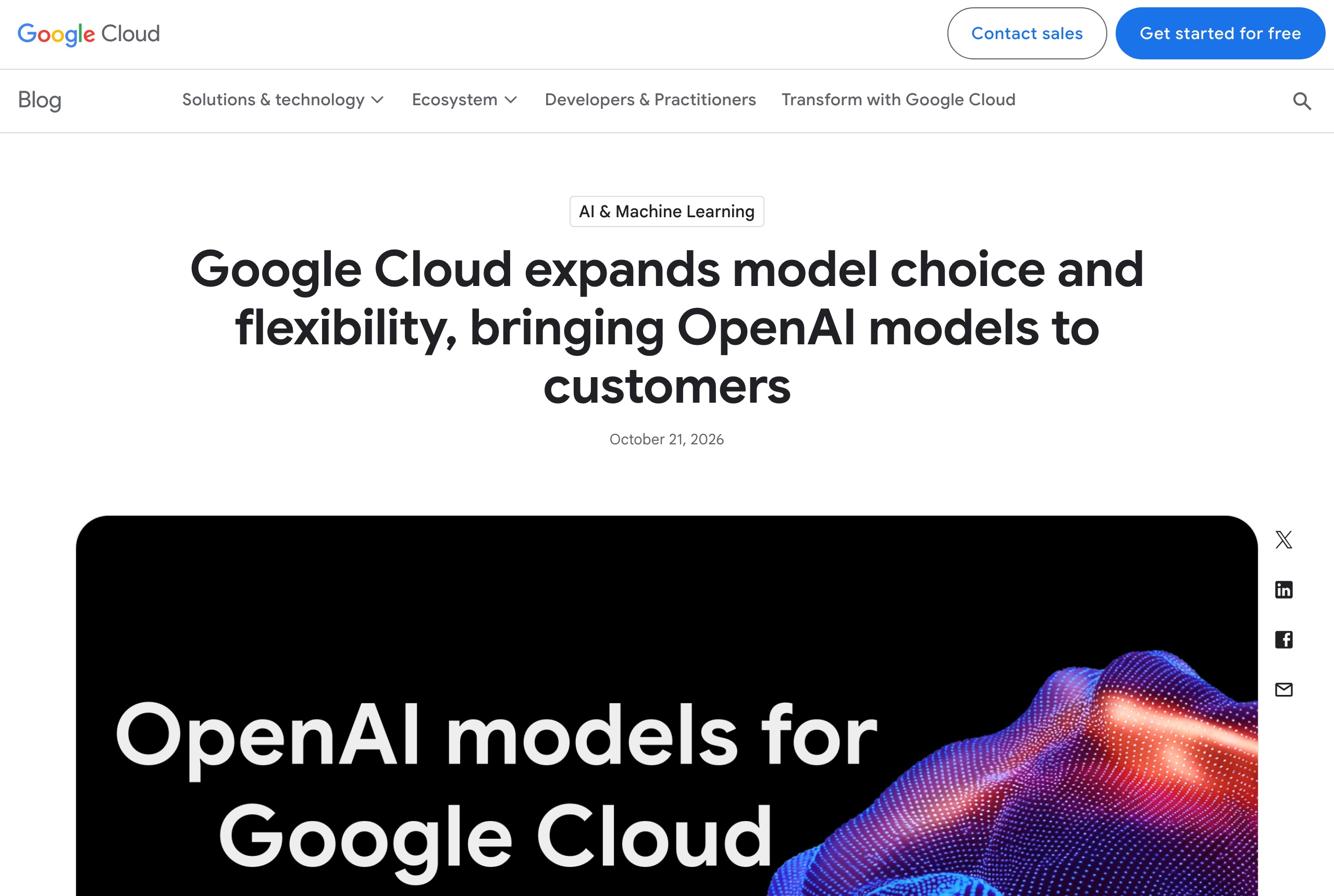 Screenshot: the official Google Cloud blog, October 21, 2026
What exactly was announced?
Google Cloud added OpenAI's models to its model catalog and opened them in private preview. The announcement was published by Michael Gerstenhaber, Vice President of Product Management for Google Cloud's Gemini platform, while OpenAI simultaneously announced on its channels that it is bringing its models and Codex workflows "where enterprises are already building."
The three models in this first phase, as described by Google:
- GPT-6 Astra: For the most demanding work: code, computer use, professional tasks, and scientific research. We covered it in the complete guide to GPT-6 Astra.
- GPT-6.1 Sol: Intelligence close to Astra at a lower cost. Full comparison in the GPT-6.1 Sol review.
- GPT-6 Luna: A fast, economical model for high-volume everyday work.
Beyond the models, developers can connect Codex CLI and Codex Desktop directly to Google's platform, so model inference runs on Google's cloud. Down the line, Google says the models will also come to Google Antigravity, Google's agentic development environment, and to the Gemini for Business service.
Why is Google selling a competitor's models?
Because in the cloud market, whoever holds the customer wins even when the model isn't theirs. The cloud provider takes its share of every transaction that flows through its Marketplace, and the customer has no reason to move to another cloud just to access a model they need.
According to Google's blog, it is now the only major cloud provider offering the top three proprietary large language models, alongside more than 200 additional models. Google Cloud CEO Thomas Kurian said, according to the ANI news agency, that the company is focused on offering a wide choice of models, "including those from OpenAI," so customers can pick the right model for each task at the best quality and lowest cost.
OpenAI has a clear interest here too. Company president and co-founder Greg Brockman described the partnership as a move that brings the models and Codex "where customers are already building." After AWS and Microsoft, Google Cloud was the missing link.
What does this mean for your organization?
If your organization already works with Google Cloud, the path to OpenAI just got much shorter: no new vendor, no separate contract, no new budget. But that shortcut comes with decisions that need to be made.
1. A multi-model strategy, not a single-vendor one
Google itself writes that a modern organization should match the right model to each task rather than run everything on a single model. In practice, you can build a system where Luna handles request classification, Sol writes drafts, and Astra is called in only for complex code. Switching between models happens on the same platform, without changing your architecture. We covered the comparison between the main enterprise tools in Copilot vs. Gemini vs. Claude for organizations.
2. Procurement through your existing cloud commitment
This is probably the most practical change. According to Google, usage of OpenAI models is purchased through Google Cloud Marketplace, appears on a single invoice, is offset against cloud commitments (Committed Spend), and counts toward Flexible Savings Plans. In many organizations, pre-committed cloud budget that hasn't been fully used is exactly the place to fund a pilot, without opening a new procurement process.
3. The questions you must ask before bringing in sensitive data
Google promises that prompts and responses stay within your data boundaries and are not used for training, that models run on dedicated Google infrastructure, and that every action is logged under a verified identity with VPC Service Controls and unified audit logs. Even so, before you start, it is worth asking your account manager:
- In which regions do the models run? Are they available in Google Cloud's Tel Aviv region, or only in the US and Europe? The official announcement does not specify.
- When exactly does zero data retention arrive? It is currently marked "coming soon."
- When does confidential compute arrive? Also "coming soon."
- What is the per-token price on Google compared to OpenAI's direct API? Pricing was not published in the announcement.
- Are the legal terms Google's, OpenAI's, or a combination of both?
4. Codex is no longer limited to OpenAI's cloud
Development teams working on Google Cloud can run Codex against Google's platform. Organizations weighing their options across agentic development environments will find useful background in the comparison between Claude Code and Google Antigravity, especially now that Antigravity itself is set to receive OpenAI's models.
5. Start with a small, measured pilot
The right way to begin is not to migrate an entire system. Pick one task that is already running in your organization on another model, and run it in parallel on Sol or Luna. Compare three things: response quality, latency, and monthly cost. After two weeks you have real data from your own organization, not just comparison tables from the internet.
What is still unknown?
The announcement details the models and the purchasing model, but leaves several important specifics open.
- Pricing: No per-token price has been published, and it is unclear whether it will match OpenAI's direct API.
- Regions and data retention: No list of regions. Zero data retention and confidential compute are not yet available.
- Timeline: "In the coming weeks" for broader availability, and "soon" for Antigravity and Gemini for Business, with no specific dates.
- Additional models: Google writes "and more to come," without specifying which ones.
- Risk management: OpenAI itself classified Astra as its first model to reach a critical cyber-risk rating. It is not clear whether Google will apply additional usage restrictions to it. Full background in the article on Astra and its critical risk classification.
The complementary story from the same week
In the same week that OpenAI entered Google's cloud, Google continued pushing its own models forward. We covered the new generation of Gemini in the guide to Gemini 4 Argon, and on the voice side from that same week, in the article on ElevenLabs Eleven Realtime. The picture that emerges is clear: the cloud is becoming a model supermarket, and the advantage goes to whoever knows how to shop the shelves.
How do you start working with multiple models in your organization without getting lost?
The problem for most organizations is no longer access to models. It is knowing which model fits which task, and who on the team actually knows how to use it properly. When the same cloud budget buys Gemini, Claude, and GPT, the decision moves from procurement to the teams themselves.
Yaakov Tzedek runs AI workshops for organizations where teams work on their real tasks, compare models, and build safe working guidelines. Development teams also have access to Claude Code workshops focused on working with coding agents. Organizations that want to build an adoption plan first can start with AI consulting for organizations. The questions in the list above are a good starting point for that conversation.
Sources: Google Cloud Blog, PYMNTS, Techstrong.ai, ANI.
Frequently asked questions

Yaakov Tzedek
An Israeli AI lecturer, consultant and implementer who has supported 100+ organizations in AI implementation and lectured for 200+. Official content partner of Meta, Google, Canva and TikTok, featured on Israel's Channel 13.
More about Yaakov →