- Google and XREAL launched the XREAL AURA on October 28, 2026: transparent Android XR glasses that display apps in your field of view and let you ask Gemini about what you see. Under 95g, external compute unit on a cable, launch price from $1,099 through year-end. Orders open in the US, Canada, and Korea; Japan from November 2. Not available in Israel.
According to Google, the AURA lenses can dim to create a private cinema screen and go transparent again the moment someone enters your field of view. The glasses themselves weigh under 95g because the processor and battery sit in a separate unit connected by a cable.
Google wants you to stop looking down at your phone. On October 28, it launched a pair of glasses with XREAL weighing under 95 grams that display apps in the air and let Gemini see what you see. But the big promise comes with a cable, a price tag in laptop territory, and a list of supported countries that does not include Israel.
In short:
- What launched: XREAL AURA, transparent XR glasses running Android XR, Google's operating system for extended reality devices. Google describes them as the platform's first wired XR glasses.
- What they do: Display multiple app windows in front of your eyes, mirror a laptop screen over a cable, and play movies and games. Gemini is built in and responds to what appears in the room and on your screens.
- The hardware: Under 95 grams, a 70-degree field of view, lenses that dim on demand, and an external computing unit on the cable that holds the battery and the chip.
- Price and availability: Launch pricing from $1,099 through the end of the year, according to Google. Orders open in the US, Canada and Korea; in Japan from November 2; shipping from mid-November; ages 18 and up. Not in Israel.
- For business: Not yet a product you can buy here, but a clear signal of where AI is heading in fieldwork, training and service: an assistant that sees what the worker sees, while hands stay free.
What is XREAL AURA, and how is it different from VR headsets?
AURA is transparent glasses, not a closed headset. You see the room with your own eyes, and digital content is projected onto the lenses over what you are already looking at. That is the key difference from virtual reality headsets, which seal off the world and present it through cameras.
In the official Google blog post announcing the launch, the presentation was led by the company's head of XR (Shahram Izadi, VP and General Manager of XR). According to the post, the field of view is 70 degrees, wide enough to spread several windows at once. The glasses are light because all the heavy computation moved to a portable computing unit (a puck), connected by cable, which holds the battery and Qualcomm's new Snapdragon Reality Elite chip, making its debut in this very device.
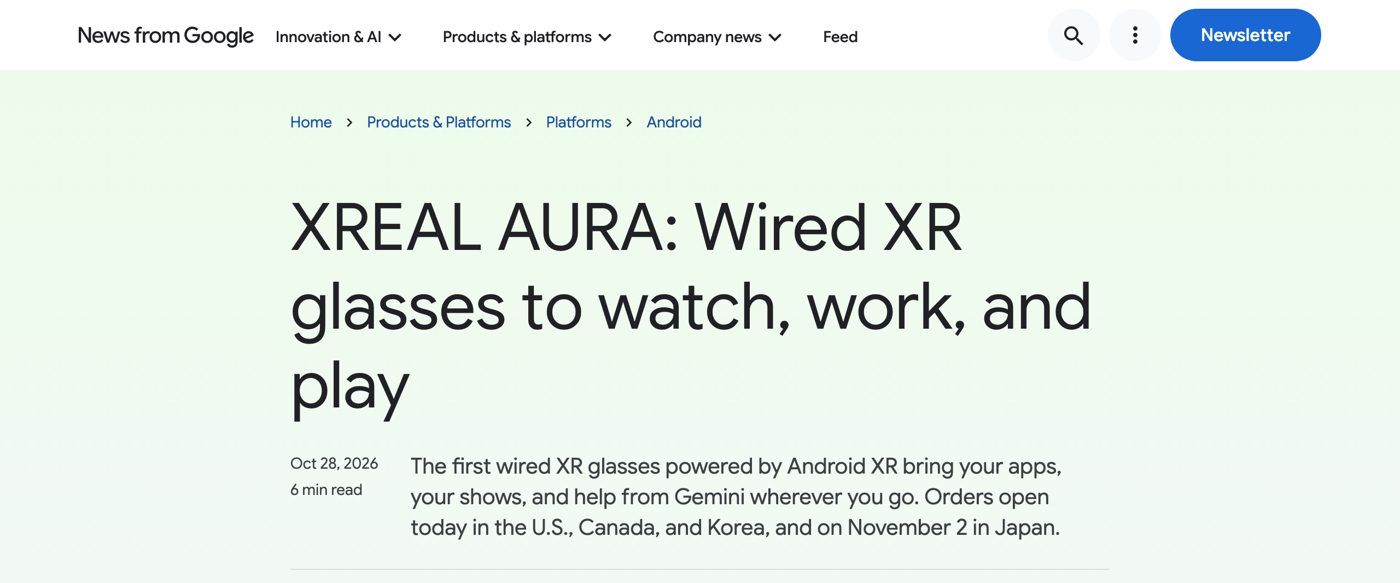 Screenshot: official Google blog post (News from Google), October 28, 2026
What does Gemini actually do in the glasses?
It sees what you see and responds to it. According to Google, Gemini on Android XR understands what is in front of you in the real world as well as on your virtual screens, so you can have a natural conversation about anything in your field of view. In the official demo video, a user hovers over a 3D map of New York, asks about a restaurant, and Gemini answers in a floating panel.
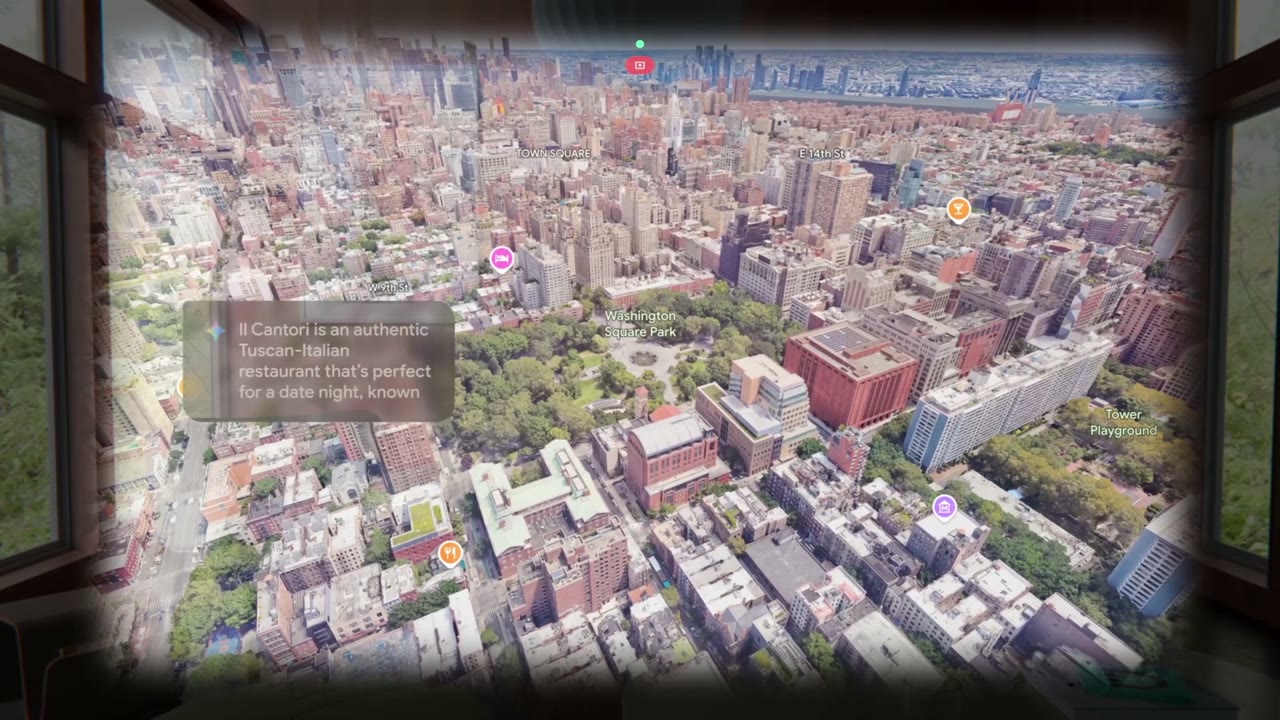 Frame from the official Google demo video for XREAL AURA
Two new things from the launch worth knowing:
- It organizes your workspace. You can ask it to "tidy up the windows," even when one of them is a laptop screen connected to the glasses.
- It highlights, not just talks. According to Google, you can now share the view with it, and it marks what in the room or on the screen deserves your attention.
Anyone not yet familiar with Gemini itself will find the basics in the complete Gemini guide, and what has changed in Google's models over recent months in the Gemini 4 Argon overview. The companion story from today is Gemini 4 Carbon, Google's new advanced model.
What does it look like as a workspace?
Like a three-monitor desk that fits in a bag. According to Google, you can open multiple apps in parallel (browser, documents, music) and position them around you at any size. Connect a keyboard and mouse over Bluetooth, or use the computing unit as a touchpad.
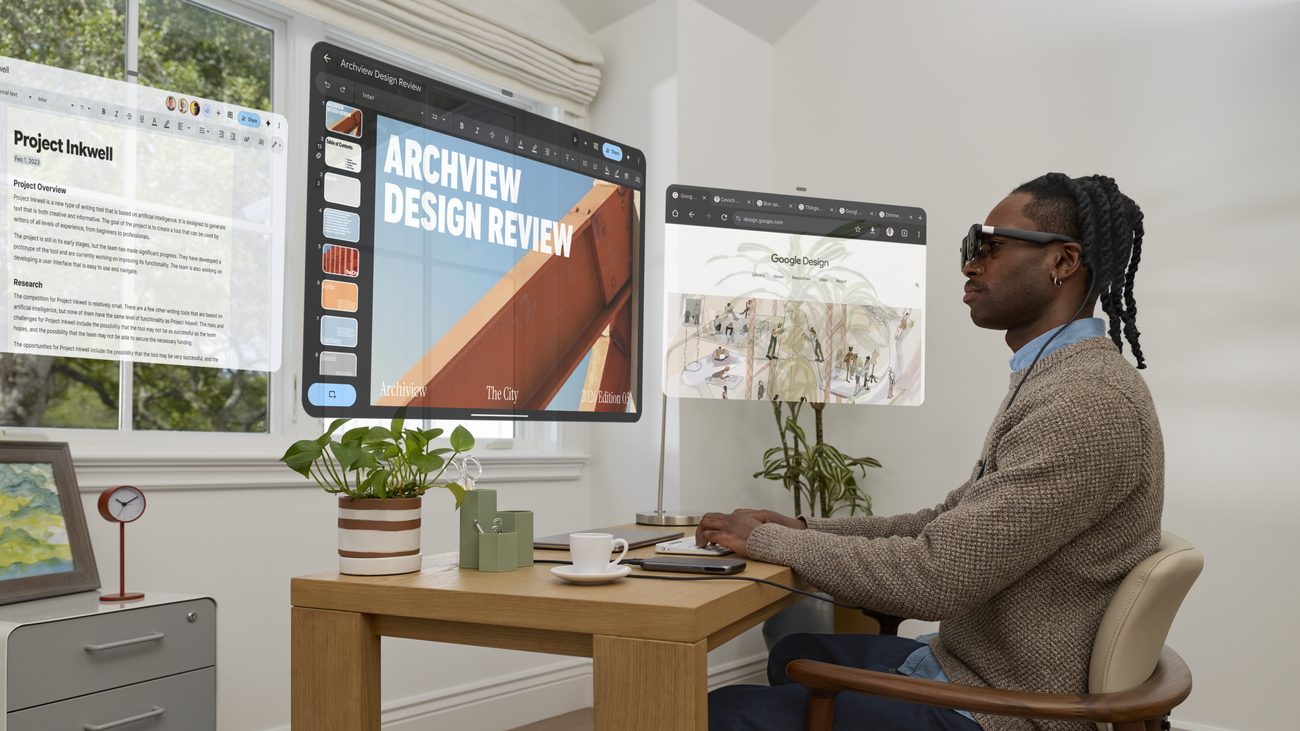 Official image: Google, from the XREAL AURA launch post
The feature that office workers will find most interesting is called Wired Mirroring. Connect a laptop via a USB-C cable that supports video transfer, and its screen appears as a window you can resize and reposition, with no software to install. Google also notes that the display is visible only to whoever is wearing the glasses, so you can open a sensitive document even in a public place.
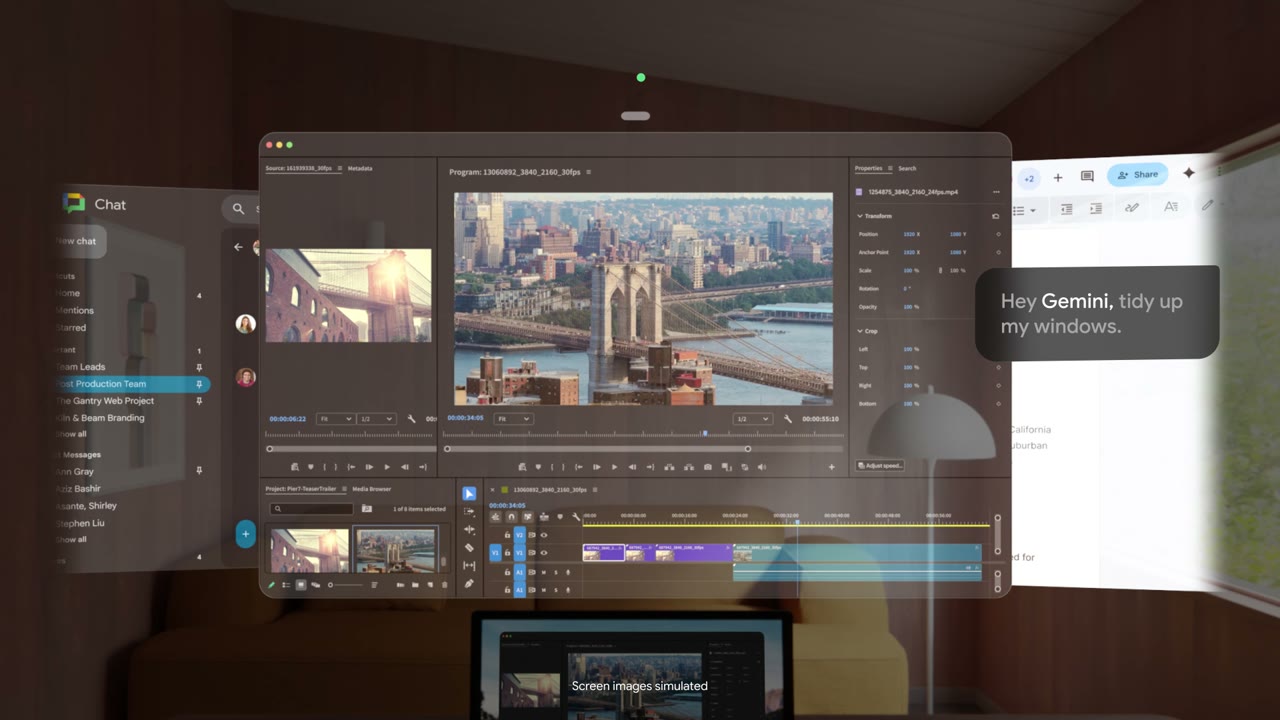 Frame from the official Google demo video. Per the on-screen caption, the screenshots in the video are simulated
How much does it cost, and when is it coming to Israel?
Launch pricing starts at $1,099, and there is no date yet for Israel. A word of precision is needed here, because the figure circulating online ($1,279) is only part of the picture.
| Item | Details |
|---|---|
| Launch price (per Google) | From $1,099, valid through the end of 2026 |
| XREAL's price list published in early October | $1,279 for the 12GB/256GB model, and $1,499 for the 16GB/512GB model |
| Orders open | US, Canada and Korea from October 28. Japan from November 2 |
| Shipping | From mid-November |
| Where to order | On the XREAL website, and in the US also at Best Buy |
| Age restriction | Ages 18 and up |
What about Israel? As of this morning, Israel is not on the list of supported countries, and we found no official announcement of a local launch. We did not check whether the official stores ship to Israel, and Hebrew support in the Android XR interface has not been confirmed. Anyone considering a personal import should verify three things first: warranty and support outside the launch countries, compatibility of Google services on an Israeli account, and the final cost after shipping and taxes.
What are the limitations, honestly?
This is a first-generation product in a new category, and it behaves like one. Before falling in love with the demo videos, it is worth knowing the other side:
- The cable stays. The glasses are light, but there is a unit in your pocket or on the desk, and a cable running up to your head. For work that involves constant movement, that is less convenient than the demos make it look.
- The price. Around one to one-and-a-half thousand dollars, before tax and shipping. That is a good laptop's worth of money for a device that still needs to prove itself in everyday use.
- Availability. Four countries in the first wave. Israel is not among them.
- The demos are the company's own. The videos and images are official marketing materials, and some of the screens in them are simulated, per Google's own caption. Independent long-term use reviews have not been published yet.
- Battery and usage time. The official post does not include a figure for runtime on a single charge.
What this means for your business
The question is not whether to buy glasses tomorrow, but which work in your organization gets done with busy hands and eyes on something else. That is where an AI assistant that sees what the worker sees changes the picture. Google itself points businesses to the Android Enterprise blog for large-scale deployment options, meaning the company sees this as an enterprise product, not just a living-room gadget.
Four scenarios worth thinking about right now (this is our analysis, not a Google promise):
- Fieldwork and maintenance. A technician in front of an electrical panel or a machine asks "what is this component and what is the next step," and gets an answer without taking off gloves or searching on a phone.
- Hands-free instruction. Operating procedures, safety protocols or a checklist open in a floating window alongside the work itself, instead of a booklet or a tablet on the floor.
- Retail and warehouse. A worker restocking a shelf or picking an order sees what is missing and what comes next, without walking to a terminal every minute.
- Onboarding new employees. A worker in their first week gets a real-time explanation of what is in front of them, while the shift manager is free to handle other things.
What can you do today, without glasses? Build the infrastructure that will work with whatever device comes next: a clean, digital knowledge base of procedures and guides that an AI assistant can read, and test Gemini Live on the phone with one real task. Anyone starting from scratch will find a practical starting point in the AI guide for small business. And anyone already letting AI act, not just answer, should know the draft rule for safe work with an AI agent: an assistant that sees its environment still needs clear boundaries on what it is allowed to do.
What is still unknown
- Whether and when Israel. No official announcement.
- Hebrew. Hebrew support in the Android XR interface has not been confirmed, and how Gemini in the glasses handles spoken Hebrew has not been tested.
- Battery life. Not published in the official post.
- How it performs in everyday use. All materials currently available are from Google and XREAL.
The bottom line
XREAL AURA moves the screen from your pocket to in front of your eyes, and moves Gemini from an assistant that listens to one that also sees. For users in Israel, it is not yet a product to buy. For businesses, it is a reminder that the next question in AI is not only what it knows, but what it sees, and where your workers need it when their hands are full.
Want to get your organization ready for Gemini, before the glasses arrive?
Most of the capabilities shown in AURA are already available today on phone and computer, inside Gmail, Docs, Meet and Gemini Live. The Gemini implementation program for organizations walks teams through practical use cases, organizes a knowledge base that an AI assistant can work with, and sets usage policy. That way, when the next device arrives, your organization already knows what to do with it.
Sources:
Frequently asked questions

Yaakov Tzedek
An Israeli AI lecturer, consultant and implementer who has supported 100+ organizations in AI implementation and lectured for 200+. Official content partner of Meta, Google, Canva and TikTok, featured on Israel's Channel 13.
More about Yaakov →