
- What Sider is: an AI sidebar for Chrome and Edge with GPT, Claude, and Gemini, page and PDF and YouTube summaries, Wisebase, the Hand agent, all plans, pricing, and privacy.
With Sider, the annual plan is not just 17% cheaper, it also gives you more credits. According to the pricing page, Nano on monthly billing gets 7,500 credits per month, while annual billing gets 10,000 credits per month, and on the Max plan the gap is 80,000 versus 100,000.
10 million active users according to the site, GPT, Claude and Gemini in the same sidebar, and an extension that summarizes any page and any YouTube video in one click. That's not even the interesting part.
The interesting part is that Sider is no longer just "chat on the side of the screen." In June 2026 it moved to a credits model that counts actual usage, and the cheapest plan costs $10 a month. Alongside the chat there is an agent called Hand, which works inside the browser using accounts you are already logged into. In other words, a very convenient tool for reading and writing, but one you need to understand before letting it touch anything work-related.
This guide was built from Sider's official homepage, pricing page, product pages, help center, privacy policy and terms of service, and the extension's page in the Chrome Web Store (all checked on September 15, 2026): what the tool can do, how to get to your first result, Hebrew support, what each plan costs, and when something else is a better fit.
In short
| Question | Short answer |
|---|---|
| What is it | An AI sidebar for Chrome and Edge, plus a desktop app for Windows and Mac and mobile apps for iOS and Android |
| What does it cost | Monthly billing: Nano $10, Lite $25, Pro $50, Max $100. Annual billing gives 17% off and more credits |
| What are you paying for | Monthly credits that are deducted by usage, and on Lite plans and above, a dedicated cloud computer for the agent |
| What it's good at | Summarizing pages, PDFs and YouTube videos, bilingual translation, writing inside text boxes, comparing models |
| Hebrew | The extension is offered in 55 languages including Hebrew, and the site exists in Hebrew. The help center is in English |
| What it's not for | Customer data, internal systems, confidential documents. And the agent should not run on sensitive accounts |
What is Sider?
Sider is an AI assistant that sits in the browser sidebar and can see the page you are on. Instead of copying text into another tab, you open the sidebar and it summarizes, explains, translates or writes based on whatever is open in front of you.
Definition: Sider is a Chrome and Edge extension, a Windows and Mac desktop app, an iOS and Android mobile app, and a website, that bundles several language models into one subscription. It has three main components: Chat for understanding content, Hand for automating tasks in the browser, and Code for modifying websites with plain language. Behind it is Vidline Inc., based in the United States.
The homepage presents Sider as "Your AI Agent for the Browser," with more than 10 million active users, more than 100,000 five-star ratings, and the Chrome Editors' Choice for 2026. The extension's page in the Chrome Web Store shows 5,000,000 users, a 4.9 rating from roughly 114,000 ratings, and a last update of September 12, 2026. These are the numbers the company and the store present, not an independent measurement.
On the company: according to the terms of service and the Chrome Web Store extension page, the service is operated by Vidline Inc. of Massachusetts. We found no "About" page on the site with a company history or leadership team, and that is a detail worth remembering when deciding how much information to entrust to the tool.
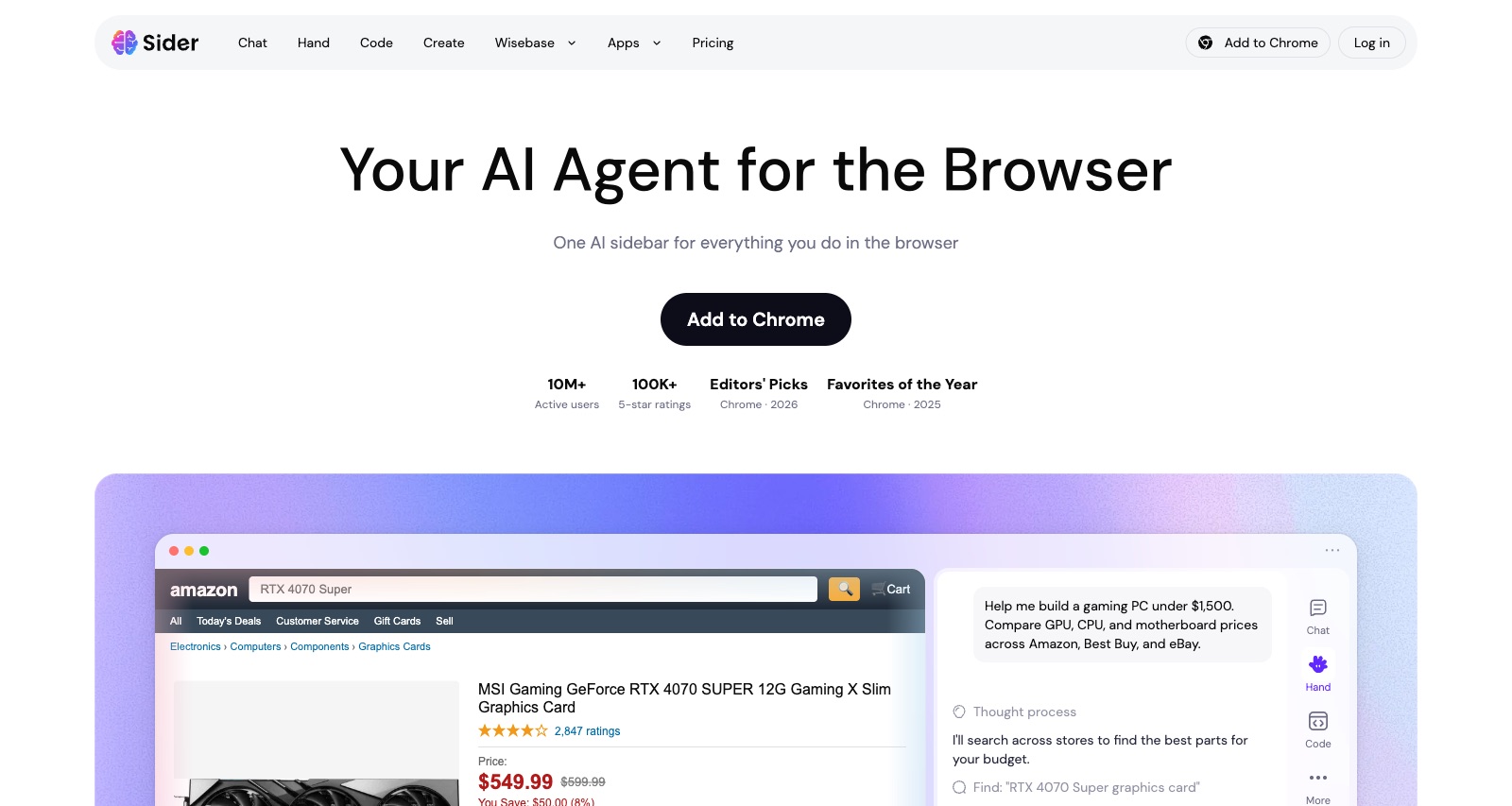 Sider's official homepage, photographed on September 15, 2026. Credit: Sider
What can Sider do?
The short answer: read, write and translate inside any page, and beyond that, research and carry out tasks in the browser. According to the product pages and the help center, these are the core capabilities, each with one practical business use:
- Chat with multiple models: The pricing page mentions GPT-6, Claude Fable 5.1, DeepSeek and Gemini, and the help center also mentions Grok. Business use: Draft a reply to a customer and ask a different model for another version.
- One question to multiple models: According to the help center, you mention several bots in the same question and compare answers. Business use: Check which model writes more natural Hebrew before settling on a default.
- Web page summarization: Via the "Read this page" button in chat, or via the Sider icon in the bottom-right corner of the page. Business use: Scan five articles about a competitor in ten minutes.
- YouTube video summarization: A "Summarize Video" button appears next to the video, with key moments and timestamps, transcript extraction and a choice of summary language. Business use: Decide whether a one-hour webinar is worth watching.
- Chat with files and PDFs: Upload a PDF, Word document, presentation, image, audio or video file and ask questions about it. Business use: Pull the payment terms and timelines out of a supplier proposal.
- Write: Create a new draft or reply to existing text, with a choice of format, tone, length, language and model. Business use: A follow-up email after a meeting.
- Context menu in any text box: Select text on a page or inside a writing field and get a translation, improvement or explanation, also via the keyboard shortcut Cmd+J on Mac or Ctrl+J on Windows. Business use: Fix an English paragraph before sending it to a supplier, without leaving Gmail.
- Bilingual page translation: According to the chat product page, side-by-side translation in more than 50 languages, plus translation of PDFs and images. Business use: Read a foreign supplier's terms of service while seeing the original wording.
- Wisebase, a knowledge base: Save pages, links and files, chat with multiple files together and save notes. Business use: Gather material about a new market over the course of a week and query it at the end.
- Deep Research: According to the product page, it scans more than 100 websites and returns a report with citations, with sources saved to Wisebase. There is also Scholar Research covering a database of more than 350 million academic papers. Business use: A background report before entering a new field.
- Hand, a browser agent: Give it a task and it opens pages, compares and extracts data into a table or report, using the accounts you are already logged into, with every step visible. Business use: A pricing table for five competitors.
- Code, website modification: Describe in plain language what you want changed on a page, and the change is saved for future visits. Business use: Hide distractions on a site you work in all day.
- Image creation and editing: The pricing page lists GPT Image 2 High, Nano Banana Pro and Seedance 2.5, alongside tools such as background removal, background replacement, text removal and image upscaling. Business use: A quick visual for a post.
How to get started: step by step
Six actions and fifteen minutes to your first summary that saves real time.
- Install from the official source. Go to sider.ai and click Add to Chrome, or search the Chrome Web Store and confirm that the developer is Vidline Inc. Never install an extension from a link someone sent you, because impersonator extensions are a genuine risk.
- Register and check what you have. Sign in, go to Billing and see how many credits you have. If you are evaluating this for work, remember that according to the pricing page the account is intended for personal use.
- Summarize a real page. Open a professional article you have been meaning to read, open the sidebar and choose "Read this page." Ask: "Summarize in Hebrew in five bullet points, and what does this mean for a small business in Israel."
- Summarize a video. Open a YouTube webinar, click "Summarize Video," jump to the timestamp of the most important point and check that the summary actually matches what was said.
- Write inside a text box. In an email draft, select a paragraph, open the context menu (Cmd+J or Ctrl+J) and ask for a shorter, more professional version. Read it before you send, always.
- Compare models on one task. Send the same request in Hebrew to two or three models and note which one produced the most natural Hebrew. Then check the credits log to see how much each reply cost.
After the sixth step you have a useful summary, an improved draft and a real credit cost per action. That is the foundation for deciding whether to pay.
Hebrew and RTL
The interface is offered in Hebrew, but the quality of Hebrew in the responses depends on the model, not on Sider. Sider is a wrapper, and the model you choose is what does the writing.
What is officially known:
- Extension: According to the Chrome Web Store extension page, the extension is offered in 55 languages, Hebrew included.
- Website: The site is translated into 51 languages, including Hebrew, and the pricing page is available at sider.ai/he/pricing. In our review the translation appeared partly automated, with phrasing like "yarkhon" (monthly) carrying vowel marks, so read the terms in English as well.
- Help center: In English. The official explanations of credits and features are found there.
- Translation: According to the help center, text, page and file translation is available in more than 50 languages. A full list of target languages does not appear on the pages we reviewed.
What to test yourself (a ten-minute protocol):
- Summarize a Hebrew-language article: From an Israeli news site. Check names, numbers and dates against the source.
- Bilingual translation from English to Hebrew: Check right-to-left alignment and that punctuation does not jump to the wrong side in lines that mix Hebrew and English.
- Writing inside a text box: Compose in Hebrew inside Gmail or LinkedIn. Check text direction and foreign words in the middle of a sentence.
- The same request across three models: Which one writes Hebrew that sounds like a person, not a translation.
- A Hebrew PDF: Ask a question whose answer appears on a specific page and verify that the citation is correct.
From the field: The rule I give in workshops about every tool that bundles models: "Don't judge the tool, judge the model." If the Hebrew came out crooked, switch models and run it again before giving up. And with a credits-based tool, also check how much each run cost.
How Much It Costs: Every Plan from the Official Site
Four paid personal tiers: Nano, Lite, Pro, and Max. All tiers include every feature; what changes is the number of credits and cloud computing power. This is what the pricing page looked like on September 15, 2026. Prices change, so check the official site.
One important thing about how the price is displayed: the page has a toggle between monthly and annual billing. When I checked, the toggle was set to monthly, so the prominent prices (10, 25, 50, and 100 dollars) are the per-month cost on a monthly billing cycle. Switching to annual shows a discounted monthly rate with the note "Billed yearly," meaning you pay the full year upfront.
| Plan | Monthly billing | Annual billing | Credits per month | Cloud compute |
|---|---|---|---|---|
| Nano | $10/month | $100/year ($8.33/month) | 7,500 monthly, 10,000 annual | Temporary, on demand |
| Lite | $25/month | $250/year ($20.83/month) | 15,000 monthly, 25,000 annual | Dedicated: 2 vCPU, 2GB RAM, 40GB |
| Pro | $50/month | $500/year ($41.67/month) | 35,000 monthly, 50,000 annual | Dedicated: 2 vCPU, 4GB RAM, 40GB |
| Max | $100/month | $1,000/year ($83.33/month) | 80,000 monthly, 100,000 annual | Dedicated: 4 vCPU, 8GB RAM, 40GB |
Team plans. Under the Team tab, billing is monthly per seat, and each seat includes all features plus dedicated cloud compute. Three tiers are shown at 15,000, 35,000, and 180,000 credits per month; a single seat at the first tier costs $25 per month.
What about free? The pricing page doesn't show a free tier, but installation is free and the homepage invites you to "Get Sider for Free." According to the credits FAQ in the help center, a free user gets 30 basic credits per day, 5 YouTube summaries total, 10 image generations, 10 conversations with files or links, and up to 200 pages per PDF. The Deep Research page mentions one free trial. This page is undated, so check your own account to see what actually appears there.
What you're actually paying for. According to the credits policy page, as of June 2026 on the new plans credits are deducted "based on actual usage," and you can see the breakdown in the Credits log under account and billing. The detailed table on that page applies only to old plans, but it points in a useful direction: powerful models, deep research, and image generation cost far more than a simple chat with a lightweight model. In practice, there is no way to know in advance how many tasks fit inside 7,500 credits, so measure for a week.
Four more details before you pay. Credits reset at the start of each billing cycle, on the same day of the month you signed up, not on the 1st. Monthly subscriptions on the new plans are non-refundable after billing. Annual subscriptions are fully refundable within 7 days if fewer than 500 credits have been used. Upgrading from monthly to annual gives you credit for the remaining portion of the current month. And according to the pricing page, commercial use of outputs is permitted.
The cheapest plan that works for a small Israeli business. If you're a business owner who wants summaries, translations, and drafts, start with the free tier for a week and count how many times you hit a wall. If you do, Nano on monthly billing ($10) is the logical next step, because it lets you test your consumption without a commitment. Only after a full month of credit logs does it make sense to consider annual billing, which also gives you more credits. Lite and above are mainly worth it for anyone who plans to run Hand on a regular basis.
Business Use Cases in Israel
Sider's strength is working inside the page and research that gets saved. Here are five scenarios where it saves real time, with either public content or your own content only.
Business owner: Reads a few industry articles every morning. Summarizes each one in five bullet points and saves them to Wisebase, then at the end of the week asks the library "what are the three things that changed in the market this week." Half an hour a day becomes ten minutes, and the knowledge stays in one place.
Marketing: A content manager who needs a post from a one-hour YouTube webinar. Summarizes it with key moments, jumps to the strongest one, and asks for three versions of a LinkedIn post in Hebrew. The image gets created in the same place, and anyone who needs precise branding moves to a dedicated tool.
Operations: A procurement manager receives a supplier quote in English as a PDF. Translates the file and asks: "What are the payment terms, what are the delivery times, and what happens in case of delay." Every answer is verified against the relevant page in the document before a decision is made.
HR: A recruiter writing a job listing. Drafts a version using the writing menu, asks for a short version for Facebook and a professional version for LinkedIn, and checks grammar. What stays out: candidates' resumes, because those are other people's personal data.
Sales: A salesperson before a meeting with a new company. Asks Hand to go through the company's website and recent press coverage and return a table of products, stated clients, and three opening questions. The agent works only on public websites, and CRM data stays in the CRM.
Sider vs. Monica and ChatGPT or Claude Directly: An Honest Comparison
Sider and Monica win on convenience and variety; the native tools win on depth and control over your data. Monica is the closest competitor in concept, and the data on it comes from the Monica guide checked on the same day.
| Sider | Monica | ChatGPT or Claude directly | |
|---|---|---|---|
| What it is | A sidebar that aggregates multiple providers, with a browser agent | A sidebar that aggregates multiple providers | The model provider's own application |
| Entry price | Nano from $10/month, plus limited free use | Free with 40 queries per day, Pro from $9.9/month | Free and paid tiers with each provider |
| Payment model | Credits based on actual usage | Basic and advanced queries, plus credits for heavy features | Subscription with the provider, subject to their usage limits |
| In-page work | Strong: summarize, translate, write, Hand agent | Strong: summarize, translate, write, agents | Depends on the provider's extension or app |
| Teams | Per-seat team plans | According to their help center, a team subscription has not launched yet | Business and enterprise plans with each provider |
| Data | Passes through Sider, then to providers | Passes through Monica, then to providers | Directly with the provider under their own privacy settings |
When to choose each one:
- Sider: You work mostly in the browser, want multiple models without multiple subscriptions, and care about research saved in Wisebase or an agent that browses sites on your behalf.
- Monica: Same need, with a clearer daily free tier and a query model that is easier to predict. The only way to decide between the two is a week of real tasks in both.
- ChatGPT or Claude directly: You are focused on one model, need its full capabilities, or work in a team that requires user management and enterprise privacy settings. I covered the differences between them in Claude vs. ChatGPT, and the Claude browser agent in the Claude for Chrome guide.
Anyone who is mainly looking for answers with sources is better served by a dedicated tool like Perplexity. Anyone who primarily works with a fixed document collection should get to know NotebookLM. And anyone whose main task is translating documents should also check out DeepL.
Privacy and Limitations
The short answer: an extension that summarizes pages sees those pages, and an agent that operates inside your accounts acts on your behalf. For public content that is fine; for sensitive information it is not. Here is what the official documents say.
Privacy Policy (last updated March 5, 2025):
- Account information is collected, along with usage information that includes the features you activated, the content you viewed or worked with, device type, browser, and IP address.
- Data may be shared with service providers such as Google, Cloudflare, and Microsoft, who are contractually required to protect it.
- Retention periods: account information is kept for 99 years after account closure, usage and analytics data for 3 months, and correspondence with the company for 99 years.
- The company states that it does not sell personal information for money, and that the service is not intended for children under 13.
- The rights section describes joint ownership of generated content, shared among you, Sider, and providers such as OpenAI, with full commercial use rights for you and the right for Sider to use the content for internal research, product improvement, and demonstrations.
Terms of Service (last updated May 8, 2025):
- The service is operated by Vidline Inc.
- The services "were not built to comply" with industry regulations such as HIPAA and FISMA, and must not be used where such compliance is required.
- According to the terms, outputs belong to you and may be commercialized. This does not fully align with the joint-ownership clause in the privacy policy. Anyone for whom ownership of outputs is critical should read both documents in full.
Chrome Web Store extension page: The developer's privacy disclosure states that the extension handles "personally identifiable information" and "website content," and that this data is not sold or used for purposes unrelated to the extension's function. Chrome displays the exact permissions at installation time, and you can also view them on the extension's details page in your extensions manager. It is worth taking a minute to do that.
Personal use only. According to the pricing page, Sider accounts are intended for personal use, and sharing an account, automated use, or purchasing through unauthorized channels may result in suspension without a refund.
What not to put into Sider:
- Identifying information about clients, patients, or employees.
- Screens from internal systems: CRM, payroll, client files, medical or legal systems. Do not open the sidebar on those pages.
- Contracts, third-party quotes, and confidential documents.
- Passwords, credit card details, and access keys.
- And especially for Hand: do not give the agent tasks inside bank accounts, payment systems, work systems, or work email inboxes.
Honest limitations:
- The model determines the quality. A lightweight model can miss nuances in Hebrew and in long documents.
- A summary is not a source. Summaries of pages and videos can omit or distort. Numbers, quotes, and dates must be verified in the original.
- Credits are hard to predict. On the new plans there is no public table of cost per action, so only the credits log tells you what your workload actually costs.
- Model names are inconsistent. The pricing page mentions GPT-6 and Claude Fable 5.1, while the help center lists GPT-5.5, Claude Sonnet 4.6, and Grok 4.3. Check the model menu to see what is actually available.
Common Mistakes
- Opening the sidebar on work systems. The extension sees the page it is activated on. CRM, payroll systems, and client files are off-limits.
- Letting Hand run inside sensitive accounts. The agent uses the accounts you are logged into. Start with tasks on public websites and watch each step.
- Paying annually on day one. Annual billing is cheaper and gives more credits, but refunds are limited to 7 days and 500 credits. Start with a month of monthly billing and a credits log.
- Leaving search answers on "Always." According to the help center, the AI answer that appears next to Google results consumes credits. In settings, switch it to "On button click."
- Sharing an account at the office. The account is personal; teams have per-seat plans.
- Trusting a summary without checking. A summary of an article, webinar, or research report is a starting point, not a decision.
Frequently Asked Questions
What is Sider?
An AI assistant that works as an extension for Chrome and Edge, as a desktop app for Windows and Mac, as a mobile app for iOS and Android, and on the web. It opens in a sidebar on any page and lets you chat with multiple models, summarize pages, PDFs and YouTube videos, write and translate, save knowledge in Wisebase, and run a browser agent called Hand.
How much does Sider cost?
According to the pricing page (checked September 15, 2026), on monthly billing: Nano at $10, Lite at $25, Pro at $50 and Max at $100 per month. Annual billing comes with a 17% discount, for example Nano at $100 per year. Prices change, so check the official site.
Does Sider have a free plan?
The pricing page only shows paid plans, but installation is free. According to the help center FAQ, a free user gets 30 basic credits per day, 5 YouTube summaries and 10 file chats in total. Check your account to see what appears for you.
How do Sider credits work?
According to the help center, as of June 2026, on the new plans credits are deducted based on actual usage, and the breakdown is visible in the credit log in your account. Credits reset at the start of each billing cycle, on the same day of the month you signed up.
Does Sider work in Hebrew?
According to the Chrome Web Store, the extension is available in 55 languages, Hebrew included, and the Sider site also exists in Hebrew. The help center is in English. Answer quality in Hebrew depends on the model you choose, so run a real task across a few models before you pay.
Is it safe to use Sider at work?
For public content and drafts, yes. According to the terms of service, the product was not built to meet regulatory requirements such as HIPAA, and according to the Chrome Web Store the extension handles website content and identifying information. Do not enter customer data, internal systems or confidential documents.
Sider or Monica?
Both extensions are similar in concept. According to their pricing pages, Monica has a free plan with 40 accesses per day and a Pro plan from $9.9, while Sider has Nano from $10 with credits and the Hand agent. The real difference is in quotas and features, so compare them over a week of real work.
Sider or ChatGPT and Claude directly?
Sider gives you multiple providers under one subscription and lets you work inside any page. The native tools give you the full capabilities of the provider, privacy settings and enterprise plans. If you mainly work with one model, the native tool is the better choice.
The Bottom Line
Sider is a convenient way to bring AI into your browser: summarize an article or a webinar in one click, translate while keeping the original in view, draft text right inside a text box, save research to a knowledge base, and access multiple model providers without multiple subscriptions. For most small businesses, one free week followed by one month of Nano is enough to know whether it fits your workflow.
And to circle back to the opening: 10 million users is not really the interesting part. The interesting part is the two numbers you measure yourself: how many credits your work actually consumes, and which pages and which accounts you are willing to let the sidebar and the agent operate on. And once you discover that you mostly work with one assistant, it is worth learning it in depth, for example in the ChatGPT course, or comparing it against the closest alternative in the Monica course.
Want to practice this inside the page? The interactive Sider course for 9.90 ILS, part of the interactive AI courses series.
Further reading: Monica: The Complete Guide · Claude for Chrome · Perplexity: The Complete Guide · ChatGPT Work: The Guide · NotebookLM: The Guide
Sources
All pages checked on September 15, 2026. Prices change, check the official site.
- Sider official homepage: https://sider.ai/
- Official pricing page: https://sider.ai/pricing
- Hebrew pricing page: https://sider.ai/he/pricing
- Sider Chat page: https://sider.ai/chat
- Sider Hand page: https://sider.ai/agents/hand
- Extensions page: https://sider.ai/extensions
- Wisebase page: https://sider.ai/wisebase
- Deep Research page: https://sider.ai/wisebase/deep-research
- Windows app page: https://sider.ai/apps/windows
- Help center, chat: https://sider.ai/help-center/feature-guides/ai-chat
- Help center, translation: https://sider.ai/help-center/feature-guides/ai-translator
- Help center, YouTube summarizer: https://sider.ai/help-center/feature-guides/youtube-summarizer
- Help center, writing: https://sider.ai/help-center/feature-guides/AI-article-writer
- Help center, context menu: https://sider.ai/help-center/feature-guides/Context-Menu
- Help center, chat with PDF and Wisebase: https://sider.ai/help-center/feature-guides/ChatPDF
- Help center, Sider icon: https://sider.ai/help-center/getting-started/Sidebar-Icon
- Help center, credit questions: https://sider.ai/help-center/faqs/sider-credit-issue
- Help center, credit calculation rules: https://sider.ai/help-center/credits/New-Credits-Calculation-Rules
- Privacy policy: https://sider.ai/policies/privacy
- Terms of service: https://sider.ai/policies/terms
- Chrome Web Store extension page: https://chromewebstore.google.com/detail/sider-chat-with-all-ai-gp/difoiogjjojoaoomphldepapgpbgkhkb
- Monica comparison data: Monica guide, based on https://monica.im/pricing
Yaakov Tzedek, AI lecturer, consultant and organizational AI implementation specialist, and leader of the daily AI tip community. Join the WhatsApp group.
Frequently asked questions

Yaakov Tzedek
An Israeli AI lecturer, consultant and implementer who has supported 100+ organizations in AI implementation and lectured for 200+. Official content partner of Meta, Google, Canva and TikTok, featured on Israel's Channel 13.
More about Yaakov →