- ElevenLabs launched Eleven Realtime on October 20, 2026: speech-to-speech models for voice agents, with v1 Mini for everyday conversation and v1 Max for complex tasks like customer service. First response averages 0.57 seconds, 90+ languages including Hebrew, phone/website/WhatsApp integrations, and an OpenAI-compatible API.
In ElevenLabs' documentation, Eleven Realtime does not maintain its own language list. It points to the language list for Eleven v4, the voice model launched in late September 2026, and Hebrew (he) appears there. In other words, Hebrew is supported on paper, and actual quality in a real conversation still needs to be tested.
Eleven Realtime is a new family of models from ElevenLabs that handles speech-to-speech without the intermediate stages you normally have to assemble yourself: the customer speaks, the agent understands, thinks, and responds in voice, with the first word arriving in an average of 0.57 seconds. The announcement was published on October 20, 2026, and introduced two models: v1 Mini for everyday conversation at low cost, and v1 Max for complex tasks such as customer service. Both connect to phone lines, websites, WhatsApp, and contact-center platforms.
A phone agent that starts responding in 0.57 seconds. In 90 languages, with 17,000 voices to choose from. That's not even the interesting part. The interesting part is that until now, anyone building a voice agent had to select and wire together four separate components and tune them until the conversation stopped stuttering. Now it's one choice from a dropdown.
In short:
- What it is: Speech-to-speech models for voice agents, where speech recognition, turn-taking, the language model, and the voice are all tuned together.
- Two models: v1 Mini (the default, fast and cheap) and v1 Max (thinks before it answers, for complex tasks).
- Speed: First audio arrives after 0.57 seconds with Max and 0.62 seconds with Mini, on average.
- Channels: Phone, website, WhatsApp, and contact-center platforms, through ElevenAgents.
- Price: $0.08 per connected minute, plus token charges.
- Hebrew: Listed among the supported languages. Quality in real conversation: test it yourself.
What exactly did ElevenLabs launch?
ElevenLabs defines Eleven Realtime as "a new class of speech-to-speech models," where each model is a complete voice agent. Its documentation states that the company handles the configuration of the language model, the speech recognition, and the voice itself. What remains for you is what genuinely belongs to your business: the agent's instructions, the tools it runs, and its knowledge base.
The problem the product solves is familiar to anyone who has tried. A conventional voice agent is a pipeline: a component that transcribes, a component that detects when the customer has finished speaking, a language model that formulates a response, and a component that converts that response to speech. Every link adds latency, and every link can break when a customer interrupts mid-sentence. One of the company's co-founders, Mati Staniszewski, put it this way: "The hard part of a voice agent isn't the voice. It's managing the conversation."
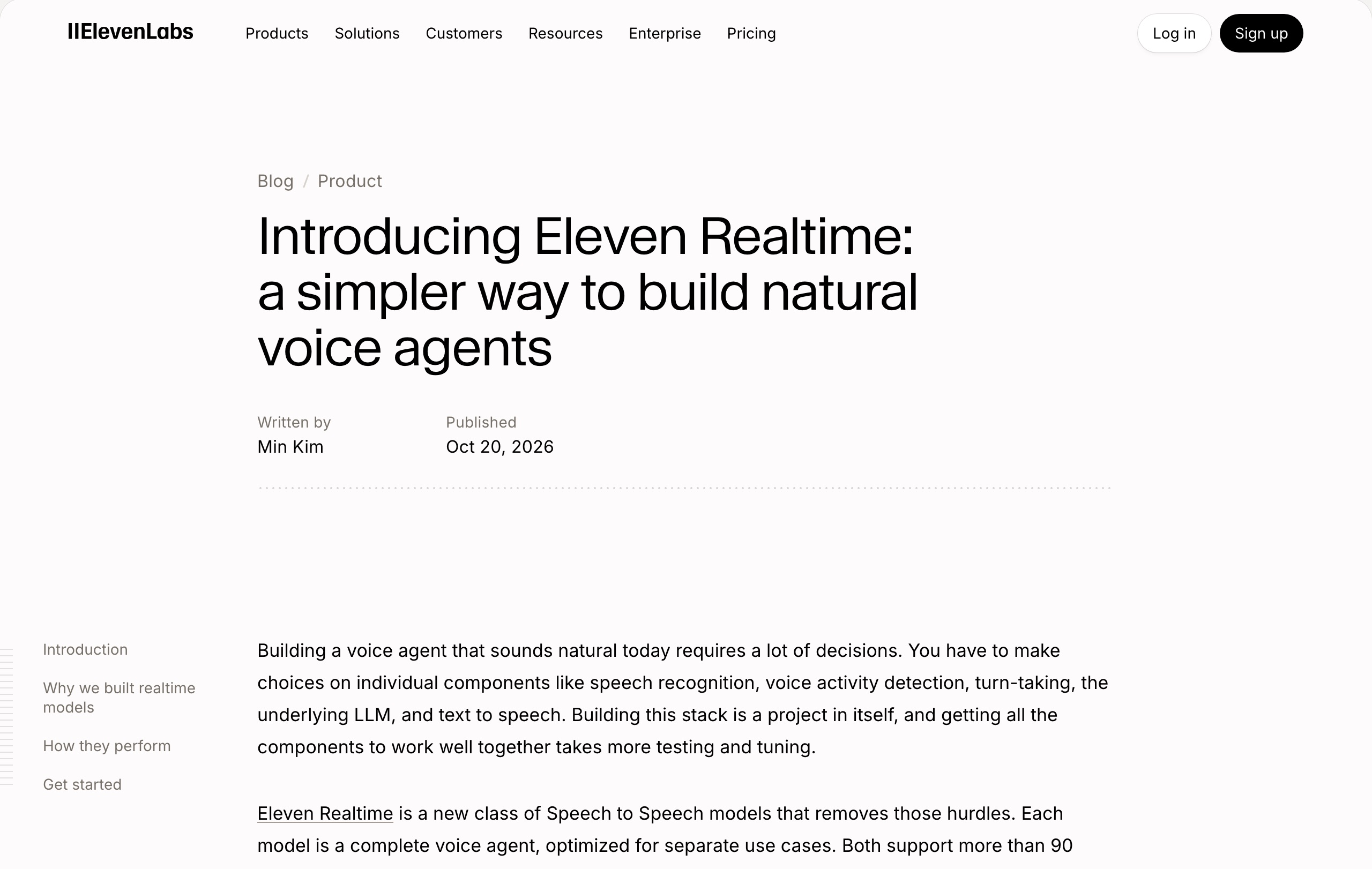 Screenshot: the ElevenLabs blog, Eleven Realtime announcement page (elevenlabs.io/blog/realtime)
What is the difference between v1 Mini and v1 Max?
Mini is built for fluid, low-cost conversation. Max is built for conversations where a task needs to be executed correctly. According to ElevenLabs, Mini suits assistants, tutors, and interactive characters. Max suits customer service, lead qualification, and appointment scheduling, and it "thinks before it answers."
The figures the company published, using benchmarks it selected itself:
| Metric | v1 Mini | v1 Max |
|---|---|---|
| Time to first audio (average) | 0.62 seconds | 0.57 seconds |
| Big Bench Audio (spoken reasoning questions) | 75.9% | 98.8% |
| Task completion with tools | 60.3% | 87.1% |
| Full-Duplex-Bench (conversation dynamics) | 95.8% | 94.1% |
The row that matters most for a business is the third one. An agent that schedules an appointment or checks an order status needs to invoke a tool, receive a result, and return it to the customer. That is where the gap between the models is largest: 87.1% versus 60.3%. On the other hand, Mini is slightly better at the flow of the conversation itself, such as handling interruptions and fast turn exchanges.
How do you connect this to phone, website, and WhatsApp?
You build an agent in ElevenAgents, ElevenLabs' platform for voice agents, and select Eleven Realtime as the model. According to the product page, the steps are: open or create an agent, choose v1 Mini or v1 Max from the list, configure instructions, tools, and a knowledge base, and publish to the desired channel. The channels the company lists: a phone line, a website widget, WhatsApp, and contact-center platforms.
Developers have a second path: a Realtime API that operates over a WebSocket connection and is compatible with OpenAI's Realtime protocol. According to the documentation, the events and the connection format are identical, so anyone who has already written a client for OpenAI swaps the server address and the session settings without rewriting the code from scratch. One caveat worth knowing: applications that run over WebRTC will need a change at the transport layer.
What does it cost, and does it work in Hebrew?
According to the API pricing page, both models cost $0.08 per connected minute, plus token charges from the model. Beyond the account's concurrent-call limit, a burst rate of $0.16 per minute applies. Token charges vary with conversation length and complexity, so the real cost per call is worth measuring in a pilot rather than estimating upfront.
On Hebrew: the documentation states that Realtime models support 90+ languages and points to the language list for Eleven v4, the voice model ElevenLabs launched on September 28, 2026. Hebrew appears on that list. That is what the spec says. How well the agent understands spoken Hebrew with slang, street names, and ID numbers, nobody has published yet, so test it yourself before routing real customers through it.
For full background on the company's tools, models, and pricing, see the complete ElevenLabs guide in Hebrew.
What does this mean for your business?
A clinic, a law office, or an insurance agency can deploy a voice agent that answers the main line, handles common questions, and schedules appointments, including after hours. What changed is not the capability itself. What changed is how much assembly work is required before the conversation sounds natural. And the hour saved on assembly is worth investing in testing.
Before going live, five things:
- Real Hebrew test calls. At least twenty calls, with different people, different accents, and background noise. Test names, dates, phone numbers, and addresses.
- Disclosure that the caller is speaking with AI. The first sentence of the call should make it clear the customer is speaking with an automated agent. It is both fair and saves the awkward moment when the customer figures it out on their own.
- Recording consent. If calls are saved or transcribed, that notice must appear at the start of the call. On the obligations of a business in Israel, see the guide to Amendment 13 to the Privacy Protection Law.
- Transfer to a human. A keyword like "agent," or detected anger and frustration, should immediately transfer to a real person or open a callback request. An agent that does not know when to step aside is the agent that loses customers.
- A "do not touch" list. Topics the agent does not approach at all: medical diagnoses, legal advice, price guarantees. Write this into the instructions and verify it holds even when a customer pushes.
My recommendation: start with v1 Max for scheduling and service, because there task execution matters more than a few hundredths of a second. Anyone who wants to understand all types of voice agents and when each one fits will find that in the voice agents guide, and anyone who wants to build one step by step can start with the interactive course for building a voice agent. For a business that prefers to have someone else build and deploy it, there is the AI agents for business service.
What is still unknown?
A few open questions worth watching:
- Gradual rollout: According to ElevenLabs' changelog, the models are "rolling out gradually across workspaces." They may not yet appear in your menu.
- Hebrew quality: No independent evaluation of comprehension and pronunciation in spoken Hebrew has been published yet.
- Independent benchmarks: Every number in the table was published by the company itself. Third-party evaluations have not yet appeared.
- Regional availability: Reports indicate that regulatory compliance and regional availability vary by model. A business that is required to keep data within a specific region needs to verify this before signing up.
- Total cost per call: Token charges are not broken down as a single number, so the real cost per call will only become clear in actual use.
Related stories from today: Perplexity Computer now runs locally on Mac, and on the infrastructure side, OpenAI models on Google Cloud.
Want to build an agent like this in your organization?
A good voice agent is not primarily a technology problem. It is a script, clear boundaries, and testing. That is exactly what we work on in workshops: Yaakov Tzedek runs AI workshops for organizations and businesses, where participants work on real processes from their own work. For those who want to build tools and automations themselves, there are the Claude Code workshops. No promises that you will leave with a phone agent ready to go live, but you will leave with a method for testing it before it speaks to your first customer.
Frequently asked questions

Yaakov Tzedek
An Israeli AI lecturer, consultant and implementer who has supported 100+ organizations in AI implementation and lectured for 200+. Official content partner of Meta, Google, Canva and TikTok, featured on Israel's Channel 13.
More about Yaakov →