- Manus receives a goal and finishes it independently: research, analysis, and a final deliverable. How it differs from ChatGPT, who it's right for, and what to watch out for.
Manus drew global attention when it demonstrated an agent completing complex tasks end to end with almost no human intervention, marking a clear shift from 'chat that answers' to 'agent that acts'.
Manus is an autonomous AI agent, and that is a fundamental difference from regular chat. Instead of answering a question and waiting, Manus receives a goal ("research the market and build a comparison report"), breaks it down into steps, and executes them on its own: browsing, gathering information, analyzing, and building a deliverable, until the task is done.
For many people, Manus marked the shift from "AI that answers" to "AI that does." This is precisely the AI Agents category, which is gaining serious momentum in 2026.
What is the difference between an agent and a chat?
This is the key point for understanding Manus:
- Chat (like ChatGPT): Responds to each message, and you drive the process step by step.
- Agent (like Manus): Receives a single goal and drives the process itself, planning, executing, correcting, and finishing.
For a deeper understanding of the category and how agents are built, see the complete guide to AI agents. And if you want to see how agents actually connect to systems and tools, the MCP guide in Hebrew explains exactly that layer.
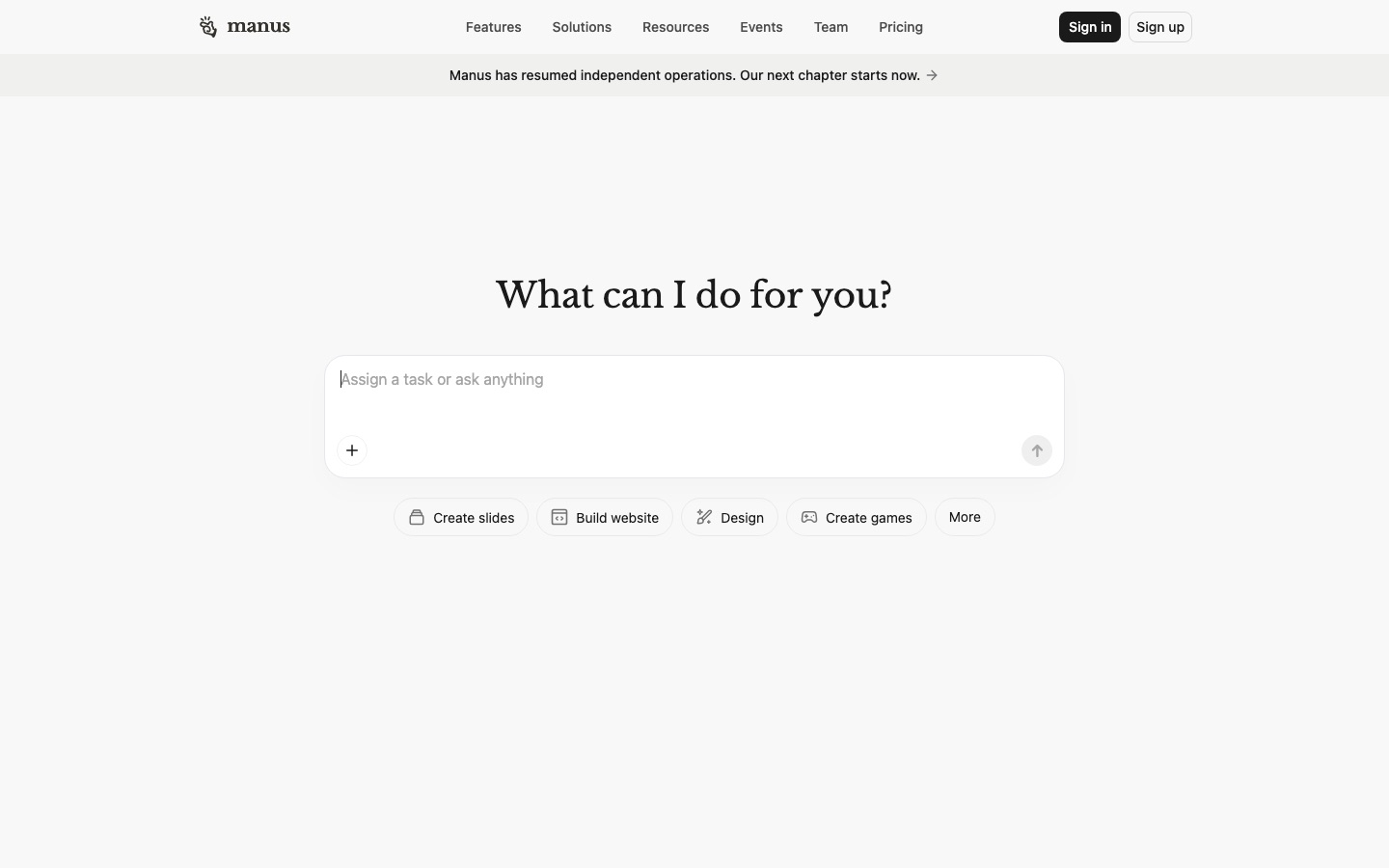 The official Manus website, photographed in September 2026. Credit: Manus
What can Manus do?
- Multi-step research: Collecting information from many sources and assembling a complete picture.
- Building deliverables: Reports, tables, presentations, or simple websites.
- Using tools: Browsing, files, and sometimes actions in external systems.
- Self-correction: Handling situations that were not defined in advance, mid-task.
💡 From the field: In my workshops I explain that an autonomous agent is a powerful tool, but not a "fire and forget" one. The longer the task, the greater the chance of an error along the way. The rule: a clear goal, defined boundaries and permissions, and verification of the output. For sensitive tasks, keep a human in the loop to approve critical steps.
Who is Manus right for?
- Researchers and analysts who need multi-source collection and analysis.
- Anyone who wants to delegate entire tasks to AI, not just ask questions.
- People interested in the future of agents who want to see where things are heading.
Common mistakes when working with an autonomous agent
From my experience in implementations and workshops, these are the mistakes that come up again and again, with Manus and with every other autonomous agent:
- A vague goal. "Do some market research for me" is not a goal, it is a wish. An agent needs a clear definition: what is being examined, who it is being compared against, and what a "finished" deliverable looks like.
- Giving a critical task on the first attempt. Start with tasks where, even if they fail, nothing is lost. Trust is built gradually.
- Not checking the output. An agent running dozens of steps can make a mistake in one of them, and that mistake carries forward. A report that looks impressive still requires fact-checking.
- Expecting an agent to replace judgment. It is excellent at gathering, assembling, and executing. Strategic decisions stay with you.
- Choosing an agent when chat is enough. For a focused question or drafting text, regular chat is faster and cheaper. An agent justifies itself on multi-step tasks.
Manus vs. chat vs. code agent: at a glance
| Chat (ChatGPT / Claude) | Manus | Code agent (Claude Code) | |
|---|---|---|---|
| Who leads? | You, step by step | The agent, end to end | The agent, within a code project |
| Best for | Questions, drafting, brainstorming | Multi-step research and deliverables | Development, automation, working on files |
| Oversight level | Full at every step | Checking the output at the end | Approving actions along the way |
Anyone who wants an autonomous agent that works on their own files and systems should also get to know Claude Code in Hebrew. And anyone looking for a personal agent you talk to by message alone, with no interface, should check out what is Instinct. For a broad map of all the relevant tools for working in Hebrew, there is the Hebrew AI tools guide.
Summary
Manus is an autonomous AI agent that executes tasks end to end, a clear example of the shift from a chat that answers to an agent that acts. It is powerful for research and multi-step tasks, and it requires a clear goal and oversight of the output.
My recommendation: get familiar with the logic of agents, this is the future. Want to learn how to build an AI agent for your business? Start with the AI agents guide and the free Claude course, and if you are an organization that wants to implement agents on your own processes, talk to me.
Further reading: Two more autonomous agents worth knowing, Genspark: the all-in-one agent environment and OpenClaw: the open-source personal agent that broke GitHub.
Frequently asked questions

Yaakov Tzedek
An Israeli AI lecturer, consultant and implementer who has supported 100+ organizations in AI implementation and lectured for 200+. Official content partner of Meta, Google, Canva and TikTok, featured on Israel's Channel 13.
More about Yaakov →