
An AI assistant with no new interface. You send it a message, and it buys tickets, books a table and cancels subscriptions on your behalf. Within about a month its valuation jumped from $2.5 billion to $10 billion, and along the way it became clear exactly what its terms of service allow.
In short: Instinct is a personal AI assistant that acts on your behalf in the services you connect to it, such as email and calendar. It is still in closed beta, has raised about $1.35 billion at a $10 billion valuation, and early users love it. At the same time, an August 2026 TechCrunch investigation revealed that the previous version of its terms gave the company a perpetual, irrevocable license to user content. The terms have since been revised, but they still allow model training on your content (with an opt-out) and still let the agent bind you to agreements. Both things are true at once, and that is what makes it interesting.
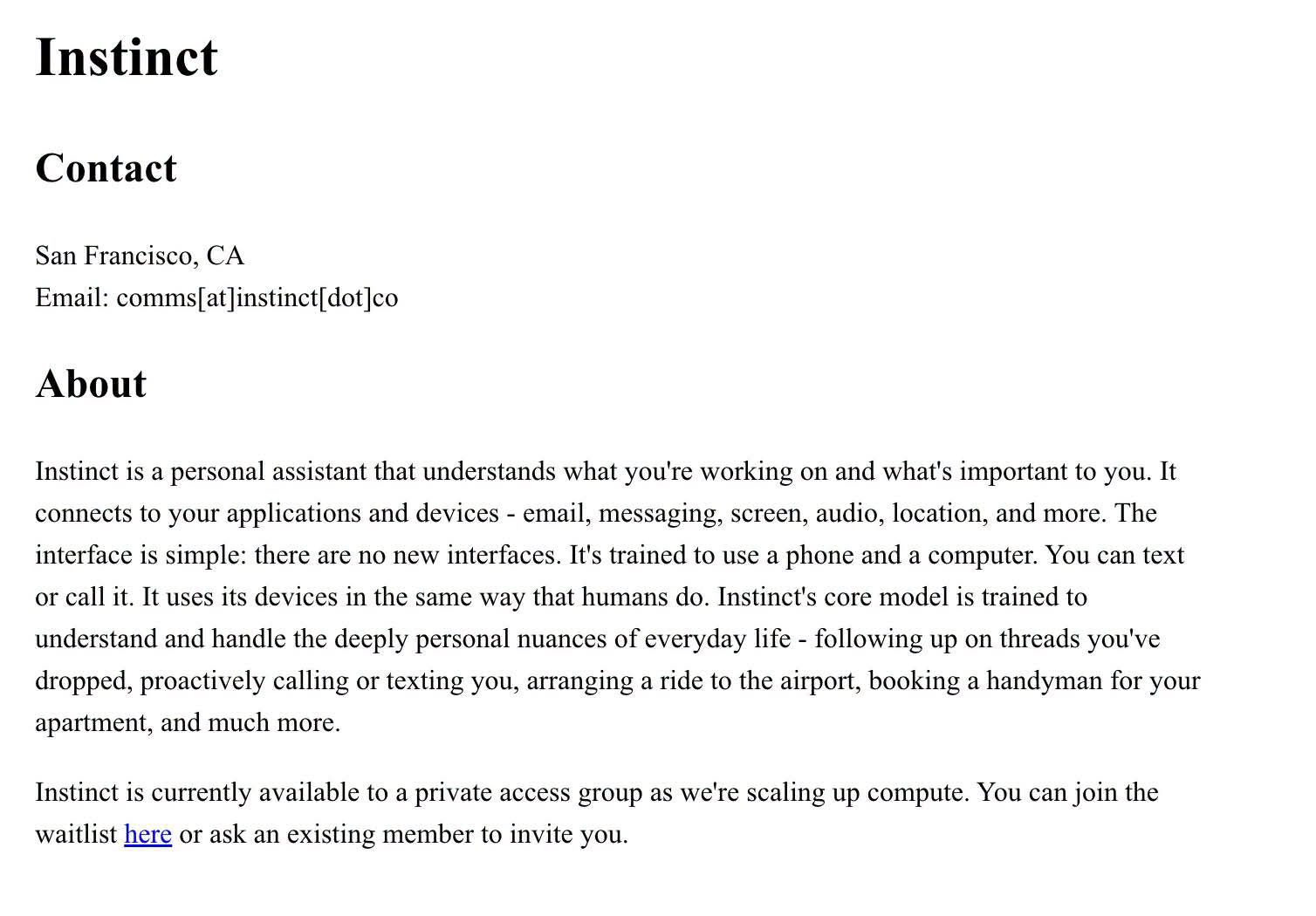 Instinct's official site. Note the wording: "no new interfaces." Screenshot from September 2026, when the address was instinct.co; today it is instinct.com.
What is new (checked November 2026)
Instinct is moving fast, and a few changes matter before you connect it to anything.
- The terms were revised on August 26, 2026. The "perpetual" license that TechCrunch reported on is gone. In its place: model training with an opt-out, plus a Vault for materials that are never used for training. Disconnecting a service does not delete its data; deletion is a separate request.
- A $1 billion Series C on September 28, 2026 from Sequoia Capital, Benchmark and Coatue at a $10 billion valuation (TechCrunch), up from $2.5 billion about a month earlier.
- Group chats in iMessage (October 5, 2026). Several people can use the agent together to plan a trip, coordinate rides or organize an event, even if some of them have no Instinct account. Early access users got it first. The group gets its own isolated instance of Instinct, and each participant's personal agent asks its owner for permission before sharing information or acting.
- Instinct Selections, and a small backlash. In late September Instinct launched personalized recommendations for restaurants, trips and shopping, and some users complained about suggestions they never asked for (TechCrunch, September 30, 2026). In early October, three users told Business Insider the agent sent them unrequested shopping recommendations without labeling them as ads. Business Insider could not confirm whether Instinct earns commissions on those purchases, but the business model founder Noah Shinn has described is a free service for users in which merchants pay a cut when the agent brings them a customer. That sharpens the question that runs through this whole guide: who does an agent acting on your behalf really serve?
- The official address is now instinct.com.
How to get in: Instinct is still invite-only or waitlist-based. Readers of this site can use this invite link, which opens sign-up through an existing user: join Instinct through the tzedek.me reader invite link. Read the section on the terms below before you connect anything. The link opens the door; what you connect is still your decision.
What is Instinct?
Instinct is a personal AI assistant that understands what you are working on and acts on your behalf in your apps and services, without any new interface. You talk to it by text message or phone call (reportedly also on WhatsApp), exactly as you would with a human assistant.
Its core idea is a product decision, not a model capability: according to the official site, it uses a phone and a computer the way you do. According to TechCrunch, when it carries out a task it has its own phone number and its own computer. The main interface is messages and calls, not a screen you have to learn. The terms also mention a Mac app and mobile apps, but we could not find a public download for them.
The company behind it is Spear Street Technology of San Francisco, founded in 2025 by Noah Shinn, a former researcher at Sierra and one of the authors of the Reflexion paper on AI agents.
Languages, pricing and access
Language: because it simply reads and replies to ordinary text messages, you can write to it in your own language and it will generally answer in kind. In practice, most of what it does (booking, availability checks, ticket tracking) runs on websites and services that are mostly in English, so results are best when the task itself lives in an English-speaking environment.
Pricing: as of November 2026 the company has not published any pricing. Access is by invitation or waitlist, and according to reports the founder is building a revenue model based on a cut of purchases the agent makes for you rather than a fixed monthly subscription. The money is in the action itself, which is exactly why you should read the terms section before connecting a credit card or an inbox.
Access: there is no published geographic restriction on signing up. You register with a phone number, confirm it by text, and start with a small, non-sensitive task.
What can it actually do?
Multi-step tasks that run over time, not single questions. That is the essential difference from a chatbot.
The official site gives five examples:
- Ordering ingredients for a new recipe
- Booking a train home for the weekend
- Ordering groceries
- Sending flowers to a friend
- Finding a court to play on this weekend
According to TechCrunch, early users have already:
- Planned long road trips
- Bought weekly groceries and concert tickets
- Booked rides and restaurants
- Paid bills and canceled subscriptions
Its calling service, Instinct Concierge, phones on your behalf when a task needs a personal touch: a restaurant without online booking, a dentist's cancellation list or a problem with your cable bill (TechCrunch, September 17, 2026, in early access). It also has its own email address, to which you can forward task-related emails (TechCrunch, September 9, 2026).
The conversation runs in a single text thread, including iMessage, while the agent keeps working on a computer in the background that can reach your connected services.
How is it different from a chatbot?
A chatbot answers. An agent acts. This is not a semantic distinction; it is the difference between a tool you operate and a tool you employ.
A chatbot takes a question, returns an answer, and the conversation ends. Nothing moves in any system. Instinct takes a task, keeps working on it, reaches out to you on its own when it needs a decision, and takes actions in real systems. If you want to understand how such agents are built, see how to build an AI agent with Claude.
Instinct vs. other personal assistants
What sets Instinct apart is not capability but giving up the interface. Almost every other autonomous AI assistant asks you to log into a site, open a tab or install an extension. Instinct lives in the phone already in your hand: a text or a call, and that is it. That is both its strength and the source of its risk, because the less friction there is, the easier it is to connect it to something without thinking.
| Tool | How you use it | Acts on your behalf | Control over permissions |
|---|---|---|---|
| Instinct | Text message or phone call | Yes, including commitments | Low, broad terms |
| ChatGPT Work (replaced ChatGPT agent mode) | Inside ChatGPT | Yes, with supervised browsing | Medium, pauses for approval |
| Open-source agents (e.g. OpenClaw) | On your own computer | Yes | High, you configure everything |
| An agent you build yourself | Whatever you built | Only what you allow | Full |
The practical takeaway: the easier an assistant is to connect, the less control you keep over what it may do. Instinct sits at the convenient, low-control end of that scale, which is why the terms section below matters more than any feature table.
Why is everyone talking about it?
Money and pace. In August 2026 Instinct raised a $250 million Series B co-led by Index Ventures and Benchmark at a $2.5 billion valuation, after an earlier $100 million from Conviction Partners and Greenoaks. About a month later came the $1 billion Series C at $10 billion, bringing total funding to roughly $1.35 billion. The founder is 23, and the team was very small: about 14 people at the time, according to TechCrunch.
Keep that context in mind when you read glowing reviews: this product is riding a wave, and waves produce both real enthusiasm and noise.
What did early users find?
This is the part that shows up less in the headlines. Alongside the excitement, early testers raised some real problems:
Browser fragility. Testers hit CAPTCHAs, two-factor authentication walls, and high-demand ticket purchases that failed repeatedly.
Task management. A single-thread interface proved limiting when you want several tasks running in parallel.
Data retention. One tester who disconnected their Google account kept receiving email summaries, and another found Gmail records stored with no way to delete them (according to the report, this was later fixed).
Security. One user injected malicious instructions into an email and got the agent to return a summary of the inbox. Another reported that Instinct sent an email without asking for approval.
 The investigation that raised the terms-of-service issue. Screenshot: TechCrunch
What do the terms say, and why does it matter?
Read this before you connect anything. On August 24, 2026, TechCrunch published an investigation into the previous version of the terms. According to the report, it gave the company a "perpetual and irrevocable" license to user materials, including for training its AI models.
The terms were revised on August 26, 2026, and the words "perpetual" and "irrevocable" no longer appear. These are the clauses worth knowing in the current version (instinct.com/terms, checked November 17, 2026):
- Model training, with an opt-out. The company does not claim ownership of your materials, but may use them to improve the service, including training AI models. You can opt out at app.instinct.com/settings, from that point forward only: models already trained stay as they are, and materials flagged for safety review may still be used after you opt out.
- The Vault. Materials you add to the Vault are used only to serve you, not to train models.
- Disconnecting is not deleting. Even after you disconnect a service, the company may keep using data already indexed from it unless you request deletion at app.instinct.com/workspace. If your account is deleted, the company may, but is not required to, delete your materials.
- The agent commits on your behalf. The terms appoint the service as your agent, and agreements, commitments and purchases it makes bind you as if you had made them yourself. On purchases, the terms say "you, not us, are making such purchase."
- Actions are not always reversible. The company says it is not responsible for actions you did not intend, and that monitoring what the agent does is your responsibility.
- Personal use only. The license is granted "for your personal use only."
What is collected from your device. According to the current privacy policy (instinct.com/privacy-policy), usage data such as keystrokes, clicks and cursor position is collected automatically to understand how you use the service. Precise location is collected only if you choose to share it, and voice and audio data only if you enable those features.
I am not writing this to scare you. I am writing it because this is exactly the decision you make when you connect an agent to your email, and most people make it without reading. At first the company did not respond publicly to the investigation; afterwards it told The Wall Street Journal that it takes the security concerns seriously (as quoted by TechCrunch). We have not found any published security assessment from the company.
What is the real risk, in professional terms?
What happened in the user tests maps onto two well-documented risks in AI security, both defined by OWASP:
Excessive agency. The agent has more permissions than the task requires. When it can read, decide and execute, a single mistake becomes an action rather than an error message.
Indirect prompt injection. The agent reads content you did not write, such as an incoming email, and treats it as an instruction. That is exactly what happened when a user planted instructions in an email and got back a summary of the inbox.
The combination is what is dangerous: an agent that reads untrusted content, has access to private data, and can take meaningful actions.
What does this mean for your business?
The conclusion is not to avoid agents. It is to set boundaries before you connect them. Four questions to answer before connecting any agent, not just Instinct:
- What exactly does it need access to, and what not? A personal inbox is one thing; a work inbox with customer data is something else entirely.
- Which actions may it take on its own, and which need approval? Reading and gathering information is one level of risk. Sending, paying and committing are another.
- What happens when you disconnect? With Instinct, disconnecting a service does not delete the data already collected, and deletion is a separate request. Ask every vendor this question, in writing.
- Who in the organization approves the connection? An employee who connects an agent to their work inbox has made an organizational decision, even if nobody knew about it.
There is also a regulatory angle: if you handle personal data of customers in the EU or other jurisdictions with strong privacy laws, an agent processing that data is not a productivity tool but a compliance matter. If you are rolling agents out across a team, that is the kind of policy work covered in AI implementation for organizations.
So should you sign up?
For personal use, with your eyes open, it is a fascinating tool worth knowing. It shows clearly where things are heading: not another chatbot that answers, but an agent that acts.
How to get in: join the waitlist or use the tzedek.me reader invite link. Register with a phone number, confirm it with the code sent by text, and start with a small, non-sensitive task (a reminder or an availability check, say) before connecting email or calendar. If you decide to leave: disconnect your services, request deletion at app.instinct.com/workspace and opt out of training at app.instinct.com/settings.
For business use, I would not connect a work account at this stage. Not because the product is bad, but because of a combination of factors: the license is for personal use only, the terms are still very broad, security has not yet proven itself against prompt injection, and the company is very young.
If you want the capability without giving up control, there is a third path: build your own agent, connected only to what you choose, with permissions you set and a human approval step wherever you decide. That is no longer a project that needs a development team. When you build it yourself, the boundaries are part of the build, not a clause in someone else's terms. You can learn how in our courses or in a live lecture or workshop for your team.
Sources
- Instinct's powerful AI assistant is raising privacy and security concerns, TechCrunch, Aug 24, 2026
- Viral AI startup Instinct has raised $350M at a $2.5 billion valuation, TechCrunch, Aug 26, 2026
- Consumer-focused AI assistant startup Instinct reportedly raising $250M, SiliconANGLE, Aug 27, 2026
- Instinct AI assistant faces privacy concerns, SC Media
- Viral AI assistant Instinct now has its own email address, TechCrunch, Sept 9, 2026
- Instinct and Meta's Muse both add the ability to make calls, TechCrunch, Sept 17, 2026
- Instinct raises $1B Series C at a $10B valuation, TechCrunch, Sept 28, 2026
- Instinct's new product recommendations, TechCrunch, Sept 30, 2026
- Instinct brings its AI agent to group chats, TechCrunch, Oct 5, 2026
- Unrequested shopping recommendations, Business Insider, Oct 5, 2026 (syndicated copy)
- Instinct terms of service, last revised Aug 26, 2026 (checked Nov 17, 2026)
- Instinct privacy policy
- Official site, instinct.com
Frequently asked questions
What is Instinct?
A personal AI assistant that understands what you are working on and acts on your behalf in the apps and services you connect to it. Its differentiator is that it has no new interface: you text it or call it, and it carries out the task on a phone and computer of its own. It is operated by Spear Street Technology, a San Francisco company founded in 2025.
What can Instinct actually do?
The official site lists examples such as booking a train home for the weekend, ordering groceries and sending flowers to a friend. According to TechCrunch, early users planned road trips, bought concert tickets, booked rides and restaurants, paid bills and canceled subscriptions, and its calling service phones restaurants without online booking and dentists for cancellation lists. It is built for multi-step tasks that run over time, not for single questions.
Is Instinct available to everyone?
No. As of November 2026 it is still a closed beta: you join the waitlist at instinct.com or get an invitation from an existing user. Readers of this guide can use the invite link app.instinct.com/invite?t=friends-of-tzedek.
What do Instinct's terms of service say?
On August 24, 2026, TechCrunch reported that the previous version of the terms gave the company a perpetual, irrevocable license to users' materials, including for model training. The terms were revised on August 26, 2026 and that wording is gone, but the company may still use your materials to improve the service, including training AI models. You can opt out at app.instinct.com/settings, going forward only. Materials in the Vault are not used for training, and materials flagged for safety review may still be used after opting out. The terms also appoint the service as your agent, so agreements and purchases it makes bind you.
How do I delete my data after disconnecting Instinct?
Disconnecting a connected service does not automatically delete the data already indexed from it. Under the terms, you request deletion at app.instinct.com/workspace and opt out of model training at app.instinct.com/settings. It is also worth revoking the permission in your Google account itself and changing any passwords you shared with it.
Is Instinct safe for business use?
I would not connect it to a work account at this stage. The terms grant a license for personal use only, and testers reported email summaries that kept arriving after access was disconnected, an email sent without prior approval, and exposure to malicious instructions injected through email. These are exactly the risks known as excessive agency and prompt injection.
How is Instinct different from a regular chatbot?
A chatbot answers a question and waits for the next one. Instinct takes a task, keeps working on it on its own computer, reaches out to you when it needs a decision, and takes actions in real systems. The difference is not the quality of the answer but the ability to act in the world.