
- What Jasper is, how Brand Voice, knowledge base and marketing agents work, Pro vs. Business pricing, Hebrew support, privacy, and Jasper vs. ChatGPT, Claude and Writesonic.
Jasper's Style Guide lets workspace admins set rules down to comma usage and em dash handling, applied at the moment of generation rather than as an after-the-fact correction. The feature is available on the Business plan only.
Jasper costs $69 per seat per month, and according to the company's website it runs models from OpenAI, Google, Anthropic, and Meta. That means the AI underneath it is the same one already open in another tab. That is not what you are paying for.
You are paying for the layer on top of the model: a brand voice saved once and used everywhere, a knowledge base the whole team works from, style rules enforced at the moment of writing, and agents built around specific marketing tasks. For a team of six people writing in three different voices, that is worth money. For a solo business owner writing alone, probably not. And there is one more question every marketing manager in Israel has to ask before handing over a credit card: what happens with Hebrew.
This guide was built from the pricing page, product pages, security and trust pages, and Jasper's official Help Center (reviewed September 15, 2026). It is aimed at marketing managers and agencies in Israel: what the tool does, how to launch a first campaign, how much it costs, what is officially known about Hebrew, and when you are better off staying with ChatGPT or Claude.
In short
| Question | Short answer |
|---|---|
| What it is | An AI platform for marketing teams: agents, brand voice, knowledge base, and Canvas for collaborative work |
| How much it costs | Pro: $69 per seat per month, $59 billed annually. Business: custom pricing, one-year commitment |
| Free plan | No free plan. 7-day trial, credit card required |
| Hebrew | Not on the official language list. You can request it in a prompt, and you must test before you pay |
| Privacy | According to the company, your content is not used to train models. SOC 2, GDPR, US-based storage |
| Best fit for | Teams and agencies with multiple writers, multiple brands, and a need for shared rules |
What is Jasper?
Jasper is an AI platform built for marketing teams, not for general conversation. Instead of an empty chat box, you get task-specific agents (campaign brief, search ad, email sequence) and a context layer that travels with every piece of content: how the brand writes, what is true about the product, and who the audience is.
Definition: Jasper is a cloud platform for creating marketing content with AI. It combines a library of more than 100 marketing agents, a brand layer called Jasper IQ (brand voice, knowledge base, audiences, style guide, and visual guidelines), a collaborative workspace called Canvas, and a bulk-production tool called Grid. The underlying models come from multiple providers, and Jasper routes each task to the model best suited for it.
One important thing to understand: Jasper does not develop its own large language model to replace GPT or Claude. In its official architecture documentation it describes ongoing evaluation of new models against real marketing tasks, and routing each task to whichever provider performs best. The advantage it sells is that you do not have to track every model release yourself.
The practical implication: the baseline writing quality is close to what you would get from the leading models directly. The difference lives in consistency, team sharing, and control.
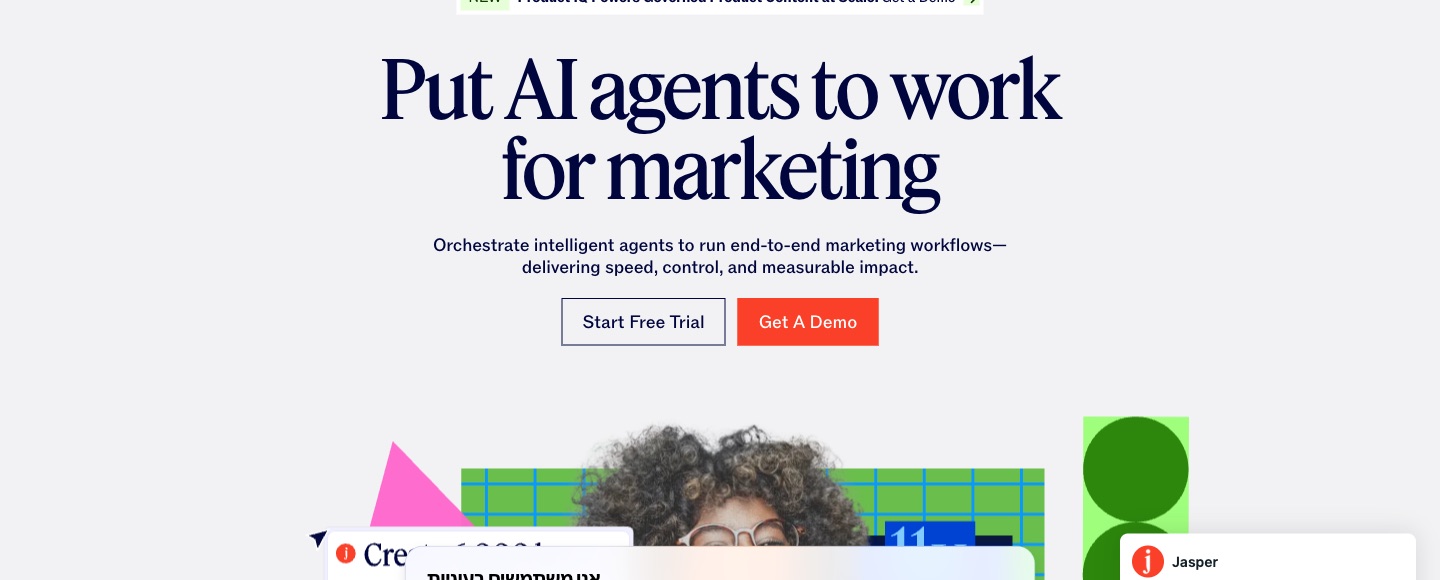 Jasper's official homepage, captured September 2026. Credit: Jasper
What can Jasper do?
The tool is built from a brand layer, a set of agents, and two work surfaces: Canvas for projects and Grid for volume. Here are the core capabilities from the Help Center, each with one business use case:
- Brand Voice: Upload up to 8 writing samples (text, .txt, .pdf, .docx files, or URLs) and Jasper analyzes the tone and style. You can preview two versions of the same text, one with the voice applied and one without. Use case: an agency that maintains a separate voice for each client.
- Knowledge Base: Store product details, messaging, FAQs, and positioning as text, audio, images, video, documents, or URLs. You can attach up to 5 knowledge items to any agent or chat generation. Use case: a product page that does not invent features.
- Knowledge Connectors: Sync a folder from Google Drive or SharePoint, one-way and read-only. Changes to a file update within 1 to 10 minutes, and only files in the root folder are synced. Use case: the department's messaging document stays a single source of truth.
- Audiences: Persona profiles. Pro allows up to 3 audiences per generation; Business allows up to 4. Use case: one email that speaks to both the CFO and the CTO.
- Style Guide: Writing rules, terminology, and capitalization enforced at the moment of creation. Can be generated automatically from 1 to 3 documents in roughly 4 to 5 minutes (beta). Business-only. Use case: the product name is spelled correctly every time.
- Canvas: A project environment with a two-dimensional canvas and table view, real-time editing, comments, and project-level settings (voice, audience, goals) that every asset in the project inherits. Use case: all launch assets in one place.
- Agents: A library of more than 100 agents, organized by marketing discipline, content type, and funnel stage. Pro includes agents for core workflows; Business adds GEO, translation, and deep-research agents. Use case: a campaign brief that generates ads and emails downstream.
- Jasper Studio: A no-code agent builder with input fields, files from the knowledge base, and publishing permissions. Business-only. Use case: a "LinkedIn post in our format" agent deployed to the whole team.
- Grid: A spreadsheet-style interface that runs a workflow on up to 1,000 rows, such as product descriptions or bulk translations. Available in Business on request from the account team. Use case: 300 product descriptions from a CSV file.
- GEO Hub and GEO Agent: Measures brand visibility in responses from ChatGPT, Gemini, Claude, and Perplexity, and suggests actions. The agent publishes nothing without approval. Use case: finding out why a competitor is cited and you are not.
- Extensions and integrations: A Google Docs add-on, a Word add-on, a browser extension for Chrome and Edge, and on the integrations page: Webflow, Semrush, Salesforce, Slack, Asana, Monday.com, Zapier, and Make. Use case: writing in Jasper without leaving the document.
How to get started: step by step
The right way to start is to set up the brand layer before you write a single sentence. The Help Center recommends starting with one brand voice, 2 audiences, and 5 knowledge items. This is the order that works for a first campaign:
- Start a 7-day trial and mark day six in your calendar. A credit card is required, and the subscription starts automatically at the end of the trial period. A reminder on day six gives you time to decide without pressure.
- Build one brand voice. Upload 5 to 8 texts the brand has actually published and that you like: posts, a landing page, a newsletter. Run the preview and compare the version with the voice applied to the version without it. If there is no clear difference, the samples are not representative enough.
- Upload 5 knowledge items. A product page, a pricing document, FAQs, a messaging document, and a competitor document. This is what prevents the agent from inventing features or prices.
- Define 2 audiences. For example, "marketing manager at a mid-size company" and "small business owner." A short description of pain points, objections, and what matters to them is enough to start.
- Open a project in Canvas and set the context. In the project settings, select a voice, audiences, and campaign goal. Every asset created in the project inherits them, which prevents the common mistake of one asset written without the voice.
- Run a brief agent and derive assets from it. Start with a campaign brief, edit it manually, and only once it is accurate ask it to generate a search ad, three posts, and an email. Check each asset against the knowledge base, and share the project with whoever needs to approve it.
A reasonable result after two days of work: one campaign project with a brief and several assets, all written in the same voice. That is exactly what you need to decide whether to pay.
Hebrew and RTL
Hebrew is not officially supported as a default language in Jasper, as of September 15, 2026. The language list in the Help Center includes 33 languages and dialects, among them Greek, Turkish, and Ukrainian, but not Hebrew. The pricing page mentions "30+ languages" in Pro.
What is officially stated: The Help Center opens with a sentence that Jasper can help write in "almost any language." For languages not on the list, it recommends changing the language at the project or agent level, or adding an explicit instruction to the prompt such as "write in Hebrew." The translation agent supports 27 languages including Arabic, but the full list appears only inside the interface, and Hebrew is not mentioned in the documentation.
What this means in practice: The models underneath Jasper do write Hebrew, so you will likely receive Hebrew-language output. What is not guaranteed is everything built on top of them: analysis of brand voice from Hebrew writing samples, style guide rules, right-to-left alignment in the editor and in exports, and agents that may revert to English mid-output. The Help Center itself notes that if Jasper keeps writing in English after a language change, you should contact support.
A testing protocol for the trial period (about half an hour):
- In the agent settings, check whether Hebrew appears in the language selector. If it does not, work with an explicit instruction in the prompt.
- Build a brand voice from three to five Hebrew texts and check whether the voice description and preview understand the tone or only translate it.
- Run the same agent three times and check whether the output stays in Hebrew throughout the entire text, including headings and lists.
- Write a sentence that mixes Hebrew, an English product name, and a number, and check word order and punctuation at the end of the line.
- Export to Google Docs and Word and check paragraph direction, bullets, and tables.
- Request a product description from a Hebrew knowledge base and verify that the facts were retrieved correctly and not translated back and forth.
If three of the six tests fail, Jasper is probably not the right tool for producing Hebrew content on a regular basis. It may still suit an agency that writes primarily in English for clients abroad.
How Much It Costs: Every Plan from the Official Site
There are two plans: Pro at a published per-seat price, and Business at a custom quote. There is no permanent free tier, only a 7-day trial. Prices are from the official pricing page, verified September 15, 2026. Prices change, so check the official site.
| Plan | Price | What You Get | Limitations |
|---|---|---|---|
| Trial | $0 for 7 days | All features of the selected plan | Credit card required, auto-renews to paid |
| Pro | $69 per seat/month, or $59 billed annually | Canvas, agents for core workflows, 2 brand voices, 5 knowledge assets, 3 audiences, 30+ languages, image generation, browser extension, basic integrations, email support | No Studio, Grid, API, style guide, groups, or SSO |
| Business | Custom pricing, 12-month commitment | Everything in Pro, plus GEO agents, translation and research agents, no-code agent builder, Grid, unlimited voices/knowledge/audiences, API, groups and permissions, SSO/SAML, style guide, customer success manager | Some actions consume credits |
What you actually pay: With Pro, you pay per seat, meaning one charge per person on the team. Three writers on annual billing comes to $177 a month before tax and fees. With Business, according to the help center, pricing is a platform fee plus credits. Chat, agents, Studio, and the brand layer are unlimited, but API and MCP, Grid rows, research and optimization agent runs, and the GEO Hub all draw from a shared credit bank across the workspace. An admin can cap credits per user. Plagiarism checking (powered by Copyleaks) is a separate paid add-on.
The cheapest plan that works for a small Israeli business: Pro, one seat, monthly billing, $69, for a month or two of real testing. Commit to annual billing only after Hebrew has passed the protocol described above. And honestly: a business where one person writes, in Hebrew, will get most of the value from ChatGPT or Claude with a project that holds the brand voice, at a fraction of the price.
Use Cases for Israeli Businesses
The value of Jasper grows with the number of people writing in the brand's name. Five scenarios by role (examples for illustration):
Digital agency owner: Each client gets their own brand voice, audiences, and knowledge base, and in the Business plan a private group that keeps clients separated. A new writer who joins a client account starts from the same context, not from six months of WhatsApp messages. The time test: how many revision rounds per month does each client save.
Marketing manager at a B2B company: One campaign brief in Canvas, from which search ads, an email sequence, and LinkedIn posts are generated, all with two audiences: the end user and the budget approver. The messaging document lives in Drive and syncs to the knowledge base, so updating a message carries through to every future asset.
Marketing operations at an online store: A CSV of products goes into Grid, and an agent column writes a description for each row according to the voice and style guide. Important to verify: if the descriptions are in Hebrew, run 20 rows first and review them manually.
HR and employer branding: A separate brand voice for recruitment content, an audience of "a developer with five years of experience," and a knowledge base holding benefits and culture. A job ad, a social post, and an outreach email all come back in the same tone. Personal candidate information should not be uploaded, only general content.
Sales and agencies with international clients: A sales deck in English, and the translation agent (in Business) prepares versions for other markets using a fixed glossary from the knowledge base. This is where Jasper is especially strong, because those languages are officially supported.
Jasper vs. ChatGPT/Claude and Writesonic: An Honest Comparison
ChatGPT or Claude win on flexibility and Hebrew, Jasper wins on team control, and Writesonic focuses on search visibility. A comparison based on what is publicly available from the official sites:
| Jasper | ChatGPT or Claude with custom instructions and projects | Writesonic | |
|---|---|---|---|
| Focus | Team-based marketing content production | General-purpose assistant for any task | SEO and visibility in AI search engines |
| Brand voice | Built-in, with preview and workspace default | Custom instructions and project files, more manual | Brand voices by plan (1 to 10) |
| Team controls | Permissions, groups, style guide, SSO in Business | Available in enterprise plans, less marketing-specific | Users by plan |
| Hebrew | Not on the official language list, via explicit prompt | Writes Hebrew well (test on your own content) | Not mentioned on the pricing page |
| Entry price | $69 per seat/month | Free tiers and personal subscriptions available | From $79/month billed annually |
| Trial | 7 days, credit card required | Free tier | Trial without a credit card |
When to choose each:
- ChatGPT or Claude: One or two writers, content in Hebrew, a low budget, and willingness to maintain your own brand voice file and project. This is the approach behind the guide to Claude projects and skills, and it starts with good prompts for marketing.
- Jasper: A team of three or more, or an agency managing multiple clients, content primarily in supported languages, and a genuine need for shared rules, permissions, and a single source of truth.
- Writesonic: When the central question is how the brand appears in ChatGPT and Gemini answers. According to its pricing page, Starter costs $79/month billed annually and includes tracking for 50 prompts and 15 articles per month. Jasper has a comparable GEO Hub, but only in Business.
Exactly what each Writesonic plan measures, and which engines are missing from the standard plans, is covered in the complete Writesonic guide.
Privacy and Limitations
According to Jasper, your content is not used to train models, and ownership stays with you. The pricing page states this explicitly, and the trust page adds that data and outputs are not used to train third-party models.
What the official pages declare:
- Compliance with SOC 2, PCI, DPA, CCPA, and GDPR (trust page), with a SOC 2 report available on request through the security portal.
- Hosted on Google Cloud in the US-East1 and US-East4 regions, meaning in the United States. Encryption in transit via TLS 1.2 and above (default 1.3), and at rest via AES-256.
- Annual penetration testing by an external party, and SSO.
- Data deletion through the privacy center. Workspace deletion is permanent and can only be requested by an admin.
What not to upload: Customer details, contact lists, personal medical or financial information, and contracts. The knowledge base is designed for facts about your brand and product, not CRM data. An organization subject to Israeli data storage requirements should verify that US-based storage is acceptable before uploading internal documents. It is worth anchoring this in an organizational AI policy.
The browser extension: According to the help center, the extension accesses text on every page you visit, and can be disabled on specific sites. In an organization, disable it on internal systems.
Limitations, honestly:
- Hebrew is unofficial, as detailed above. This is the most important limitation for the Israeli market.
- Many of the strongest capabilities are Business-only: style guide, Studio, Grid, API and MCP, groups, translation and research agents. Pro is a trimmed-down version.
- Business requires a one-year commitment and credits for heavy operations, so the final cost is not known in advance.
- HubSpot does not appear on the official integrations page. A connection is possible via Zapier, Make, or the API, meaning extra setup work.
- The Webflow integration is still in beta, requires an application, and only one Webflow workspace can be connected.
- The sensitive content filter may block innocent text by mistake, and the help center acknowledges it errs on the side of caution.
- You do not choose the writing model. Jasper decides which model to route each task to, and it is not always clear what is running underneath.
Common Mistakes
- Writing before defining voice, knowledge, and audiences. Without that layer, Jasper is an expensive chat interface and the output comes out generic.
- Building a brand voice from text you do not actually like. The voice learns exactly from what you upload. Five strong examples beat eight mediocre ones.
- Paying annually before testing Hebrew. The test takes half an hour, and committing annually to a tool that does not write good Hebrew is far more expensive.
- Forgetting the trial is running. The card is charged automatically on day eight. Cancel or commit, do not just forget.
- Trusting the agent on facts. Even with a knowledge base, verify prices, dates, and product names before publishing.
- Uploading personal information to the knowledge base. Brand and product, yes. Customers and employees, no.
Frequently Asked Questions
What is Jasper?
Jasper is an AI platform for marketing teams: agents for writing campaigns, blogs, ads, and emails, built on top of a layer called Jasper IQ that holds brand voice, knowledge base, audiences, and style guide. According to the official site, it routes each task to the appropriate model from providers including OpenAI, Google, and Anthropic.
How much does Jasper cost?
According to the pricing page (verified September 15, 2026): Pro costs $69 per seat/month, or $59 billed annually. Business is custom pricing with a 12-month commitment. There is a 7-day trial. Prices change, so check the official site.
Does Jasper have a free plan?
No. There is a free 7-day trial for the Pro plan. According to the help center, a credit card is required at sign-up, and if you do not cancel before the trial ends, the subscription starts and the card is charged.
Does Jasper write in Hebrew?
Hebrew does not appear on the default language list in the help center. In that same document, Jasper states that you can write in almost any language through an explicit instruction, such as "write in Hebrew." Hebrew is therefore possible but not officially supported, and you must test it during the trial period.
Does Jasper train models on our content?
According to the pricing page, Jasper does not use your data to train models, and ownership of the content remains yours. The trust page adds that data and outputs are not used to train third-party models. The company declares compliance with SOC 2, GDPR, and CCPA.
What is the difference between Pro and Business?
Pro is priced per seat and suits individual writers: Canvas, basic agents, 2 brand voices, 5 knowledge assets, and 3 audiences. Business adds advanced agents (GEO, translation, research), a no-code agent builder, Grid, API, style guide, groups, SSO, and unlimited quantities across the board.
Jasper or ChatGPT?
ChatGPT or Claude with custom instructions and projects is enough for most small businesses, and both work well in Hebrew. Jasper justifies the price when there is a team writing at high volume, multiple brands or clients, and a real need for shared rules, permissions, and management-level oversight.
Jasper or Writesonic?
Jasper focuses on branded content production for teams: brand voice, knowledge, Canvas, and agents. Writesonic today focuses on SEO and visibility in AI search engines, with prompt tracking and site audits. Someone who primarily needs visibility tracking should consider Writesonic. Someone who needs a content production pipeline should consider Jasper.
The bottom line
Jasper doesn't sell a better model. It sells shared memory: voice, knowledge, and rules that don't disappear when a writer leaves or a new client joins. For a marketing team or agency that produces a lot of content in the languages it supports, that layer is worth the $69 per seat.
And to come back to where we started: that same AI is already open in another tab. Before you pay for the layer on top of it, check two things during the trial week: that Hebrew holds up to the protocol, and that you have enough people for the shared memory to save real time. If the answer to either is no, start with the guide to AI in marketing teams and with ChatGPT or Claude.
Want to practice this inside the page? The interactive Jasper course for 9.90 ILS, part of the interactive courses series. And for the skill behind every marketing tool, including the prompts Jasper runs for you, there's the prompts course.
Further reading: Grammarly: the complete guide · Canva AI: the complete guide · Make: the complete guide · ChatGPT prompts in Hebrew
Sources
All pages checked on September 15, 2026. Prices change, verify on the official site.
- Jasper official pricing page: https://www.jasper.ai/pricing (Pro and Business, prices, 7-day trial, 30+ languages, no use of data for training, cancellation)
- Jasper homepage: https://www.jasper.ai/ (Agents, Canvas, Grid, Studio, Jasper IQ, library of 100+ agents)
- Architecture and models page: https://www.jasper.ai/llm-optimized (model providers OpenAI, Google, Anthropic and Meta, and task routing)
- Trust page: https://www.jasper.ai/trust (no training of third-party models, SOC 2, PCI, DPA, CCPA, GDPR)
- Security page: https://www.jasper.ai/security (storage on Google Cloud in the US, encryption, penetration tests, SSO)
- Integrations page: https://www.jasper.ai/integrations (list of integrations, HubSpot not listed)
- Marketing agents page: https://www.jasper.ai/agents (optimization, research, translation, campaign brief agents and more)
- Help center, languages and translation: https://help.jasper.ai/hc/en-us/articles/40683069658907-Language-Localization-and-Translation (list of default languages, writing in another language)
- Help center, default language: https://help.jasper.ai/hc/en-us/articles/18618624802203-Default-Workspace-Language
- Help center, translation agent: https://help.jasper.ai/hc/en-us/articles/51554255842331-Translation-Agent (27 languages, glossary, limitations)
- Help center, Brand Voice: https://help.jasper.ai/hc/en-us/articles/18618693085339-Brand-Voice
- Help center, Jasper IQ: https://help.jasper.ai/hc/en-us/articles/18618654325787-Jasper-IQ
- Help center, Knowledge Base: https://help.jasper.ai/hc/en-us/articles/18618707176347-Knowledge-Base
- Help center, Knowledge Connectors: https://help.jasper.ai/hc/en-us/articles/48810855221019-Knowledge-Connectors
- Help center, Audiences: https://help.jasper.ai/hc/en-us/articles/36829917506203-Audiences
- Help center, Style Guide: https://help.jasper.ai/hc/en-us/articles/25925092890011-Style-Guide
- Help center, Canvas: https://help.jasper.ai/hc/en-us/articles/37817833127963-Jasper-Canvas
- Help center, Studio: https://help.jasper.ai/hc/en-us/articles/36783295610395-Jasper-Studio
- Help center, Grid: https://help.jasper.ai/hc/en-us/articles/46746641765787-Jasper-Grid
- Help center, credits-based pricing: https://help.jasper.ai/hc/en-us/articles/46644376016923-Credits-Based-Pricing
- Help center, free trial: https://help.jasper.ai/hc/en-us/articles/18618674196891-Free-Trial
- Help center, GEO Hub: https://help.jasper.ai/hc/en-us/articles/51579082265883-GEO-Hub
- Help center, Webflow integration: https://help.jasper.ai/hc/en-us/articles/18618715638171-Jasper-Webflow-Integration
- Help center, Google Docs add-on: https://help.jasper.ai/hc/en-us/articles/24093008165275-Google-Doc-Add-on
- Help center, browser extension: https://help.jasper.ai/hc/en-us/articles/18618668080027-Jasper-Extension
- Help center, plagiarism checker: https://help.jasper.ai/hc/en-us/articles/18618623637787-Using-the-Plagiarism-Checker
- Help center, data deletion: https://help.jasper.ai/hc/en-us/articles/40166990052379-Data-Deletion
- Writesonic pricing page: https://writesonic.com/pricing (Starter $79/month billed annually, trial without a card)
Yaakov Tzedek, AI lecturer, consultant and organizational AI implementer, and leader of the daily AI tip community. Join the WhatsApp group.
Frequently asked questions

Yaakov Tzedek
An Israeli AI lecturer, consultant and implementer who has supported 100+ organizations in AI implementation and lectured for 200+. Official content partner of Meta, Google, Canva and TikTok, featured on Israel's Channel 13.
More about Yaakov →