- Amazon launched Alexa for Shopping via SMS in the US: send a photo, a gift idea, or a price comparison request, and the agent fills your cart and buys. Per Digiday, sponsored products appear in results.
According to Amazon, more than 400 million customers used Alexa for Shopping in the past 12 months, and usage of its agentic capabilities has grown eightfold since the start of the year. The new SMS channel isn't starting from zero: it connects to an assistant that's already in massive use.
Amazon has added a new contact to your phone: Alexa Shopping. Send it a photo of a lasagna recipe, and the ingredients are already in your cart. The rollout began last weekend in the US for a small group of invite-only customers, and Amazon promises millions more users in the coming weeks. But the capabilities are not the interesting story. What is interesting is what the official announcement leaves out.
In short:
- What happened: Amazon opened its shopping agent, Alexa for Shopping, to text messages. The contact is called Alexa Shopping, and it searches, compares, fills your cart and buys.
- Who gets it: A small group of US customers, by invite. Millions more in the coming weeks. Not available in Israel.
- What the announcement leaves out: According to Digiday and Adweek, Sponsored Products can appear in the agent's replies during search and comparison, currently at no cost to advertisers.
- The context: In September, Amazon blocked Meta's shopping agent from its site. Its own agent gets full access.
- What to do: Treat a shopping agent like a salesperson in someone else's store, and if you sell online, start preparing your products for buyers that are agents.
What exactly did Amazon launch?
A new channel for an agent that already exists: regular text messages. Alexa for Shopping is Amazon's shopping assistant, which according to Digiday replaced Rufus in May and took over the main search bar in the app. Now, according to Amazon's official announcement, anyone who receives an invite confirms the terms, links their phone number, and starts texting a contact named Alexa Shopping.
What you can ask for in a message, according to Amazon:
- Multiple things at once: Dog food, a birthday gift and paper towels, all in one message.
- Photos: A snapshot of a recipe adds the ingredients to your cart, and a photo of a product you saw searches for similar items.
- Comparisons: Top robotic vacuums, for example, ranked by specs, reviews and price.
- Price tracking: Alerts when the price drops, and a price history of up to a full year.
- Cart and purchase: The agent adds items to your cart and can complete the purchase on your behalf.
There is one more detail worth understanding: the conversation carries across channels. A request you started by text continues in the app, on the website and on Alexa devices, and vice versa. According to Amazon, the agent remembers what you were working on, what you told it and what you prefer, and over time shipping updates and deals will arrive in that same thread.
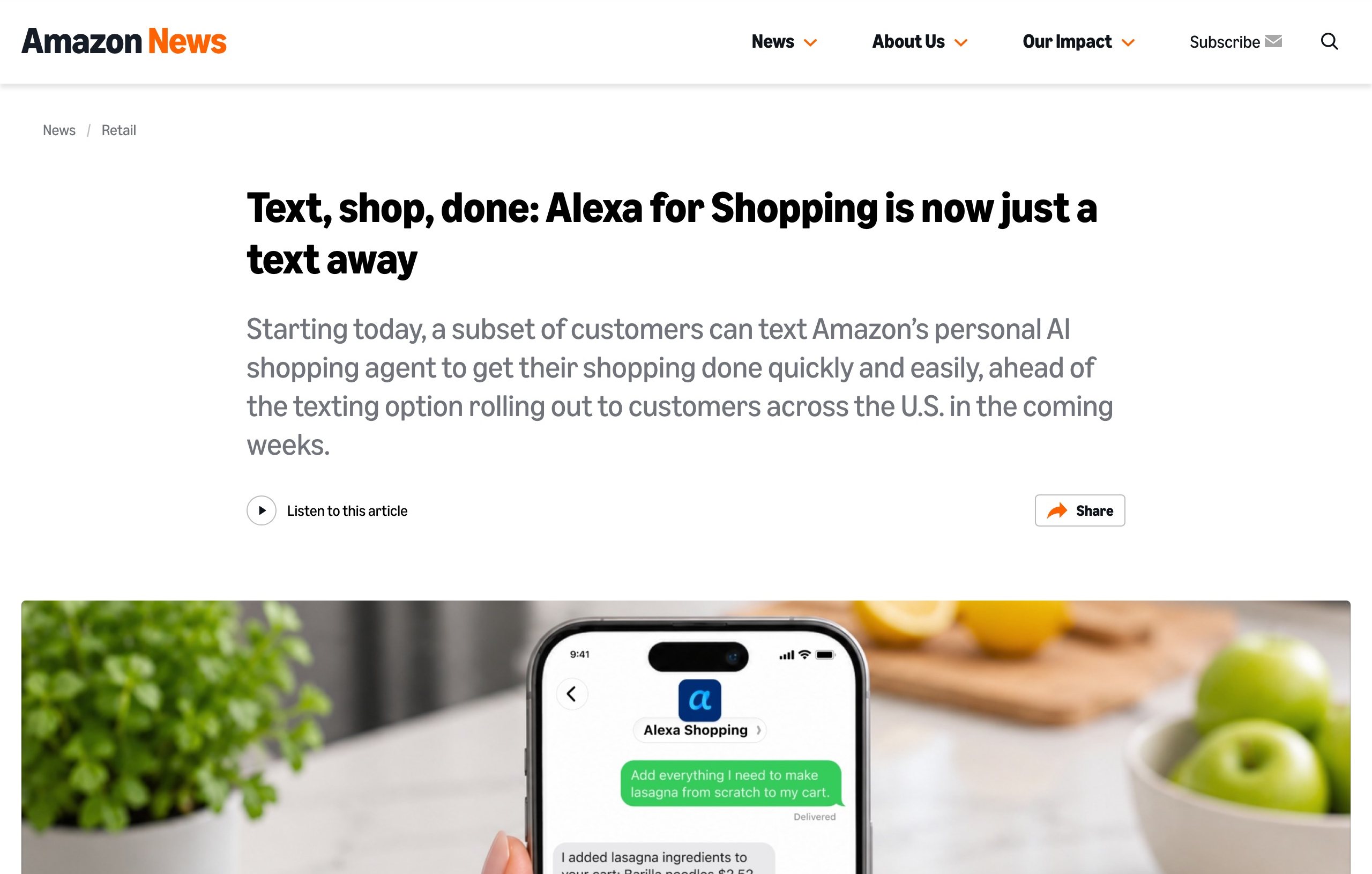
Screenshot: Amazon News (aboutamazon.com), official launch announcement, 9.11.2026
Does it buy on its own, or only when I confirm?
Both, depending on how you configure it. In the default mode, the agent returns options, you choose, and it completes the purchase when you say so. Amazon states explicitly that recurring orders happen "with your approval."
But according to Digiday, there is also auto-buy: set a target price, and the agent buys on its own the moment the price hits it. That is the capability that turns it from an assistant into a true agent: it acts even when you are not in the conversation. And that is exactly why the next question is worth asking.
Who does the agent work for: you, or the ad system?
This is the part that does not appear in the official announcement. According to Digiday and Adweek, Sponsored Products can appear among the options the agent sends you during the search and comparison stage. For now Amazon is not charging advertisers for those placements, meaning this is an experiment. According to Digiday, purchases the agent completes on its own will stay ad-free.
Amazon's launch announcement says nothing about ads. It is not a secret, but it is also not what is presented to the buyer. That is the essential difference between a salesperson in a store and an independent shopping advisor: when you ask the agent "what is the best vacuum cleaner for me?", part of the answer can be a product someone paid to have appear there.
According to Digiday, Amazon has been building the ad business around the agent all year: ads inside the assistant conversation in March, Alexa for Shopping replacing Rufus in May, and an ad format for agents announced in the summer at the Cannes advertising festival. Text messages are simply the next channel.
And what does this have to do with blocking Meta?
Because Amazon decides which agents get into its store. In September, roughly 12 days after Meta launched Muse, Amazon blocked its shopping agent from the site. According to reports, Amazon claimed that Meta had not given advance notice that the agent would be entering the site, that it does not identify itself as an agent while browsing, and that it appeared to be storing customers' login credentials. Meta claimed the agent does not see passwords or payment details. We covered Meta's agent in the article on Muse Spark and personal agents.
This is not an isolated case. Amazon sued Perplexity over its shopping agent in the Comet browser, which we covered in depth in the Comet browser guide. The picture is clear: external agents that work for you get blocked. Amazon's own agent, which also works for Amazon's ad system, gets full access, and now a spot in your contacts.
What do you do with this now?
An Israeli shopper has nothing to activate today, but there is plenty to learn. The service is available only in the US, and Amazon has not announced plans for other countries. Even so, the same logic will apply to every shopping agent you use, whether it is Amazon's, OpenAI's or anyone else's. Three rules worth adopting right now:
- Ask the agent what is sponsored. When an agent offers three options, ask it to flag which ones are sponsored products, and ask for a comparison that goes beyond the list it suggested.
- Auto-buy only with a clear ceiling. A target price, a quantity and a defined product. Not "buy me something good when there's a deal."
- Check the price history yourself. A year of history is a great tool, but whether it is actually a good price is a call that stays yours.
We compiled the broader rules for working with an agent that has permission to act on your behalf in the AI agent safety rules.
What does this mean for your business?
Your next customer may never reach your site at all. If an agent is searching, comparing and recommending, it reads the product information, not the design of the page. A clear price, in-stock availability, shipping time, full specs and reviews: those are the things an agent can compare. A product with a vague description simply will not make the list.
There is also a lesson about the platform. Anyone who sells exclusively through a large marketplace depends on that marketplace's agent, and on what that agent chooses to show, including what was paid to appear. Anthropic has already open-sourced code for commerce agents, and we detailed what that means for stores in Israel in the article on Claude's commerce agents. Whoever starts preparing their store for buyers that are agents is ahead of the market.
Sources: Amazon's official announcement, Digiday's report on sponsored products and Adweek's report.
Also today in leading tools
Uber: 320 million trips and orders in a single week, and only 4 rides through AI agents
This number puts all the excitement about shopping agents in perspective. In Uber's Q3 earnings call on November 4, 2026, the company reported that during Halloween week, the busiest week of the quarter, it handled roughly 320 million trips and food orders combined (Uber and Uber Eats). Of those, only about 500 food orders came from external AI agents, and only 4 rides.
Management described this in the call as "very, very early and very limited traction." The practical takeaway: agents that buy for us are still an experiment, even at the companies building them. Worth preparing for, without building revenue expectations on them in the coming year. TechCrunch's report, Nation's Restaurant News report.
And this morning we covered: the Claude Code button that leaked passwords, and the new Spaces in Muse
If you missed it, this morning we published the story about the "Yes, and don't ask again" option in Claude Code, which saved passwords and keys in a file that ended up in thousands of GitHub repositories, along with 5 steps to check your own setup. In the same article you will also find the new Spaces that Meta launched in Muse. Full article.
Want to understand agents from the inside, before they buy for you?
A shopping agent is, at its core, an AI agent with permission to use your credit card. Anyone who understands how an agent receives a task, what limits are set for it and how to review what it did, also knows how to ask the right questions when someone else's agent is working on their behalf. That is exactly what the agents bundle teaches.
The AI agents bundle includes the Claude Code (Claude Code) video course and the Grok Bot video course, plus the SocialFlow (SocialFlow) course as a gift. Price: 297 ILS + VAT (350.46 ILS including VAT), until November 12 at 23:59.
Frequently asked questions

Yaakov Tzedek
An Israeli AI lecturer, consultant and implementer who has supported 100+ organizations in AI implementation and lectured for 200+. Official content partner of Meta, Google, Canva and TikTok, featured on Israel's Channel 13.
More about Yaakov →