
- Anthropic open-sourced Claude Commerce Agents: a framework for building a shopping agent and a merchant agent for your store. 35% larger carts, 60% higher checkout completion, and a Claude Code plugin that wires the agent to your backend.
Shopify did not wait for Anthropic's announcement: it had already published its own commerce agents implementation repo, built on top of the UCP protocol and Sign in with Shop. When the largest ecommerce platform in the Western world builds infrastructure for shopping agents before the standard has even settled, it is signaling that it treats AI-agent-driven purchasing as the near future, not an experiment.
Your customer is already asking AI what to buy. They're already getting a recommendation. They're already completing a purchase, just not with you.
Yesterday (September 2, 2026) Anthropic released a complete open-source infrastructure that brings that purchase back home: Commerce Agents that businesses embed on their own websites. According to Anthropic's data, retailers already running agents like these on Claude saw carts grow by up to 35% and purchase completion rates rise by 60%. But those numbers aren't the real story.
The real story is the battle over who owns the customer: the general-purpose chatbot, or the business itself. I went through the announcement, the repo and the coverage, and here is everything that matters.
In short: Anthropic published an open-source blueprint for two types of agents, a Shopping Agent for customers and a Merchant Agent for internal teams, with sample implementations across four verticals and a Claude Code plugin that builds an agent against your existing backend. Shopify, Visa, Mastercard and Accenture are already on board. And on September 10, Anthropic is hosting a dedicated event for commerce agent builders.
What exactly did Anthropic release?
Two types of agents, defined once and running on every Claude execution environment. The first is a Shopping Agent: an AI assistant that the business embeds on its website or app, and customers talk to in order to find products, compare options and complete a purchase. The second is a Merchant Agent: a tool for the team that manages back-office operations, updating the catalog, changing prices and running promotions.
The official repo, github.com/anthropics/commerce-agents, includes sample implementations across four verticals: retail, travel and tourism, telecom and entertainment. Choosing four such different domains is a statement of intent: this is not a template for a clothing store but infrastructure for any business that sells anything online, from a plane ticket to a data plan. And this is not a theoretical demo but a starting point you can fork and adapt.
On the technical side, every agent is defined once and runs on three execution paths: the standard Messages API, the Claude Agent SDK for anyone building a full agentic system, and Managed Agents for anyone who wants Anthropic to host the agent. The definition does not change between paths, only the runtime environment.
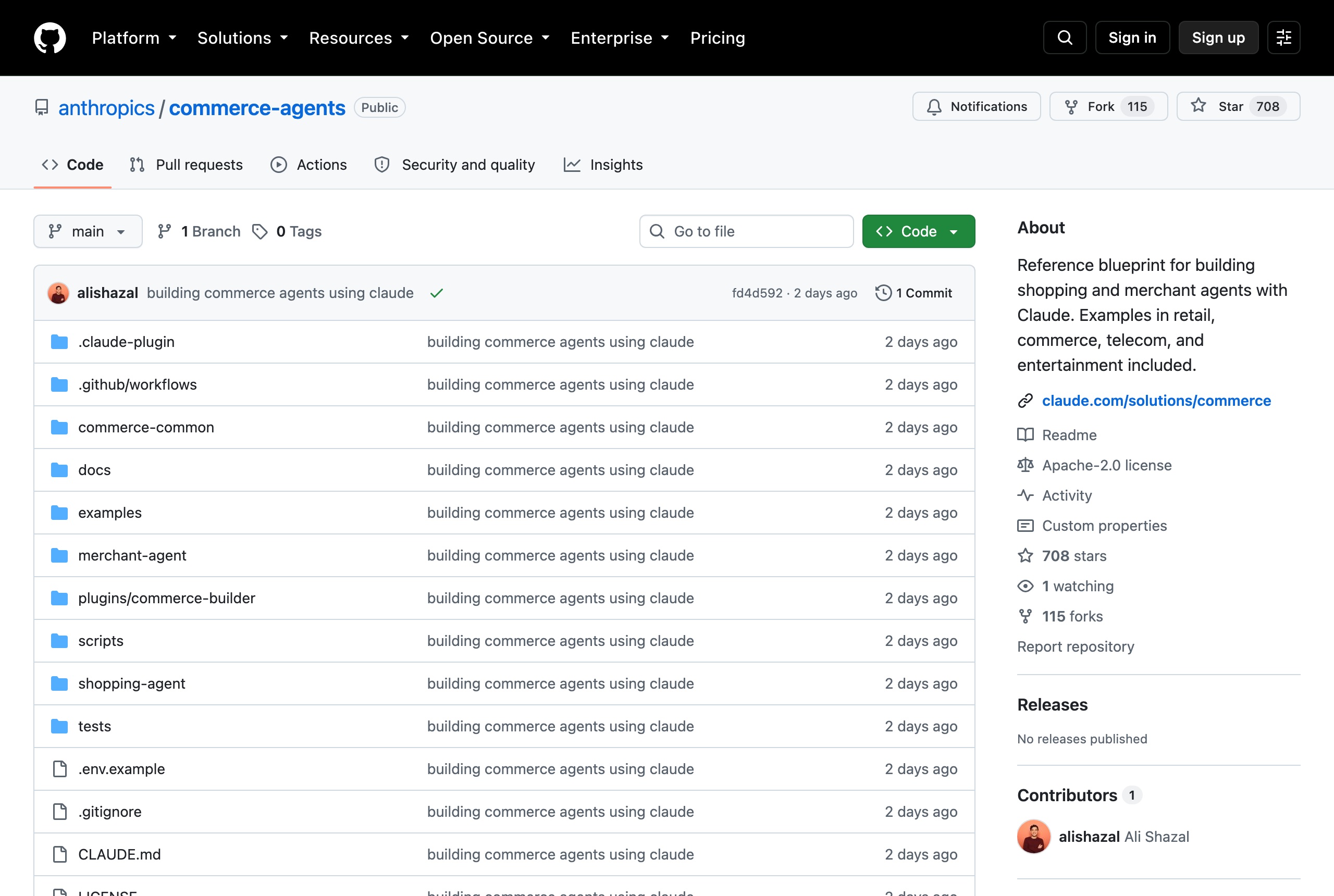
Screenshot: GitHub, anthropics/commerce-agents
Why don't businesses want you buying through ChatGPT?
Because when a purchase goes through a general-purpose chatbot, the business loses its relationship with the customer. When a customer asks a general AI assistant "what's the best suitcase under 400 ILS" and gets a recommendation and a completed purchase elsewhere, the store becomes an anonymous supplier at the end of a pipeline: no brand, no customer data, no upsell opportunity, and no control over how its products are presented.
That is exactly the gap the new infrastructure closes. Instead of waiting for customers to migrate to other platforms, the business embeds its own shopping agent, on its own data, inside its own site, under its own brand. The customer gets a conversational shopping experience, and the business keeps the direct relationship.
The big players have already voted with their feet. Shopify published its own implementations repo, built on top of the UCP protocol and the Sign in with Shop authentication system, and Visa, Mastercard and Accenture are among the early adopters. When the world's largest payment companies are preparing for a scenario in which an AI agent completes purchases, the direction is clear.
What does the Merchant Agent actually do?
The unglamorous work of running a store: catalog, pricing and promotions, in a conversation instead of across dozens of screens. If the Shopping Agent is the customer-facing side, the Merchant Agent is the tool for the team behind the scenes. Instead of opening the management interface, finding a product, editing a field and saving, the team drafts a request: update descriptions in a certain category, set up a weekend promotion, go through products with no image.
The connection between the two agents is the part people tend to miss. The same catalog and the same backend interfaces serve both of them, so the investment in exposing your systems to one agent automatically serves the other as well. A business that starts with the internal Merchant Agent, a relatively safe testing environment since customers never see it, arrives at the external Shopping Agent with most of the infrastructure already in place.
And here too, the sensitive-action principle holds: changing a product in the catalog is an action that waits for human approval, by design. The agent prepares the changes, presents them, and someone on the team approves before they go live.
What about security? Who actually approves the purchase?
A human. This is a core design principle in the infrastructure, not a footnote. According to Anthropic's recommended design, sensitive actions such as completing a purchase or changing a product in the catalog are not performed autonomously by the agent but are passed to a human for approval. The agent prepares the cart, summarizes the details, and at the critical moment it stops and waits.
This is the same principle we teach in every AI workshop for organizations: a good agent is not one that does everything on its own, but one that knows when to stop. In the context of real money and a real catalog, that principle is the difference between a tool management approves and an experiment stuck in a legal review loop.
How do you get started? The practical guide
Three steps from the repo to an agent running against your backend:
-
Clone the repo. Run
git cloneon github.com/anthropics/commerce-agents and choose the vertical closest to your business: retail, travel, telecom or entertainment. The existing implementation serves as a skeleton, and you replace the business logic with your own. -
The Claude Code plugin. The repo includes a plugin for Claude Code that builds the agent against the business's backend. Instead of writing the connection layer manually, you activate the plugin inside a Claude Code project and it spins up the agent against your existing systems. Anyone who has already connected systems to Claude via the MCP protocol will feel right at home: it is the same concept of exposing existing capabilities to an agent.
-
What the backend needs to provide. The agent needs clean access to three things: the product catalog (including descriptions and images), real-time inventory and pricing, and a cart and checkout flow. You do not need to replace the e-commerce system, you need to expose an interface to it. And you define the human approval checkpoints at this stage: where the agent stops and who approves.
From there you choose a runtime environment based on your needs: Messages API for direct integration, Claude Agent SDK for a full agentic system with tools and memory, or Managed Agents if you prefer Anthropic to handle hosting. And for anyone who wants to go deep, Anthropic is hosting a dedicated commerce agent building event on September 10.
Who is this relevant for in Israel?
Three audiences, and each one gets a different opportunity here:
Online store owners. If you have a store with a broad catalog, a Shopping Agent is the difference between a customer who filters alone and abandons the cart and a customer who has a conversation and finds exactly what they were looking for. Shopify stores get a particularly convenient starting point, because Shopify's repo already covers part of the journey. Anthropic's numbers, carts up to 35% larger and purchase completion 60% higher, were measured at retailers already running on Claude. Even if your numbers are more modest, on a store turning over hundreds of thousands of shekels a month that is an improvement you feel on the bottom line.
Digital agencies and development companies. Until now, building a Shopping Agent for a client was a lengthy infrastructure project. Now there is an official blueprint, sample implementations and a plugin that dramatically shorten the path, and whoever offers this first to their e-commerce clients buys a year's advantage over the competition. This is exactly the dynamic we saw with intelligent customer service bots: whoever moved first charged a pioneer's price.
AI implementers. A new service market is opening here with clear demand: every store that is afraid of losing customers to general-purpose chatbots is a potential client. The required skill, working with Claude Code against an existing backend, is exactly what we build in the live Claude Code intro session: three hours at the end of which you have a real system live. And for anyone who wants ready-made workflow templates, the skill kits in the store are built on the same method.
And what does this mean for your business?
Three bottom lines:
-
Conversational shopping is coming to your site, not just to other people's chatbots. The investment that was previously required to build a Shopping Agent dropped dramatically the moment an official open-source blueprint existed. The question is no longer whether, but who in your market will be first to implement it.
-
The data and the customer relationship stay with you. This is the real strategic advantage of an agent on your own site versus a purchase through an external platform: you see the conversations, you learn what customers are looking for and not finding, and you use that to build your next catalog.
-
Human approval is not a compromise, it is the product. The infrastructure was designed so that money and catalog changes pass through a human being. Build your agent on that same principle from day one, and you will save yourself the hard conversation with management after the first incident.
Anyone who wants to see how you actually build an agent like this, against real systems and not in a slide deck: practical AI workshop for organizations for teams, or live Claude Code intro session for individuals who want to leave with a working system.
Want to build a commerce agent for your business?
Everything you just read here, cloning a repo, connecting a plugin to an existing backend, an agent running against a real catalog and real inventory, is exactly the work you do in Claude Code. At the live Claude Code intro session on September 16 at 21:00 you sit for three hours, and by the end you have a real system live with a database and users, not a slide and not a demo. No programming background required, just the drive to build.
We will not build a complete commerce agent there in three hours, that is not a one-day preparation. But you will leave with the exact skill this infrastructure demands: working with Claude Code against an existing system and getting a live result out of it. All the details and registration for the session are here.
Sources: The official announcement on the Claude blog · Coverage on Digital Commerce 360 · The official repo on GitHub
Frequently asked questions

Yaakov Tzedek
An Israeli AI lecturer, consultant and implementer who has supported 100+ organizations in AI implementation and lectured for 200+. Official content partner of Meta, Google, Canva and TikTok, featured on Israel's Channel 13.
More about Yaakov →