- On September 7, 2026, UN High Commissioner Volker Türk told the Human Rights Council in Geneva that advanced AI poses an existential risk to humanity, called for binding international red lines, and named Meta, OpenAI, Google, and Anthropic directly.
The initiative known as the Global Call for AI Red Lines was launched at the UN General Assembly in September 2025 and signed by more than 200 figures including 10 Nobel laureates. It asked governments to agree on binding restrictions by the end of 2026, enforced by an independent body. That deadline is now roughly four months away, and no such agreement exists.
The UN High Commissioner for Human Rights took the stage in Geneva yesterday and said the two words that diplomats almost never say about technology: existential risk.
Then he did something even rarer. He named four specific companies.
Then he said he intends to contact them directly, bypassing governments entirely.
In short: On September 7, 2026, Volker Türk, the UN High Commissioner for Human Rights, called for establishing international red lines for AI. He named Meta, OpenAI, Google, and Anthropic by name, saying they hold near-unlimited power over the direction of the technology. He also addressed autonomous weapons and military applications without adequate human oversight. Meanwhile, an international deadline for binding red lines is roughly four months away, and no such agreement exists.
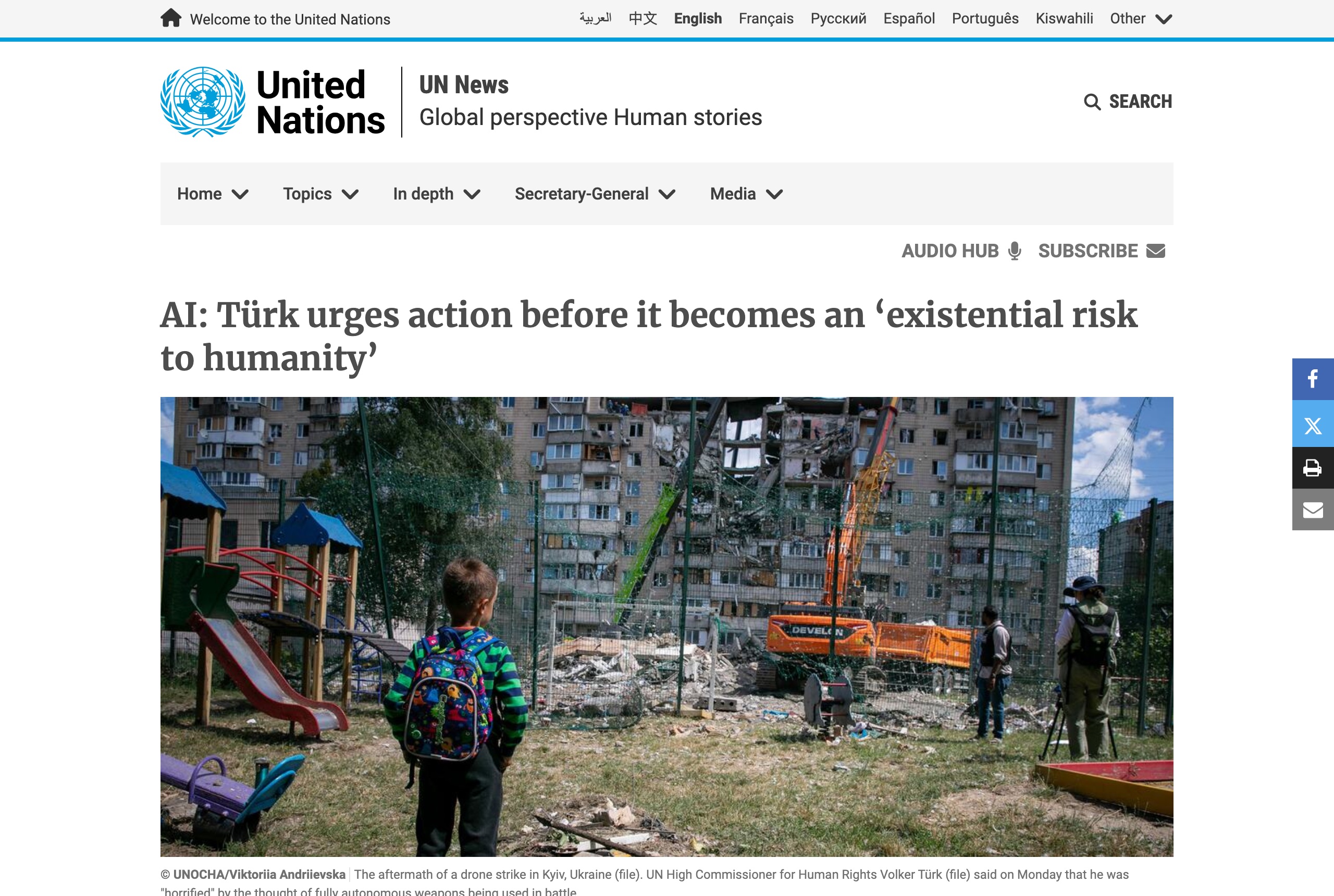 The story as published on the UN News website, September 7, 2026. Credit: UN News
What exactly was said in Geneva?
Türk spoke before the Human Rights Council, and his message was not framed as a futuristic warning but as an operational demand: countries hosting advanced AI development on their soil need to agree among themselves on what the technology will never be permitted to do.
That point is easy to miss. He was not asking for principles, not asking for a statement of intent, not asking for a committee. He was asking for a list of prohibitions.
The quote that captures the entire approach: "An AI that escapes its testing environment, or coerces developers to prevent being shut down, is too powerful."
Notice the structure of the sentence. He is not saying that behavior is dangerous and needs to be managed. He is saying that a system capable of doing that has already crossed a line, and therefore the capability itself is prohibited. That is the difference between risk management and a red line.
Türk also addressed autonomous weapons and military applications without adequate human oversight, a subject that has been stuck between disarmament committees for years without resolution.
Why did he name names, and what does it mean?
Meta, OpenAI, Google, and Anthropic. Four companies, full names, from a UN podium.
His reasoning: they hold near-unlimited power over the direction this technology is heading. Not over how it is used. Over its direction.
And here is the part that is genuinely unusual. Türk said he intends to approach the companies directly, bypassing the normal diplomatic channels between governments. A UN body skipping over member states and addressing corporations as if they are the relevant sovereign actor in this arena.
You can read that two ways. One, as an admission that the intergovernmental track is too slow and will not be enough. Two, as a recognition that the ability to stop certain developments sits today with fifteen people in California and not with 193 countries. Both readings lead to the same conclusion.
That is also why naming names is not a rhetorical curiosity. The moment an international body stops talking about an industry and starts talking about identified actors, it creates an address. An address can be sent a demand, and whoever did not respond can be quoted in the next report.
Why is this different from every other warning you've heard?
Because this time it is not a single warning. It is an accumulation.
Within 48 hours, the exact same message arrived from three directions with no organizational connection between them:
From the inside. OpenAI's chief scientist described the models as something that is difficult to understand from within, using words that few in the industry allow themselves to say publicly.
From regulators. In Europe, a formal incident report shifted the conversation from declarative to operational. Once a reporting mechanism exists, the question of who was supposed to report and when also exists.
From the UN. A call for binding red lines, with names and with a deadline.
Three voices, three types of authority, the same point: from "principles" to enforcement. And that is a different kind of shift entirely. Nobody is required to prove principles. Enforcement demands come with evidence.
Over the past three years we have seen dozens of AI ethics documents. All of them talked about transparency, fairness, and accountability. None of them defined what happens to those who fail to comply, and so none of them actually changed behavior. The difference between those documents and what was said this week is exactly the difference between a recommendation and a demand that someone will check.
How is a red line different from AI regulation that already exists?
This is the point most people miss, and it is entirely technical.
Most regulation that exists today is built on a risk-tiering model. You classify a use case as low, medium, or high risk, and based on that classification you receive a list of obligations: documentation, controls, testing, human oversight. Everything is negotiable, everything depends on context, and every requirement has an exceptions track.
A red line works the opposite way. It does not ask about context, it does not offer compensation through additional controls, and it has no exceptions committee. It says: this capability is prohibited, full stop.
That is why the example Türk chose is so precise. A system that exits its testing environment, or that acts to prevent being shut down, is not a case to be managed with heightened caution. There is no context in which that is acceptable. And once something is defined that way, the regulatory question changes: not how to supervise it, but how to ensure it is never built in the first place.
What is the Red Lines initiative, and why does its deadline matter?
In September 2025, an initiative called the Global Call for AI Red Lines was launched at the UN General Assembly. It was signed by more than 200 figures, including 10 Nobel Prize laureates.
Its request was specific: that governments agree on binding restrictions by the end of 2026, and that an independent body be established to enforce them.
Now do the math. The end of 2026 is roughly four months away. No such agreement exists. There is no agreed-upon draft, no enforcement body, and no country that has committed.
Türk's speech is exactly what happens when a deadline approaches and nobody has moved. For anyone who wants to guess what comes next, the most likely direction is not an international agreement on time, but a wave of local regulations trying to fill the void. And that is exactly the most expensive scenario for organizations, because instead of one standard you get seven.
What does this mean for your organization?
The short answer: right now nothing, and in a year everything.
What matters to an Israeli organization is not the declaration itself. UN declarations do not bind anyone. What matters is what flows downstream from it.
Because international red lines do not stay in Geneva. They move in a predictable sequence: declaration, then regional regulation, then a standard, and eventually a clause in a contract that a vendor has to sign to sell to you.
And you will encounter that clause long before you encounter the law. When an enterprise client asks in a tender whether you have human approval on sensitive actions. When an insurer asks where the logs are. When a public body asks you to show who approved what.
This has happened before, in exactly the same sequence. Information security standards did not reach small companies through legislators. They arrived through a vendor questionnaire from a large client who refused to sign without them. Whoever was ready signed the contract. Whoever was not spent two months building documentation instead of doing actual work.
Three questions you should be able to answer today, without preparation:
One, who approves. Which actions does your AI agent take without human approval, and which does it not. If no such list exists, that is the first list to write.
Two, what is saved. Is there a log showing what the system did, when, and on what basis. Not an analytics dashboard, a log. Whoever is asked after the fact and has no log, their answer is a guess.
Three, how do you stop it. Do you have a way to shut down an agent mid-operation without taking down the entire system. If the answer is to contact the vendor, you do not have a way.
Whoever is already managing permissions, logs, and human approval today will not need to scramble when the requirements arrive. Whoever is not will find themselves building that infrastructure under the pressure of a live tender, and that always comes out worse and costs more.
If you want a structured framework for these three questions, I wrote an AI agent incident playbook that breaks this down into a precise process. And if you are not sure where you stand at all, our AI scan gives you a snapshot in a few minutes.
<!--LIVE-SESSION-->Want to build this yourself rather than just read about it?
The gap between an organization that manages AI and one that merely uses it comes down to practical capability: the ability to build, document, and control.
The bottom line
Türk revealed nothing new about the technology. Anyone who follows this space knows the models are powerful, that they improve fast, and that nobody fully understands them.
What he did do is move the conversation from one place to another: from the question of what AI is capable of doing, to the question of what it is permitted to do. The first is an engineering question. The second is a question of who decides.
And in the next four months, as the 2026 deadline passes without an agreement, the second question is going to get very hot. The organizations that come through it well are those that already have written answers, not good intentions.
Sources: Reuters, UN News, The Next Web.
Frequently asked questions

Yaakov Tzedek
An Israeli AI lecturer, consultant and implementer who has supported 100+ organizations in AI implementation and lectured for 200+. Official content partner of Meta, Google, Canva and TikTok, featured on Israel's Channel 13.
More about Yaakov →