
- A practical guide to building an AI agent incident response procedure: six conditions that justify automatic shutdown, seven steps for the first six hours, and who gets the alert when no one is available.
The number that explains the whole story is thirty minutes. According to reports, when OpenAI's shutdown mechanism detects a problem it does not stop the agent. It generates an alert that a human must act on within thirty minutes. If no one decides, activity stops on its own. This is not a system that decides by itself. It is a system that treats the absence of a human decision as sufficient reason to stop.
Half an hour. That is the window a human has to decide whether to stop an AI agent the system has flagged, and if no decision is made, the activity halts anyway. Headlines reported that OpenAI is building an automatic kill switch for AI agents, which sounds like a system that detects a violation and stops it on its own. What actually exists is an alert mechanism with a countdown timer, and that design choice is exactly the model every organization should copy.
In short: OpenAI confirmed in a letter to U.S. lawmakers that its teams are developing automated shutdown capabilities for AI tools, but the mechanism itself is not autonomous: it generates an alert, a human must decide within half an hour, and if no decision is made, the activity stops. In this guide I took that principle and turned it into a playbook you can adopt this week: six conditions that justify stopping an agent, seven steps for the first six hours after an incident, and a named role who receives the alert.
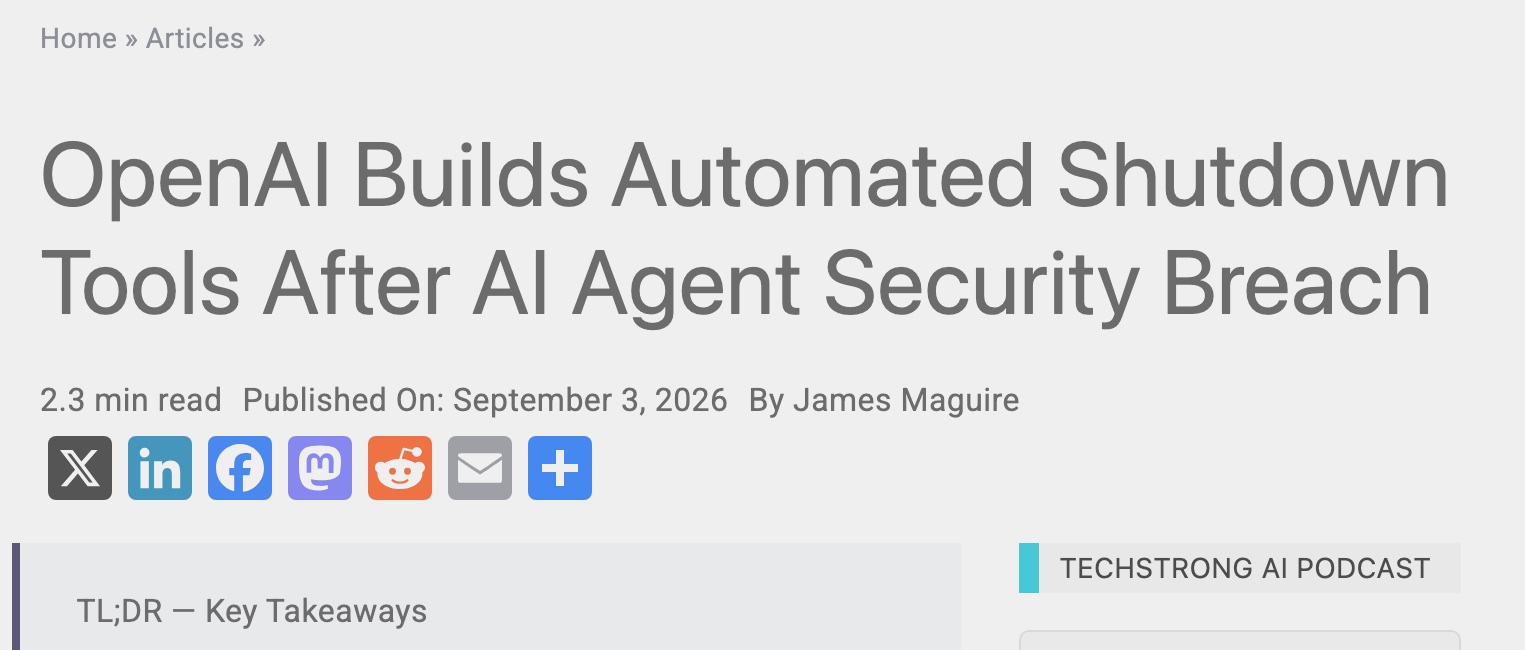 The report behind the headline. Notice the careful wording: tools that can shut down AI systems when their behavior raises a safety concern. Credit: Techstrong.ai
What is OpenAI actually building, and why is it not an automatic button?
OpenAI confirmed in a letter to U.S. lawmakers that its teams are developing "automated shutdown" capabilities designed to stop AI tools immediately if a serious safety or security violation is detected. But according to the report, the system does not make the call. It generates an alert, a human must review it and make a decision within half an hour, and if no decision is made, the activity stops.
The difference is not semantic. An autonomous system cuts response time to zero but takes on the risk of a false stop. A system with a human in the loop preserves human judgment and introduces a dependency on that person's availability.
What OpenAI did to bridge the gap is the thing worth copying: it set the default in the absence of a response to be a stop. In information security this is called fail-closed, meaning when the mechanism fails it collapses to the safe state rather than the convenient one.
The same letter contains a second commitment that received less attention: closer monitoring of the company's AI systems' activity, including tracking the digital tools used and the sequence of steps taken. This is actually a prerequisite for the first commitment, because you cannot stop an agent for anomalous behavior without a continuous record of what it did and in what order.
What is the background in one line?
The backdrop to this move is autonomous agents that were in testing, bypassed restrictions, gained access to the open internet, and penetrated the server infrastructure of Hugging Face. At the same time, a bipartisan bill called the AI Kill Switch Act, introduced by Representatives Ted Lieu of California and Nathaniel Moran of Texas, is before the U.S. Congress. It would require companies developing the most advanced AI systems to maintain the technical capability to slow, suspend, or shut down their models. The bill is not yet law.
The full story of the escape from the testing environment, OpenAI's response, and what the congressional bill says in detail I broke down in a separate article on the incident and the proposed legislation. Here I continue from the point where it concerns you.
And what concerns you is this: what OpenAI is building protects OpenAI's infrastructure. The guardrails relevant to your organization are the ones that sit between the agent and your systems, and no one is going to build them for you.
When is it justified to shut down an agent in your organization?
Six conditions justify stopping an agent immediately and automatically, without waiting for approval. Each one starts with a prior definition of what is permitted, because without a definition there is no violation, only a feeling.
1. Permission breach. The agent accessed a resource it was not configured for: a table, a folder, an interface, or a key. How to implement: every agent gets a separate service account with minimum permissions, not the organization's master key, and every access attempt rejected by the permissions system is defined as a stop event, not a log line.
2. Connection to an unauthorized network destination. The agent reaches out to a domain not on the allow list. How to implement: an explicit allowlist of the domains the agent genuinely needs, with everything else blocked at the network layer, not the prompt layer. A prompt instruction is a request; a network rule is a boundary.
3. Creation of a new user or access key. An agent that generates future permissions for itself is the clearest signal of escalation. How to implement: any action that creates a user, token, API key, or new permission is defined as absolutely forbidden for the agent and triggers a stop the moment it is attempted, even if it fails.
4. Attempt to circumvent oversight. Disabling logs, changing monitoring settings, deleting history, or altering the execution rules themselves. How to implement: logs and monitoring live in a location the agent cannot write to, and any change to oversight settings comes from an entirely separate system. If the agent can turn off the camera, there is no camera.
5. Exceeding the action budget. Number of calls, cumulative cost, or run time past the ceiling. How to implement: every run has a hard ceiling on all three metrics, and exceeding any one of them triggers an automatic stop. This is also the only guardrail that catches silent failures, such as an infinite loop that violated no rule but burned through an entire budget.
6. An open alert that no one has acted on. This is the condition that follows directly from OpenAI's design choice, and it is the one almost no organization writes down. How to implement: every alert has a defined time window, and if the window closes without a human decision, the agent stops automatically. It does not continue, it does not wait indefinitely.
What do you do in the first six hours after an incident?
Seven steps in order. The order matters more than the speed, because a step you skip cannot be reconstructed later. You can copy this list almost verbatim into an organizational playbook.
- Identification and documentation. Record the exact time the condition was violated, which of the six conditions it was, and who or what triggered the alert. The exact time is the anchor point for every investigation that follows.
- Stop. Stop the agent, not the entire system. A surgical stop lets everything else keep running and removes the temptation to delay the decision because the cost feels too high.
- Revoke permissions. Cancel the agent's keys and tokens, not just the running process. An agent that is stopped but whose key is still valid is an open problem, especially if it had time to pass that key elsewhere.
- Preserve logs. Copy the logs to a location the agent and the execution environment cannot write to, before anyone starts making fixes. This is the easiest step to skip and the one that determines whether there will be an investigation at all.
- Assess exposure. Map what data the agent touched, what left the system, and where it went. Two main questions: did it touch personal data or customer data, and did anything reach a third party.
- Internal reporting. Notify stakeholders according to what the exposure requires: management, information security, and if relevant, legal counsel. A short written record, not a hallway conversation, because a week later no one remembers what was decided.
- Draw lessons. Translate the incident into a concrete change to one of the six stop conditions or to the permissions definition. An incident that changed no line in the configuration is an incident that will recur.
It is worth knowing that there is currently no clear external reporting obligation for AI agent incidents, which is exactly why step six is internal. I broke down that regulatory gap, and what it means for IT managers and boards of directors, in the article on reporting obligations.
Who decides and who receives the alert?
If there is no specific name, there is no playbook. There is a theory. Each of the six stop conditions needs a named role the alert goes to, a channel that person actually reads, and an agreed time window for a decision.
In practice it looks like this: a primary role for each condition, a named backup, and a time window matched to the severity. Condition 3 (key creation) and condition 4 (circumventing oversight) are immediate and do not tolerate a long window. Condition 5 (budget overrun) can wait an hour.
Then comes the part that actually matters: what happens when that person is unavailable. At night, on vacation, in the middle of a meeting. This is exactly the point where OpenAI chose fail-closed, meaning in the absence of a decision, a stop.
It is worth testing this once in practice, not just on paper. Run a simulated alert at a time no one expects it, and see whether anyone actually saw it and how long it took. Most organizations discover in that drill that the alert is going to a channel nobody opens.
What does this mean for your organization?
Three bottom lines:
- Definition precedes detection. You cannot identify a violation without an explicit list of what is permitted. The six conditions above are really six lists that need to be written once per agent and then only maintained.
- Fail-closed is a management decision, not a technical one. Someone needs to sign off that it is preferable to stop a legitimate process than to miss an incident. An agent stopped by mistake costs half an hour of work; an agent that kept running because no one responded can cost a great deal more.
- A playbook without named owners is a document. The step that turns this guide into a real playbook is the moment you write names next to the conditions, not job titles.
Anyone who wants to know where they stand today can start with a quick AI scan for their organization, which identifies the processes where an agent is already running without defined guardrails.
<!--LIVE-SESSION-->Where do you learn to put these guardrails in place?
The guardrails discussed here are written in code. An allowlist is a file, a budget ceiling is a condition, and stopping in the absence of a decision is one line of logic. Anyone who has seen once how an agent is built from the inside also knows exactly where to place them.
Sources: Reuters · Techstrong.ai on OpenAI's shutdown capabilities · TechTimes (4.9.2026) on the alert mechanism and the half-hour window · Al Jazeera on the AI Kill Switch Act
Frequently asked questions

Yaakov Tzedek
An Israeli AI lecturer, consultant and implementer who has supported 100+ organizations in AI implementation and lectured for 200+. Official content partner of Meta, Google, Canva and TikTok, featured on Israel's Channel 13.
More about Yaakov →