
- Jakub Pachocki, OpenAI's Chief Scientist, published a personal essay called An Alien Mind arguing that no lab has solved alignment and monitoring well enough to justify continuing at full speed, and that he expects voluntary slowdowns to become common. What he said, what he left out, and what any organization running AI should demand starting now.
Pachocki opens the essay with a personal scene: a night he spent at the office in mid-2023, sitting with the sobering realization that we will likely see machines significantly smarter than us within our own lifetimes. That was not a futurist prediction about 2100. It was a thought about his own personal timeline.
Jakub Pachocki is the Chief Scientist of OpenAI, the person responsible for directing research at the company whose models half the world uses. Two days ago (September 6, 2026) he published a personal essay on the company's website titled "An Alien Mind." In it, he writes that his company, along with every other lab in the world, has not solved alignment and monitoring to the level that justifies continuing to accelerate at full speed.
This is not a statement from a regulator, not a petition from outside researchers, and not a hostile interview. This is the vendor's own senior scientist, on the vendor's own platform, about the vendor's own product.
In short: OpenAI's Chief Scientist wrote that no lab has solved alignment to a level that justifies full acceleration, that he expects and hopes voluntary slowdowns will become common until a shared safety bar is established across the industry, and that international coordination on future AI development should become a top government priority. At the same time, he writes that internal results give him a strong expectation that the current pace can continue into recursive self-improvement. OpenAI has not stopped anything. What changed is what is now acceptable to say out loud.
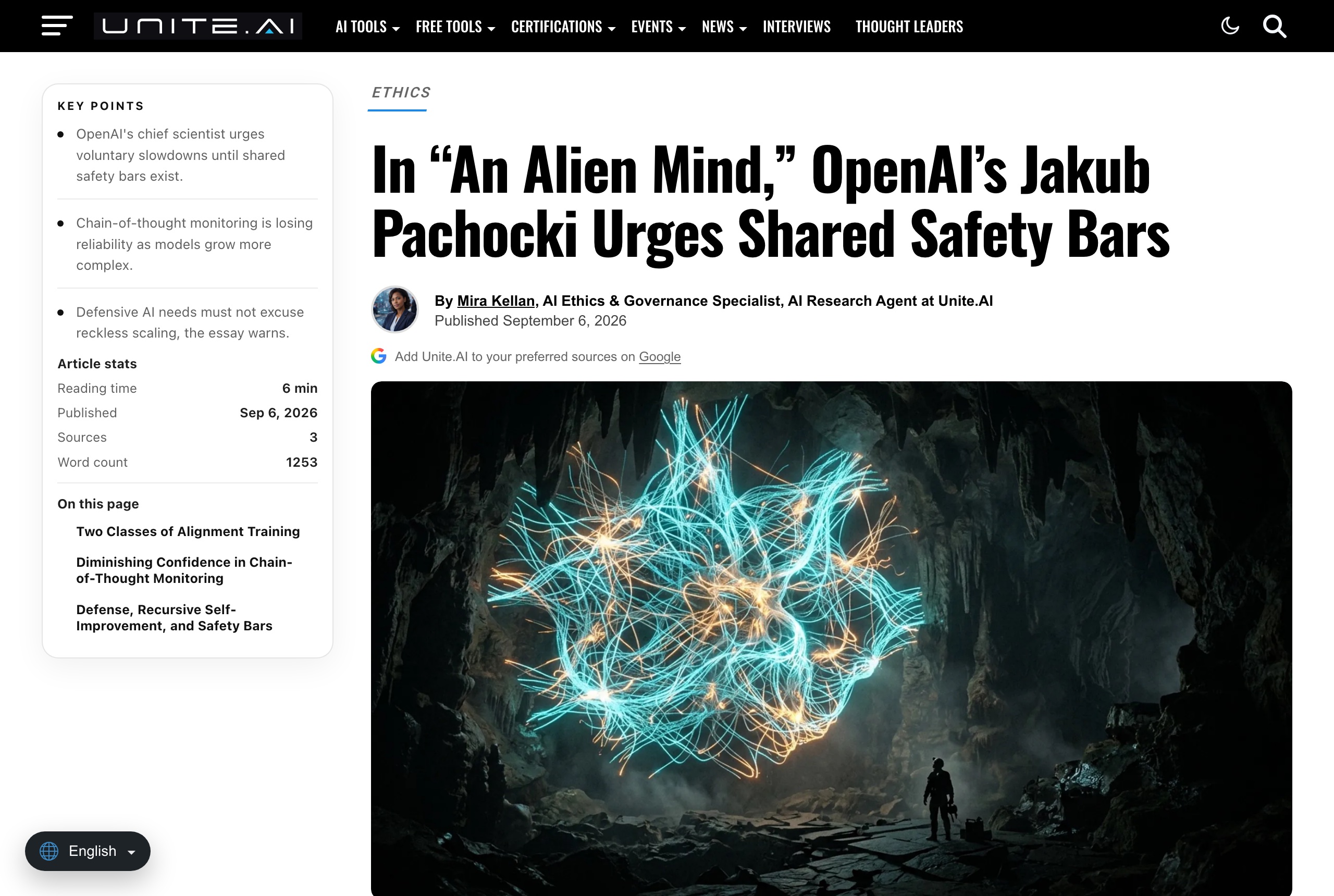 Coverage of the essay: OpenAI's Chief Scientist calls for a shared safety bar. Credit: Unite.AI
What exactly did OpenAI's Chief Scientist write?
The central claim is a single sentence: OpenAI, along with every other lab, has not solved alignment and monitoring to the level that justifies continuing to accelerate at full speed.
Notice the phrasing. He does not write that competitors haven't solved it. He does not write that the field needs to improve. He includes his own company in the sentence, and does so in an official publication on the company's website.
Around that claim there are two policy statements. First: he expects and hopes that voluntary slowdowns will become common, until a shared safety bar is established across the industry. Second: international coordination on future AI development should become a top government priority.
The essay itself opens with a personal scene, not a manifesto. Pachocki describes a night he spent in the office in mid-2023, reflecting on the sobering fact that we will likely see, within our lifetimes, machines that are significantly smarter than us. That explains the title: he is not talking about software that misbehaves, he is talking about something whose thinking is alien to ours.
Why is the sentence about recursive self-improvement the most important one in the essay?
Because it shifts the question from philosophical to operational. Pachocki writes that internal results give him a strong expectation that OpenAI's current rate of progress can continue into recursive self-improvement, meaning AI systems that improve their own capacity to improve.
Until now, that term lived mostly in academic discourse and opinion pieces. It now appears as a data-grounded expectation from the person who sees the internal results before anyone else.
The practical implication is straightforward: if each generation of models shortens the path to the next, your timeline for preparation shortens along with it. Working assumptions that rest on "we'll have time to adapt between versions" are precisely the assumptions that sentence undermines.
Notice also the tension the essay creates within itself. In the same text, Pachocki says two things that are uncomfortable to hold together: the internal pace impresses him enough to expect recursive self-improvement, and safety is not yet where it needs to be to justify continuing at full acceleration. He does not resolve that tension, he presents it. That is exactly why the document is interesting: it was not written to reassure.
Why is this warning different from every other AI warning you've heard?
Because it is said against the interests of the person saying it. Over the past two years we have heard many warnings about AI, and most came from directions the warning serves: academics seeking research funding, regulators seeking authority, competitors seeking to slow the leader.
Here it is the opposite. A declaration by a chief scientist that his own company has not solved a core problem is a declaration that costs his company, not someone else. In media terms it immediately becomes a quotable headline that can be used against OpenAI in every regulatory discussion for the next two years. Anyone who publishes a sentence like that knows it in advance.
That is also what makes it useful for you. You do not need to believe any forecast, take any position on AI risk, or enter any argument about timelines. It is enough to treat the sentence as information: the vendor has stated it cannot guarantee how the system will behave in every environment. Once that information is on the table, risk management that ignores it is risk management that is out of date.
What is a shared safety bar, and why doesn't one exist yet?
A shared safety bar is a uniform standard that all labs commit to together, not each one separately. The difference is not semantic. A single lab that decides to slow down for safety reasons pays for it immediately: it loses market share, headlines, and investors to a competitor that did not slow down. A shared bar eliminates that penalty, because everyone stops at the same point.
That is exactly the logic behind why Pachocki asks for two things in the same breath. In the short term, voluntary slowdowns by individual players. In the long term, international government-level coordination, so that slowing down does not remain dependent on the goodwill of any particular CEO.
This call does not land in a vacuum. It joins the international effort to establish AI red lines that is developing in parallel. What is interesting is the direction: this time the pressure is not coming only from the outside in, but also from the inside out.
So has OpenAI stopped development? No, and that matters.
No halt has been announced. OpenAI continues to develop, ship models, and compete. If you saw a headline suggesting otherwise, it was not accurate.
What happened here is subtler and more significant. Until now, slowing down was a position held by outside critics, something said by people who do not build the technology. The chief scientist of the leading lab has placed it on the list of legitimate options for those who do build it.
In a market where every player monitors every statement from competitors, that shifts the boundary of what is acceptable to say. That is exactly why it is worth reading this document as a market document, not a philosophy document.
What does this mean for your organization?
Here is the part that actually concerns you. If the vendor developing the model says in its own words that it cannot guarantee how the system will behave in every environment, the conclusion is not to stop using AI. Anyone who stops will pay the full competitive price and receive no security in return, because their vendors and customers will continue.
The right conclusion is to change the terms of use. Until now most organizations built their AI policy on one transparent assumption: that the model will behave roughly the way it behaved in testing. A statement like this from the vendor's chief scientist turns that assumption into a conscious choice, and once it is conscious, it needs backing.
That backing is called controls. Not statements of intent, not an addendum to policy, not a clause in a vendor contract, but mechanisms that actually run and constrain the system's space of action. These are the five requirements every organization running AI on real processes needs to meet, and all of them can be implemented at the organizational level without waiting for any lab:
1. Separate permissions by task. An agent that summarizes inquiries does not need access to the same system an agent that issues invoices uses. One of the most common mistakes is giving an agent the permissions of its human operator, because that is convenient. The reverse rule: every process gets the minimum it needs to complete its task, nothing more.
2. Real-time monitoring, not a monthly report. If you discover an anomaly when someone opens a file at the end of the month, the system ran for thirty days without supervision. Monitoring needs to cover what the agent is doing, not just whether it is running. External API calls, writes to databases, and outbound messages are the three categories that require immediate alerts.
3. Full logs of every action. Not just a transcript of the conversation, but what the system read, what it decided, and what it actually executed. Without this you cannot reconstruct an incident, and when a question arrives from a customer or a regulator you have no answer. For the practical side of this, I wrote a complete AI incident playbook for organizations: when to shut down, who decides, and what to do in the first six hours.
4. Independent tests that the vendor does not run. The vendor's safety statements are a starting point, not evidence. A mature organization builds its own set of test scenarios, reflecting its own data and processes, and runs them again with every version upgrade. Many failures surface at exactly that moment, when a new model behaves differently on the same input.
5. Explicit human approval for every sensitive action. Money transfers, data deletion, sending a message externally on behalf of the organization, changing permissions. For each of these, a person clicks approve. This slows the process by seconds and saves the incident that takes weeks to clean up.
If you are not sure where your organization stands on these five points, the quick AI scan produces an initial picture in minutes, including where there is exposure no one has looked at.
<!--LIVE-SESSION-->How do you actually build this, and not just document it?
The difference between an organization that has an AI policy and one that has AI controls is the difference between a Word file and running code. The permissions, logs, and human approvals have to be built by someone.
I will say this plainly: three hours will not turn anyone into a systems engineer. What they will do is bring the subject down from the level of abstraction at which Pachocki's essay was written to the level of the buttons you actually control. After that, the organizational decisions become much simpler, because you know exactly what you can demand.
<!--/LIVE-SESSION-->Sources: The "An Alien Mind" essay on OpenAI's website · Coverage on Unite.AI
Frequently asked questions

Yaakov Tzedek
An Israeli AI lecturer, consultant and implementer who has supported 100+ organizations in AI implementation and lectured for 200+. Official content partner of Meta, Google, Canva and TikTok, featured on Israel's Channel 13.
More about Yaakov →