- What it is: A chat and agents app (web, mobile, desktop) and a family of open-weight models from Moonshot AI, China. The interface is in Chinese and English.
- What it does well: Long context (256K tokens in K2.6, one million in K3), agent mode that runs for hours with hundreds of tool calls, Agent Swarm, deep research, presentations and documents, and code.
- What it costs: A free tier at the basic level; paid plans from 19 to 199 dollars, currently "sold out." API: K2.6 at $0.95 input and $4 output per million tokens, K3 at $3 and $15.
When Kimi launched in October 2023, its differentiator was not intelligence but memory: according to Wikipedia it was the first model to handle a 128,000-token context window without losing information, and by March 2024 a version with 2 million Chinese characters was already being tested. Two and a half years later, long context is still the number-one reason people choose it.
Kimi is the chat and agents app from Moonshot AI, a Beijing-based company founded in March 2023, and also the name of the family of language models the company releases with open weights. Its flagship model, K3, launched on July 17, 2026, with 2.8 trillion parameters and a one-million-token context window. According to Pure AI, it is the largest open model ever released. That is not even the most interesting part. The most interesting part is that in the same month, according to a review by GEO Toolbox, the company stopped selling new subscriptions because demand exceeded its hardware capacity, and two months later Anthropic accused it in an official report of routing some user responses through Claude. An impressive tool, a controversial company, and an Israeli business that needs to decide what to do with all of that. This is the complete guide.
In short
- What it is: A chat and agents app (web, mobile, desktop) and a family of open-weight models from Moonshot AI, China. The interface is in Chinese and English.
- What it does well: Long context (256K tokens in K2.6, one million in K3), agent mode that runs for hours with hundreds of tool calls, Agent Swarm, deep research, presentations and documents, and code.
- What it costs: A free tier at the basic level; paid plans from 19 to 199 dollars, currently "sold out." API: K2.6 at $0.95 input and $4 output per million tokens, K3 at $3 and $15.
- Hebrew: Not on the official language list, and we were not able to test it ourselves. Test before you rely on it.
- Privacy: A Chinese company, servers outside Israel, content used for training with no opt-out button in the app. Keep sensitive documents on your own self-hosted instance.
What is Kimi?
Definition: Kimi is the shared name for two products from Moonshot AI. The first: an AI app for consumers and businesses, with chat, file uploads, search, an agent mode that executes tasks, an agent swarm, presentation creation, documents, spreadsheets, and websites. The second: a family of language models (K2, K2.5, K2.6, K2.7 Code, K3) that the company releases as open weights, meaning the model files are available to download and run independently, and are also available via API.
Kimi's historical differentiator, according to Wikipedia, was memory: when it launched in October 2023 it supported a 128K-token context without losing information, and in March 2024 a version handling 2 million Chinese characters was tested. By the end of 2024 it had more than 36 million monthly active users. Those figures come from the Wikipedia article, which sources them from Chinese reports, so treat them as an order of magnitude.
Who is behind Kimi: Moonshot AI
According to Wikipedia, Moonshot AI was founded in March 2023 by three graduates of Tsinghua University, led by Yang Zhilin, a researcher who previously worked at Google Brain and Meta. Major funding came quickly: a one-billion-dollar round led by Alibaba in February 2024, giving Alibaba a 36 percent stake, another round with Tencent in August 2024, and a valuation of 35 billion dollars in July 2026, which, according to the same Wikipedia article, makes it the second most valuable private AI company in China after DeepSeek. In other words, anyone using Kimi is working with a product whose owners include Alibaba, the creator of Qwen. That does not make the two models the same thing, but it does explain why they compete and complement each other at the same time.
Which model is it, exactly? K2, K2.6, K2.7 Code, and K3
This is where most of the confusion lives. "Kimi" in the app is an interface; behind it runs one of several models, and which one you get depends on your plan. The table below is based on the model cards on Hugging Face, the API pricing page, and reports cited in the sources:
| Model | Released | Size | Context | License | Why it matters |
|---|---|---|---|---|---|
| K2 | July 2025 | 1 trillion parameters, 32B active | 128K | Modified MIT | The release that opened the open-weight series |
| K2.5 | January 2026 | 1 trillion, 32B active | 256K | Modified MIT | First agents, swarm of 100 |
| K2.6 | April 20, 2026 | 1 trillion, 32B active | 256K | Modified MIT | Text and vision, long agents, swarm of 300 |
| K2.7 Code | June 2026 | 1 trillion, 32B active | 256K | Modified MIT | Dedicated code model |
| K3 | July 17, 2026 | 2.8 trillion, 104B active | 1 million | Kimi K3 License | The flagship, vision and video built in |
"Active parameters" is the number that matters for anyone running locally: a Mixture of Experts architecture activates only a portion of the model per token. K2.6, for example, holds 384 experts and activates 8 per token, according to the model card. This means a one-trillion-parameter model runs at the cost and speed of a much smaller model, but you still need to store all of it: according to Kingy's comparison, the K3 files weigh 1.56 terabytes.
What is K3 actually worth? According to Pure AI, on the Artificial Analysis index, an independent benchmark that compares models, K3 ranked fourth out of 189 models with a score of 57 at launch, behind Claude Fable 5 and two configurations of GPT-5.6 Sol, and ahead of Claude Opus 4.8. Kingy reports a score of 60 in a later version of the index. The model card shows 93.5 on GPQA Diamond and 88.3 on Terminal-Bench 2.1, but those are Moonshot's own numbers. Pure AI notes that the claim of first place on two internal coding benchmarks has not been independently verified.
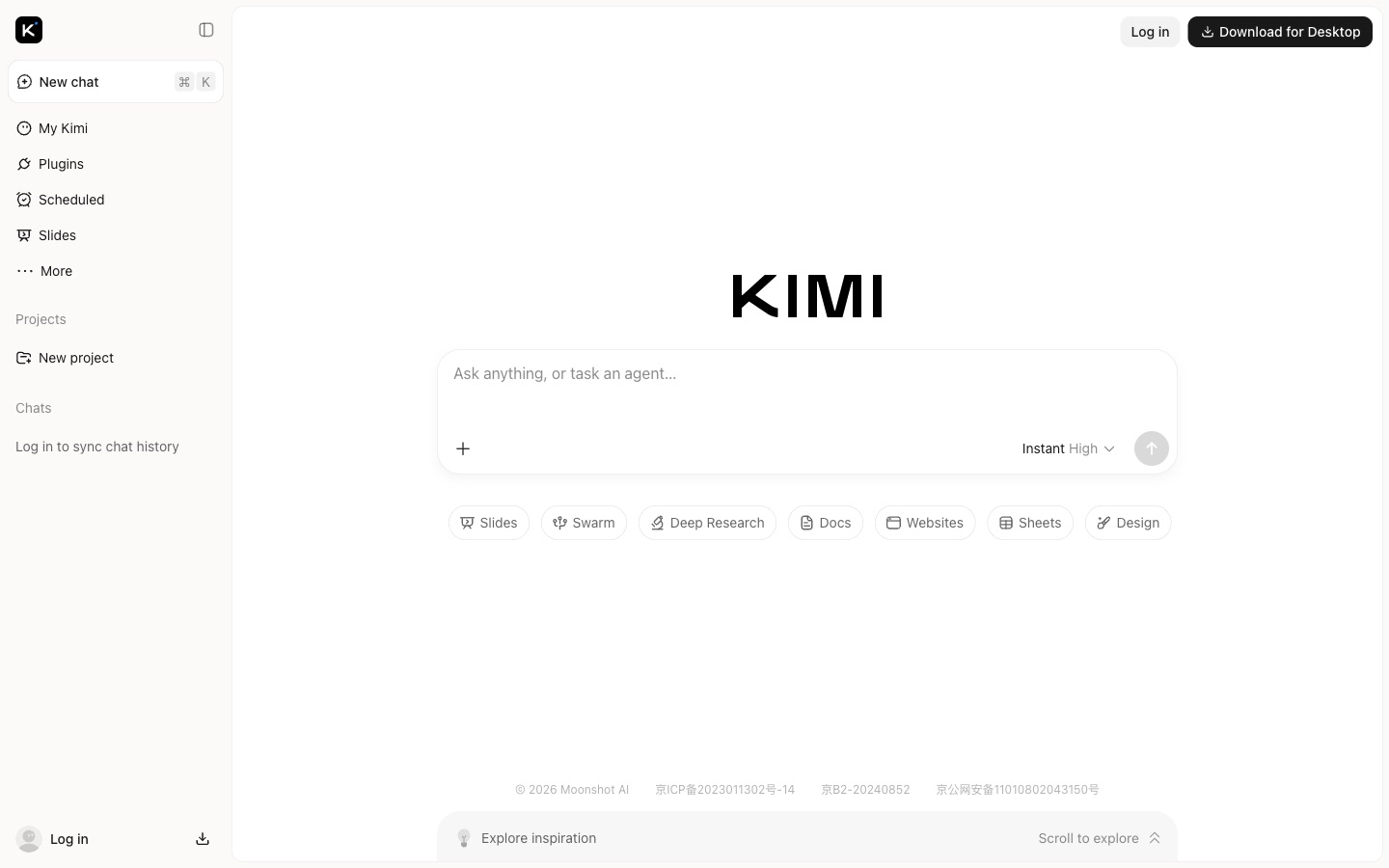 The kimi.com home screen after switching to English, captured on September 21, 2026. The default language is Chinese. Credit: Moonshot AI
What Kimi does well: long context and agent mode
Long context
Context is how much text the model holds in its head at once. 256K tokens in K2.6 is roughly a 500-page book in English; one million in K3 is four of those, or an entire code repository. According to Kimi's official capabilities page, the app accepts up to 50 files at once, 100 MB per file, in PDF, Word, Excel, PowerPoint, image, text, and video formats. Inside the app, also according to that page, K2.6 operates with roughly 128K tokens, and K3's one-million-token context is available on higher subscription tiers.
What this means for a business: drop an 80-page contract, three price quotes, and a protocol document, then ask "where are the contradictions." Or upload a year of reports and ask for trends. Other models handle this in chunks; Kimi and its peers handle it in a single pass.
Agent mode, Swarm, and Deep Research
According to the NxCode guide from March 2026, the app has four modes: Instant (no visible reasoning), Thinking (step by step), Agent (autonomous tool use), and Agent Swarm (multiple agents in parallel). According to Kilo, which integrates the models into its coding product, K2.6 runs up to 300 sub-agents in 4,000 coordinated steps, compared to 100 and 1,500 in K2.5. In a demonstration that ran for 13 continuous hours, it evaluated 12 optimization strategies, made more than 1,000 tool calls, and modified more than 4,000 lines of code. These are numbers from the vendor and its partner, not an independent measurement, but they explain why "agents that run for hours" is the central marketing claim of the series.
In practice, the app's home screen shows seven buttons: Slides, Swarm, Deep Research, Docs, Websites, Sheets, and Design. The sidebar has plugins, scheduled tasks, and projects. This is not just a "chat" interface. It is an attempt to be a full agent workspace.
Code
K2.7 Code is a dedicated code model, and Kimi Code is an open-source terminal code agent under the Apache 2.0 license, according to NxCode. According to Kilo, K2.6 scored 80.2 percent on SWE-Bench Verified, a benchmark of real bug fixes from GitHub. Anyone familiar with Claude Code will recognize the concept: an agent that reads the project, plans, and executes. The difference here is a model you can run yourself, and the price.
What "open weights" means, and what the license says
Definition: Open weights are the files of a trained model, available for download. This is not "open source" in the full sense: you do not get the training data or the training process, but you do get a model you can run on your own server, fine-tune, and integrate into a product, without any prompt leaving your infrastructure.
According to the license files on Hugging Face, K2.6 is released under a "Modified MIT" license with one condition: a commercial product or service with more than 100 million monthly active users, or more than 20 million dollars in monthly revenue, must display "Kimi K2.6" in its interface. K3 is released under the "Kimi K3 License" with the same condition, plus an addition: anyone offering the model as a service (Model as a Service) who, together with related companies, earns more than 20 million dollars over any 12 consecutive months needs a separate agreement with Moonshot, except for internal use or access through official products and authorized inference partners. For an Israeli business running the model for its own use, both licenses permit use, modification, and the creation of derivatives.
A practical note: running K3 locally requires data-center-grade hardware. K2.6, with 32 billion active parameters and built-in INT4 quantization according to the model card, is the realistic candidate for an enterprise server, and even that does not run on a laptop. Anyone looking for a small, practical open model has reason to look at Qwen as well, which comes in many sizes.
Does Kimi Work in Hebrew?
The honest answer: we don't know for certain, and we're not willing to guess.
What is known. Kimi's official capabilities page lists 13 supported languages: German, Russian, French, Traditional Chinese, Korean, Portuguese, Thai, Turkish, Spanish, Italian, Indonesian, English, and Vietnamese. Hebrew is not on the list. The interface is available only in Chinese (the default, even when accessing from Israel) and English. A third-party site focused on Kimi support claims the model "reads, understands, and generates Hebrew without a problem," but that claim is unsourced.
What we tried. On September 21, 2026, we opened kimi.com in a browser, switched to English, and typed a Hebrew prompt: a request to explain the difference between a tax invoice and a receipt in three sentences and add a cash flow tip. The moment we hit send, a login window appeared: a WeChat QR code, a phone number (default country code 86+), or sign-in with Google via kimi.ai. We don't open accounts on behalf of our readers, so the test stopped there.
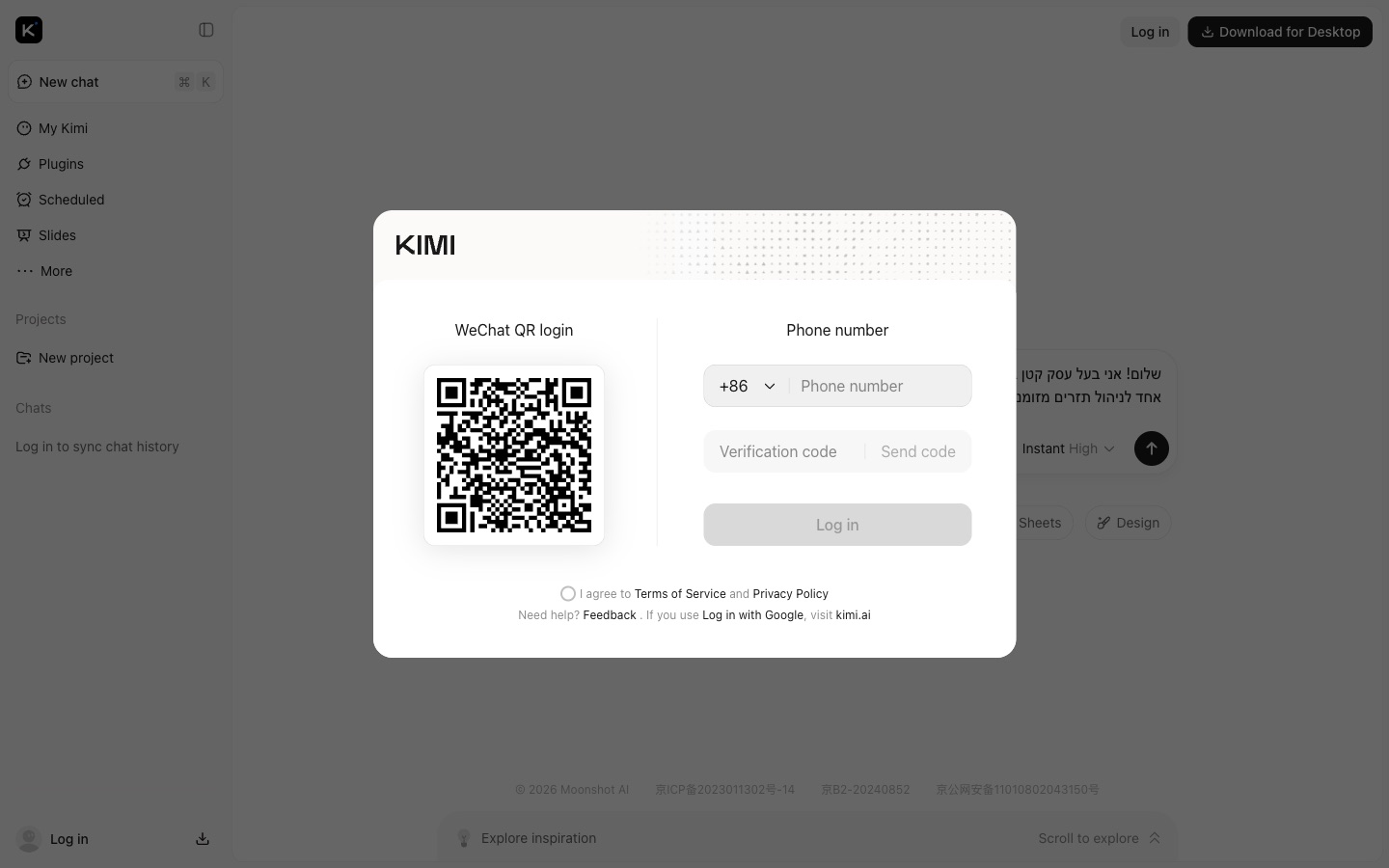 The chat requires login before the first message. Note that the Hebrew prompt displays correctly in the box, right to left. Captured September 21, 2026. Credit: Moonshot AI
What we recommend doing, in five minutes, before trusting Kimi with Hebrew:
- A writing prompt: "Write an 80-word email to a client who is late on payment, politely, in Hebrew." Check: masculine and feminine forms, construct states, and whether any words are invented.
- A comprehension prompt: Paste a paragraph from a Hebrew contract and ask "Who is responsible for repairs and what is the response time?" Check whether the answer is faithful to the text.
- A back-translation prompt: Ask for a short sentence to be translated into English and back. If the second round produces natural Hebrew, the model holds the language.
In our experience with other Chinese models, as we wrote in the guide on Qwen and the guide on DeepSeek, Hebrew comprehension is usually better than Hebrew generation. Until we test it ourselves, we'll assume the same applies here, and nothing more.
How Much Kimi Costs: App and API
The App
The kimi.com pricing page does not load without an account, so the numbers here come from a GEO Toolbox review published July 18, 2026 and updated September 5, 2026. The plans are named after musical tempo markings:
| Plan | Monthly | Annual | Agent Credits | What You Get |
|---|---|---|---|---|
| Adagio | Free | 6 | Chat, files, and search; no K3 and no Swarm | |
| Moderato | $19 | $180 | 60 | K3, Swarm (25 uses), speed priority |
| Allegretto | $39 | $372 | 150 | Kimi Code, one-million-token context |
| Allegro | $99 | $948 | 360 | 4 parallel tasks, 120 Swarm uses |
| Vivace | $199 | $1,908 | 720 | Maximum quotas, 240 Swarm uses |
And the important detail from that same review: as of July 19, 2026, Moonshot stopped selling new subscriptions, with all four paid plans showing as "sold out" because demand for K3 exceeded its compute forecasts. Existing subscribers were not affected, and the company promised to open slots in batches, with no date given. If the situation has changed by the time you're reading this, the numbers in the table are a starting point, not a guarantee.
The API
Here there is an official page, and as of September 21, 2026 it states, in price per million tokens:
| Model | Context | Input | Cached Input | Output |
|---|---|---|---|---|
| kimi-k3 | 1,048,576 | $3.00 | $0.30 | $15.00 |
| kimi-k2.6 | 262,144 | $0.95 | $0.16 | $4.00 |
| kimi-k2.7-code | 262,144 | $0.95 | $0.19 | $4.00 |
| kimi-k2.7-code-highspeed | 262,144 | $1.90 | $0.38 | $8.00 |
According to Pure AI, K3's price is the highest among Chinese AI labs. For perspective, Kingy's August 2026 comparison calculates the average cost per task on Artificial Analysis's long-context benchmark: $0.84 for K3, versus $0.11 for DeepSeek V4 Flash. Expensive for a Chinese model, cheap relative to the frontier.
Privacy and Data Location: What an Israeli Business Needs to Consider
We are not lawyers and will not claim what is permitted or prohibited. But here are the facts that appear in the documents, from which you can make your own decisions:
- Where the data lives. The API platform privacy policy (in effect from April 30, 2025) states: "We store the information we collect on secure servers in Singapore," and that data may be transferred and stored outside your country of residence. According to a Modem Guides analysis from July 16, 2026, the consumer app policy permits transfer "outside your country of residence" but does not name a specific country.
- Training on content. The API policy states that prompts, files, and outputs are used "to improve the models." According to Modem Guides, the consumer policy explicitly states "including training and optimizing our models," and there is no button or setting within the product to opt out of this, unlike ChatGPT, Claude, and DeepSeek. The documented path is submitting a rights request by email, according to your jurisdiction.
- Deletion. Under both policies, account deletion is final and irreversible, with exceptions for legal obligations.
- The rating. VerifyWise, which rates AI applications on transparency, gives Kimi a C, 57 out of 100, partly due to broad content licensing in the terms of service and silence on deletion timelines and standards for government access.
- The company is Chinese. It is subject to the laws of the country in which it operates, like any company. What that means in practice for data belonging to Israeli clients is a question for whoever is responsible for privacy at your organization, not for a guide.
The rule we follow with every Chinese model, and which also appears in the DeepSeek guide: in the app, only what you would paste in a public post. General questions, drafting, market research, article summaries. Client documents, financial data, proprietary code, medical information: only in an open-weights model running on your own infrastructure, or with a hosting provider you trust and have signed a data processing agreement with. And that is precisely the advantage of open weights: the choice exists.
The Anthropic Dispute: What Was Alleged, and What Was Not Verified
This is a section that is uncomfortable to write, and also impossible to skip. According to Wikipedia, in February 2026 Anthropic accused Moonshot, along with DeepSeek and MiniMax, of violating its terms of service through thousands of fake accounts used for "distillation," meaning training a model on Claude's responses. On September 10, 2026, in its threat intelligence report, Anthropic raised a new claim: that Moonshot had quietly routed some Kimi user requests to Claude and presented Claude's responses as if they were Kimi's. According to a Dealroom summary, the report describes a network of 5,380 accounts appearing to be located primarily in Singapore and Japan, roughly 300,000 requests in a single cluster over about ten days, and more than 23 million exchanges between May and July, mostly against Claude Opus.
Two things are important to say honestly. First: these are Anthropic's claims based on its own telemetry, and Dealroom notes they have not undergone independent public review. Second: according to that same summary, Moonshot did not respond directly. We mention this because it touches on a basic business question: when you pay for a model, who are you paying and what are you getting. Until there is a resolution, this is one more consideration in favor of an open-weights model running on your own infrastructure, where at least you know exactly what is running.
Kimi vs. DeepSeek vs. Qwen
The three major open Chinese models, based on Kingy's comparison from August 18, 2026 and Elser's from July 20, 2026:
| Kimi K3 | DeepSeek V4 | Qwen 3.8 Max | |
|---|---|---|---|
| Size | 2.8 trillion, 104 billion active | Pro: 1.6 trillion, 49 billion active. Flash: 284 billion, 13 billion active | 2.4 trillion (per Kingy) |
| Context | 1 million | 1 million | 1 million in cloud |
| License | Kimi K3 (custom) | MIT | Qwen3.8-Max (custom) |
| API price (input / output per million) | $3 / $15 | Flash off-peak: $0.22 / $0.66 | $2 / $6 |
| Artificial Analysis score | 60 | Flash: 52 | Not measured at time of comparison |
| Strongest at | Long context, vision and video, agents | Price and throughput, reasoning | Multilingual, ecosystem, many sizes |
Kingy's verdict, in her words: Kimi K3 is "the strongest choice when code and long context matter more than token price," DeepSeek V4 Flash is "the price and throughput winner, by a wide margin," and Qwen 3.8 Max is the best multimodal generalist in the cloud. Our recommendation for an Israeli business: start with Qwen, because it comes in sizes that run on a reasonable server with declared multilingual support; test DeepSeek when cost is the primary consideration; and turn to Kimi when the task involves very long documents or an agent that needs to run for hours.
How to Get Started: Step by Step
- Account. kimi.com (default Chinese) or kimi.ai with Google sign-in. Change the language to English in settings. If you decide to open an account, remember the rule: "only what you would paste in a public post."
- The Hebrew test using the three prompts above, before anything else.
- One long document. Upload a 50-page PDF and ask for a summary with page citations for each claim. This is the test where long context is supposed to justify itself.
- One deep research task. "Compare five suppliers of X in Israel by price and terms, with links." Check the links. All of them.
- API for a project. Developers sign up at platform.kimi.ai, get a key, and start with kimi-k2.6, which is three times cheaper than K3 and sufficient for most tasks.
- Local model for sensitive work. Download K2.6 from Hugging Face and run it on a server with vLLM or SGLang, following the instructions on the model card. According to that card, temperature 1.0 in thinking mode and 0.6 in immediate mode.
Who This Is For and Who It Isn't
A good fit: Teams working on very long documents; developers who want a code agent backed by a model they can run themselves; organizations looking for a powerful open-weights model for an internal server and who have the hardware; researchers and marketers who need deep research at a low cost.
Not a good fit: A business that needs flawless Hebrew writing (until it tests this for itself); anyone managing personal or sensitive client data who wants to paste it into the app; anyone who needs a stable subscription right now, while the plans are "sold out"; and anyone looking for a Hebrew-language tool for a non-technical team, since the interface is in Chinese and English.
What This Means for Your Business
Three questions:
1. What is the longest document you currently analyze in chunks? If the answer is "a contract," "a tender," or "a year's worth of reports," that is exactly where a million-token context window is worth trying, and Kimi is one of three models that offer it.
2. Where does the data have to stay? If the answer is "with us," the open-weight model is the path forward, and Kimi K2.6 is one of the candidates, alongside Qwen. If the answer is "doesn't matter," you may not need a Chinese model at all, and price becomes the deciding factor.
3. Who reviews the output? An agent that runs for 13 hours and rewrites 4,000 lines is both an impressive story and a potential disaster. Before you hand an agent a long task, define what it is allowed to change and who approves the result.
If you want to learn this hands-on, with exercises built directly into the page, there is the interactive Hebrew course on Kimi: 14 lessons, checking Hebrew output, reviewing your own privacy policy, and a first agentic task.
Frequently Asked Questions
What is Kimi? A chat and agents app from Moonshot AI in Beijing, and also a family of language models (K2, K2.6, K2.7 Code, K3) that the company releases with open weights. The differentiators: very long context and an agent mode.
What is the difference between K2.6 and K3? K2.6: one trillion parameters, 32 billion active, 256K token context, adapted MIT license, realistic to run on an enterprise server. K3: 2.8 trillion, 104 billion active, one million tokens, built-in vision and video, its own license, and three times more expensive on the API.
Is Kimi free? At the basic level, yes: chat, files, and search, without K3 and without the swarm. The paid plans, from 19 to 199 dollars per month, have been showing as "sold out" since July 19, 2026. The API is open and billed per token.
Does Kimi work in Hebrew? Hebrew is not on the official list of 13 supported languages, and we could not test it ourselves because the chat requires an account. Test it with the three prompts in the guide before you rely on it.
Is it safe to use Kimi for work? For general questions, yes, the same as any chat tool. For client data, not in the app: content is used for training with no opt-out button, the servers are outside Israel, and the company is Chinese. Keep sensitive documents on the open-weight model running on your own infrastructure, and consult whoever is responsible for privacy in your organization.
Kimi or DeepSeek? DeepSeek V4 Flash is tens of times cheaper and carries a full MIT license. Kimi K3 is stronger for long context, vision, and agents. For most businesses, DeepSeek or Qwen is the starting point, and Kimi is the tool for the long tasks.
The Bottom Line
Kimi is a top-tier open model, with long context and agent mode as genuine advantages, and with three caveats you should not skip: Hebrew support is neither declared nor tested, the privacy policy trains on your content with no opt-out, and the Anthropic allegations have not yet been resolved. For an Israeli business, the right way into Kimi is through the open weights on your own server, and through a five-minute Hebrew test. Not by pasting a contract into the app.
For all our guides and courses on AI in the organization: our implementations and interactive AI courses at 9.90.
Sources: API pricing page · Official capabilities page · API platform privacy policy · K2.6 model card · K3 model card · Pure AI on the K3 launch · Kilo on K2.6 · GEO Toolbox on subscription plans · NxCode on the app · Modem Guides on the privacy policy · VerifyWise, the trust index · Kingy: Qwen vs. Kimi vs. DeepSeek · Elser: K3 vs. V4 vs. Qwen 3.6 · Dealroom on the Anthropic allegations · Wikipedia: Moonshot AI · Wikipedia: Kimi. All figures are accurate as of September 21, 2026.
Yaakov Tzedek, AI lecturer, consultant, and organizational AI implementer, and leader of the largest Claude Code community in Israel.
Frequently asked questions

Yaakov Tzedek
An Israeli AI lecturer, consultant and implementer who has supported 100+ organizations in AI implementation and lectured for 200+. Official content partner of Meta, Google, Canva and TikTok, featured on Israel's Channel 13.
More about Yaakov →