
- Abu Dhabi's IFM research institute released K2 Horizon: six models from 0.9B to 375B parameters, with training data, code, and methodologies. What separates open weights from true open source, who it actually matters to, and the question you can finally ask any AI vendor.
The K2 Horizon family spans the full range of hardware: the smallest model, at 0.9 billion parameters, was designed to run on watches and glasses, while the largest, at 375 billion parameters, targets heavy enterprise workloads. All six share the same architecture and the same training methodology, so you can develop on the small model and move to the large one without changing your deployment process.
In recent weeks, almost every major model vendor has announced it's "opening" something to the community. Almost every time, the announcement meant exactly one thing: a weights file you can download.
On September 3, 2026, the IFM (Institute of Foundation Models) research institute from Abu Dhabi did something different. It released a family of six models called K2 Horizon, and published the training data alongside them.
The difference between those two actions is the difference between receiving a car and receiving the engineering blueprints, parts list, and production log along with it.
In short: Six models ranging from 0.9 billion to 375 billion parameters, with a 512K context window, under an Apache 2.0 license. What's unusual here isn't the size but what was published alongside them: the code, the methodologies, the intermediate checkpoints, and the training data. This allows an external researcher to reproduce the process, not just run the output. For most organizations in Israel, this won't change anything tomorrow morning, but it gives them a new question to ask every vendor.
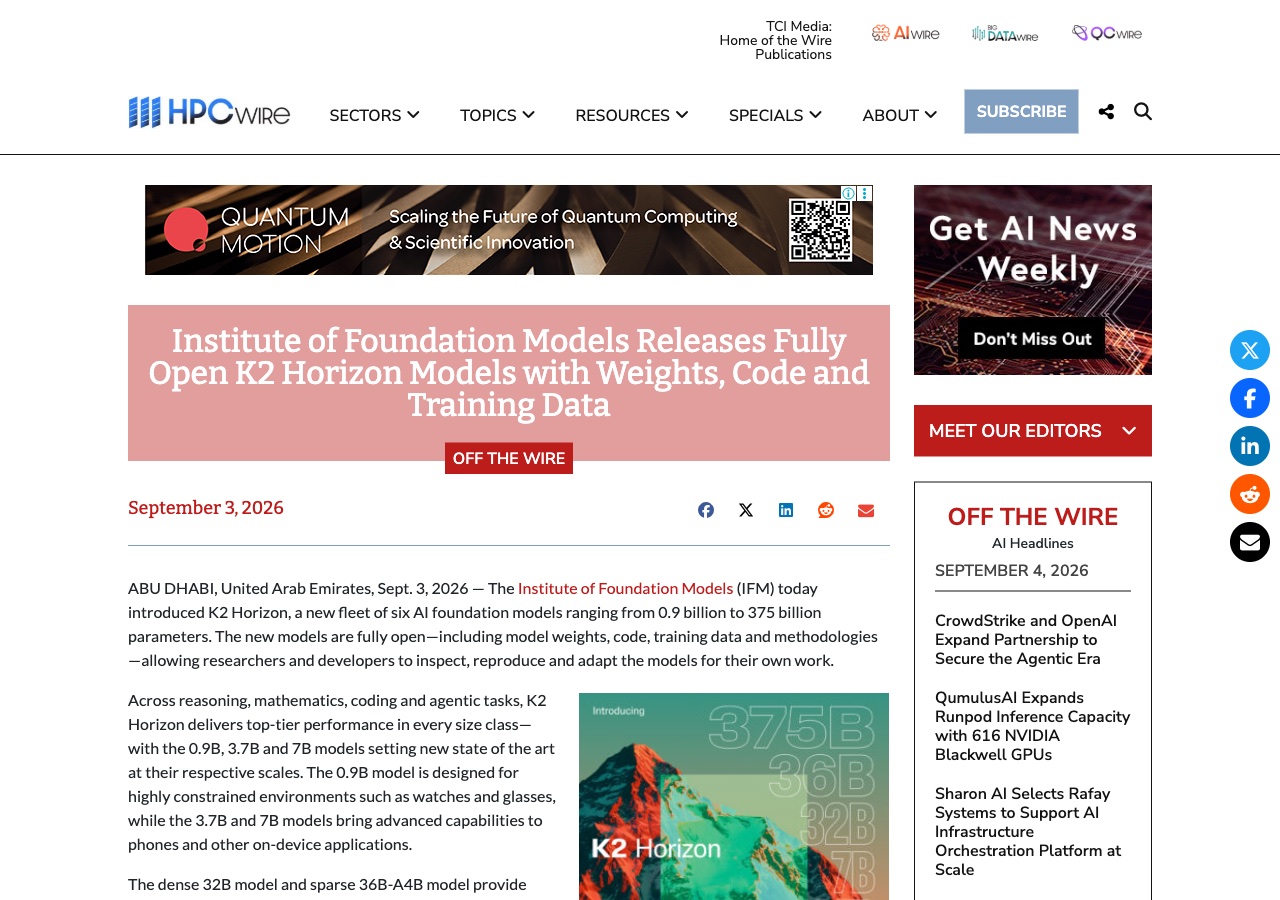 The official K2 Horizon announcement, including the full fleet range. Screenshot: AIwire
What exactly was released?
IFM published a fleet of six models that share a single architecture, a single vocabulary, and the same training methodology. The smallest is 0.9 billion parameters, and the largest is 375 billion.
The small end is designed for highly constrained environments, including watches and glasses. The 3.7 and 7 billion models target phones and edge devices. The 32 and 36 billion models suit local storage and on-premises servers, and the largest model is intended for heavy enterprise workloads.
Everything was released under an Apache 2.0 license, available through Hugging Face and inference engines like vLLM and SGLang.
The fact that all six share an architecture, vocabulary, and interfaces has a practical implication that's easy to miss: you can design and test a workflow on the small, inexpensive model, then move up to a larger one without rewriting the implementation. In real projects, that's exactly where weeks get burned, when teams discover that switching between models means rebuilding everything from scratch.
But none of those numbers are the real story here.
What's the difference between "open weights" and genuine open source?
It's the difference between receiving a product and receiving its production process. Here's the clean definition:
Open weights. You get the trained model as a file. You can download it, run it on your servers, fine-tune it for your needs. What you don't get: what data it was trained on, what process was used, and exactly what went in along the way. This is what most models described as "open" today actually offer.
Full openness. In addition to the weights, the training data, code, methodologies, and intermediate checkpoints saved throughout training are also published. An external researcher can take that package, repeat the process, and verify whether they arrive at the same result.
This difference is not semantic, and it isn't a debate for licensing specialists. With open weights you can examine what a model does. With full openness you can also examine why.
Eric Xing, founder of IFM, shared the details of the release with Reuters and laid out the position simply: science works when others can see the data, follow the method, and reproduce the result. Without that part, what you have is a product, not research.
Who does this difference actually matter to?
An organization that's required to audit the sources of its information, not just the output.
There's a difference between an organization that asks "is the answer correct" and an organization that must answer "where did this knowledge come from." The second type is whom this release touches:
- Copyright legal risk. When a model is trained on data of unknown origin, an organization using it commercially takes on a risk it can't quantify. With visible training data, at least you can check.
- Regulation. Regulators in healthcare, finance, and defense are moving toward requiring explanations for automated decisions. "The model decided" is not an answer that survives an audit.
- Technological sovereignty. Security and government agencies that can't rely on a foreign vendor, and need the system to be reproducible even if the vendor changes policy or disappears.
- Academic research. A university publishing a paper on model behavior needs the experiment to be reproducible. Without the training data, it simply isn't research.
For those four groups, this release isn't a tech headline. It's a change in the toolkit available to them.
Notice what they all have in common: none of them are looking for a more powerful model. All of them are looking for a model they can defend before a third party, whether that's a judge, an auditor, a regulator, or a peer reviewing a paper. That's an entirely different category of requirement, and it almost never appears in the performance comparisons published by the industry.
So why won't this change anything for you tomorrow morning?
Because the gap between "it's possible to audit" and "we will audit" is enormous, and most organizations aren't on the other side of it.
A 375 billion parameter model doesn't run on a server sitting in the communications room. It requires a serious GPU setup, with purchase costs or cloud costs that run every month whether you used it or not. And someone needs to maintain it, monitor it, and update it.
Reproducing the training of a model at that scale is a research team project, not a job for an IT manager. The fact that the training data is open doesn't make auditing it cheap.
So what will actually happen? Most businesses in Israel will continue consuming managed APIs, and that's the right choice for them: pay per use, no upfront investment, with contractual accountability from a vendor.
That's exactly the same logic I wrote about when DeepSeek released an open vision model a few days ago. The choice between an open and a managed model is an architecture decision, not a procurement decision.
What's the immediate value, then?
One question you can finally ask every vendor, and reasonably expect an answer to.
Until now, when you asked an AI vendor "what was your model trained on," the standard response was a mix of "public sources" and "licensed data." You couldn't verify it, and you couldn't compare it to anything.
Now there's a reference point. A model at industrial scale exists that does publish its data, so the vague answer has shifted from an unavoidable norm to a vendor choice.
The practical framing I recommend in procurement conversations is three questions:
- What data sources was the model trained on, and what portion of them are explicitly licensed?
- If a copyright infringement claim is opened based on model output, who bears liability and what exactly does the contract say?
- Is there documentation of the training sources that can be presented to a regulator or external auditor?
If a vendor can't answer all three questions, that doesn't mean they're a bad vendor. It means you know exactly where your risk sits, and who absorbs it.
What this means for your organization
Don't switch vendors because of this headline. Change the questionnaire.
The only practical step worth taking this week takes an hour: go through the tools already in use at your organization, and mark next to each one whether you know what it was trained on. In most organizations I work with, the answer is "no" on almost every line, and nobody has asked until today.
Once you have the list, filter it by real risk. A tool that drafts email replies is not in the same category as a tool that analyzes legal documents or medical records. The gap between those two rows is the whole exercise, and in most cases it narrows down to three or four tools that actually require scrutiny.
If you want an organized map of the places where AI can already work for you, and where it adds risk instead of value, the AI scan does exactly that.
There's also a direct connection to today's companion story. When senior scientists in the industry describe the models they themselves are building as something they don't fully understand, that admission and the demand for visible training data are two sides of the same question: how much can you actually know about the system you're bringing into your organization.
<!--LIVE-SESSION-->How to stop reading about models and start building with them
The difference between someone who reads AI news and someone who makes good decisions based on it isn't the number of articles. It's the moment you built one system yourself, saw from the inside where the model fits in, what gets passed to it, and what breaks when you swap it out.
Sources for this article: The official IFM announcement as published in AIwire, Reuters coverage that included Eric Xing's remarks, and additional reporting in Asharq Al-Awsat.
Frequently asked questions

Yaakov Tzedek
An Israeli AI lecturer, consultant and implementer who has supported 100+ organizations in AI implementation and lectured for 200+. Official content partner of Meta, Google, Canva and TikTok, featured on Israel's Channel 13.
More about Yaakov →