- DeepSeek quietly released DeepSeek-V4-Flash-Vision-Exp: an experimental 305B-parameter vision model, MIT license, built for agents that see a screen and act on it. Official benchmarks, an honest comparison with Claude Opus 4.8, and the real question: who actually benefits from running this on-premises.
The most interesting line on the model card isn't the vision capability, it's what didn't break because of it. Compared to the previous text-only DeepSeek-V4-Flash-0731, the DeepSWE score actually went up, from 54.4 to 59.3. Adding vision did not come at the expense of coding ability, which is exactly the failure pattern seen in many multimodal models before it.
DeepSeek released a vision model. No launch event, no video, no slide deck. Just a model card uploaded to Hugging Face under an MIT license, with a table inside that puts it in the same league as the most expensive closed models on the market.
The name: DeepSeek-V4-Flash-Vision-Exp. 305 billion parameters. And this one, unlike every competitor in that table, you can download and run on your own servers.
In short: An experimental multimodal model, the first in the DeepSeek-V4 family, released under an MIT license. It was not designed to describe images. It was designed to serve as an agent that looks at an interface or a document and then takes action. On benchmarks it reaches Claude Opus 4.8, but does not beat it on every row. And its real cost is not in tokens, it is in hardware.
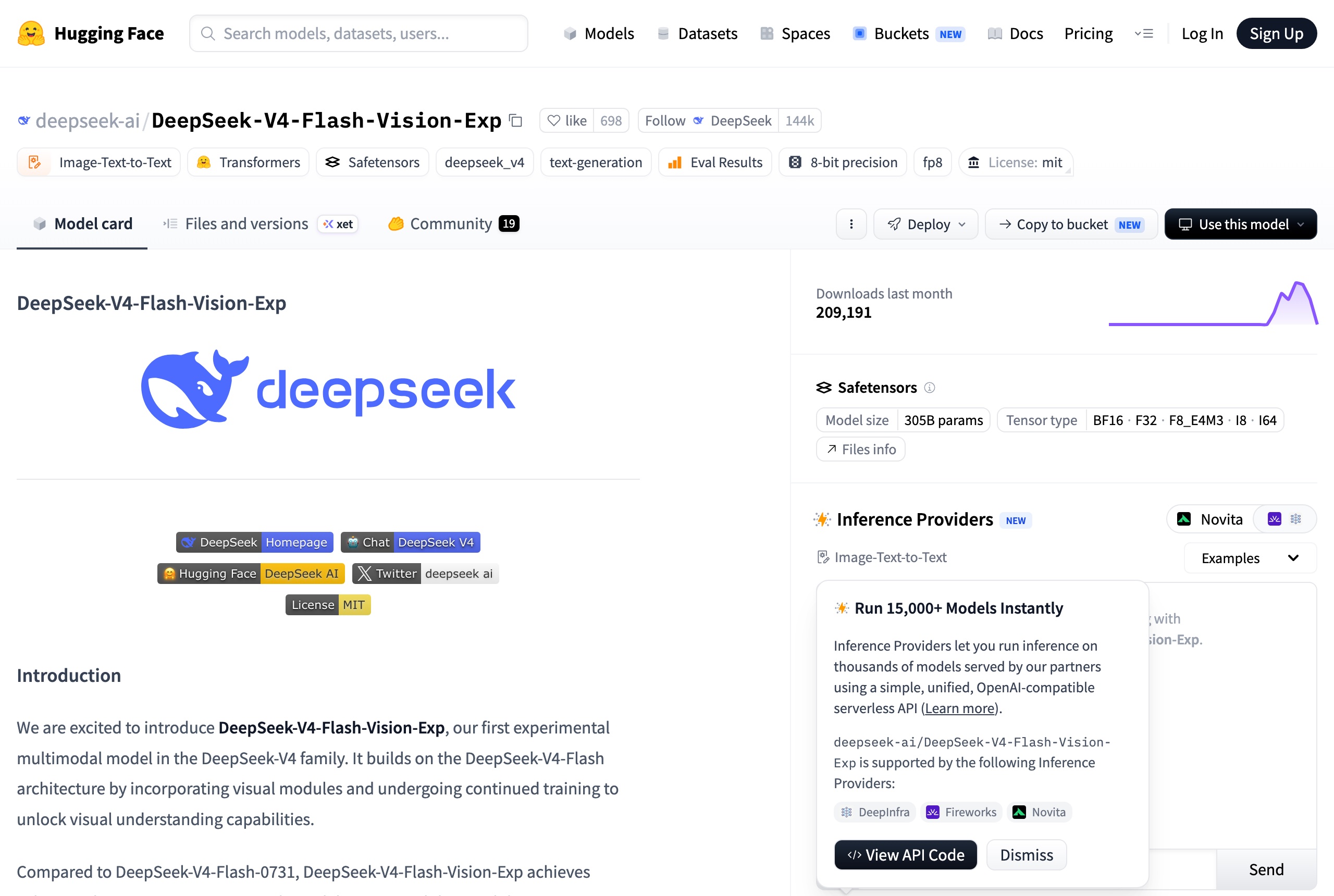 Screenshot: Hugging Face
What exactly was released?
DeepSeek-V4-Flash-Vision-Exp is the first experimental multimodal model in the DeepSeek-V4 family. It is built on the existing DeepSeek-V4-Flash architecture, with visual modules added and continued training to unlock visual understanding capability.
It is available through two parallel tracks: a full weight download from Hugging Face under an MIT license, or a standard call to the DeepSeek API using the identifier deepseek-v4-flash-vision-exp. The vLLM team has also already published a dedicated run recipe for it.
The line you should not skip: DeepSeek explicitly marks it as Experimental in the model card. That is not a legal footnote, it is a declaration that behavior may still change.
What do the official numbers say?
DeepSeek published a full benchmark table, split into two parts: text agent capabilities and multimodal agent capabilities.
Text agent capabilities:
| Metric | Score |
|---|---|
| Terminal-Bench 2.1 | 83.9 |
| NL2Repo | 57.7 |
| Cybergym | 75.3 |
| DeepSWE | 59.3 |
| Toolathlon-Verified | 75.9 |
| DSBench-Hard | 63.6 |
| AutomationBench (Public) | 25.7 |
Multimodal agent capabilities:
| Metric | Score |
|---|---|
| ApexBench (Pass@1) | 36.5 |
| Agents' Last Exam | 27.3 |
| Chartography | 64.3 |
| ZeroBench (Pass@5) | 35.0 |
Notice the gap between the two tables. On text tasks the scores are high; on complex vision tasks they are significantly lower. That is exactly what you would expect from an experimental vision model, and exactly what is worth keeping in mind before you plan a production pipeline around it.
What broke when the model was given eyes?
Almost nothing, and that may be the best piece of news in this release.
The history of multimodal models is full of cases where adding vision capability to a text model hurt what the model already knew how to do. It learned to see, and along the way forgot a little of how to write code.
Here the opposite happened. Against the previous text-only model, DeepSeek-V4-Flash-0731, the score on DeepSWE rose from 54.4 to 59.3:
| Metric | DeepSeek-V4-Flash-0731 | DeepSeek-V4-Flash-Vision-Exp |
|---|---|---|
| DeepSWE | 54.4 | 59.3 |
The practical implication is straightforward: you are not being asked to choose. Anyone already using a DeepSeek model for pure text agent tasks does not pay a performance penalty by switching to the version that sees. In other model families, that was a genuine question.
So does it beat Claude Opus?
No. And DeepSeek's own table says so explicitly.
| Metric | DeepSeek-V4-Flash-Vision-Exp | Claude Opus 4.8 |
|---|---|---|
| Terminal-Bench 2.1 | 83.9 | 85.0 |
| DeepSWE | 59.3 | 58.0 |
This matters, because a large portion of the coverage around this release showed only the number 83.9 without the comparison, which creates a misleading impression. The real picture is a draw: on one metric the closed model leads, on the other the open model leads slightly. Both models are in the same league, and neither replaces the other at the push of a button.
There is one more caveat that has to be stated. This comparison was published by DeepSeek about itself. Not all results have been independently verified by a third party, and that is true of every model vendor that publishes its own table, not just DeepSeek.
Why is a vision model for agents an entirely different story?
Because the difference is between "describe this image for me" and "look at the screen and do something."
A classic vision model receives an image and returns text. An agent that sees receives a screenshot of a system, a scanned form, or a diagram, understands what is shown, and then decides what the next step is and executes it: click, fill a field, extract a data point, pass it forward.
That is exactly the type of task the benchmarks in the table measure. Chartography tests chart comprehension, Toolathlon tests tool use, AutomationBench tests end-to-end automation. This is not a list of metrics for a model designed to write image captions.
And from there follows the real organizational angle, which is not the performance angle.
Who actually needs an open vision model?
The short answer: anyone whose documents cannot leave the network.
An MIT license and self-hosting mean that the scanned document, the screenshot of the internal system, or the financial diagram never travel to any vendor's server. They stay inside your infrastructure, and the model comes to them instead of them going to it.
This is primarily relevant for three groups:
- Software companies whose code and infrastructure are the asset, and that already run their own GPU infrastructure for other purposes
- Defense bodies and classified organizations where sending a data point outside is not a policy question but a prohibition
- Organizations under heavy privacy regulation, healthcare, finance, public bodies, where the act of transferring data to a third party triggers reporting and oversight obligations
If you are not in one of those three, this model is interesting to you competitively, not operationally.
And there is a point that is easy to miss. Even within those three groups, not every process needs to run internally. An organization can run an open model on the genuinely sensitive documents and continue using a managed API for everything else. This is not a binary decision, and in most cases the right architecture is a hybrid one.
What is the real cost of self-hosting?
Three line items that are almost always forgotten when people talk about a "free model."
Hardware. 305 billion parameters is not a single graphics card and not a server sitting in the network closet. This means a serious GPU cluster, with purchase costs or dedicated cloud costs running every month whether you used it or not.
Maintenance. Someone needs to update, monitor, troubleshoot, review new versions, and verify that performance is not degrading. That is a role, not a task.
Accountability for the output. When a managed model makes a mistake, you have a vendor, a contract, and an SLA. When the model runs on your infrastructure, the mistake is yours alone, especially when the model is marked Experimental.
Against that stands a managed API: pay per use, no upfront investment, stable performance, and contractual accountability. Data protection is achieved through a data processing agreement, a defined storage region, and a clear usage policy.
The rule I give clients is simple: if you cannot name the monthly hours someone on your team will dedicate to maintaining the model, you are not yet ready to run it in-house. That line item is what turns projects like this from a saving into an expense.
What this means for your organization
I will say it directly: for most organizations, a managed API will still be the right choice, and that is perfectly fine.
This release does not mean you need to run a model in-house. It says something else, and something more important: the ceiling for open source has risen, and from now on you have negotiating leverage. When a vendor offers you a price or usage terms, the existence of an open alternative in the same league is a data point that stands with you at the table.
The practical step is not technical. It is to sit down and identify which types of documents in your organization genuinely cannot leave, and which ones you have simply gotten into the habit of treating that way. In most organizations I walk into, the second list is far longer than the first. If you want a structured map of the places where AI can already work for you, the AI scan does exactly that.
There is also a connection here to two complementary stories from today. An open agent running inside the organization, with no external vendor overseeing it, is precisely the kind of agent that needs brakes and a reporting protocol. I wrote about the kill switch for AI agents and about the incident disclosure obligation for agents, and both are relevant here several times over: when the model is yours, the control is yours, and so is the responsibility.
<!--LIVE-SESSION-->This choice is an architecture decision, not a procurement decision
The moment you decide between an open model and a managed one is not a moment of comparing prices. It is a moment of determining how the system is built, what travels where, and who is accountable when something breaks. And anyone who has built one of these systems themselves understands what actually stands behind each option.
Sources for this article: The official model card on Hugging Face, DeepSeek's API documentation, and vLLM's run recipes.
Frequently asked questions

Yaakov Tzedek
An Israeli AI lecturer, consultant and implementer who has supported 100+ organizations in AI implementation and lectured for 200+. Official content partner of Meta, Google, Canva and TikTok, featured on Israel's Channel 13.
More about Yaakov →