- Over Halloween weekend, Grok Bot users found their weekly quota had jumped to 100% overnight. Elon Musk confirmed it was no bug: operating costs were too high relative to revenue. Here is what we know, how to make the quota last, and what else changed at Anthropic and in the Grok API.
Grok Bot's quota is not measured by the number of messages you send. According to the official plans page, it is measured by the agent steps and tokens the bot consumes, so one long, open-ended task can cost more than dozens of short questions.
Grok Bot users went to sleep with half their quota left and woke up with none. For some, the weekly counter jumped overnight from 50% to 100% used. It was not a bug, and that is exactly why every business that has built workflows on the bot should pay attention.
In short:
- What happened: Over the Halloween weekend, users discovered their weekly Grok Bot quota had hit the ceiling overnight. TechCrunch reported this on November 2, 2026.
- The explanation: Elon Musk wrote on X on November 1 that the cost of running Grok Bot was unsustainably high relative to revenue. Not a bug.
- What is unknown: What the limits will look like going forward. As of today there is no official breakdown.
- What you control: Task size, schedule frequency, the number of bots running in parallel, and the on-demand spending cap.
- Also today: Anthropic's prohibition on sustained abusive behavior toward Claude takes effect on November 12, and SpaceXSI is adding invisible watermarks to Grok API text output starting November 7.
What exactly happened to Grok Bot over the weekend?
Many users' weekly quotas ran out all at once, with no change in their usage habits. According to Amanda Silberling's report in TechCrunch, the counter jumped for some users "from just 50% to 100%" in a single night.
The response came from Musk himself, in a post on X on November 1: "The cost of serving Grok Bot was unsustainably high relative to revenue."
The implication is straightforward. This was a deliberate company decision, not a bug that will be patched tomorrow. At the same time, Musk has not yet spelled out what usage limits subscribers should expect going forward. We checked Grok Bot's official help pages on November 3 and found no announcement of a change or any updated quota table.
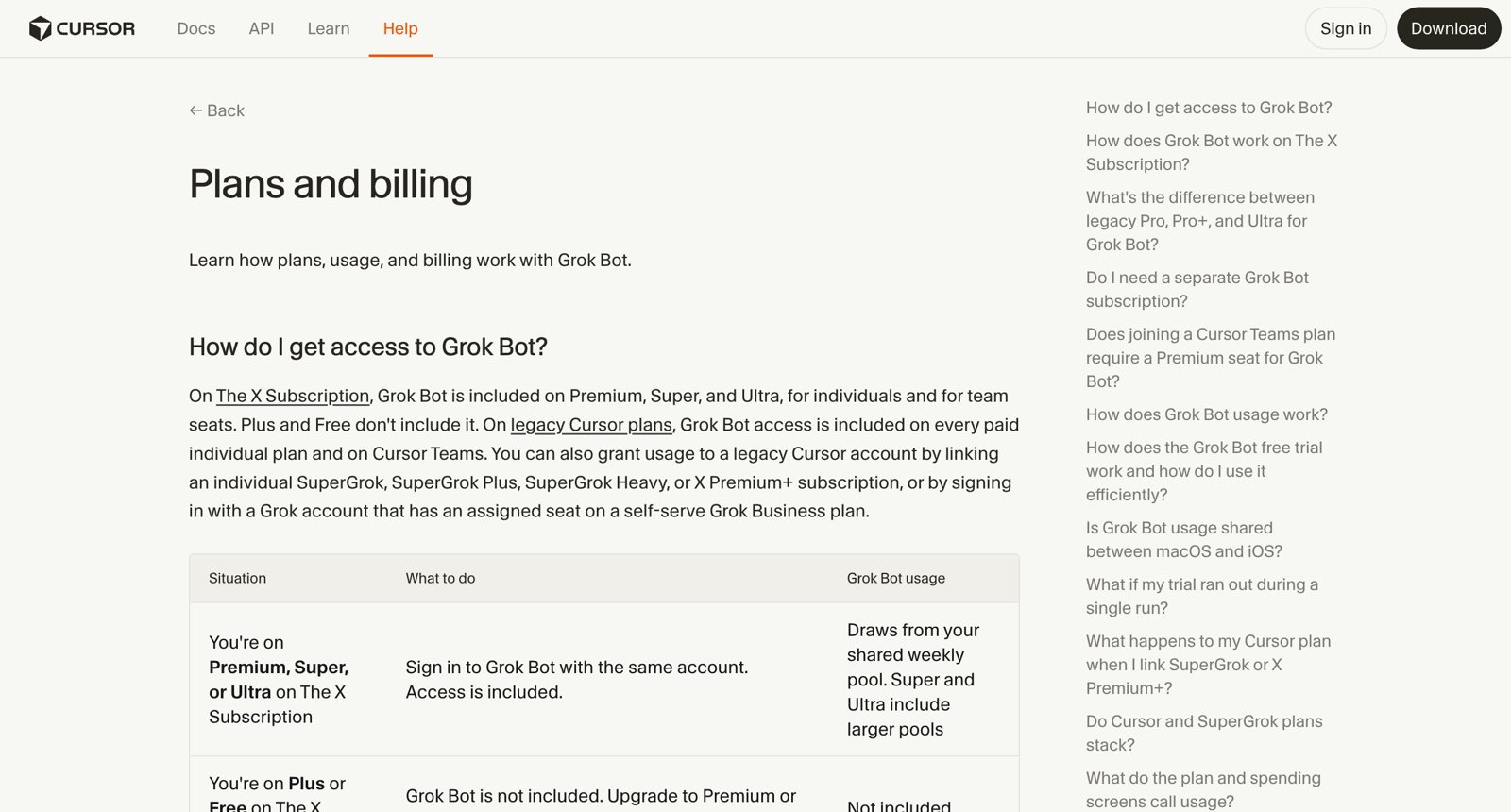
Screenshot: Grok Bot Plans and billing page in the Cursor help center, November 3, 2026
Why now?
An agent running in the background costs far more than a chat session, and that is exactly the product Grok Bot sells. A bot that navigates websites, reads files, and runs routines every morning consumes compute power even when no one is watching.
According to the official plans page, usage "is measured by agent steps and tokens, not by the number of messages you send." A large, long-running task costs more, full stop. When Musk previously described Grok Bot as the fastest-growing product he had ever seen, he was also describing the problem: every new user running background bots adds to the server bill.
It is worth remembering that the product structure itself has changed since launch. Today, according to the help page, Grok Bot is included in the Premium, Super, and Ultra tiers of The X Subscription (Plus and Free tiers do not include it), as well as legacy Cursor plans. The complete Grok Bot guide covers the full history of tiers and pricing.
How do you make your weekly quota last?
The most important point: you cannot choose a cheaper model. According to the official FAQ, Grok Bot selects the model for each task and there is no model selector. All savings come from how you define the work. Seven steps, all grounded in the official documentation:
- Check the counter before a large task. The official recommendation is to review usage on the plan screen before large runs. The counter is in settings under Usage & Billing, or on the Usage page at grok.com/dashboard.
- Start small and with a well-defined task. This is the official recommendation for users in a trial period, and it applies to everyone. "Sort my emails" is an open-ended task that can generate dozens of steps. "Mark as important every email from a client on the attached list" is a task with a boundary.
- Remember the quota is shared. The bot draws from the same weekly quota as Cursor and Grok apps, and it counts against the entire account, not per bot. macOS and iOS share the same counter. A long chat in the app in the morning can eat into what you planned for a bot in the evening.
- Audit your schedules. Background schedule runs consume quota. A schedule that runs every hour when once a day is enough wastes twenty-three runs. Go through every recurring schedule and ask: is this frequency actually necessary?
- Reduce bots running in parallel. A team of five bots each checking the same inbox is five times the same work. The team bots guide shows how to divide responsibilities without duplication.
- Set an on-demand spending cap. When the quota runs out, you can continue with on-demand usage, which is billed separately. In settings you can disable it or set a monthly cap. Note: according to the help page the cap is not a hard stop mid-run, and a bot can finish a run that has already started even if it has exceeded the cap.
- Add an approval gate before large actions. A bot that pauses and asks before launching a hundred-step task saves both errors and quota.
Should businesses be worried?
Not worried, but planned. Users who rely on Grok Bot as a personal assistant will mostly notice that the week runs out faster. Anyone who has built a business process on it, such as lead response or billing reminders, needs to ask what happens on the Wednesday when the quota is already gone.
Three questions worth answering this week:
- What is the critical process? If the bot handles lead responses, that is the last process you want stopped. Give it priority and reduce the frequency of report and summary schedules.
- What is the emergency budget? Decide in advance how much you are willing to spend on on-demand usage per month and set the cap accordingly. That decision should be made calmly, not on a Friday night.
- What is plan B? A process with no manual fallback or backup tool is a business risk, independent of Grok Bot. This week's story is just a reminder of that.
The broader lesson applies to every agentic tool, not just Grok Bot: the subscription price is not the real price. Vendors are still searching for the equilibrium between compute costs and revenue, and anyone who depends on them needs to build processes that can function with less.
Also today in leading AI tools
Anthropic: sustained abusive behavior toward Claude enters the usage policy
Starting November 12, 2026, Anthropic's usage policy prohibits "sustained, purposeless abusive or cruel behavior" toward its models. The update was published on October 8, and according to Anthropic it applies only to extreme cases where a user repeatedly engages in cruel behavior with no apparent purpose. Normal frustration, arguing with an answer, dark themes in creative writing, and research testing of the model are not included.
What about enforcement? According to Anthropic, Claude's ability to end a conversation with an abusive user on Claude.ai and Claude Code "will remain the primary enforcement mechanism." The policy's general clause states that in the event of a violation the company may warn, restrict, or suspend access. A debate emerged in coverage: Box CEO Aaron Levie called politeness toward AI "an easy Pascal's wager," while critics argued this amounts to anthropomorphizing a machine. For teams using Claude at work, nothing changes in normal use. Full policy on the Anthropic website.
Grok API: invisible watermarks in text output starting November 7
Businesses building products on the Grok API need to know: starting November 7, 2026, text generated by the grok-4.7, grok-4.6, grok-4.5, grok-4.3, and grok-4.20 family models will include an invisible watermark by default. According to SpaceXSI's documentation (the company developing Grok), the move is intended to comply with the EU AI Act, and it applies to text responses, structured output, and tool call arguments.
No code changes are required, and according to the documentation there is no effect on quality or speed. Team managers can disable watermarking per model in the console, but disabling it requires confirming that an exemption under applicable law applies to your use case. Anyone exporting text to customers in Europe should check this with legal counsel before turning it off.
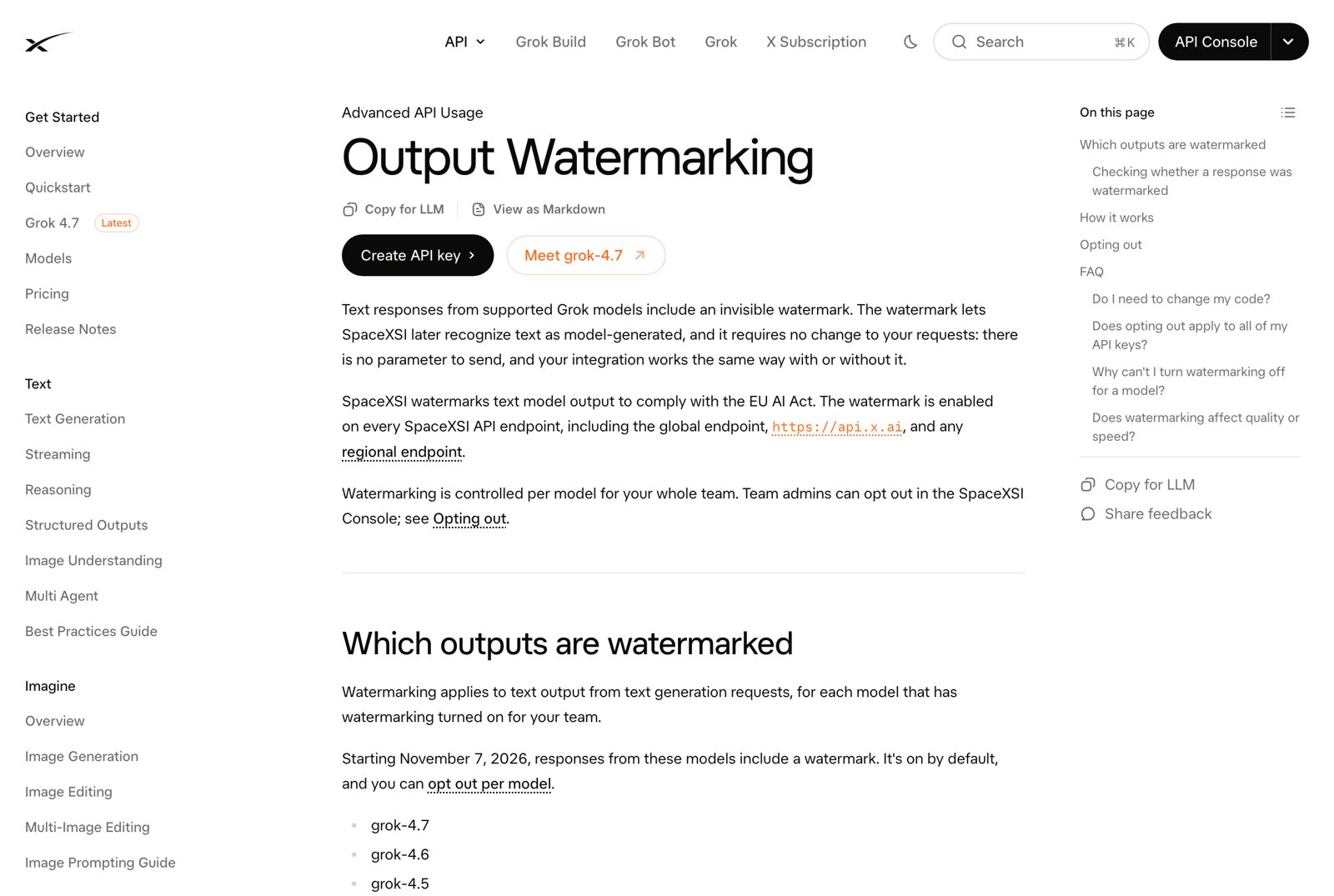
Screenshot: Output Watermarking page in SpaceXSI developer documentation, November 3, 2026
Data Bot: how SpaceXSI uses Grok Bot internally
On November 2, SpaceXSI published Data Bot, a team bot inside Grok Bot that its data science team trains so that any team in the company can query the data warehouse and get analysis as if from a data scientist. According to the company, product managers and marketing staff reach it through Grok Bot or Slack, and it produces written reports with charts. This is not a new product for sale, but an example of what a team bot looks like in real use. Announcement on the company website.
📬 This article was included in the weekly "This Week in AI" roundup for November 6, 2026, along with all the guides and articles published on the site that week.
Want to learn to work with agents within the limits?
This week's story shows the question is no longer just "what can the bot do" but "how much does it cost when it does it." The Grok Bot video course includes a full lesson called "Cost Counter and Cap" that shows how to set a ceiling before a bot runs on its own overnight, plus lessons on recurring schedules, approval gates, and team bots. It will not increase your quota, but it will teach you to get more out of it.
The AI Agents Bundle includes the Grok Bot video course and the Claude Code video course, with the SocialFlow course included as a gift. Price: 297 ILS + VAT (350.46 ILS including VAT), until November 12 at 23:59. Anyone who wants to go deeper on costs first can start with the advanced Grok Bot guide, including token costs.
Frequently asked questions

Yaakov Tzedek
An Israeli AI lecturer, consultant and implementer who has supported 100+ organizations in AI implementation and lectured for 200+. Official content partner of Meta, Google, Canva and TikTok, featured on Israel's Channel 13.
More about Yaakov →