- On October 30, 2026, OpenAI, Google and Microsoft announced they will honor a shared robots.txt token, __usage_ai-training, letting site owners signal a preference against AI model training on their content. The draft was written by an Anthropic employee and submitted to the IETF. It is a preference signal, not a technical block, and it is not yet a standard. Effective dates, the difference between training and grounding, what to put in robots.txt today, and what it all means for GEO.
The technical draft behind the shared signal was written by an Anthropic employee and submitted to the IETF as an individual submission. The draft itself states explicitly that it has not been approved by the IETF and carries no official standing in the standards process.
Until now, anyone who wanted to prevent AI companies from training models on their site had to know every crawler by name. GPTBot, Google-Extended, ClaudeBot, and a long list of names that change every few months. On October 30, OpenAI, Google, and Microsoft announced they would honor a single shared signal, based on a draft written by someone at Anthropic. It sounds like a "don't touch my content" button. It isn't exactly that.
In short:
- What was announced: A shared signal in robots.txt called
__usage_ai-training, through which a site owner expresses a preference against using their content to train AI models.- Who: OpenAI, Google, and Microsoft published announcements on October 30, 2026. The technical draft was written by an Anthropic employee.
- When: OpenAI says "in the coming months," Microsoft from February 1, 2027, Google "in 2027." Anthropic, according to the draft's author, has already begun implementing it.
- What it isn't: Not a technical block, and not a binding standard. It is a preference that the companies have committed to honor.
- For GEO: Blocking training is not the same as blocking citation. But with Google the effect on Gemini apps is more nuanced, and it's worth understanding that before adding a line.
What exactly was announced?
Three of the major companies announced on the same day that they would honor the same signal. OpenAI wrote that it would honor a "shared signal" in robots.txt, the file where sites express preferences about how their content may be used to train AI models. Google published an announcement on the Google Search Central blog, and Microsoft on the Bing blog.
The basis is a draft called Machine-Readable Training Preference Signal, submitted to the IETF (the body that defines many internet standards) on October 30. It was written by Kevin Kelley of Anthropic. It builds on the work of the IETF's AIPREF working group, which is defining a vocabulary for AI preferences.
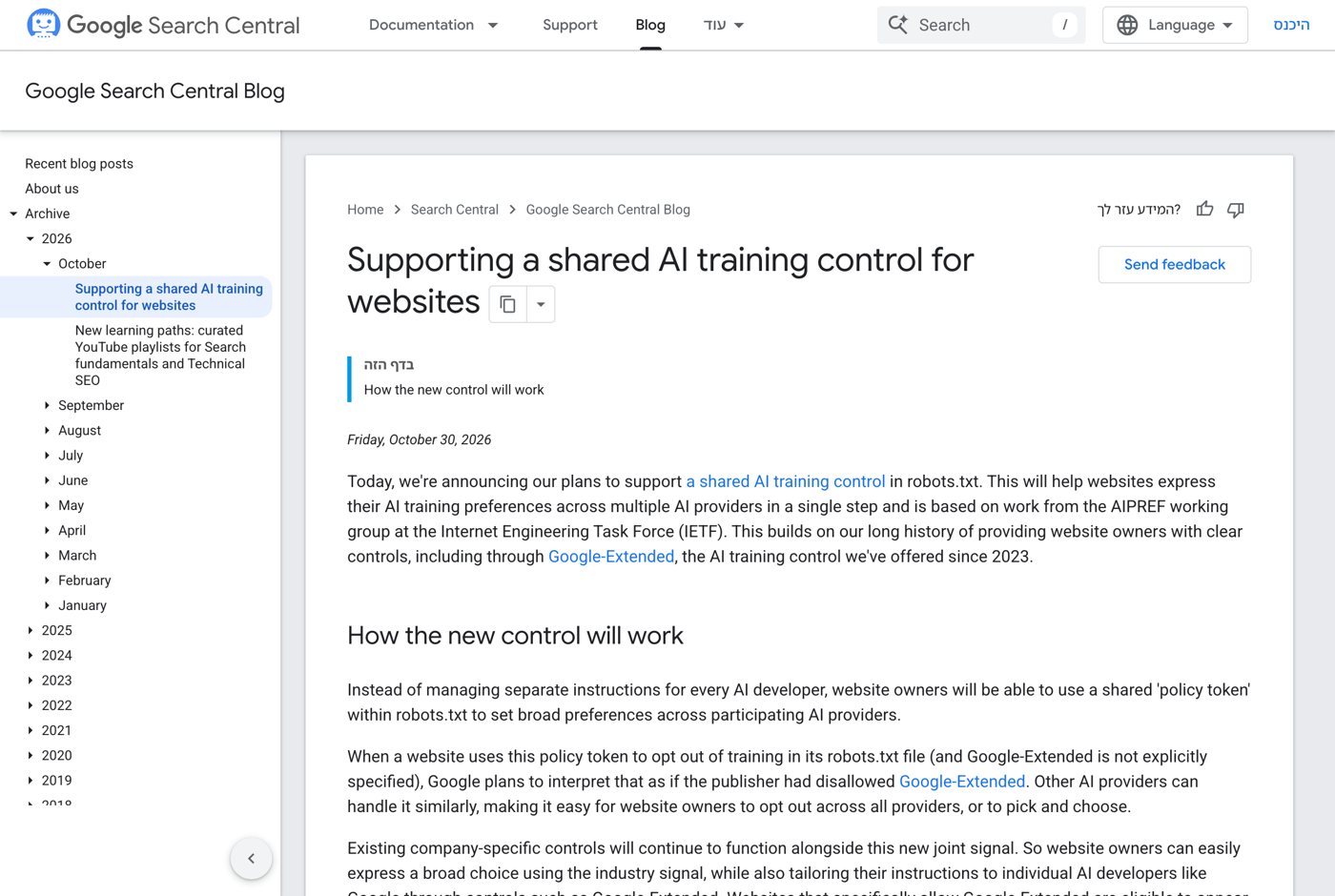 Screenshot: the official announcement on the Google Search Central blog, October 30, 2026
What does it look like in robots.txt?
The signal is written like a crawler name, but it isn't an actual crawler. It is a "policy token" that all participating companies read. This is what a preference against training across the entire site looks like:
User-Agent: __usage_ai-training
Disallow: /
And if you want to allow training only on part of your site, for example the press kit, you add an exception. This is the example from the draft itself:
User-Agent: __usage_ai-training
Disallow: /
Allow: /press-kit/
You can also do the reverse: block only a specific directory, for example Disallow: /premium/, and leave the rest open.
Does this block AI?
No, and that's the part that's easiest to miss. The draft explicitly defines the signal as a preference rather than an access control, and states that it is "not an instruction for crawling behavior." That means crawlers can still reach your pages. What changes is the companies' commitment not to use the content for training.
Two more important points:
- This is not yet a standard. The draft itself notes that it has not been approved by the IETF and has no official standing in the standards process. Google writes that it will continue working with partners to turn it into a standard.
- Private agreements take precedence. According to the draft, an agreement between a site and an AI company can override the preference expressed in the file.
Anyone who wants to actually prevent access needs a technical block, for example at the server or CDN level. robots.txt remains what it has always been: a polite request that the major companies choose to honor.
When does each company start honoring the signal?
Each company announced its own timeline:
| Company | What was announced | When |
|---|---|---|
| OpenAI | Will honor the signal, and existing controls will continue to work | "In the coming months" |
| Microsoft | Will honor training and grounding preferences at crawl time | From February 1, 2027 |
| Will interpret the signal as blocking Google-Extended | "In 2027" | |
| Anthropic | The draft's author wrote that the company has already begun implementing it | No official date published |
On Anthropic it's worth being precise: no separate official announcement from the company was found. The information comes from the email in which the draft's author introduced it to the IETF mailing list, as reported. Microsoft has two additional dates: from March 1, 2027, NoArchive and NoCache tags will no longer be read as a training or grounding preference, and the temporary grounding preferences configurable in Bing Webmaster Tools will expire on September 30, 2027.
Training vs. grounding: why blocking training doesn't erase you from AI answers?
This is the most important distinction for anyone working in GEO. Microsoft defines both terms clearly:
- Training: using content to change the parameters of a model. The content becomes part of the "knowledge" of the next version.
- Grounding: using content as real-time input to support an answer. This is the scenario where AI cites you and links to you.
The shared signal is about training. Appearing in answers, with citation and link, is controlled in most cases elsewhere:
- OpenAI: Existing controls remain. GPTBot is tied to training, and appearing in ChatGPT Search answers depends on OAI-SearchBot. Blocking training should not remove you from ChatGPT's search.
- Microsoft: There is a separate grounding control, in a meta tag or HTTP header for Bingbot (
ai-grounding:disallow). According to Microsoft, the preferences do not affect eligibility for regular Bing search results. - Google: This is where you need to pay attention. Google will interpret the shared signal as if you had blocked Google-Extended, unless you have explicitly configured Google-Extended. According to Google's documentation, Google-Extended controls both Gemini training and grounding, and in the new announcement Google writes that sites that explicitly allow Google-Extended are eligible to appear in answers and receive clicks through grounding in Gemini apps. On the other hand, Google-Extended does not affect appearance in Google Search and is not used as a ranking signal.
The practical implication: a site that blocks training via the shared signal and wants to continue appearing in Gemini app answers should consider explicitly configuring Google-Extended. That's a business decision, not a technical one.
What to put in robots.txt right now?
Everything starts with one question: what is your content doing for you?
If your content is marketing (a blog, guides, service pages), the goal is for AI to know you and cite you. In most cases there is no reason to block anything. This is exactly the domain of GEO, appearing in ChatGPT and AI engine answers. We covered it in depth in the GEO guide, and in the guide on how to get AI to cite your site.
If your content is the product (paid content, a professional database, research), there is logic to adding the signal now. It won't hurt, and it will take effect gradually at each company. At the same time:
- Keep your existing controls. All the companies wrote that separate controls (GPTBot, Google-Extended, and others) continue to work.
- Separate by directory. Block training only on what actually has monetary value, and leave marketing pages and press kit open.
- Check Google separately. Decide whether you want to appear in Gemini apps, and configure Google-Extended accordingly.
- Check Bing. Anyone currently using NoArchive or NoCache to restrict AI needs to switch to the new controls by March 1, 2027.
- Document the decision. A decision about using content for AI training is a management decision, not just one for whoever maintains the site.
If you're not sure, don't block without checking first. Incorrectly blocking the wrong crawler can cost you visibility in exactly the channel that is growing the fastest. If you want someone to build this strategy with you, that's part of the work in the GEO service.
The companion stories from today: Pika launched a new video model with sound and open weights, and Meta is quietly testing an AI stylist that builds a wardrobe from your Instagram photos. Both stories, like this one, are about the same question: what does AI do with the content we have already published.
The bottom line
For the first time, site owners will have a single language to tell multiple AI companies "don't train on my content." It's a meaningful step, but it is a preference, not a wall, and it takes effect gradually through 2027. The truly important decision is not whether to add the line, but whether you want AI to learn from you, cite you, or both.
📬 This piece was included in the weekly "This Week in AI" digest of November 6, 2026, along with all the guides and articles published on the site that week.
Want to build the site and tools yourself, without waiting for a developer?
Editing robots.txt, checking tags, writing a script that checks which crawlers are reaching your site: all of these are tasks you can do on your own, once you know how to work with the right tools. The AI Agents Bundle includes a Claude Code course, where you learn to build and maintain systems for your business in Hebrew and without a programming background, together with a Grok Bot course, and a SocialFlow course as a gift. 297 ILS + VAT instead of 594, until November 12, with 16 lessons open to watch for free.
Sources:
- OpenAI: Making it easier for websites to express AI training preferences (30.10.2026)
- Google Search Central: Supporting a shared AI training control for websites (30.10.2026)
- Microsoft Bing: Your content, your choice: clearer preferences for training and grounding (30.10.2026)
- IETF: Machine-Readable Training Preference Signal (draft-kelley-aipref-training-preference-signal)
- Google: Google-Extended documentation
Frequently asked questions

Yaakov Tzedek
An Israeli AI lecturer, consultant and implementer who has supported 100+ organizations in AI implementation and lectured for 200+. Official content partner of Meta, Google, Canva and TikTok, featured on Israel's Channel 13.
More about Yaakov →