
- HyperVault, a TCS subsidiary, is investing up to $7.41 billion in a one-gigawatt AI computing campus in Hyderabad. What this means for the global AI infrastructure race, why Israel is not really in this game, and why data sovereignty has become a business question, not a technical one.
This investment is not measured in servers but in electrical capacity. One gigawatt is on the order of a large power station, and that is now the unit used to measure AI data centers. India, which spent thirty years supplying the world with tech talent, is now trying to sell it something entirely different: a physical place where AI itself runs.
The AI race has stopped being a race about models. It has become a race about electricity, land, and water. Yesterday, India put $7.41 billion on the table to be on the winning side of it.
On September 5, 2026, HyperVault, a subsidiary of Indian services giant TCS (Tata Consultancy Services), together with its partners, announced an investment of up to 700 billion rupees in an AI data center campus in Hyderabad, in the state of Telangana. The planned capacity: one gigawatt.
In short: Up to $7.41 billion, 264 acres, one gigawatt built in phases, targeting AI companies and hyperscalers with high-density GPU deployments. This is not an announcement about new technology. It is an announcement about real estate, electricity, and cooling. And that is exactly what makes it interesting: the current phase of the AI race is being decided in the physical world, and that is where Israel starts from behind.
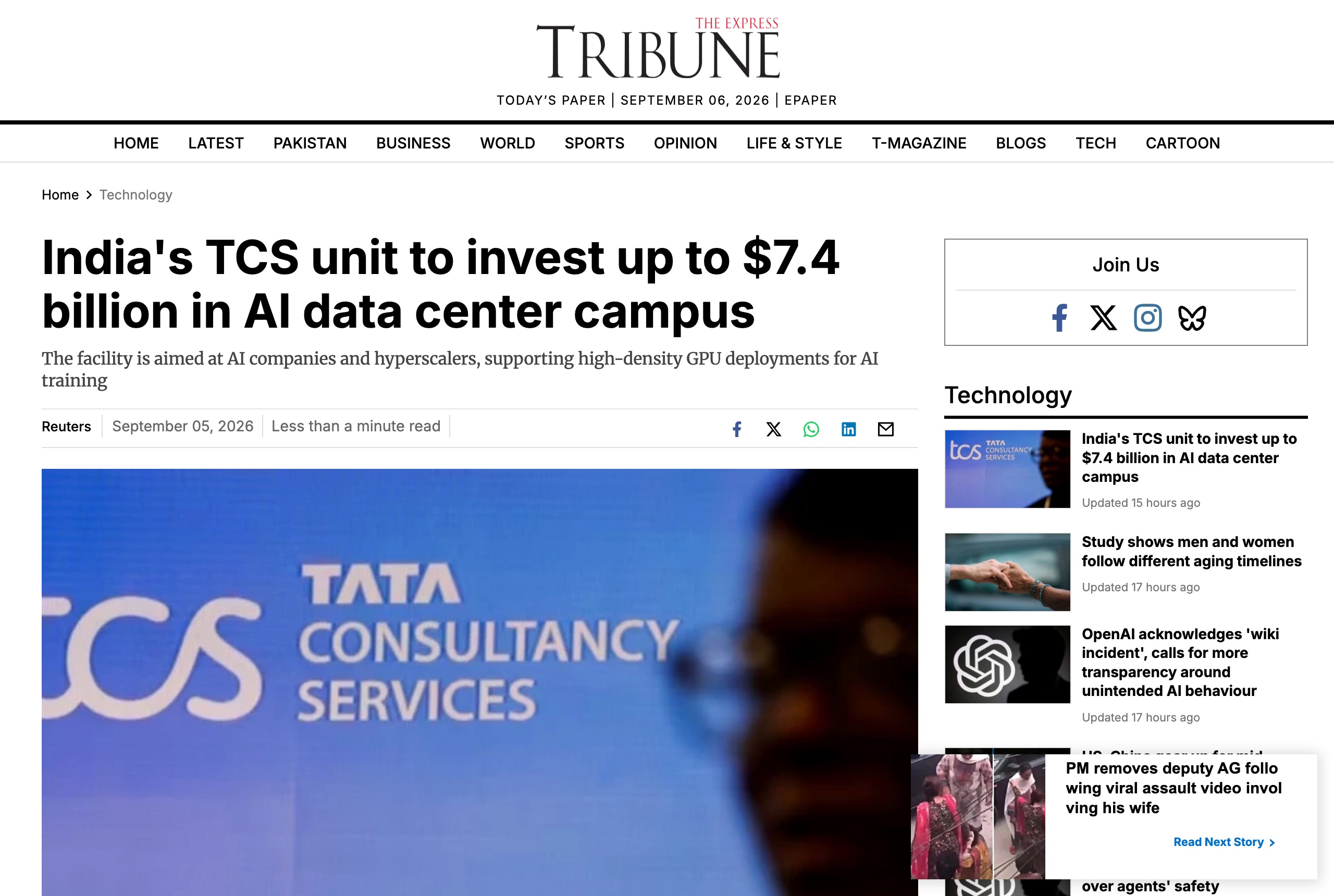 The report as published on 5.9.2026: "Indian TCS unit to invest up to $7.4 billion in AI data center campus." Screenshot: The Express Tribune, based on Reuters reporting
What exactly was announced in Hyderabad?
HyperVault secured 264 acres in Hyderabad and plans to build a one-gigawatt campus on the site, in phases. The investment reaches up to 700 billion rupees, approximately $7.41 billion, and it does not come from a new cloud player but from the infrastructure arm of one of the largest services companies in the world.
The stated target is AI companies and hyperscalers, with support for high-density GPU deployments for training and inference. In plain terms: a place where someone else trains and runs their models, and TCS charges for the electricity, the cooling, and the space.
According to HyperVault, once fully built, the campus is expected to be among the largest AI infrastructure facilities in India. The campus is designed to use green energy and water-neutral design principles, a claim worth remembering when we get to the subject of water.
Why is one gigawatt the number worth pausing on?
Because in the GPU era, electricity is the bottleneck. Not money, not servers, not engineers. One gigawatt is on the scale of a large power station, and that is the unit by which AI data centers are measured today. Not "how many servers," but "how many megawatts can be connected to the grid."
Everything else follows from that. High-density GPU deployments generate heat that needs to be removed, and removing heat requires water or cooling systems that consume more electricity. Scale that up to a gigawatt and the question becomes entirely physical: is there land, is there a grid connection, is there water, is there permitting.
That is why this announcement matters more than another model launch. A model can be replaced in six months. A cooling plant cannot. Whoever is pouring concrete and securing grid connections right now is deciding where the AI of the next decade will run.
Notice the gap in timelines as well. A new model ships every few months; a gigawatt-scale campus is built in phases over years. That means the decisions being made today about physical location will lock in the map long after today's models are forgotten. Announcing now is buying a position, not equipment.
Why India, and why now?
The world has long known India as a powerhouse of technical talent. For decades it supplied engineers, development centers, and outsourcing services, and TCS itself is the symbol of that model. This announcement signals an attempt to change the role.
TCS CEO K. Krithivasan said Hyderabad offers the scale, the talent, and the ecosystem needed to serve global customers. Note the phrasing: not "to serve India," but global customers.
The business translation: India does not just want to write the world's code, it wants to be the place where the world's AI runs. That is a shift from exporting working hours to exporting electrical capacity, and it is a step up the value chain.
Can Israel even compete for infrastructure at this scale?
Let's be honest: at this scale, not anytime soon. And not because of technology or talent, but because of far less exciting things.
The constraints are structural. Hundreds of acres of available land is a scarce and expensive resource in Israel, competing with many other uses. Grid capacity and the lead time for large power connections is a question anyone who has tried to build a power-intensive facility in Israel knows well. Water for cooling in a hot, dry climate is a real constraint, not a footnote. And planning and permitting timelines in Israel are not known for their speed.
I am not going to throw Israeli megawatt figures around here, because any such number goes stale fast and mostly fuels arguments. The right question is directional: Is the trend in Israel toward the capacity that would support a gigawatt-scale campus, or toward much smaller facilities serving a local market? Given every constraint I just listed, the honest answer is the second.
And that is fine, as long as the implications are understood. Israel can compete very effectively at other layers of the same race: research, chips, algorithms, security, and enterprise applications. It simply is not competing at the layer measured in gigawatts.
The problem starts when the layers get confused. An organization that assumes Israeli AI excellence automatically translates into infrastructural independence is making decisions on a false premise. Your team can be among the best in the world and still be entirely dependent on electrical capacity located on another continent, at a provider that does not know you and is not subject to your laws. That is not a failure, it is simply the structure of the market, and it requires a different kind of planning.
So what is actually within your control? Data sovereignty.
Here is the practical conclusion, and it is not a comfortable one. If infrastructure continues to be rented from abroad, the important question is not which GPU you are buying, but where your data sits and under which law.
Until now, Israeli organizations have treated this as an IT question: which cloud region to open the account in. It is no longer a technical question. When your sensitive data is processed in a facility located in another country, you are subject to that country's law, its diplomatic relationships, and the policies of the provider based there.
Three questions every executive should be able to answer today, without asking their cloud vendor:
- Where physically does our data sit? Not "in the cloud," but in which country and in which facility.
- Who can access it by law, without asking our permission? Authorities in the country where the facility is located are part of the answer.
- What happens if access is cut off tomorrow? A vendor changes its policy, relationships shift, new regulation arrives. Is there a migration plan, or does the business stop?
Anyone who wants to start before they have full answers can run a quick AI scan for your organization and see exactly where sensitive information is leaking out through existing processes. It takes minutes and produces a picture that is hard to ignore.
What this means for your organization
Three practical bottom lines:
- Stop thinking about AI as software and start thinking about it as infrastructure. The price you pay for a model reflects electricity, land, and cooling in a place you cannot see. That means the price will be shaped by geopolitics, not just competition between vendors.
- Make data sovereignty a line item in the decision, not an appendix. Before signing on to a new AI tool, ask where it processes and stores data. If the answer is vague, that is the answer.
- Build what is within your control. You will not build the gigawatt, but you can build the layer that runs on top of it. An open model running on your own hardware, such as DeepSeek V4 and the wave of open models, is exactly the tool that turns the question of "where is the electricity" into one with local control.
The other side of the same story is in the money. At the very same time India is announcing concrete and electricity, the capital markets are pricing Anthropic at astronomical valuations. It is the same race, once from the physical side and once from the financial side, and both announcements say that the bet on AI has moved from the experimental phase to the phase of heavy investment.
<!--LIVE-SESSION-->Where do you build the system that runs on that electricity?
You will not build the Hyderabad campus. You can build the system that runs on it, and that gap is exactly where your opportunity sits.
Sources: Reuters report from 5.9.2026 as published in The Express Tribune · Bloomberg and The Next Web reports from the same day
Frequently asked questions

Yaakov Tzedek
An Israeli AI lecturer, consultant and implementer who has supported 100+ organizations in AI implementation and lectured for 200+. Official content partner of Meta, Google, Canva and TikTok, featured on Israel's Channel 13.
More about Yaakov →