
- A mathematician at Anthropic published a formal proof of the Riemann Hypothesis built with Claude: 175,187 Lean files that passed independent verification. Here is what was actually checked, why the math community has not yet accepted it, and what the story tells us about working with Claude on long, verifiable tasks.
Alpöge wrote that he asked Claude for a written version of the proof and received over 250,000 pages. He decided not to publish it, noting that releasing a massive, unreadable document would simply be inappropriate. So what was published is a four-page note, plus proof code that only a computer can read end to end.
A mathematician at Anthropic published a proof of the Riemann Hypothesis on Friday, one of the most famous open problems in mathematics. The proof was developed in collaboration with Claude, and computers at several universities have already checked all 175,187 of its files. And yet, no mathematician can tell you today that the problem has been solved.
That gap, between "the computer verified it" and "the community accepted it," is the real story here. It is also what is most useful to anyone who works with Claude every day.
In short: On November 20, 2026, Levent Alpöge published a formal proof in Lean of the Riemann Hypothesis and of the Generalized Riemann Hypothesis for Dirichlet L-functions. Independent checks found that every file compiles without errors. There is still no written proof that humans can read all the way through, there is no peer review, and responses from mathematicians are divided. What is clear: Claude held together an enormous, long, multi-stage task that ends with a verification you cannot cheat.
What exactly was published?
A four-page note and an archive of proof code in Lean. Alpöge, a member of Anthropic's technical staff, wrote in the note that he believes he discovered, while working with Claude, a proof of the Riemann Hypothesis, and that the method extends to the generalized conjecture as well. According to him, he led the direction and Claude "left him in awe" toward the end.
The archive itself contains 175,187 files and roughly 17 million lines of code, according to the University of Waterloo verification page. Lean is a language in which every step of a proof is automatically checked by a small, strict piece of software called a "kernel." If a single step does not follow from the previous one, the file simply does not pass.
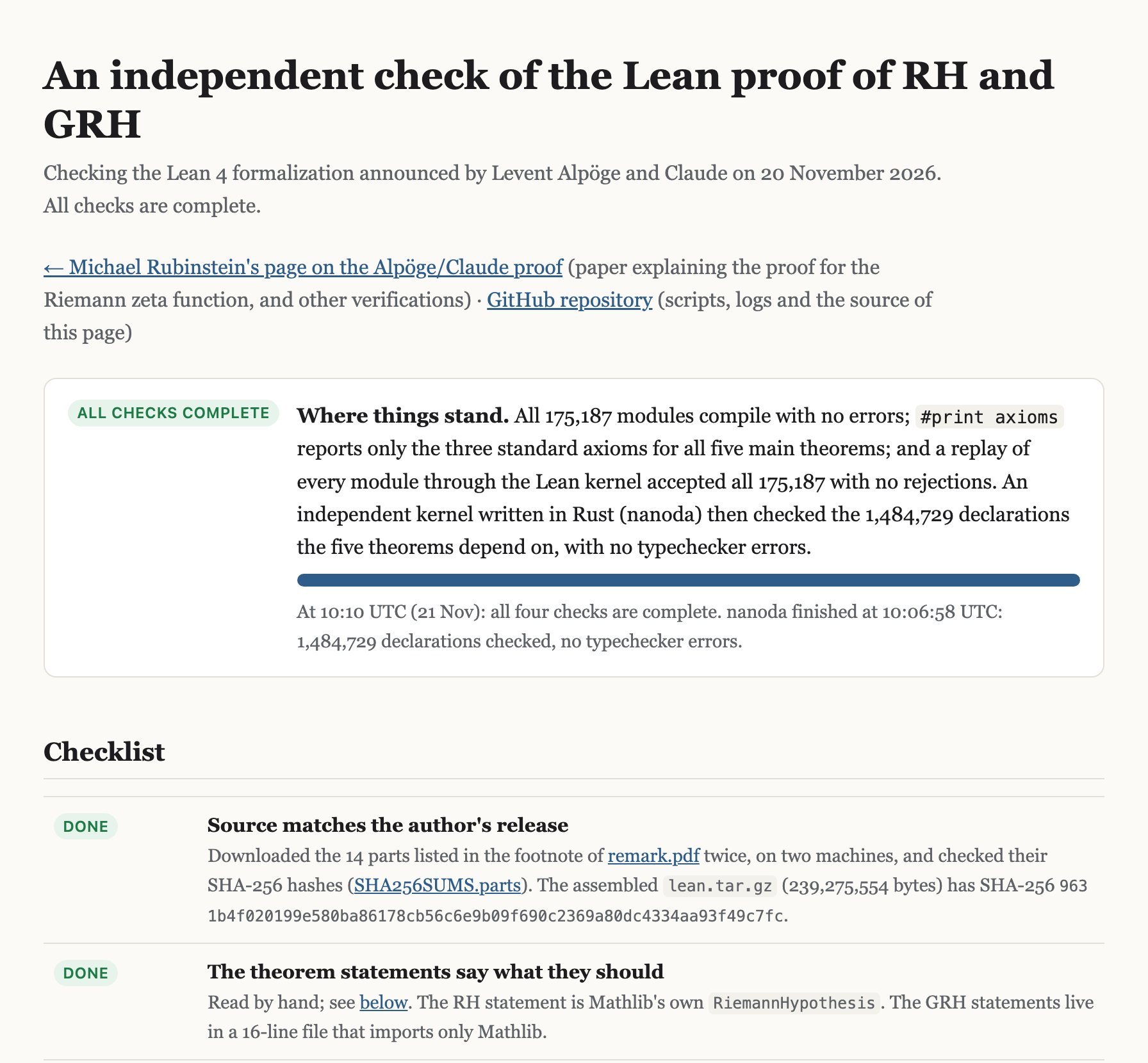 Screenshot: Michael Rubinstein's verification page, University of Waterloo, mrubinst.github.io/grh-lean-verification, status as of November 21, 2026
What exactly was checked, and by whom?
Several mathematicians ran separate checks, and all of them passed. According to Michael Rubinstein's verification page from the University of Waterloo and Andrew Sutherland's verification page from MIT:
- Compilation: All 175,187 modules pass without errors.
- Axioms: The five central theorems rely on only the three standard Lean axioms, with no hidden assumptions.
- Independent kernels: Lean's kernel accepted all modules, and a separate kernel written in Rust checked approximately 1.48 million definitions the theorems depend on, without a single error.
- Statement formalization: The definition of the Riemann Hypothesis is taken directly from the open mathematics library Mathlib, and the definitions of the generalized hypothesis appear in a short file that imports only Mathlib. Rubinstein writes that he read them manually.
Two details worth knowing. First, these checks were themselves run with Claude Code, on university servers. What gives them weight is not that Claude "confirmed" anything, but that several different kernels, written by different people, reached the same result. Second, on Sutherland's page some of the additional comparison steps were still running as of November 22.
What has not yet been proved?
A proof the computer accepted is not a proof the mathematical community has accepted. Three open gaps:
- There is no readable proof. Alpöge wrote that he intends to understand the argument, simplify it, and write it up properly. Rubinstein posted a 265-page working draft explaining the proof for the zeta function, but according to the draft itself, the central inequality is not proved in it. It reduces that inequality to 13 numbered assumptions and notes what still needs to be written.
- The definitions need human review. A kernel verifies that a conclusion follows from the definitions. It does not verify that the definitions in Mathlib are exactly what Riemann intended. Both verification pages state this explicitly.
- There is no peer review, and the community is divided. According to Quanta Magazine, one prominent number theorist at New York University argued that a valid Lean proof explains nothing, while another researcher described it as breathtaking. Lean experts are expected to accept its validity before anyone fully understands it. And on the Clay Mathematics Institute website, which offers a one-million-dollar prize for the problem, it is still marked as unsolved.
The scope is also limited: the generalized hypothesis was proved only for Dirichlet L-functions. That does not cover, for example, Dedekind zeta functions or the general automorphic case.
How does this connect to Anthropic's result from August?
These are two separate things, and it is worth not confusing them. In August 2026, Anthropic officially announced that Claude had improved a known bound on the proportion of zeros of the zeta function lying on the critical line, from 41.6% to 67.2%. That paper stated that the authors did not expect those methods to lead to a proof of the Riemann Hypothesis.
The current proof is a different piece of work, using a different method, published on Alpöge's personal website. As of November 23, we have not found an official announcement of it on Anthropic's news site.
What did the division of work between the human and Claude look like?
According to Alpöge's note, he chose the direction and Claude led most of the technical path. Alpöge describes identifying an idea that worked in a simple model and driving the work toward its analogue in the real problem. From there, he says, Claude proposed technical steps that surprised him and pulled ahead of him toward the finish line.
He also writes honestly that in some of the areas the proof relies on he is not an expert, that suboptimal choices may have entered the argument, and that he expects much shorter proofs to appear soon. This is a familiar picture to anyone who works with Claude: a person who knows the goal and the direction, a model that carries out an enormous volume of work, and an output that functions before anyone has had a chance to understand it all the way through.
What does this say about Claude's capabilities at work?
The lesson is not "Claude solves everything." The lesson is that Claude excels especially at long tasks that have an external check you cannot get around. Three practical takeaways:
- Long, multi-stage tasks are no longer theoretical. 175,000 files that all connect to one another is months of work. That same capability, at a much smaller scale, is what allows Claude Code to build a complete system, move data across dozens of files, or analyze hundreds of documents in sequence.
- The verification is the important part. The proof is impressive because it has an uncompromising external judge. In your own work, that judge can be automated tests for code, a reconciliation of totals against the original report, or a checklist of conditions every output must meet. Without that judge, even long, impressive work remains a claim.
- Do not rely on the agent saying everything is fine. The verifiers did not ask Claude whether the proof was correct. They ran several separate kernels. The same principle applies in business: let Claude build, and check with a separate tool or a different person.
What does this mean for your business or organization?
Three bottom lines:
- It is worth giving Claude larger tasks than you are used to. Not a single question in a chat window, but a full process: an agent running across your files, an end-to-end monthly report, a migration of a legacy system.
- Plan the verification before the task. Before you start, define how you will know the result is correct. That is the difference between an AI project that goes into production and one that stalls at the "looks good" stage.
- Separate "works" from "understood." Even inside an organization, an output that passes tests but that nobody understands is a risk. Someone on the team needs to understand what was built, not just know that it runs.
Want to learn to work with Claude on real tasks?
AI TV has a full video course on Claude Code, from installation to a working system, along with dozens of additional courses on agents, automations, and AI tools for business. One subscription, on the website and in the app, at 49.90 ILS per month including VAT, cancel anytime.
For organizations that want their teams to build processes like this on their own systems, with verification built in from day one: practical AI workshops for organizations. And for anyone following the development of the models themselves, here is what changed in Fable 5.2.
Sources: Levent Alpöge's note (PDF) · Michael Rubinstein's verification page, University of Waterloo · Rubinstein's page on the proof and draft explanation · Andrew Sutherland's verification page, MIT · Quanta Magazine on the reactions · Clay Mathematics Institute: Riemann Hypothesis · Anthropic on the zeta zero bound, August 2026
Frequently asked questions

Yaakov Tzedek
An Israeli AI lecturer, consultant and implementer who has supported 100+ organizations in AI implementation and lectured for 200+. Official content partner of Meta, Google, Canva and TikTok, featured on Israel's Channel 13.
More about Yaakov →