
- Anthropic published an internal experiment: one engineer gave Claude Fable 5.2 an empty folder, and the model orchestrated over 1,000 subagents for eight days until a working OS prototype booted on a laptop.
According to Anthropic, over 90% of the changes merged into the company's main codebase are now written by Claude, under human direction. The OS experiment is the far end of that same workflow, not something separate from it.
Anthropic published an internal experiment: one engineer gave Claude Fable 5.2 an empty folder and a single task, to build an operating system prototype. The model coordinated more than 1,000 sub-agents that worked eight days around the clock, and the result boots on a laptop. This is not a product, and it does not mean AI is replacing a development team. It does show what working with many agents actually looks like, and there are a few things worth taking away this week.
In short:
- One engineer, an empty folder, eight days: Claude Fable 5.2 coordinated more than 1,000 sub-agents that wrote, tested and reviewed the code.
- The result: an operating system prototype that boots on a laptop, with its own kernel, drivers, file storage, windows, a login screen and an installer.
- Anthropic calls this an experiment and a prototype. No code to download, no price, and how much human guidance was involved along the way was not disclosed.
- What to take from it: the Orchestrator pattern. One powerful model directs, smaller models execute, and a separate agent reviews.
- Real-world examples from the same announcement: a security audit at Uber using roughly 170 review agents, and a service migrated from Python to Rust that runs approximately 26x faster.
What exactly happened in the experiment?
One engineer at Anthropic gave Fable 5.2 a single task: build an operating system prototype. The model started from an empty folder, coordinated more than 1,000 sub-agents, and they worked eight days around the clock.
The important detail is what the agents actually did: according to Anthropic they wrote code, tested it and reviewed it. That means not a thousand agents writing in parallel, but a division of labor that includes both testing and code review.
What came out at the end, according to the announcement:
- A working operating system that boots on a laptop.
- Its own kernel, running the machine.
- Drivers for disk, keyboard and network.
- Persistent file storage.
- Windows, a login screen and an installer.
- Built-in Claude capabilities inside the system.
Anthropic included a video in the announcement showing the system running.
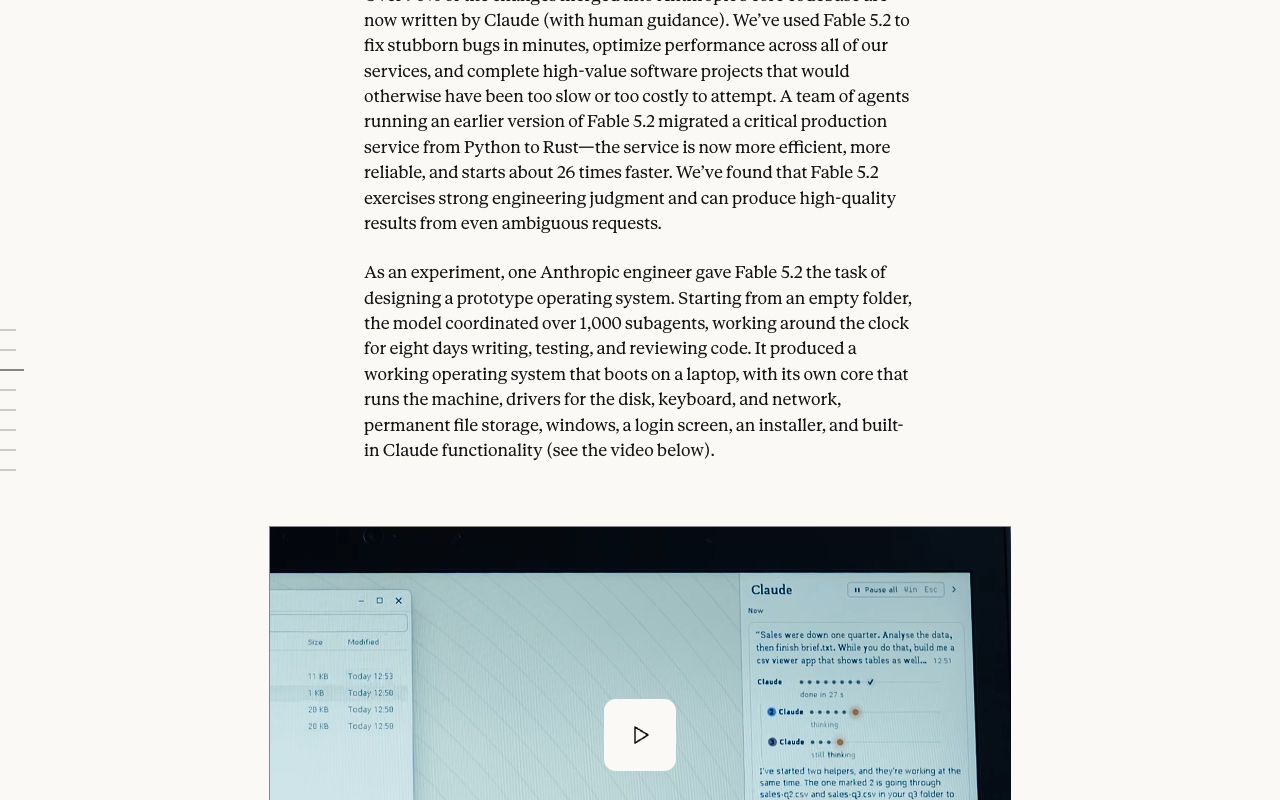
Screenshot: Claude Fable 5.2 announcement page, anthropic.com, 10.11.2026
Does this mean AI builds an operating system on its own?
Not exactly. Anthropic itself uses the words "experiment" and "prototype," and the story comes from the company's own announcement about its own model.
It is worth reading this with a few caveats:
- This is not a product. No download, no price, no commitment that anyone will ever use this system.
- The code was not published on the announcement page. There is currently no way to independently verify the code quality or how stable the system is.
- How much the engineer was involved was not disclosed. It says one engineer gave the task. It does not say how many times that engineer intervened along the way.
- The cost was not disclosed. More than 1,000 agents over eight days consume an enormous number of tokens, so this is not an experiment a small business can replicate tomorrow.
- A prototype is not an operating system that competes with existing ones. A system that boots and shows windows is a very long way from a system that millions of people work on every day.
So the right headline is not "AI replaces a development team." The right headline is that one model managed to hold a large project together for eight days without falling apart, and that is already news.
How does one model manage more than 1,000 agents?
Using a pattern called the Orchestrator: one powerful model breaks down the task, distributes it to other agents, collects the results and decides what comes next.
Anthropic states this explicitly in the announcement. Fable 5.2 can operate in two roles beyond direct work: Advisor, which smaller models consult when they get stuck on a hard problem, and Orchestrator, which hands off simpler tasks to smaller models.
Matt Lee, a senior engineer at Datadog, described it this way in the announcement: the model behaves almost like an incident commander, dispatching faster models to gather initial signals and coordinating between them, which takes that load off whoever is running it.
If you are still not sure what the difference is between chatting with a model and an agent doing actual work, there is a short explanation in What is the difference between an AI agent and chat. And anyone who wants to see what a single sub-agent looks like in practice can start with A guide to a Telegram sub-agent with Claude Code.
Where is this already working outside the experiment?
The same announcement includes three examples that are much closer to everyday work than an operating system.
A security audit at Uber. Andrew Mager, an engineer on the agentic systems team at Uber, had Fable 5.2 run a 10-to-12-hour security audit. The model dispatched roughly 170 review agents and came back with a written summary, pull requests and a policy proposal. He said the model keeps working until the task is genuinely done, rather than stopping at a point that only looks like the end. He also noted that the model was honest about what it had not managed to cover.
Migration from Python to Rust. A team of agents running on an early version of Fable 5.2 migrated a critical Anthropic production service from Python to Rust. According to Anthropic, the service is more efficient and reliable, and runs approximately 26x faster.
Anthropic's own codebase. The company writes that more than 90% of changes merged into its main codebase today are written by Claude, with human oversight.
Notice what repeats across all three examples: a large task with a clear finish line (audit, migration, fix), agents reviewing other agents' work, and a person defining the goal and receiving a result that can be verified.
What can you take from this right now?
You do not need 1,000 agents. You need the method, and it works with three.
- One agent directs, the rest execute. Have the lead agent break down the task and distribute it, rather than asking one agent to do everything in sequence.
- A separate reviewing agent. The agent that wrote the code or the text does not review itself. In Anthropic's experiment the agents wrote, tested and reviewed, and those are three distinct roles.
- A task with a clear finish line. "Improve the website" is not a task for an agent. "Go through all 40 pages, find broken links and open a fix for each one" is a task.
- Parallel work without conflicts. When several agents work on the same project, each one needs its own working copy. We explained how to do this in A guide to running Claude Code and Codex in parallel with Git Worktrees.
- Boundaries before speed. The more agents you have, the faster one mistake spreads. The draft rule still applies: the agent prepares, a person approves what goes out. And if something does go wrong, there is an action plan for an agent incident.
On the model itself: Anthropic recommends starting most coding and knowledge tasks with Claude Opus 5.5 and moving up to Fable only when the work is genuinely large and open-ended. We wrote about Fable 5.2's pricing, offers and benchmarks yesterday in the launch article.
What does this mean for your business?
The question is no longer "can an agent do this," but "do I know how to define the task and verify the result."
Anthropic's experiment does not change the daily work of a small business tomorrow morning. None of us need a new operating system. But it signals where the tools are heading: long tasks, running for hours and days, with no one sitting in front of a screen.
The people who will benefit are those who have already gotten used to working this way in small doses. An agent that responds to leads, an agent that prepares the weekly report, an agent that checks the site every morning. Each of those is a task with a clear finish line and a verifiable result, exactly like the Uber and Anthropic examples, just at the scale of a business.
If you are just getting started, the guide to AI agents explains the concepts, and How to build an AI agent for your business walks through the steps one by one.
Sources: Anthropic's Claude Fable 5.2 announcement
Want agents working for you, not just in headlines?
A thousand-agent operating system is a lab experiment. One agent doing real work for you every day is something you can build this week, and from there you add another, and another.
The AI agents bundle includes the Claude Code video course and the Grok Bot video course, plus the SocialFlow course as a gift. Price: 297 ILS + VAT (350.46 ILS including VAT), until November 12 at 23:59.
Frequently asked questions

Yaakov Tzedek
An Israeli AI lecturer, consultant and implementer who has supported 100+ organizations in AI implementation and lectured for 200+. Official content partner of Meta, Google, Canva and TikTok, featured on Israel's Channel 13.
More about Yaakov →