- Claude Duet official product page(https://claude.com/product/claude-duet)
- Claude's announcement on X(https://x.com/claudeai/status/2112984664256241837)
- MacRumors on Claude Duet(https://www.macrumors.com/2026/10/21/anthropic-claude-duet/)
Claude Duet is a new app from Anthropic in which Claude works as a proactive agent: it reaches out to you with what needs attention, carries out tasks you assign, keeps working when you're away, and asks before acting on your behalf. The research preview opened on October 21, 2026, runs on Claude Opus 5.5, and is currently available only to Pro and Max subscribers in the United States, through a waitlist.
Until now every AI chat worked the same way: you open it, you ask, it answers. Duet flips that around. By morning it already knows what's urgent. And that's exactly the space where OpenAI with dots and SpaceXAI with Grok Bot already operate.
In short:
- What it is: A proactive Claude agent, in a standalone app for iPhone and Android, and in the browser through claude.ai.
- What it does: Morning briefings, checks connected apps several times a day, drafts replies, tracks invoices, prepares payroll, documents, and dashboards.
- How: Its own cloud computer, browser, and more than 6,000 integrations and plugins.
- Safety: Asks before sending a message, making a payment, signing, or deleting. Does not see passwords.
- Availability: Research preview, Pro and Max in the US only, through a waitlist. No extra charge, draws from your subscription quota.
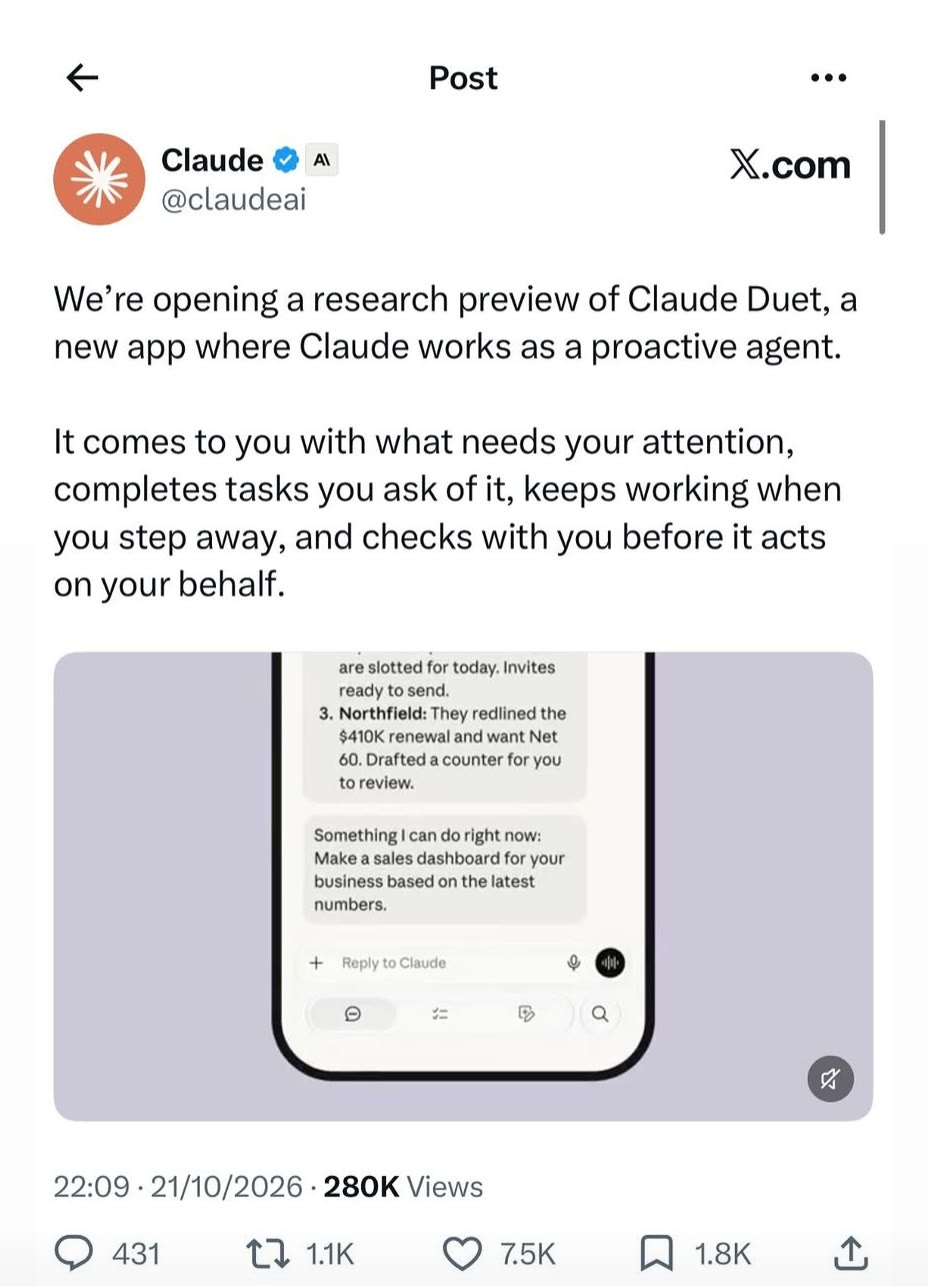 The official announcement, October 21, 2026. Credit: Claude (@claudeai) on X.
What is Claude Duet?
Duet is Claude that doesn't wait for you to come to it. Anthropic describes it as "a proactive agent that understands what deserves your attention." The platform says that while the regular Claude app waits for you to start a chat, Duet "comes to you."
You interact with Duet through messages, the way you'd message a colleague, in text or voice, with no prompts and no complicated setup. Everything happens inside one continuous thread rather than separate conversations. Duet also uses the memory, Skills, and apps you've already connected to your Claude account.
According to Anthropic, Duet was built specifically for professionals and small-business owners who have too many things to track.
What can Claude Duet do?
It operates in three modes: summarizing, alerting, and executing.
1. Morning briefing
Every morning Duet sends a short summary of what matters across your connected apps: emails waiting for a reply, meetings scheduled for the day, documents waiting to be signed.
2. Checks throughout the day
Every few hours it checks the apps again and sends a notification when something needs you. It flags items in your inbox and calendar and prepares draft replies that wait for your approval.
3. Task execution
Assign it a task and it runs in the background, updating you when it's done or when it needs your approval. According to Anthropic, the range is wide: from routine management like tracking invoices and preparing payroll, to building documents, summaries, dashboards, and even web apps.
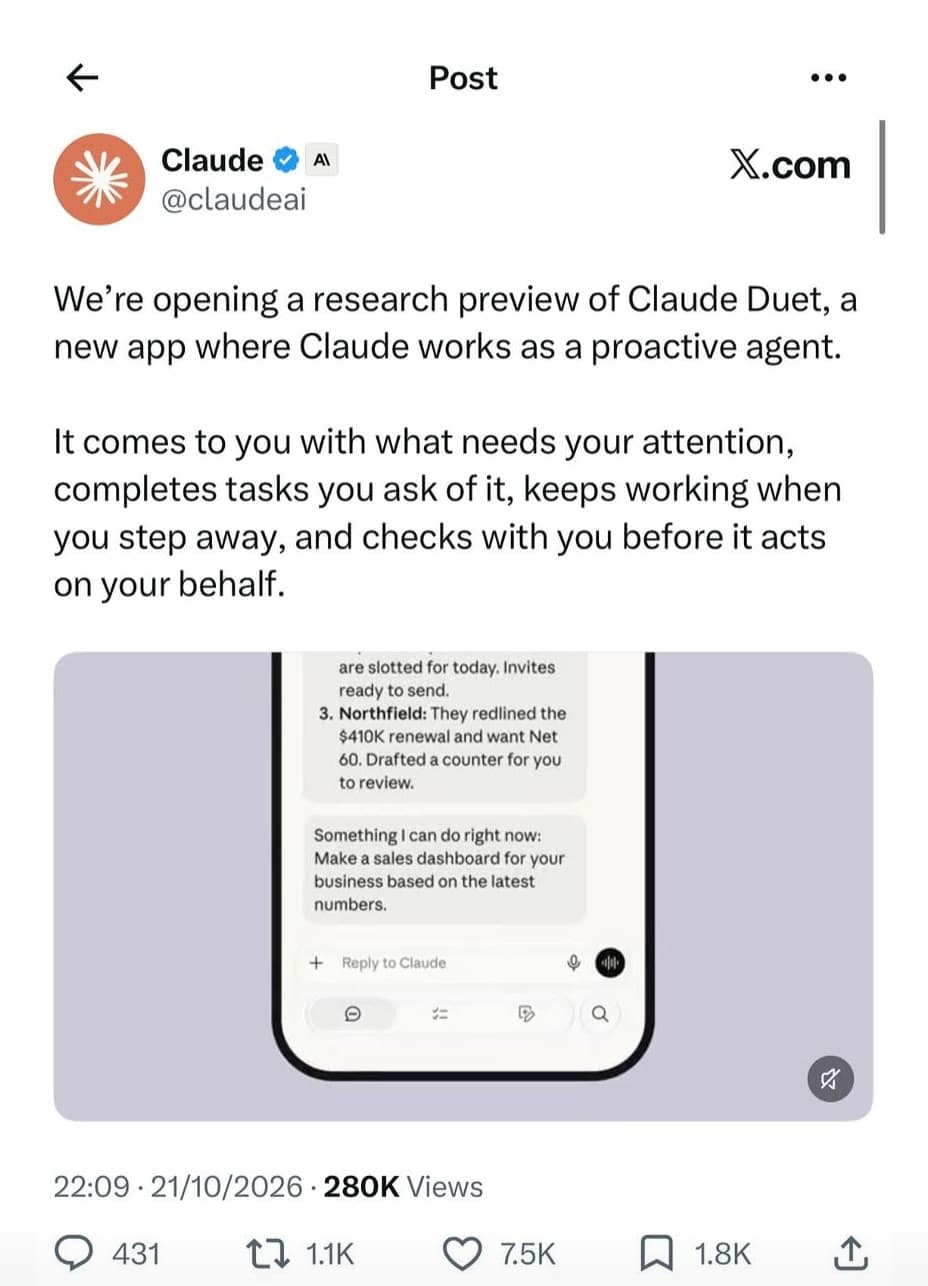
The screenshot in the announcement shows exactly that: Duet summarizes the day's tasks, reports that a client requested changes to a contract renewal and that it has already prepared a counter-proposal for review, and offers "something I can do right now: build a sales dashboard from the latest numbers."
How does it work under the hood?
Duet runs in the cloud, with its own virtual computer and browser. That's why it keeps working even when you close the app, and even when your own machine is off.
- Model: Claude Opus 5.5. For more on the model itself, see the Opus 5.5 review.
- Integrations: More than 6,000 connections and plugins, including Gmail, Google Calendar, Google Drive, Slack, HubSpot, Notion, Microsoft 365, Shopify, Stripe, QuickBooks, DocuSign, and Canva.
- Sites without a direct integration: It can work through its own browser.
- Where you use it: A standalone app for iOS and Android, and on desktop through claude.ai.
Is it safe to give it access to your accounts?
Anthropic built Duet to ask before every action with real consequences: sending a message, making a payment, signing a document, or deleting something.
The published safeguards:
- Approval before any sensitive action: It won't send, pay, sign, or delete without your confirmation.
- No passwords: When you grant it access to an account, it never sees the password or login credentials.
- Everything in your private cloud: Credentials, logins, and safety checks run on your cloud computer so sensitive details stay private.
- An extra review layer: A dedicated classifier and safety instructions check every message and guard against leaking sensitive information.
That said, an agent with access to your email and calendar does require ground rules. The recommendation: start in draft mode, as the guide to working safely with an AI agent explains.
Who can use it, and what does it cost?
As of October 22, 2026, Duet is available only to Claude Pro and Max subscribers in the United States, through a waitlist. Team and Enterprise accounts are not yet included, and there is no access in Israel yet.
There is no extra charge. Duet shares the usage quota of your subscription with the rest of Claude, including the background checks it runs. In other words, the more it works, the less quota you have left for everything else. Anthropic notes that it "uses a different quota from regular conversations."
Claude Duet vs. ChatGPT dots vs. Grok Bot: the full comparison
All three companies arrived at the same idea: an agent with its own cloud computer that works in the background even when you're not around. The differences come down to three things: who initiates contact with whom, who decides what the agent is allowed to do, and who can actually use it today.
| Claude Duet | ChatGPT dots | Grok Bot | |
|---|---|---|---|
| Company | Anthropic | OpenAI | SpaceXAI, in collaboration with Cursor |
| Launched | October 21, 2026, research preview | September 29, 2026, at DevDay | August 11, 2026, early beta |
| Model | Claude Opus 5.5 | GPT-6 Astra | Grok 4.7 family (no model selection) |
| How you interact | Standalone app (iOS, Android) and claude.ai, one continuous thread, text or voice | Inside ChatGPT (including voice), Slack, and Microsoft Teams | Grok Bot desktop and mobile app |
| How proactive it is | Most proactive: morning briefing, checks apps every few hours with notifications | Searches in the background for ways to help, starts tasks in Codex and ChatGPT Work | Works from tasks and schedules you define |
| Cloud computer and browser | Yes | Yes, and you can also connect one personal computer | Yes, with browser, files, and terminal |
| Integrations | More than 6,000 connections and plugins | More than 4,000 apps through plugins | Integrations with tools, primarily operating websites through a real browser, even without an API |
| Who decides what's allowed | Built-in: asks before sending, paying, signing, or deleting | You: custom rules set to allowed, requires approval, or blocked. Background reads are read-only | All bots share one computer and logins; SpaceXAI warns not to treat them as a security boundary |
| Passwords | Does not see passwords. Logins run in your private cloud | Sensitive actions like changing a password stay on your side | Logins are shared across all bots |
| Who can use it | Pro and Max in the US only, on a waitlist. No Team or Enterprise | Pro and Business Premium. In Enterprise, Edu, and Healthcare in an admin-enabled beta. Not in the first phase in the EU, UK, or Switzerland | Through Cursor plans (from $20/month) or SuperGrok (from $30/month), including teams |
| Price | No extra charge. Draws from the subscription quota, including background checks | The first dot is included in the subscription. Pricing for additional dots not yet announced | Included in the plan. The more expensive the plan, the larger the weekly quota |
| Strength | Real proactivity and a conversational interface like messaging a colleague | Enterprise management: rules, specialist dots, and management through Agent 365 | Operating websites and systems that have no integration |
| Weakness | Very limited availability, and a research preview that may miss things | More enterprise-oriented, requires well-configured rules | Security risk of a shared computer, and no dry run before execution |
So which one should you choose?
- Small-business owners or freelancers who want someone to tell them every morning what's urgent: Claude Duet, as soon as it opens up. That's exactly the audience Anthropic said it built this for.
- An organization already using ChatGPT that wants full control over what the agent is allowed to do: ChatGPT dots, thanks to the custom rules and enterprise management.
- Anyone who needs to automate a legacy system, a site without an API, or browser-based work: Grok Bot. Only in draft mode, and not for anything being sent externally.
Worth keeping in mind: Duet is not yet available in Israel. dots and Grok Bot are already more widely accessible, so anyone who wants to start working with a proactive agent today will choose between those two for now.
For full details on each one: the ChatGPT dots guide, the complete Grok Bot guide, and also Meta's Muse Spark, which points in the same direction of a personal agent.
Videos: Claude Duet in action
Watch the official videos
Introducing Claude Duet
Anthropic · October 21, 2026
Claude Duet Is Here! Everything You NEED To Know
Peter Yang · October 21, 2026
What does this mean for your business?
Agents are moving from "ask me" mode to "I already checked" mode. For anyone running a small business, the question is no longer whether to use an agent like this, but what to put it to work on.
Three questions to work through now, before Duet even arrives in Israel:
- What keeps falling through the cracks? Unanswered emails, uncollected invoices, meetings without preparation. Those are the first tasks to hand off to a proactive agent.
- Which systems hold that information? Gmail, calendar, accounting software, CRM. The more connected they are, the more useful the agent becomes.
- What must never happen without your explicit approval? Write those rules in advance: payments, sending to clients, cancellations, and deletions.
Anyone already working with Claude today can start building those habits with Claude Cowork and be ready when access opens up.
What is still unknown
- This is a research preview. Anthropic notes that it may make mistakes in understanding context or prioritizing urgency, and may miss things between checks.
- No independent data yet on its error rate.
- No timeline for opening outside the US or to Team and Enterprise accounts.
- It's not yet clear how much quota the background checks will actually consume over a full working day.
The bottom line
In 2026, every major AI company introduced an agent that works for you even when you're not looking. Anthropic arrived last, but with a clear definition: not an assistant waiting for a question, but a partner who comes with the answer, and asks before hitting "send."
Want to prepare your business for working with AI agents? Talk to us.
Sources:
Frequently asked questions

Yaakov Tzedek
An Israeli AI lecturer, consultant and implementer who has supported 100+ organizations in AI implementation and lectured for 200+. Official content partner of Meta, Google, Canva and TikTok, featured on Israel's Channel 13.
More about Yaakov →