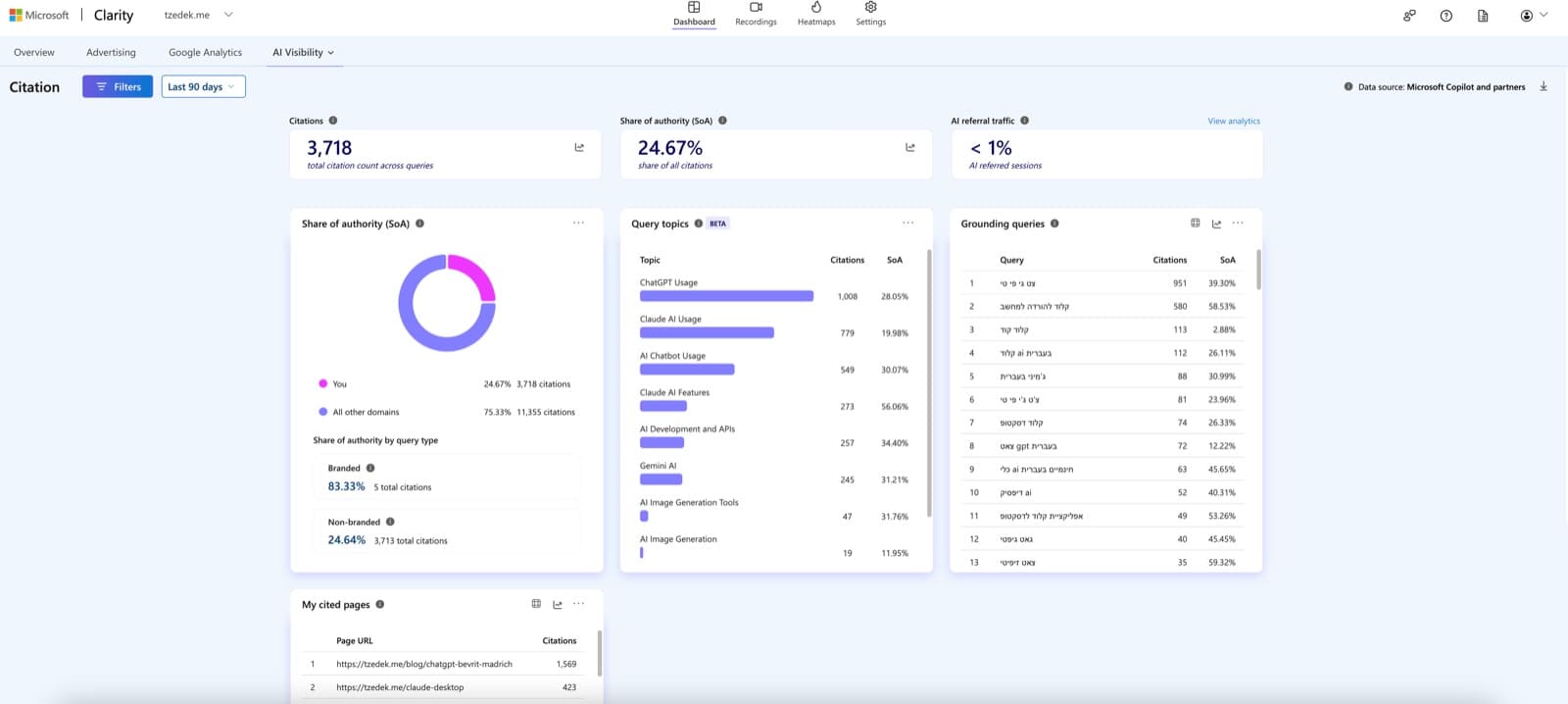
- What it is: A module inside Clarity, Microsoft's free analytics tool, that measures citations of your website in AI engines (source: Microsoft Copilot and partners).
- The key metric: Share of Authority (SoA), your share of citations out of all citations in your topic area.
- Why it matters: Without measurement, GEO optimization is guesswork. With measurement, every change you make to your site gets a score within days.
Clarity's AI Visibility module measures not just how many times you've been cited, but also your Share of Authority: what percentage of all citations in your topic area belong to you versus your competitors. That turns GEO progress from a vague concept into a single number you can actually track.
How do you know whether AI engines recognize your website at all? There's a measurement tool for that, it's from Microsoft, and it's completely free: the AI Visibility module inside Microsoft Clarity. It counts how many times you've been cited in AI engine responses, shows which queries triggered those citations and from which pages, and calculates the most important metric of all: your share of authority compared to every other site in your space. This guide covers exactly what the tool measures, how to read the report, and what to do with the numbers, including our own real screenshots.
In short (TL;DR)
- What it is: A module inside Clarity, Microsoft's free analytics tool, that measures citations of your website in AI engines (source: Microsoft Copilot and partners).
- The key metric: Share of Authority (SoA), your share of citations out of all citations in your topic area.
- Why it matters: Without measurement, GEO optimization is guesswork. With measurement, every change you make to your site gets a score within days.
- The cost: Zero. Create an account, install a snippet, wait for data.
What Microsoft Clarity is, and what the new module does
Clarity is a free behavioral analytics tool from Microsoft: session recordings, heatmaps, and visitor behavior analysis, with no traffic limits and no payment required. Over the past year Microsoft added the AI Visibility module to it, which answers the question every site owner is asking today: are AI engines citing me, and if so, for what?
This matters because a growing share of searches no longer ends with a list of results but with an AI-generated answer. Whoever gets cited in that answer gets the exposure and the trust. Whoever doesn't gets left out of the conversation entirely. Until recently it was impossible to measure this at all. Now it is, for free.
What the report shows: every metric explained
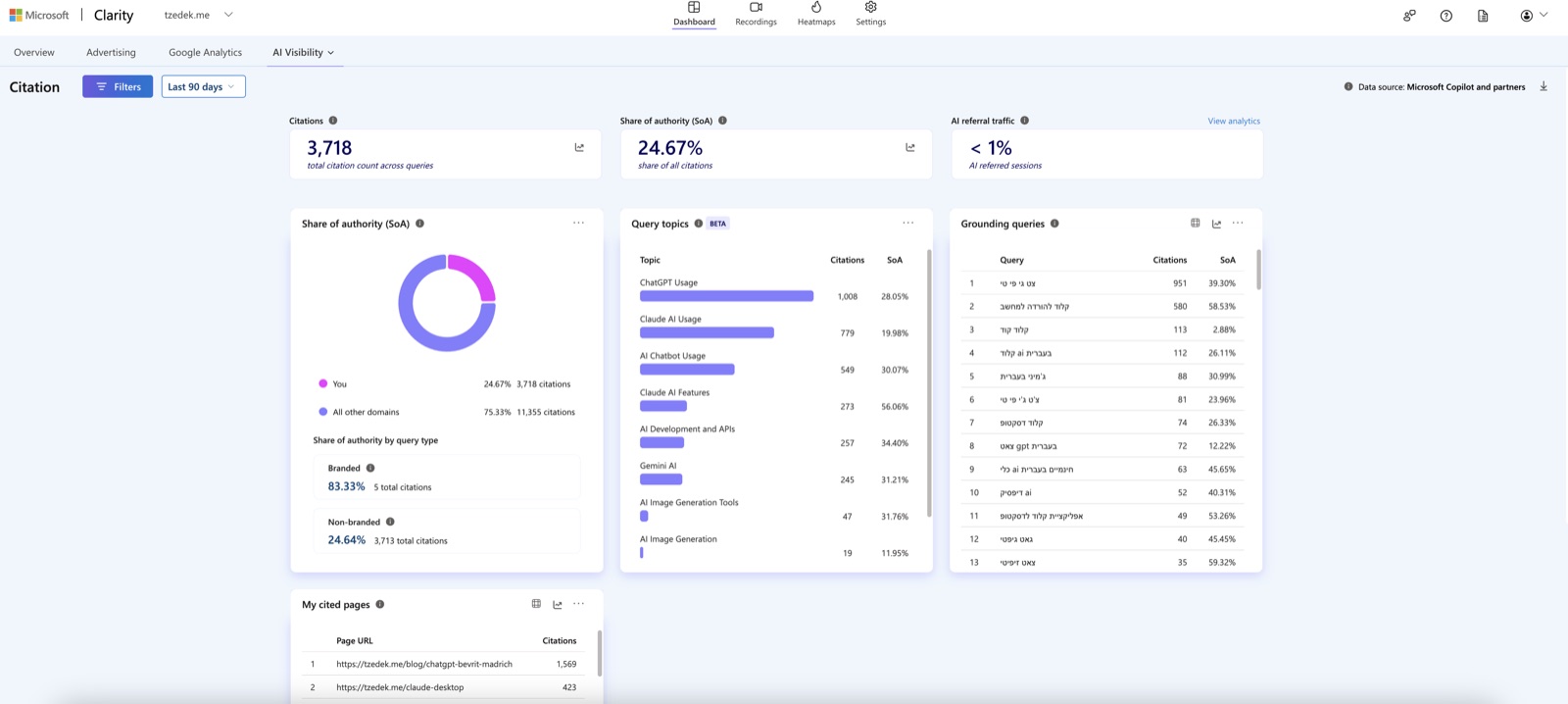
This is our report, the last 90 days for tzedek.me. Here's what you're looking at:
Citations: How many times content from your site was cited in AI responses. Ours: 3,718 citations over 90 days. This is the absolute number, and it matters less than what comes next.
Share of Authority (SoA): Out of all citations distributed across queries where you are a player, what percentage is yours. Ours: 24.67%, versus 75.33% split among every other site. This is the metric that measures you against competitors, and it's the one that needs to go up.
Branded vs. Non-branded: A branded citation happens when someone asked about you by name. A non-branded citation happens when the AI chose you on its own initiative in response to a general query. Look at our report: almost all citations (3,713 out of 3,718) are non-branded. That is exactly the goal of GEO: to be chosen, not just found.
Query topics: Which topics you're being cited for, and what your share is in each one. This is how you spot where you're strong and where there's a gap.
Grounding queries: The exact queries, word for word, that led to citations. This is where the gold is hidden: you see the real language of people asking questions, including typos and conversational phrasing, and that feeds directly into your content plan.
My cited pages: Which pages on your site are generating the citations. In our case the top page alone produced 1,569 citations, a piece of information that changed our content investment priorities entirely.
How to install and get started
- Register for free at clarity.microsoft.com with a Microsoft account.
- Create a project and add the code snippet to your site (or via Google Tag Manager; WordPress and similar platforms have a built-in integration).
- Wait for data to accumulate, then open the AI Visibility module from the project menu.
- Choose a time range (up to 90 days) and start reading.
What to do with the numbers
Measurement without action is just a pretty dashboard. Three uses that work for us:
- Strengthen what's already being cited. A page with many citations is an asset the engines trust. Refreshing and expanding it returns more than any new page would.
- Close gaps in your share. A query with many citations in your space and a low share for you is an invitation to build a dedicated answer page.
- Measure every change. After every round of improvements, come back to the report. One focused round of improvements raised our share of authority by seven percent in a week, and we knew it because of the measurement, not because of a gut feeling.
One important limitation to keep in mind: the data source is Microsoft Copilot and partners, not ChatGPT or Gemini directly. But as a systematic, consistent, and free sample, it currently has no competitor, and the patterns it surfaces are generally valid across other engines as well.
Anyone who needs direct measurement of ChatGPT and Gemini, with daily tracking of queries and competitors, can look at paid tools such as Writesonic. We detailed what each plan measures and what to check before paying in the Writesonic guide.
The next step
Measurement is half the picture. The other half is what you build to make those numbers rise. We wrote about that in depth on the GEO optimization: appearing in AI engine answers page, including our full case study and the process we run for businesses. It's also worth getting familiar with the complementary report in Google Search Console, which measures the Google side of the equation, and our free readiness scan. And if you'd like us to audit your AI engine presence: free initial GEO audit.
Frequently asked questions

Yaakov Tzedek
An Israeli AI lecturer, consultant and implementer who has supported 100+ organizations in AI implementation and lectured for 200+. Official content partner of Meta, Google, Canva and TikTok, featured on Israel's Channel 13.
More about Yaakov →