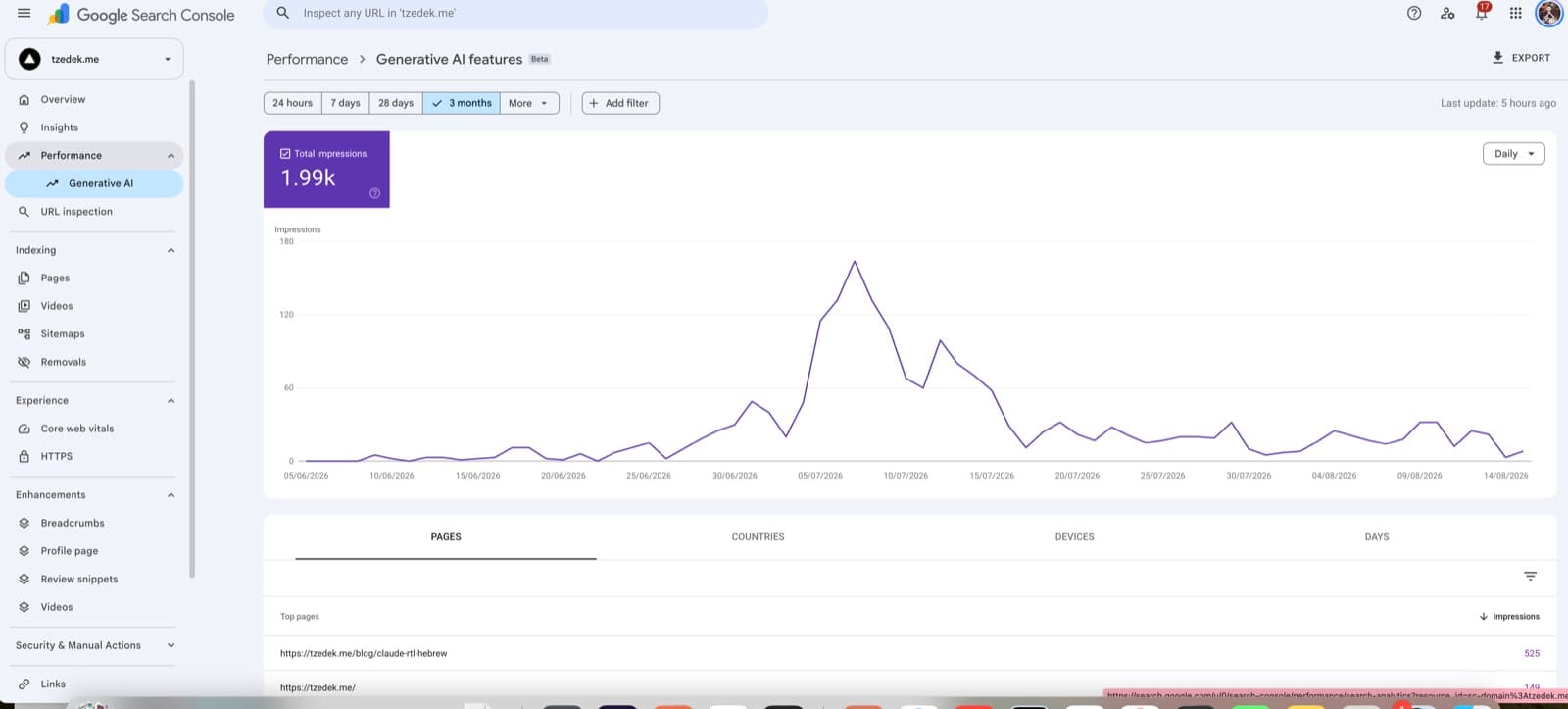
- What it is: A new beta report in Search Console that measures your site's appearances in Google's AI features, primarily AI Overviews.
- Where to find it: Performance, then Generative AI in the side menu.
- Why it matters: A growing share of searches ends with an AI answer and no click. This is the only official way to know whether you're inside Google's answers.
The Generative AI report in Search Console is the first time Google has officially disclosed how many times your site has appeared inside its AI-generated answers, a figure that until now you could only guess at.
Google quietly released the report every website owner has been waiting for: how many times your site appeared inside its AI-generated answers. The report, called Generative AI features (beta), lives inside Search Console and measures your presence in AI Overviews and the rest of Google's AI-powered experiences. This guide covers where to find it, how to read it, and what to do with the numbers, including our own real-world report.
In short (TL;DR)
- What it is: A new beta report in Search Console that measures your site's appearances in Google's AI features, primarily AI Overviews.
- Where to find it: Performance, then Generative AI in the side menu.
- Why it matters: A growing share of searches ends with an AI answer and no click. This is the only official way to know whether you're inside Google's answers.
- What to do with it: Identify which pages Google is choosing for answers, then build more like them.
What Google Search Console is, and why the new report is a big deal
Search Console is Google's free, official tool for website owners. It shows which searches you appeared in, at what position, how many clicks you received, and what technical issues your site has. For years it measured one world: the classic results list.
But search has changed. Google now shows AI Overviews above the results, and a growing share of users gets the answer there without clicking through to any website. Until now there was no way to know whether you were inside those summaries. The new report answers that question officially, which is why it's one of the most important updates of the year for anyone who depends on organic presence.
The report itself: what you see
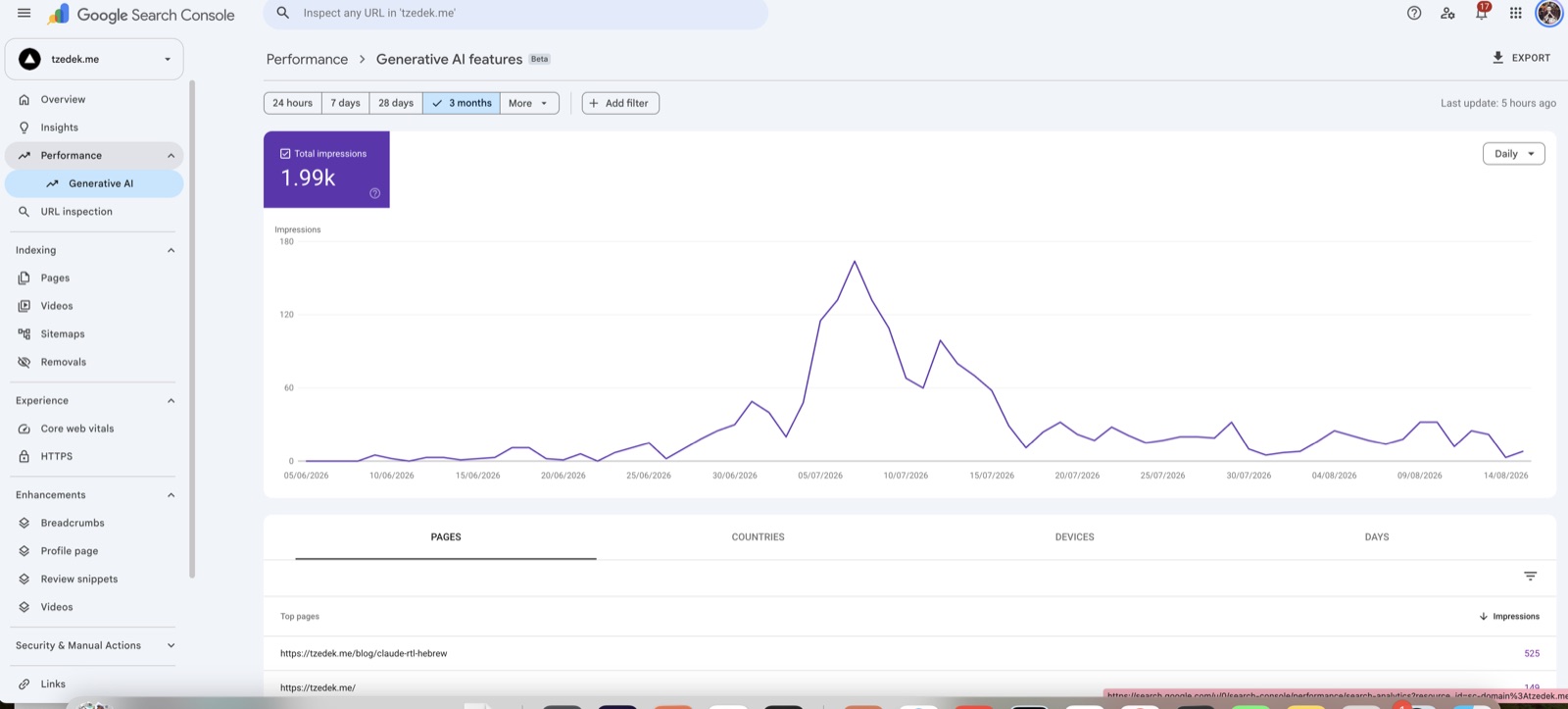
This is our report, covering the last three months for tzedek.me: nearly 2,000 impressions in Google's AI features. Here's what it contains:
Total impressions: How many times pages on your site appeared inside Google's AI-powered experiences during the selected period. Note that this is a separate figure from the standard report. These are appearances inside answers, not on the results list.
The daily chart: When those impressions happened. In our data you can clearly see a sharp spike around early July, right when a new wave of guides built in an answer-first format went live. This chart is the feedback loop: a good change to your site shows up in it within days.
Pages: Which pages Google is choosing to surface in answers. Our top page is a problem-solving guide (525 impressions), ahead of the homepage itself. That's an important lesson: Google picks the page that solves a problem, not the one that sells something.
Countries, Devices, Days: The same familiar segments from the standard report, for slicing by market and device.
Important: what the report does not measure
The report covers only Google's own features. It knows nothing about ChatGPT, Copilot, or Claude. For the full picture you need to combine it with a complementary tool. For us that's the AI Visibility module in Microsoft Clarity, which measures citations on Microsoft's side. Together the two reports give you both major sides of the AI landscape.
One more caveat: the report is in beta, presented at the impressions level, and Google may change and expand it over time. Even today, in its current form, it already answers the most important question: are you inside the answers or outside them.
How to get into Google's answers: the principles that work
Based on our measured experience, the pages that get selected for AI Overviews share a recognizable structure:
- A direct answer in the opening: The page answers the question in the first few sentences, not after eight paragraphs of background.
- A question-and-answer structure: Headings that are real questions, with self-contained answers beneath each one.
- Structured data: FAQ, Article, and Service schemas that help Google understand what the page contains.
- Solution before sales pitch: Guides that solve a problem are chosen repeatedly over marketing pages. The selling happens inside the page, after the answer has been given.
This is exactly the core of GEO optimization work, and this report is one of the two metrics we track in every optimization plan.
The next step
Log into your Search Console and check: do you have this report? What's your number? If the answer is "close to zero," your site is built for the old world, and there's profitable work to be done. We've written up the full process, including our case study and the numbers, on the GEO optimization page: appearing in AI engine answers. You can also start with a free initial GEO audit: we'll check how you look today in the eyes of the engines, on Google and beyond.
Frequently asked questions

Yaakov Tzedek
An Israeli AI lecturer, consultant and implementer who has supported 100+ organizations in AI implementation and lectured for 200+. Official content partner of Meta, Google, Canva and TikTok, featured on Israel's Channel 13.
More about Yaakov →