- OpenAI launched ChatGPT Images 2.6 on November 4, 2026: animated GIF creation from text or image, speed control, single-frame editing, reference images, and two new API models with GIF and SVG output.
Both new API models, Flare and Sunburst, can return not only GIFs but also SVG files, meaning vector graphics you can scale without losing sharpness and edit in any design tool. According to OpenAI's documentation, both capabilities are available through the Image API, not the Responses API.
4 billion images a week, and until yesterday not one of them moved. OpenAI added animated GIF generation to ChatGPT yesterday, in a single step, from text or from an image. But the most interesting part for businesses is not in the chat at all: it is in two new API models that can return GIFs and vector files.
In short:
- What happened: OpenAI launched ChatGPT Images 2.6 on November 4, 2026, the successor to Images 2.5 from September.
- The standout feature: Animated GIFs from a prompt or from an image, with speed control and single-frame editing.
- Also new: Reference images, and two new API models, Flare (fast) and Sunburst (detailed), which return GIFs and SVGs.
- API pricing: $30 per million image output tokens, the same rate as the previous version.
- Also today: Anthropic opened a public beta for message threads in the Messages API, so in a long conversation you only send the new message.
What exactly launched in Images 2.6?
ChatGPT can now generate an animated GIF in a single request. According to OpenAI's announcement on X, you can turn a text prompt or an image into a GIF, adjust the animation speed, edit individual frames, and share the result. Until now, getting a GIF out of ChatGPT required generating several images and stitching them together in a separate tool.
According to reports from The Decoder and The Next Web, based on The Verge, the update is rolling out to all ChatGPT and Codex users on the web, the desktop app, and mobile. In practice the rollout is gradual: Decrypt reported that most users do not see the option yet. If it has not appeared for you today, that is expected.
Alongside GIFs, OpenAI's announcement mentions "reference images." According to the reports, you can save an image of a person, a pet, or a character and reuse it without uploading it again in every conversation. OpenAI has not yet published official details on the limits, so it is worth checking your account before building a workflow around it.
The volume explains why this matters to the company: according to figures provided by OpenAI, users are generating more than 4 billion images per week, up from 3 billion in September, when we published the guide to Images 2.5.
What changed in the developer interface?
Two new models, with capabilities that do not exist in the chat. According to the model pages in OpenAI's documentation, gpt-image-2.6-flare is designed for "creation and editing for rapid iteration," and gpt-image-2.6-sunburst for "detailed visual work." OpenAI's announcement describes image generation that is 50% faster.
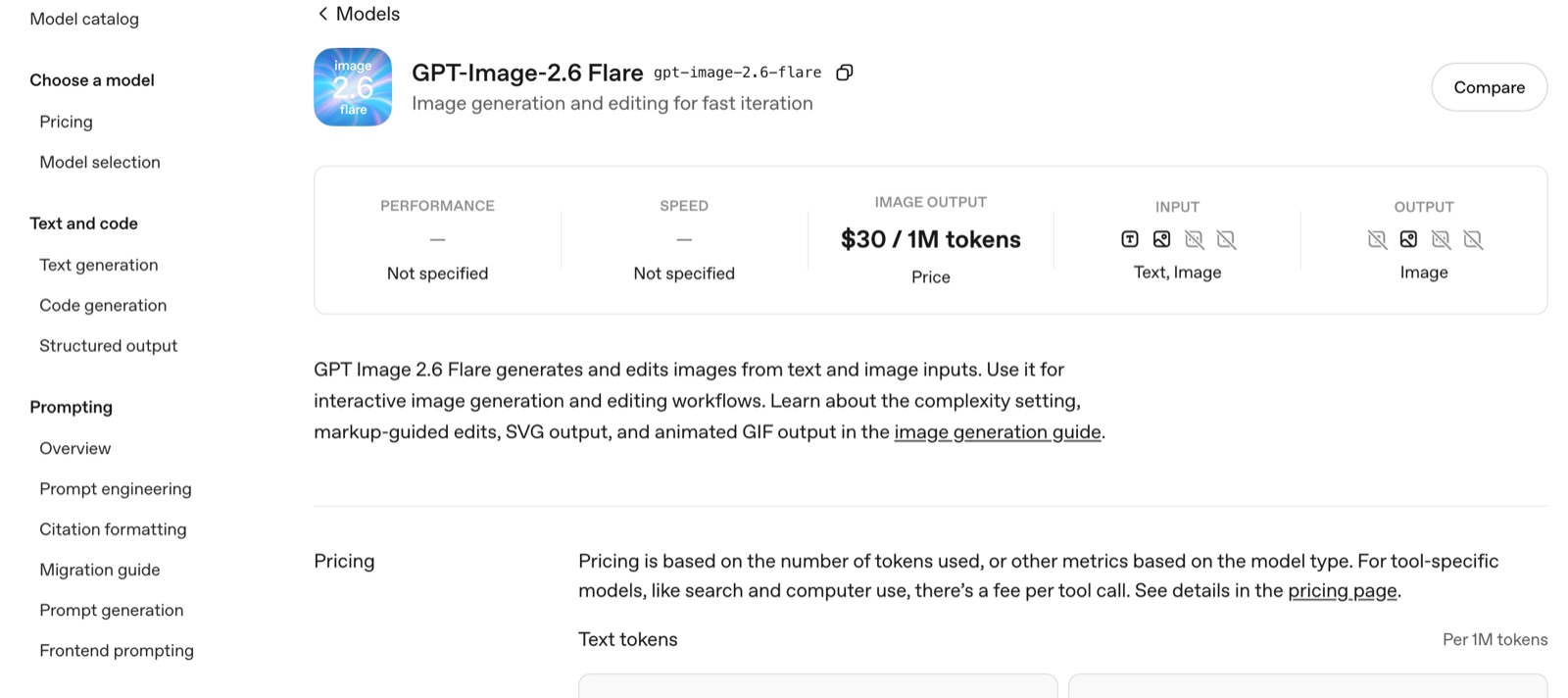
Screenshot: GPT-Image-2.6 Flare model page in OpenAI's developer documentation, November 5, 2026
According to the image generation guide in the documentation, both models support four new things:
- Animated GIF output directly from the API.
- SVG output, meaning vector graphics that can be scaled and edited.
- Inpainting by marking: you mark the area on the image you want to change.
- Complexity control (low, medium, high), with no extra charge for the choice itself. The default is high.
Two limitations worth knowing: the models work only through the image creation and editing endpoints, not through Responses, Chat Completions, or Batch. Anyone who built a workflow using bulk image generation via Batch will need to stay on the previous model for now.
What does it cost?
The per-token rate has not changed: $30 per million image output tokens. According to the model pages, Flare and Sunburst are priced identically: $5 per million text input tokens, $8 per million image input tokens, and $1.25 and $2 respectively for cached input.
But identical rates do not mean identical bills. Independent analyses published after the launch claim that at low and medium quality, an image in 2.6 consumes more tokens than in 2.5, so it ends up costing more. That is not an official figure, but it is exactly why you should not swap models in a running system without measuring first: run 20 real requests on both models and compare the cost in the dashboard.
What does this mean for your business?
GIF is the format that is easiest to drop into the channels you already use. A marketing email, a LinkedIn post, a WhatsApp message, a site banner: in all of them a short GIF catches more attention than a static image, and until now it required a designer or an extra tool.
Three use cases you can try this week:
- Rotating product view: upload a product photo and ask for a short GIF of a rotation or zoom. Good for online stores and emails.
- Step-by-step demo: "before and after" or three steps of a process, one frame per step. Single-frame editing matters here, because you can fix text in one frame without regenerating everything.
- A consistent brand character: with reference images, the same character or mascot appears in every post without uploading the image each time.
For anyone building systems: SVG output opens the door to generating icons and simple graphics automatically as part of a pipeline. In the guide to Codex you will find how to connect capabilities like these to an agent working on your code, and for a comparison with other tools there is the review of leading image tools.
Also today in leading tools
Claude API: message threads, send only what is new
Anthropic opened a public beta for message threads in the Messages API. Instead of sending the entire conversation from the beginning with every request, the first request opens a thread, and each subsequent request sends only the new messages plus the identifier of the previous response. According to the documentation, the first-response latency stays low and stable even as the conversation grows longer, and this is felt most in agents running in long loops.
Three things to know before connecting: the thread expires 5 minutes after the last request, after which you need to send the full conversation again (the Python and TypeScript SDKs do this automatically). Pricing and rate limits do not change, because Claude still reads the full conversation on every turn. And the feature is not available to organizations with zero data retention (ZDR) or HIPAA readiness. For anyone paying for the API and wanting to understand their bill, there is a guide to billing and credits in the Claude API. Official message threads documentation.
📬 This article was included in the weekly "This Week in AI" roundup for November 6, 2026, along with all the guides and articles published on the site that week.
Want an AI agent to work for you, not just draw?
GIF in ChatGPT is a nice tool. The real difference comes when an agent generates the content, sends it for approval, and publishes it on its own, without you copying files between windows. That is what you learn in the agents bundle: how to give an agent a real task, set its boundaries, and review what it did.
The AI agents bundle includes the Claude Code video course and the Grok Bot video course, plus the SocialFlow course as a gift. Price: 297 ILS + VAT (350.46 ILS including VAT), until November 12 at 23:59.
Frequently asked questions

Yaakov Tzedek
An Israeli AI lecturer, consultant and implementer who has supported 100+ organizations in AI implementation and lectured for 200+. Official content partner of Meta, Google, Canva and TikTok, featured on Israel's Channel 13.
More about Yaakov →