
- Matt Clifford, one of the architects of British AI policy, has resigned as ARIA chair after accepting a senior role at Anthropic. ARIA holds a commercial license with Anthropic, and the chair of the Commons Science Committee called it a clear conflict of interest. What does this mean for the revolving door between AI regulation and AI vendors?
The detail that turns this story from political gossip into a structural problem: ARIA, the UK government's advanced research agency, holds a commercial license with Anthropic. The agency is a paying customer of the company, while its chair accepted a senior position at that same company. This is no longer a theoretical conflict of interest. It is an invoice.
One person shaped a central part of Britain's AI policy. The same person organized the 2023 global AI Safety Summit. And this week he resigned as chair of a government research agency because he accepted a senior role at Anthropic.
In short: Matt Clifford is stepping down as chair of ARIA, the UK government's Advanced Research and Invention Agency, after accepting a senior position at Anthropic managing international relations. The chair of the House of Commons Science Committee called the dual roles "an obvious conflict of interest." And the detail that is impossible to walk past: ARIA holds a commercial license with Anthropic, meaning the agency is a paying customer of the company that hired its own chair.
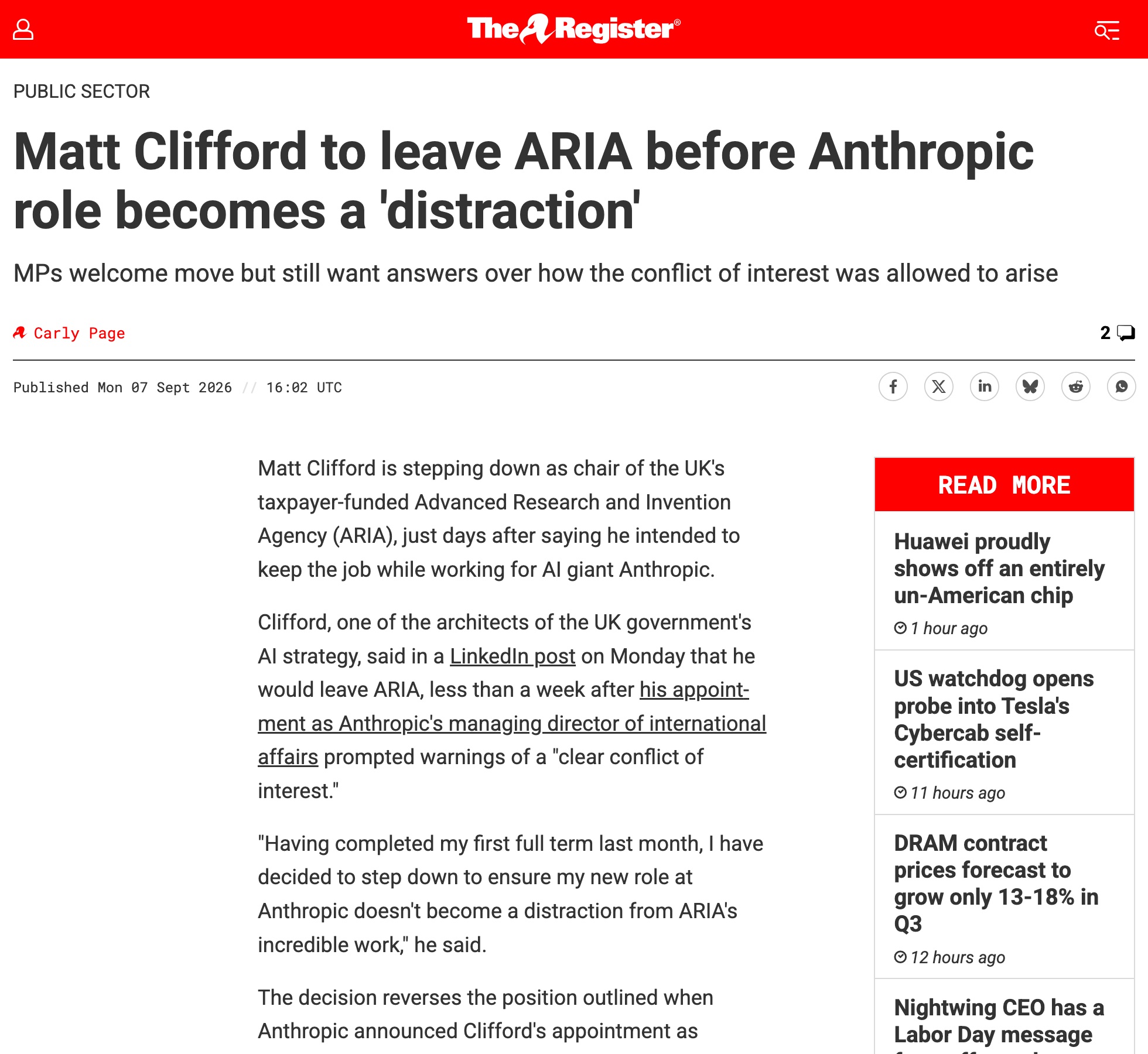 "Matt Clifford to leave ARIA before Anthropic role becomes a distraction." Screenshot: The Register, 7.9.2026
What exactly happened here?
Clifford was ARIA's founding chair since 2022. The agency is Britain's attempt to build a bold, publicly funded research body in the mold of America's DARPA.
Alongside that, he was one of the central figures who shaped the government's AI policy and the 2023 AI Safety Summit, the event that briefly made Britain the world's focal point for discussion of AI risk.
Then came the announcement of a senior role at Anthropic, managing international relations. At first it appeared he intended to hold both positions at once. Within days, that changed.
Pay attention to the nature of the role, because it is not incidental. "International relations" at an AI company means, in practice, the interface with governments and regulators. This is precisely the kind of role where Clifford's experience and connections are worth the most, and precisely the kind of role where his value to the company derives directly from the public work he did before.
Why didn't members of parliament buy it?
Chi Onwurah, chair of the House of Commons Science, Innovation and Technology Committee, said explicitly that his decision to remain ARIA chair alongside the Anthropic role constituted "an obvious conflict of interest."
That is not an offhand remark. That is the committee chair whose job is to oversee exactly this domain.
After the resignation she welcomed the move, but added the sentence that really matters: questions remain about how this situation arose in the first place, and what assessments were made before it did. In other words, the resignation resolves the individual case without resolving the mechanism that allowed it.
Clifford himself framed it differently. He announced he was stepping down so the new role would not become a distraction from ARIA's work. He will continue in post until November 6, at the request of Business and Science Secretary Jonathan Reynolds, to give the government time to find a replacement.
What is the detail that turns this from political gossip into a structural problem?
Here is the part that is easy to miss in the headlines: ARIA holds a commercial license with Anthropic.
Pause on what that means. The government agency is a paying customer. Anthropic is the supplier. And the chair of the customer was hired by the supplier.
This is no longer a theoretical argument about worldview or "proximity to industry." There is a contract, there is public money, and there is one person sitting on both sides of the table.
And this is precisely how the revolving door works in practice. Not as bribery, but as an entirely natural career progression: you know the field, you know the players, you write the rules, and then the company most affected by those rules offers you a position. Each step looks reasonable on its own.
The real problem is not the final decision but everything that preceded it. Even if Clifford acted in complete good faith, the question that remains open is what considerations accompanied him during the months when negotiations over the role were already underway and he was still chairing the agency. No one outside can answer that, and that is precisely why cooling-off rules exist: not to accuse people, but so we do not have to guess.
In a world where a small number of companies provide the infrastructure everyone builds on, regulatory expertise and commercial expertise sit in the same heads. That is not a personal failing, it is market structure. And market structure is fixed through rules, not through one-off resignations.
Does Israel need a cooling-off period in AI?
That is the question this case puts on the table, and I am not going to pretend I have a definitive answer.
What can be said: cooling-off rules in Israel's public service were written for a world that predates global model providers. They addressed financial regulators, procurement officers, domestic regulated entities. They were not written for a world where three or four companies globally supply the infrastructure entire countries rely on.
The questions worth asking out loud here:
- Who in Israel defines government AI policy, and what cooling-off rules apply to them?
- Can a civil servant who was involved in a procurement from a model provider go to work for that provider, and within what timeframe?
- Who publishes these declarations, and where can the public see them?
I am not claiming there are no answers. I am saying I do not know of a single public place where they are clearly consolidated, and that in itself is a problem. When a country is buying AI at scale, transparency about who recommended what and who went where is part of the deal.
This story connects directly to the international call for red lines in AI oversight, and to the broader question of what happens when AI companies become entities of nation-state scale. The larger the players, the more valuable the role of those supposed to oversee them becomes on the market.
How does the same problem look inside your organization?
Now let us bring this down from London to your own boardroom, because the smaller version of this story happens in every organization that selects an AI vendor.
Who is recommending the tool to you? In many cases it is a consultant, integrator, or service provider who has a commission agreement, a formal partnership, or a direct financial interest in the deployment. That is not necessarily disqualifying. But if you do not know about it, the recommendation you received is not an opinion, it is a sales pitch in disguise.
Three separations worth establishing when choosing an AI vendor:
1. The person who recommends is not the person who approves. Whoever brings the technology recommendation cannot be the same person who signs the procurement. Two people, two signatures, even in a small organization.
2. Conflict-of-interest disclosure before the recommendation, not after. Every external consultant should write one sentence stating whether they have a commercial relationship with any vendor they recommend. Anyone who refuses has already answered your question.
3. The person who measures is not the person who deployed. The party checking whether the tool actually worked after six months cannot be the same party who pushed for it. Otherwise the measurement will always come out positive.
This sounds bureaucratic until the first contract renewal arrives, and you discover nobody actually checked whether the tool delivers a return on investment.
There is another layer here worth noticing. When choosing an AI vendor, unlike most technology procurement, you are not just buying software. You are handing someone your data, your processes, and sometimes the judgment of your employees. The deeper that decision goes, the more important it is that whoever recommended it is not profiting from it more than you are.
What does this mean for your organization?
Three bottom lines:
- AI governance is not a document, it is a division of roles. An AI policy that does not define who recommends, who approves, and who measures is a statement of intent. Define all three roles by name, not by title.
- Ask for a conflict-of-interest declaration from anyone recommending an AI tool to you. It is one sentence in an email, and it changes the quality of recommendations you receive almost immediately.
- Know what you have before you know what you are missing. Before buying another license, it is worth starting with a map of what is already running in your organization and where there is a real gap. You can start with the organizational AI scan and get a picture within a few minutes.
The line underneath all of this: whoever understands how the tools actually work does not need a consultant to tell them what to buy. That is true for a country, and it is even more true for a mid-sized organization.
<!--LIVE-SESSION-->How do you learn to build rather than depend on recommendations?
Sources: House of Commons Science, Innovation and Technology Committee statement · The Register · Additional coverage: The Guardian, Times Higher Education
Frequently asked questions

Yaakov Tzedek
An Israeli AI lecturer, consultant and implementer who has supported 100+ organizations in AI implementation and lectured for 200+. Official content partner of Meta, Google, Canva and TikTok, featured on Israel's Channel 13.
More about Yaakov →