
- Security blocked ChatGPT, Gemini, and every external AI tool? You're not alone. Why blanket bans don't solve the problem, what Shadow AI is, and how smart policy, data sanitization, and proper training offer a better path.
Consistent security research shows that blocking AI tools inside an organization does not reduce employee usage. It shifts that usage to personal devices. The phenomenon has a name: Shadow AI. Sensitive data still leaks, just without any organizational oversight whatsoever.
This week, an anonymous post appeared in a large Israeli AI Facebook group, written by an employee at a major Israeli corporation. The gist: the security team had blocked all external AI tools, ChatGPT, Gemini, all of them. Only Copilot remained. And the line that closed the post: "I'm thinking about looking for a job somewhere that actually embraces AI."
I work with some of the largest organizations in Israel, including defense bodies and public-sector institutions, and that post captures the conversation I have with executives almost every week. So let's set the record straight: why the blocking happens, why it doesn't actually protect you, and what to do instead.
In short: Blanket AI blocking doesn't solve the security problem. It creates two new ones: covert, unmonitored use (Shadow AI) and the departure of your strongest employees. The third way rests on three pillars: clear policy, cleaning sensitive data before use, and practical training.
Why Organizations Block: The Fear Is Justified, the Solution Isn't
Let's be fair to the information security managers: the concern is completely real. An employee who pastes a client contract, a financial report, or a patient list into an external chat is sending sensitive data to servers outside the organization's control. In regulated sectors (healthcare, finance, defense, government) this isn't just a reputational problem. It's a genuine regulatory exposure.
The problem starts when the response to that fear is a blanket shutdown. Because blocking stops the tool, not the need.
What Actually Happens After the Block: Two New Leaks
First leak: Shadow AI. Employees don't stop using AI. They stop using it through your channels. The document that would have been sent from the corporate computer is now sent via a screenshot on a personal phone. Same sensitive data, zero oversight, zero documentation, and zero ability for the organization to even know it happened. You blocked the door. The data leaves through the window.
Second leak: the people themselves. Read that employee's post again. She isn't complaining about convenience. She's considering quitting. The employees who most want to work with AI are exactly the ones you can least afford to lose: the curious, the efficient, the ones who improve processes. A blanket block signals to them that the organization has chosen to freeze, and they draw their conclusions. In the job market of 2026, "how does your organization work with AI" has become a question candidates ask in interviews.
The Third Way: Three Pillars Instead of One Wall
In the organizations I work with, the transition from blocking to safe use is built on three complementary components:
1. A Policy That Defines, Not Just Prohibits
A good organizational AI policy answers three simple questions: which tools are approved, what types of data may be entered into each tool, and what the process is when an exception is needed. The difference between "everything is forbidden" and "here's how it's allowed" is the difference between a policy people work around and a policy people work with.
2. Cleaning the Data Before It Leaves
This is the component most organizations in Israel haven't encountered yet, and it changes the equation entirely. Instead of choosing between "send a sensitive document to AI" and "don't use AI," you clean the document first.
A dedicated anonymization tool scans the document before it's sent, identifies the sensitive details, names, ID numbers, phone numbers, amounts, client names, and replaces them with neutral labels. The clean document is sent to the AI, the response comes back, and the business meaning is preserved completely.
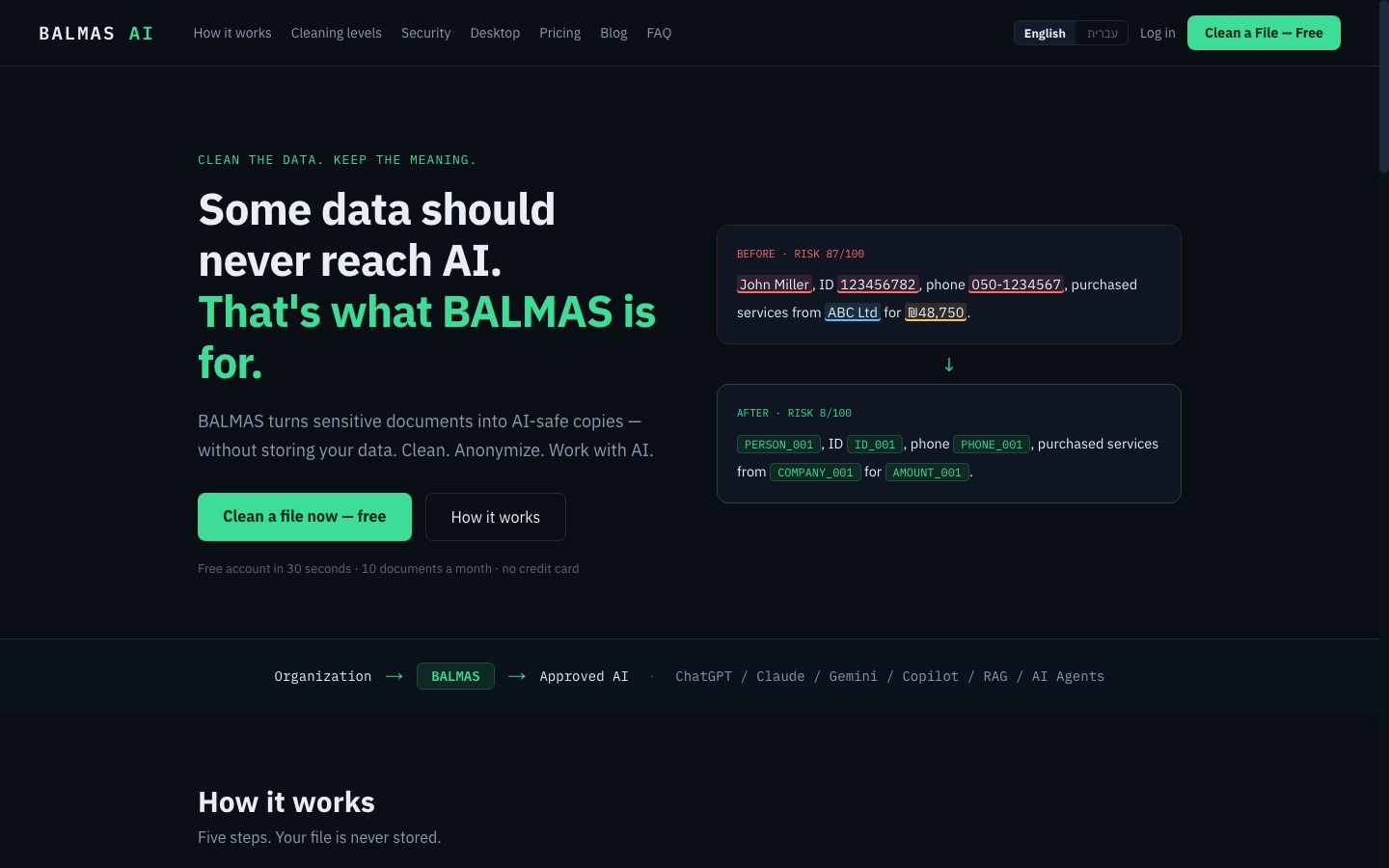 What it looks like in practice: before and after cleaning, with a risk score for each version. Screenshot: BalmasAI
A tool like BalmasAI does this automatically, without storing your files, with tiered cleaning levels based on sensitivity. You can start for free, 10 documents per month, and it's an excellent way to show your security team what a safe workflow actually looks like, rather than arguing about it in the abstract. We covered the tool in depth in the full guide and in the guide on working with sensitive documents.
3. Training That Turns Policy into Habit
Policy without training is a document in a drawer. The training sessions that work are practical: employees bring real tasks, learn what's allowed and how, and see with their own hands how to clean a document and work on it in an approved tool. That's how "you can't do that" becomes "here's the right way to do it," and Shadow AI loses its reason to exist.
And If You're the Employee Left with Only Copilot?
Two pieces of advice. First: get the most out of what you have. Copilot inside the Microsoft ecosystem is capable of far more than most users extract from it, and we wrote a complete, practical guide on exactly that. Second: don't fight your security team. Bring them a solution. A structured process of policy plus data cleaning plus training is a request a security manager can say yes to.
The Bottom Line for Managers
The employee who wrote that post isn't alone, and she isn't the problem. She's the symptom of an organization that chose the easy solution instead of the right one. The good news: the distance between blanket blocking and safe, productive AI use is shorter than it seems. Usually it's a matter of a few focused weeks of work.
This is exactly what I do with organizations: a practical AI workshop for your organization that builds the policy, the safe workflows, and the team habits, anchored to your actual processes. And for employees who want to move forward on their own, the live intro session for Claude Code on September 16 shows how far you can get when you work the right way.
Frequently asked questions

Yaakov Tzedek
An Israeli AI lecturer, consultant and implementer who has supported 100+ organizations in AI implementation and lectured for 200+. Official content partner of Meta, Google, Canva and TikTok, featured on Israel's Channel 13.
More about Yaakov →