
- On November 13, 2026, OpenAI launched ChatGPT Wallet, letting dots complete purchases on a user's behalf, and Poppy 1.0 shipped the same day, defining what an AI agent may do on a business site. Shopify activated it for all stores; Meta Muse looks for it on every site. Here is what happened, why it matters, and what to do this week, plus Code Mode in Claude Code and MathArena results.
When paying through ChatGPT Wallet, neither the agent nor the store ever sees the real card number. Each purchase gets a token with a card number, security code, and expiry date that are valid for that transaction only, so even if something leaks, it is worthless for the next one.
An AI agent already knew how to find you a product. Now it can pay for it too. And that's not even the interesting part.
On November 13, 2026, two things happened on the same day. OpenAI launched ChatGPT Wallet, an wallet that lets its personal agent complete a purchase on your behalf. And a few hours later, Poppy (Personal Agent Protocol) version 1.0 was released, a protocol that defines what such an agent is allowed to do when it arrives at a business's website. The first hands the agent a credit card. The second sets the rules of the game on the store's side.
In short:
- What happened: ChatGPT Wallet lets OpenAI's dots buy on behalf of the user, with biometric confirmation for every purchase. Currently limited to Pro subscribers in the United States.
- On the business side: Poppy 1.0 launched, Shopify activated it for all merchants, and Meta Muse looks for it first on every site it visits.
- What to do: Verify that the information on your site (prices, inventory, shipping, returns) is accurate and readable, and decide consciously whether you're blocking agents or welcoming them.
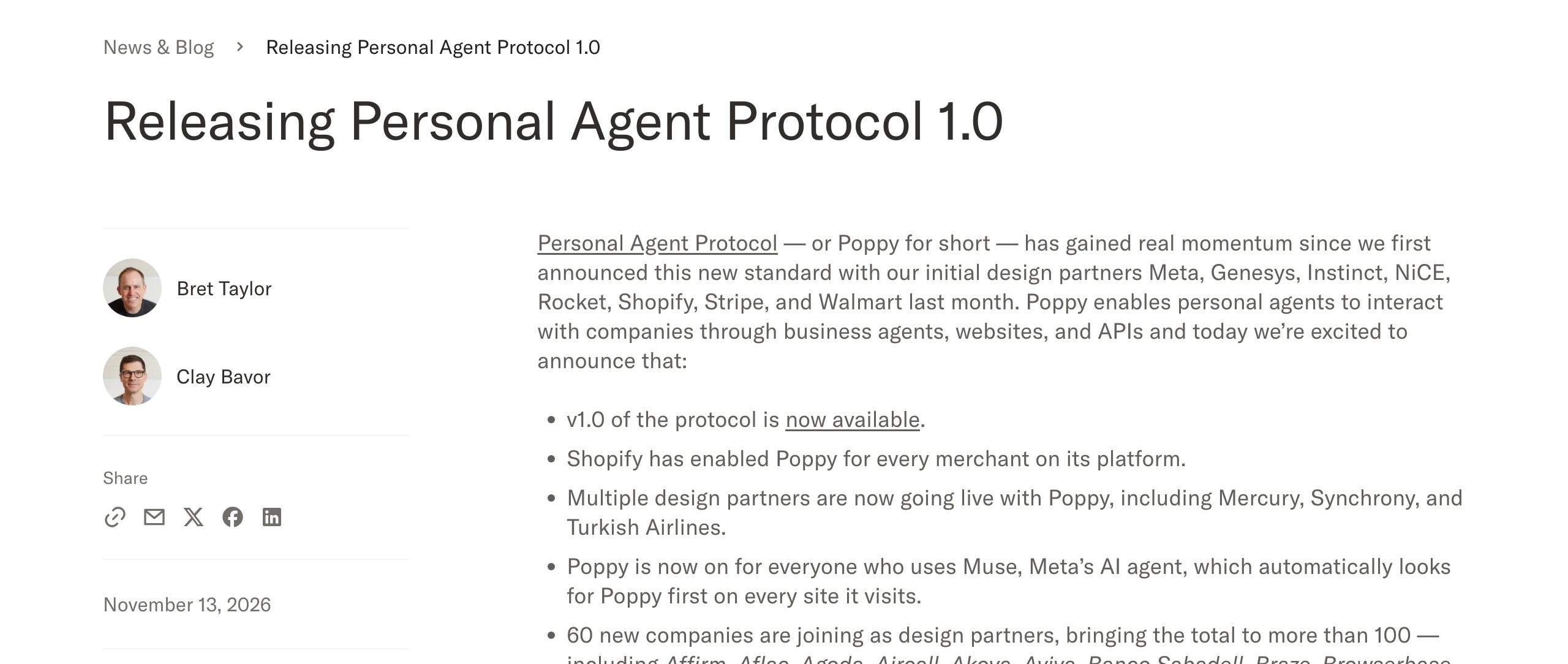 Screenshot: The official Poppy 1.0 announcement on the Sierra blog (sierra.ai), November 13, 2026.
What exactly does ChatGPT Wallet do?
You add a credit card to the wallet once, then ask the dot, ChatGPT's personal agent, to help buy something. It searches, compares, fills in your shipping and contact details with the store, and then presents you with the items, the total, and the card. The purchase only goes through after you confirm with Face ID or a fingerprint.
The clever part is in the payment itself. According to CNBC, each transaction gets a token with a card number, security code, and expiration date that are valid for that transaction only. Neither the dot nor the store ever sees your real card. The wallet was built with American Express, Mastercard, and Visa, and your card's existing benefits and protections, including the ability to dispute a charge, continue to apply.
Who gets it, and what's still missing?
In the first phase: a limited number of ChatGPT Pro subscribers in the United States, aged 18 and over, with a card issued in the United States. The Chief Innovation Officer at American Express explained to CNBC that this is a deliberate choice: to start in "a controlled environment" and expand from there. According to CNBC, OpenAI is not taking a commission on transactions at this stage.
What doesn't exist yet, and according to TechCrunch is coming later: spending caps, and category- or time-based rules that would allow you to pre-approve purchases the agent can complete on its own. In other words, today every purchase goes through you. The stated goal is that in the future, some of them won't.
What is Poppy, and why has Shopify already activated it?
Poppy is shorthand for Personal Agent Protocol, an open standard led by Sierra, the customer-service agent company founded by Bret Taylor, former co-CEO of Salesforce, and Clay Bavor, former senior executive at Google. It defines how a personal agent arrives at a business, identifies itself, and learns what it's allowed to do: through the website, through the API, or directly with the business's own service agent. The customer connects via OAuth and decides what the agent can and cannot do, and can change that at any moment.
According to Sierra's announcement on November 13:
- Shopify activated Poppy for all merchants on the platform, and every store now publishes a Poppy file automatically. Shopify also co-authored with Sierra the extension that connects Poppy to UCP, the protocol that handles product search, cart, and checkout.
- Meta Muse, Meta's personal agent, runs Poppy for all users and "looks for Poppy first on every site it visits." We covered it in the guide to Muse Spark.
- Joining: Mercury, Synchrony, and Turkish Airlines are starting to work with the protocol, and 60 new companies have joined as development partners, more than 100 in total, including Wix, Salesforce, Zoom, Intuit, and Delta.
The division is straightforward: UCP answers "how do you buy," Poppy answers "who are you and what are you allowed to do." We covered UCP and Shopify's preparations for shopping agents in the story on Claude's commerce agents.
Why is this happening right now?
Because businesses are starting to push back. On November 11, United Airlines announced it was restricting unapproved third-party AI agents, both on its own site and app and through travel agencies. The stated reasons: exposed account details, unintended purchases, and accidental points redemptions. Its CEO, Scott Kirby, told the Wall Street Journal: "I don't want to create another intermediary."
That's the context for both launches. OpenAI has no interest in stores blocking its agents, so alongside the wallet it published a guide for merchants (Commerce Partner Playbook) that explains, among other things, how to avoid accidentally blocking its agents. And Poppy offers businesses a middle path: not blocking everything, not opening everything, but defining.
What does this mean for your business?
If you have an online store: The agent is not impressed by your design. It reads prices, inventory, shipping times, and return policies. If that information is missing, contradictory, or buried inside an image, the agent will choose another store where it's clear. This is exactly the same logic as GEO, optimization for AI engines, except that instead of getting a citation you get an order.
If you're on Shopify: Poppy is already active on your store. If you're on Wix, it's on the partners list, and the Wix AI guide is a good starting point. In either case, go through your 10 best-selling products this week and make sure all the details are there in clear text.
If you have a service or sales bot: In the near future, some of the conversations it handles will come from agents, not humans. Ask your vendor whether they plan to support Poppy or MCP, and what your agent is authorized to approve on its own.
And in Israel, today: The wallet itself isn't here yet. But Muse is already looking for Poppy on every site, Shopify is already publishing, and the standard is being set now. Whoever organizes their information early gets into agents' shortlists before their competitors do.
And also today in leading tools
Code Mode in Claude Code: Claude writes code that runs its own tools
On November 12, an experimental mode called Code Mode was added to Claude Code, in version 2.1.323. Instead of calling tools one after another, Claude writes a JavaScript snippet that executes the calls: runs several commands in parallel, uses the result of one in the next, and returns to itself only the portion of the output it actually needs to read. Anthropic recommends it for changes that repeat across many files, for searches that need to be filtered before reading, and for independent commands that can run in parallel. On November 13, version 2.1.325 was released with three fixes for this mode.
It is off by default and enabled with the environment variable CLAUDE_CODE_EXPERIMENTAL_CODE_MODE=1, only in an interactive terminal session (not in VS Code, not in the desktop app, and not with -p), with a Claude subscription or a Console account, on Opus 5.5, Sonnet 5.5, Haiku 5.5, or Fable 5.2. Your existing block and approval rules continue to apply to every call, a project settings file cannot enable it, and an organization can block it in managed settings. Sources: Code Mode documentation and changelog. Anyone who wants to learn Claude Code from the ground up will find that in the Claude Code video course.
MathArena: Gemini 4 Carbon in first place, and a price worth knowing
On November 13, MathArena, the leaderboard that tests models on math competitions, added Gemini 4 Carbon and Claude Fable 5.2. The result: Carbon in first place at 85.4%, Fable 5.2 in second at 82.8%, and GPT-6.1 Sol in third at 80.6%. But the average cost per problem tells a different story: $15.70 for Carbon, $40.20 for Fable 5.2, and just $1.07 for GPT-6.1 Sol.
According to The Decoder, Carbon's most common failure is exceeding the time limit, and in one case it ran a script for more than 11 hours without checking its progress. The practical takeaway: before you switch to whichever model is leading the leaderboard, check how much each additional percentage point is actually costing you. We covered Carbon's pricing, which doubles on December 1, here. Sources: MathArena and The Decoder.
Want to understand AI agents before they come to you?
Agents that buy, book, and contact businesses on behalf of customers are no longer a future scenario. The AI agents video course includes 50 short lessons in Hebrew, step by step, so you understand what an agent can do and how to deploy one correctly in your business.
Sources: CNBC on ChatGPT Wallet, TechCrunch on ChatGPT Wallet, Sierra's Poppy 1.0 announcement, United's announcement, Code Mode in the Claude Code documentation, MathArena.
Frequently asked questions

Yaakov Tzedek
An Israeli AI lecturer, consultant and implementer who has supported 100+ organizations in AI implementation and lectured for 200+. Official content partner of Meta, Google, Canva and TikTok, featured on Israel's Channel 13.
More about Yaakov →