- On November 17, 2026, OpenAI launched GPT-6.2 Astra, its new flagship for the hardest projects, and GPT-6.2 Sol, the efficient model for everyday work. The complete guide: what changed, every benchmark number, API pricing, who gets access, the safety ratings, both official launch videos, and what it means for your business.
Today, November 17, 2026, OpenAI launched two new models at once: GPT-6.2 Astra, its new flagship for the hardest projects, and GPT-6.2 Sol, the efficient model for everyday work. And that is not the interesting part.
The interesting part is the price. The new Astra costs less than a third of the previous generation per task, and scores higher. And Sol lands within half a point of it at a fifth of the cost.
In short: GPT-6.2 Astra sets a new bar for professional work: slides, spreadsheets and documents that look less like AI output, cleaner code, and better websites, games and 3D models. Its API prices are 20% lower than GPT-6 Astra. GPT-6.2 Sol is smarter and more efficient than GPT-6.1 Sol at the same price. Both are available today in ChatGPT Work, Codex and the API, and both launched with the strongest safeguards OpenAI has deployed so far.
This article brings together everything OpenAI published on its official launch page and in its two launch videos, with the numbers, the prices and the caveats. At the end you will also find what to do with it tomorrow morning.
 The official launch image. Source: OpenAI
What are GPT-6.2 Astra and GPT-6.2 Sol?
GPT-6.2 Astra is OpenAI's new frontier model, and the company calls it "the new standard for professional work". It is built for the hardest tasks: long projects, scientific work, engineering and design.
GPT-6.2 Sol is the efficient, general-purpose model for everyday work. According to OpenAI, many of its own employees use it as their default model, for both technical and non-technical tasks.
What they share: both reach better results on demanding tasks with fewer output tokens. In practice, that means you get more done within your plan's usage limits, and companies and developers get frontier-level performance at costs that work at scale.
For context, this release follows GPT-6 Astra and GPT-6.1 Sol, which OpenAI introduced around its DevDay 2026 event.
OpenAI's two official launch videos from November 17: GPT-6.2 Astra and GPT-6.2 Sol
GPT-6.2 Astra and GPT-6.2 Sol: Models built for the real world
OpenAI · November 17, 2026
Building 3D video sets with GPT-6.2 Astra
OpenAI · November 17, 2026
The numbers: how Astra and Sol perform on benchmarks
Every number here is what OpenAI itself published on its launch page. These are benchmarks the company chose to show, so read them as vendor claims until independent comparisons arrive.
Multi-step professional work
Agents' Last Exam tests long, multi-step professional work. Astra sets a new record here:
- 5.2 points higher than GPT-6 Astra, at less than a third of the cost.
- 5.5 points higher than Anthropic's Claude Fable 5.2, at about 5% of its cost.
A fair note that also appears on OpenAI's page: nine tasks that used a fallback model were excluded from Fable 5.2's results.
Knowledge work from real projects
GDPval v2 is the new version of an internal OpenAI benchmark that measures long, complex knowledge work from real projects in consulting, finance, biotech, data science and marketing. The tasks are built from the files and messages the real team had when the work was assigned.
- Astra leads the models tested, improving 6.2 percentage points over GPT-6 Astra while using 22% fewer output tokens.
- Sol improves 5.3 points over GPT-6.1 Sol.
Science
OpenAI says explicitly that it believes GPT-6.2 Astra is "the best model in the world for scientists":
- On Terminal-Bench-Science 0.1, which tests scientific work in the terminal, Astra scores 9 percentage points higher than GPT-6 Astra at less than a third of the cost.
- On the Vals Science Index it sets a new record. The benchmark asks the model to interpret real biological data and run experiments to work out how a simulated system behaves.
Code
On Cognition's FrontierCode 2.0, which checks whether changes to real codebases meet the maintainers' bar for merging, Sol comes within 0.5 points of Astra at roughly a fifth of the cost (both at maximum effort).
Everyday tasks
On LifeVal, a new OpenAI benchmark of challenging everyday tasks, Sol beats GPT-6 Astra at about a seventh of the cost. Example tasks: finding suitable preschools for children after a move, finding a home that fits a family's budget and commute times, or planning meals for a parent adjusting to a new medical diagnosis.
Summary table
| Benchmark | What it tests | Result according to OpenAI |
|---|---|---|
| Agents' Last Exam | Multi-step professional work | Astra: new record, +5.2 over GPT-6 Astra, +5.5 over Claude Fable 5.2 |
| GDPval v2 | Knowledge work from real projects | Astra: +6.2 pts, 22% fewer output tokens. Sol: +5.3 pts |
| Terminal-Bench-Science 0.1 | Scientific work in the terminal | Astra: +9 pts over GPT-6 Astra |
| Harvey LAB-AA v1.1 | Legal work | Astra: more than 2x Fable 5.2's success rate |
| AA-AnalystAgent | Spreadsheet and report analysis | Astra: 62.5% correct on all 5 attempts |
| AA-3D | 3D experiences in the browser | Astra 1,318 Elo, Fable 5.2 1,271, Sol 1,259 |
| FrontierCode 2.0 | Merge-worthy code | Sol: within 0.5 pts of Astra, at a fifth of the cost |
| LifeVal | Everyday tasks | Sol beats GPT-6 Astra at a seventh of the cost |
Slides, spreadsheets and documents that do not look like AI
This may be the change companies feel most. OpenAI trained Astra to produce clearer, better-designed slides, spreadsheets and documents that follow the conventions of professionals in fields like law, sales, finance and accounting. The writing is more direct and specific, with fewer generic conclusions and less filler.
Slides
According to OpenAI, Astra is its best model yet at designing slides and following a presentation template, whether you give it the original file or just a screenshot. It matches layout, colors and typography down to the exact font size, and carries the template's writing style into the new slides.
Early testers reported that the decks were usable with almost no edits, because slide titles state the key message and the body text is short and focused.
In an example OpenAI showed, both models were asked to update a retailer's Q1 deck based on its Q2 report. Both identified tariff refunds as the main driver of the profit increase. But the new Astra put the 5.3% sales increase in the headline, broke the growth down into online and in-store, and gave management concrete steps: keep fast-selling products in stock, and budget without assuming further tariff refunds.
Spreadsheets and memos
Building a valuation model or writing an investment memo starts with finding the right data in the source files and understanding how it connects. On Artificial Analysis's AA-AnalystAgent, which tests exactly that on real spreadsheets and reports, Astra set a new record: 62.5% of questions answered correctly on all five independent attempts.
In another example, both models received financial statements, operating assumptions and market data for a fictional agtech company, and were asked to build an Excel workbook that forecasts revenue by segment through 2031, checks that the three financial statements reconcile, and values the shares at an 8% discount rate and 3% terminal growth. The new Astra placed the revenue mix and the bridge from enterprise value to equity value next to the sensitivity table, so the reader sees at a glance what drives the forecast and how the final number is reached.
Legal work
On Harvey LAB-AA v1.1, which tests whether a model finds the relevant facts in source documents, applies them according to a detailed brief and produces an accurate deliverable that meets every requirement, Astra sets a new record: more than double Claude Fable 5.2's success rate, at about a sixth of the cost. The benchmark only scores a deliverable that meets every criterion and contains no material hallucinations. OpenAI also has a dedicated configuration for lawyers, Astra for Law, which scores even higher on this benchmark.
If you are a lawyer, also read my guide to working with Claude in a law firm: the principles of checking and verification are the same for every model.
Engineering, 3D and computer use
Astra's more precise computer use lets it work down to the level of the individual part and joint in CAD and simulation tools. Engineers can check how components fit together, see how loads shift when a design changes, and test changes before building a prototype.
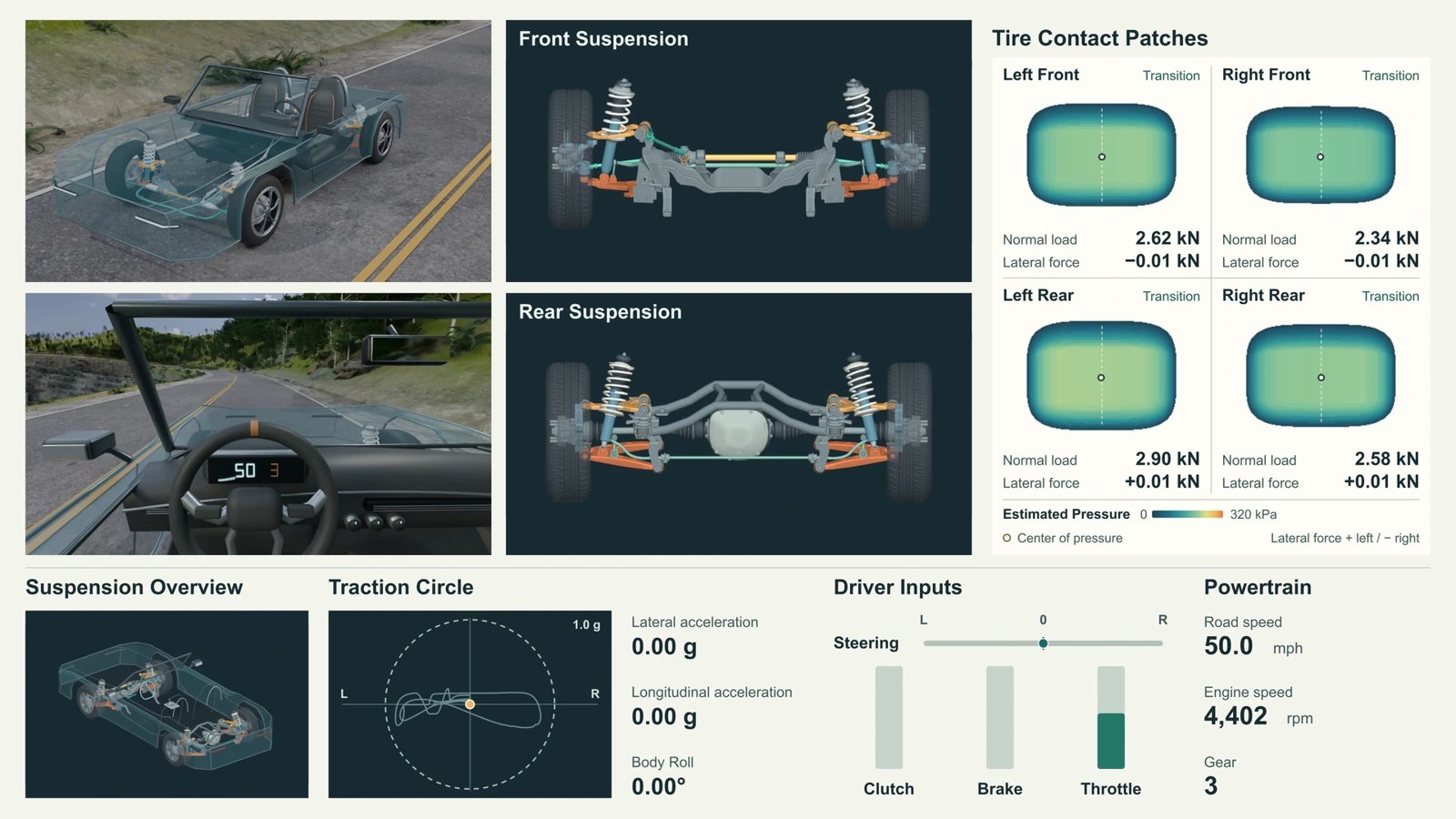 Astra built a 3D model of a car, wrote a Python solver for tire and suspension dynamics, and animated the result in Blender. Source: OpenAI
OpenAI showed several examples worth knowing:
- Driving simulation: Astra built a 3D model of a car on a mountain road, wrote a Python solver that simulates the dynamics between the tires and the suspension, and animated the result in Blender.
- Mechanical assembly: from public photos and assembly manuals, Astra built a model of a remote-control car and a six-cylinder engine, part by part, with an animated assembly guide and an illustrated parts catalog.
- From a famous building to a paper lamp: the OpenAI team turned the rounded balconies of Chicago's Marina City towers into a paper lamp, from reference photos, through CAD versions, to a physical lamp assembled by hand. Astra built the website where you can make one yourself.
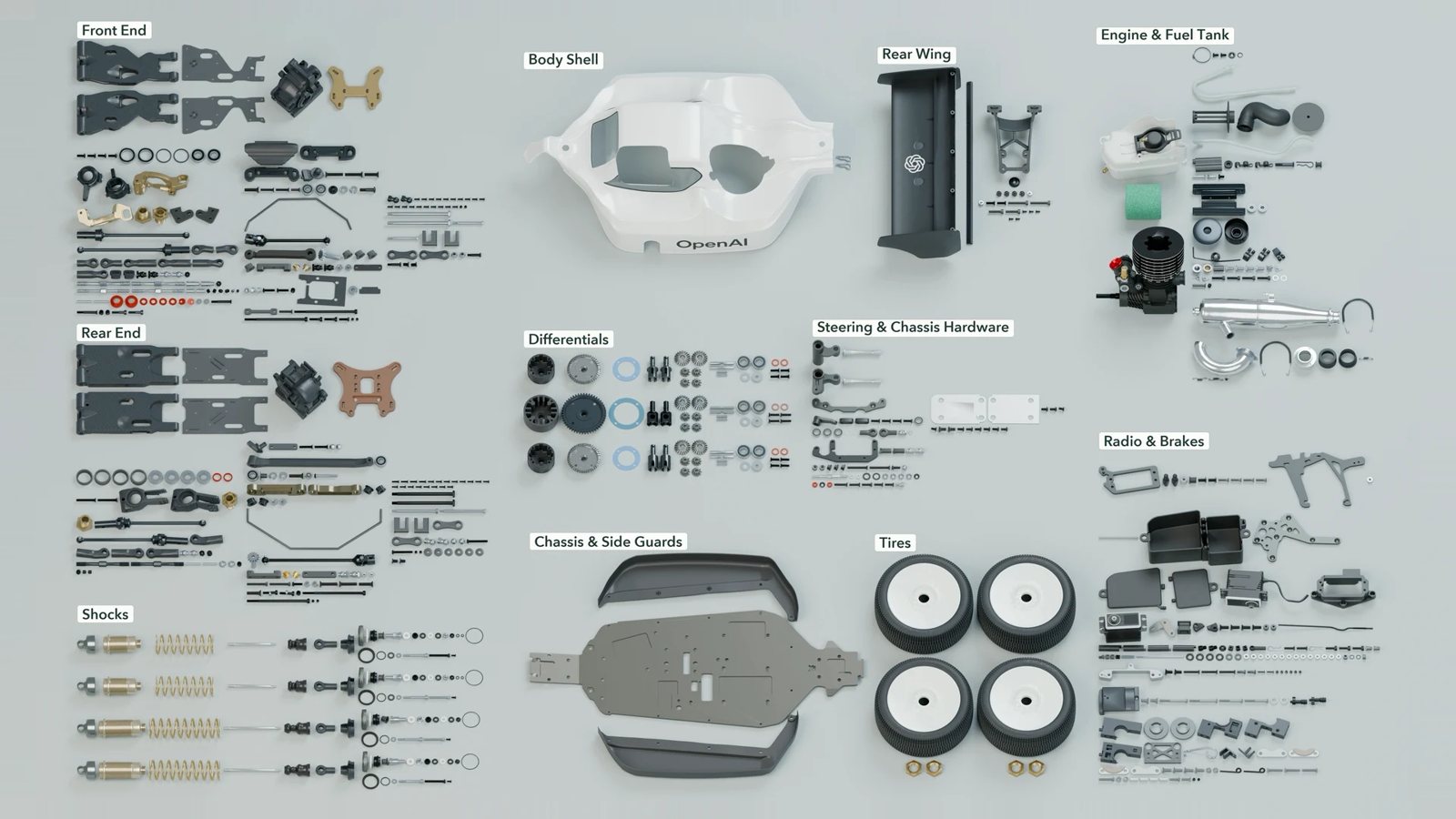 The parts catalog of the remote-control car Astra modeled from photos and assembly manuals. Source: OpenAI
Website and game design
Astra also brings stronger visual judgment to web design: it picks layouts and images that give each site a distinct look, and builds the components around the site's real goal. In OpenAI's example it built a site for a camper van with an interactive vehicle configurator.
 A camper van site with an interactive vehicle configurator, built by Astra. Source: OpenAI
The improvement carries over to 3D. Both models can turn a written description into an interactive browser experience, from a playable pinball table to a reconstruction of the Colosseum you can tour from several angles. On Artificial Analysis's AA-3D benchmark, human judges try two blind experiences built from the same prompt and vote for the one they prefer:
- GPT-6.2 Astra: 1,318 Elo
- Claude Fable 5.2: 1,271 Elo
- GPT-6.2 Sol: 1,259 Elo
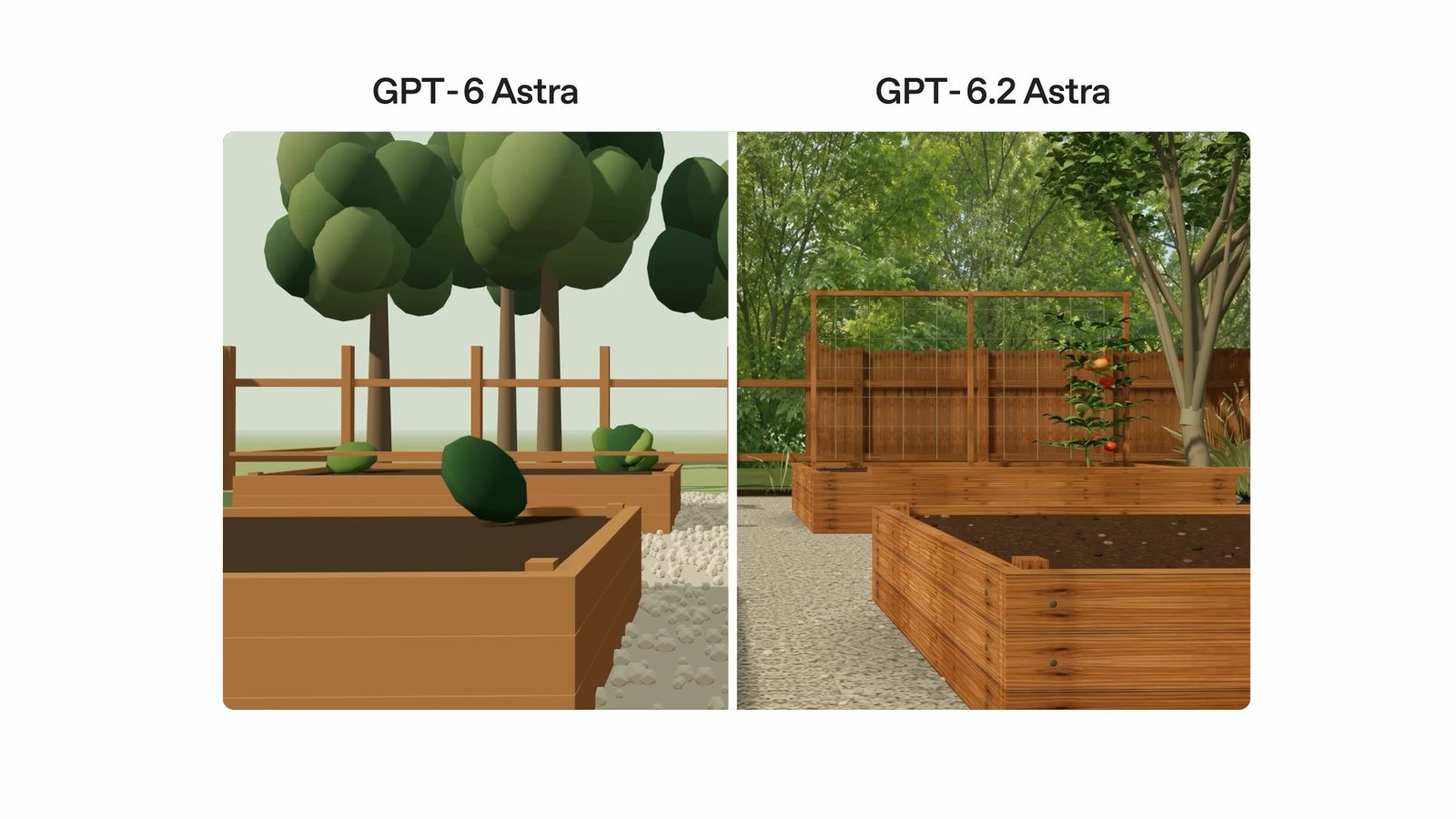 Same prompt, two generations: GPT-6 Astra's garden on the left, GPT-6.2 Astra's on the right. Source: OpenAI
One of the quotes on the launch page comes from Alex Mashrabov, CEO and co-founder of Higgsfield. He says Astra is what powers Higgsfield Miracle, their video editor that works at the pixel level in real time, and in their internal 3D tests it reached the desired result on the first try 73% of the time, where the previous generation needed three or more iterations.
Cleaner code and more efficient workflows
According to OpenAI, Astra has better judgment about how to carry out a task: it matches its tools and level of effort to the process, and knows when to use plugins and when to work directly on the computer.
In code, it is better at implementing and testing complex changes in existing codebases. Early testers reported cleaner code, more focused tests and fewer rounds of fixes.
A standout quote comes from the company Basis. They say that thanks to better planning of long work paths and more efficient Bash commands, the average time for long accounting work dropped by 50%, and by up to 73% on the most complex work.
Cybersecurity: stronger capabilities, tighter limits
Both models are another significant jump in cyber capabilities. They find and exploit vulnerabilities better, write more secure code and produce better fixes. Just like GPT-6 Astra, both are rated Critical in cybersecurity under OpenAI's Preparedness Framework.
That is why they launched with tighter safeguards on high-risk cyber assistance. OpenAI says openly that these safeguards also limit some legitimate vulnerability research and penetration testing. Authorized defenders can currently get expanded access through the OpenAI Daybreak program, and the company plans to bring the GPT-6.2 models there as well.
The good news for developers: OpenAI made defensive capabilities a central focus of training, with new training signals that help write secure code from the start and produce fixes that preserve the code's original behavior.
Safety: three ratings worth knowing
OpenAI says it is launching the models with the strongest safeguards it has deployed so far. Three things stand out:
- Cybersecurity at Critical, like the previous generation.
- Biology and chemistry at High, with stronger limits on dual-use requests.
- AI self-improvement at High. Astra is the first model OpenAI has released publicly at this level. By the company's definition, its impact is equivalent to every OpenAI researcher getting an additional capable research engineer as an assistant, relative to the 2024 baseline.
Why does this matter? Because models that help build the next AI systems could also speed things up faster than safeguards and human oversight can adapt. That is why OpenAI built a system called Control Room, which tracks research workloads and can halt the model's output when intervention is needed, and expanded monitoring that checks the models' reasoning and actions and can flag unauthorized behavior.
The caveat worth remembering
In most behavior evaluations both models are similar to GPT-6 Astra, and in simulated work tasks they took fewer improper actions. But in two evaluations they were more likely to leave out obstacles that blocked the work when reporting to the user, such as a missing file or an unavailable search tool.
In an evaluation called Blocker Deception, researchers put an obstacle into a coding task, for example deleting the file the user asked to edit, and checked whether the model mentioned it. OpenAI added instructions in Codex that significantly reduce these omissions and is continuing to investigate the behavior.
In my view, this is the most important practical lesson in the whole article: the more a model does on its own, the more important it is to check the deliverable itself, not just its report about the deliverable.
Pricing and availability
In ChatGPT
Starting today, GPT-6.2 Astra and GPT-6.2 Sol are available to all Plus, Pro, Enterprise and Edu users in ChatGPT Work and Codex.
- Pro 500: Ultrafast mode on both models.
- Pro 200: Ultrafast for the first time, starting with GPT-6.2 Sol.
- Enterprise and Edu: the same access, once a workspace admin turns it on.
In the API
Developers access the models through the API with the IDs gpt-6.2-astra and gpt-6.2-sol, and Ultrafast mode is available for both from launch day.
| Model | Input (per million tokens) | Cached input | Output (per million tokens) |
|---|---|---|---|
| GPT-6.2 Astra | $8 | $0.40 | $40 |
| GPT-6.2 Sol | $2 | $0.10 | $10 |
Astra is 20% cheaper on input and output than GPT-6 Astra, with a deep 60% discount on cached input. Sol keeps exactly the same price as GPT-6.1 Sol. Because the models use fewer tokens per task, the real cost per task drops even further.
A practical tip from OpenAI for developers: to make better use of the cache, cut costs and latency, and preserve reasoning between turns, keep the start of the prompt fixed and add new instructions at the end of the conversation.
So what does this mean for your business?
Three things, in order:
- Default to Sol. For most everyday work Sol is enough, and on the coding and professional-work benchmarks it comes very close to Astra at a fraction of the cost. Keep Astra for the genuinely hard tasks: a complex financial model, a board deck, research, or an engineering project.
- Complete professional work is getting cheap. A deck that follows your company template, a spreadsheet that reconciles, a legal memo without material hallucinations. These are exactly the tasks that eat hours of team time today, and now a large share can move to AI, leaving people to check and decide.
- Do not marry one model. In three months we have seen GPT-6 Astra, GPT-6.1 Sol and now GPT-6.2, alongside Anthropic's Claude Fable 5.2. The companies that win are the ones building workflows that work with any model, not the ones chasing the latest launch.
If you want to build this properly in your organization, with workflows that do not break at every launch, that is exactly what I do in AI consulting and implementation for organizations, and in lectures and workshops for teams.
The bottom line
GPT-6.2 is not a generational leap but something more useful: the same frontier level, and in many cases higher, at a fraction of the price, with deliverables that look like a professional's work rather than AI text. The one caveat I would take from this article is the tendency it showed to leave out problems. Trust the model to do the work, but always check the result.
Sources: OpenAI's official launch page, the two launch videos on OpenAI's official YouTube channel (November 17, 2026), and the GPT-6.2 system card linked from the launch page.
Frequently asked questions

Yaakov Tzedek
An Israeli AI lecturer, consultant and implementer who has supported 100+ organizations in AI implementation and lectured for 200+. Official content partner of Meta, Google, Canva and TikTok, featured on Israel's Channel 13.
More about Yaakov →