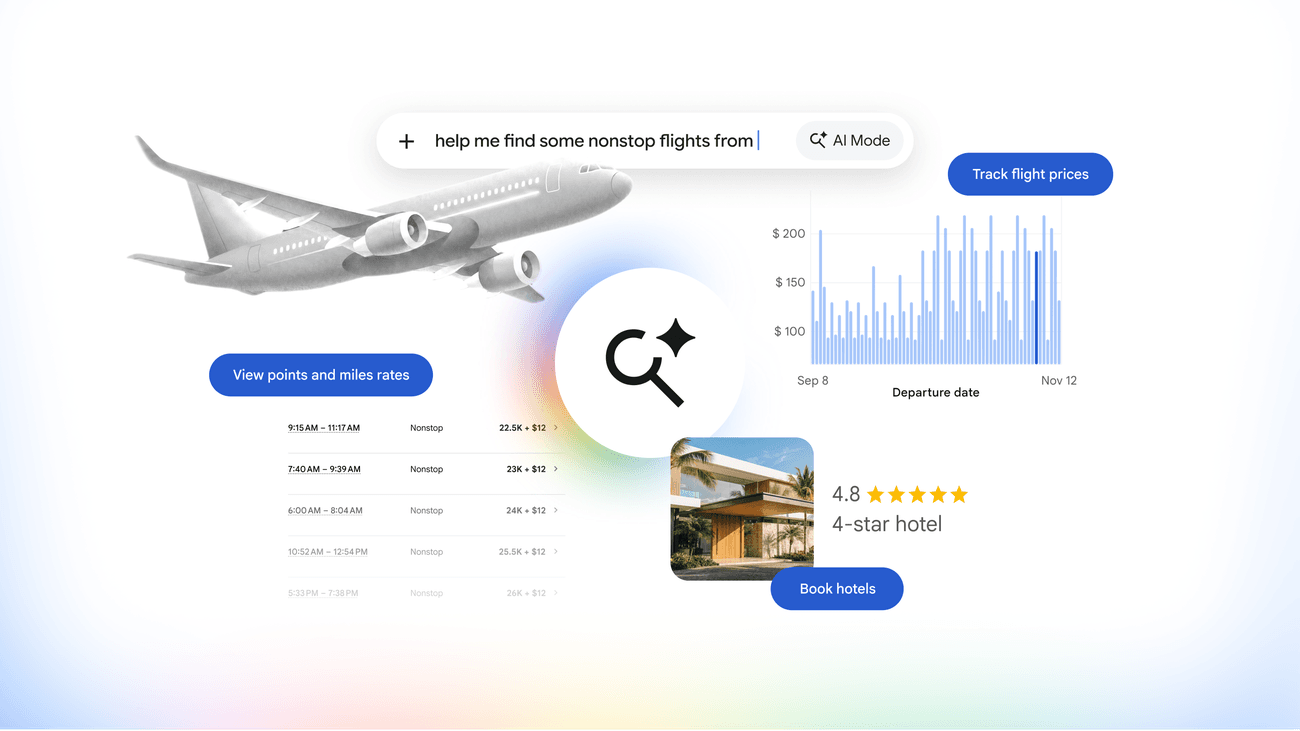
- Google upgraded AI Mode into a full travel agent: automatic flight price tracking across 180+ countries, prices shown in points and miles, and end-to-end hotel booking inside the chat with Google Pay.
In every one of Google's demo screens, the following sentence appears in small print: AI can make mistakes, so double-check responses. Even when Google hands the AI a credit card, it keeps responsibility with the human. That is exactly the principle every organization needs to adopt when working with agents.
On August 27, 2026, Google made the move everyone knew was coming: it stopped settling for answering travel questions and started handling the travel itself. AI Mode, its conversational search experience, gained three new capabilities that turn it into a full-fledged travel agent: automatic flight price tracking, translation of prices into loyalty program points and miles, and complete hotel booking, including payment, without ever leaving the conversation.
This is a travel story only on the surface. Underneath, it is the defining story of 2026: the shift from "find it for me" to "do it for me", and this time it is happening at the player through which most of the internet's traffic flows. I broke down the announcement, watched the official demos (embedded below), and looked at what any of this means for Israeli users and businesses.
What Exactly Launched? Three Capabilities, One Category Shift
Google's AI Mode can now track flight prices and send email alerts for every change (available in 180+ countries), display flight and hotel prices in loyalty program points and miles (global), and complete a full hotel booking with Google Pay inside the conversation itself (launched in the US in English). The first two are convenience upgrades; the third is a category change.
1. Price Tracking: The Agent Working for You While You Sleep
The flow is remarkably simple: describe in plain language where and when you want to go ("direct flights to Vegas the weekend of the 9th"), and AI Mode pulls live options from more than 300 airlines and travel sites, including a price graph by date. Then comes the sentence that makes all the difference: "Track these prices for me." The system confirms the route, dates, and filters, and from that point every price drop lands in your inbox.
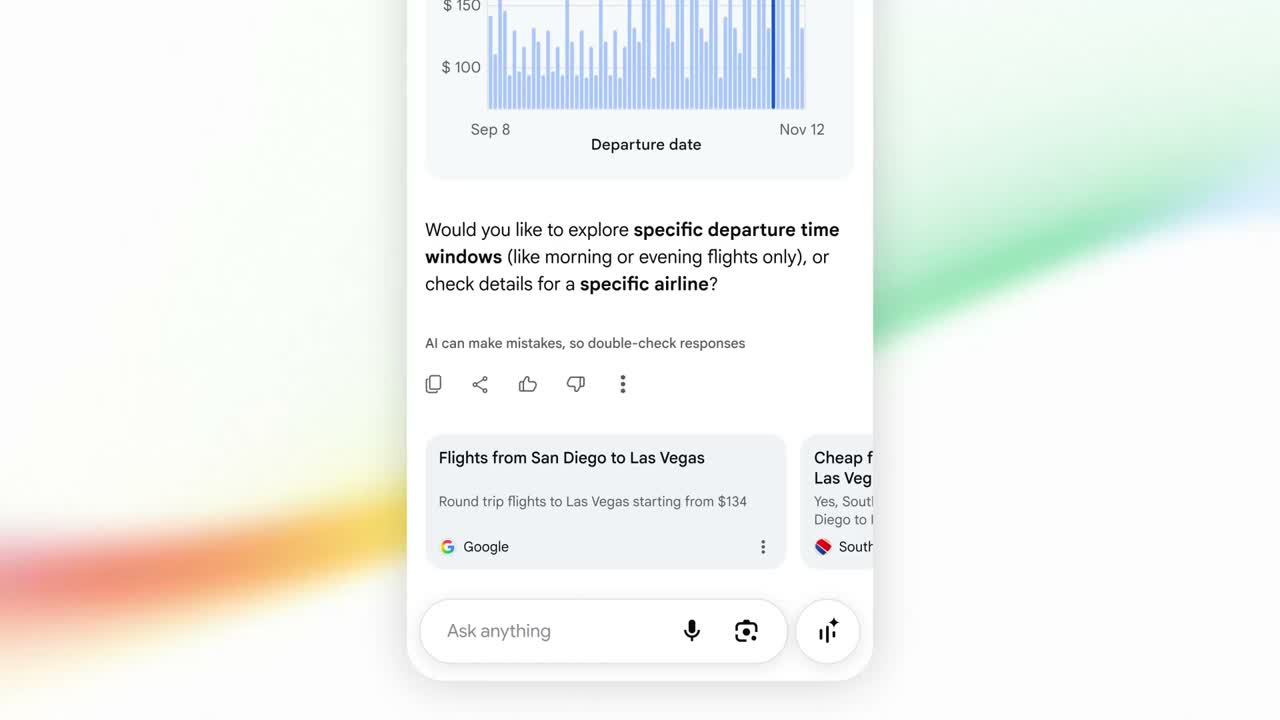 The price graph and live offers inside the conversation. Note the fine print: "AI can make mistakes, check the answers." Credit: Google
Anyone familiar with Google Flights will point out that price tracking has been there for a while, and that is true. The novelty is where it lives: not in a dedicated tool you have to know exists, but inside a conversation that started as "help me plan a vacation." The feature itself has not changed; the door to it has, and that is the entire story of the agentic era.
2. Points and Miles: The Translation No Other Site Ever Got Right
Anyone who has accumulated points in a frequent-flyer program knows the tedious drill: open the program's site, hunt for award space, compare to the cash price, and do the math yourself. Now you just ask in plain language: "I want to fly from Atlanta to Miami with my American miles," and you get a table of flights with the points price alongside each one.
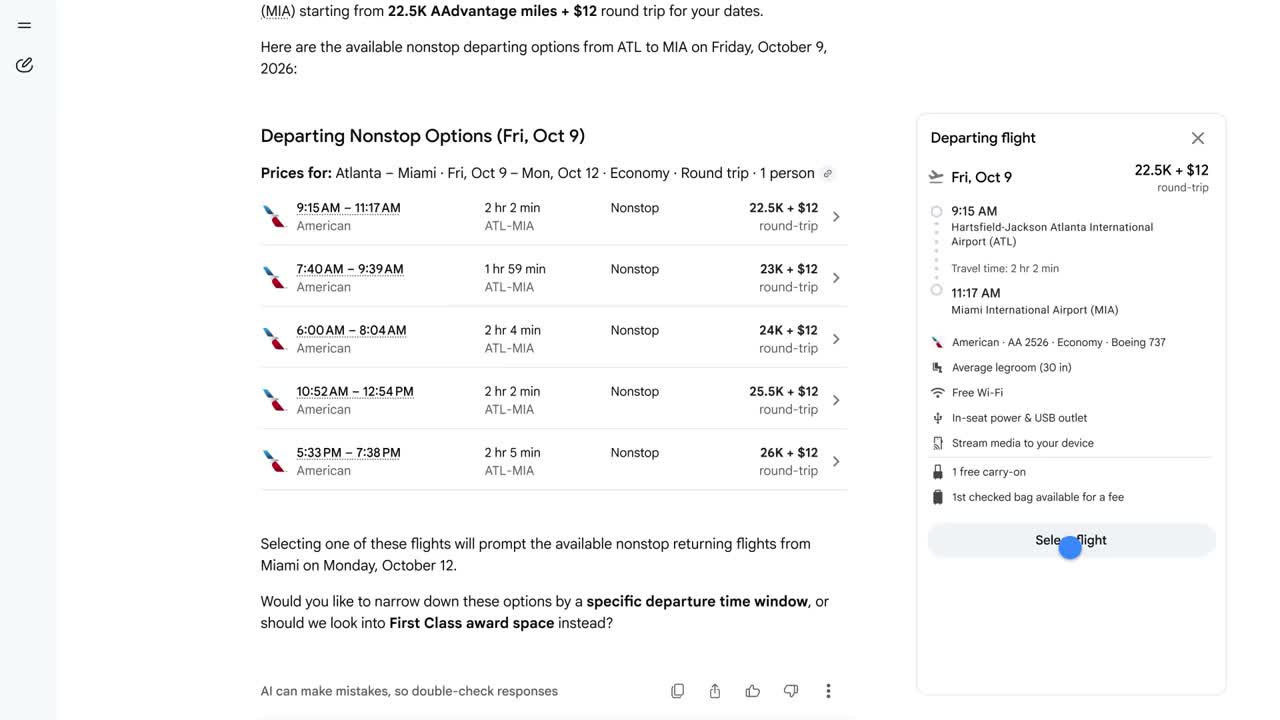 22.5K miles + $12, next to every flight, including aircraft details and amenities. Credit: Google
At launch, the supported programs are Alaska and Hawaiian, American, Choice, Hilton, and Wyndham, with Accor, Flying Blue, Hyatt, LATAM, and Lufthansa joining in the coming weeks. For Israeli travelers the immediate impact is modest (local programs are not there), but anyone accumulating points in international programs finally has one place that speaks both currency and points.
3. Hotel Booking Inside the Chat: This Is Where the Rubicon Gets Crossed
This is the real leap. The full flow, as it appears in the official demo embedded above: you discuss the destination and preferences, receive options with reviews and comparisons, tap Continue on Google on your chosen hotel, select a room type, compare cancellation terms (the demo shows an actual choice between non-refundable and free cancellation up to a date), and pay with Google Pay. Booking complete, without leaving the search even once.
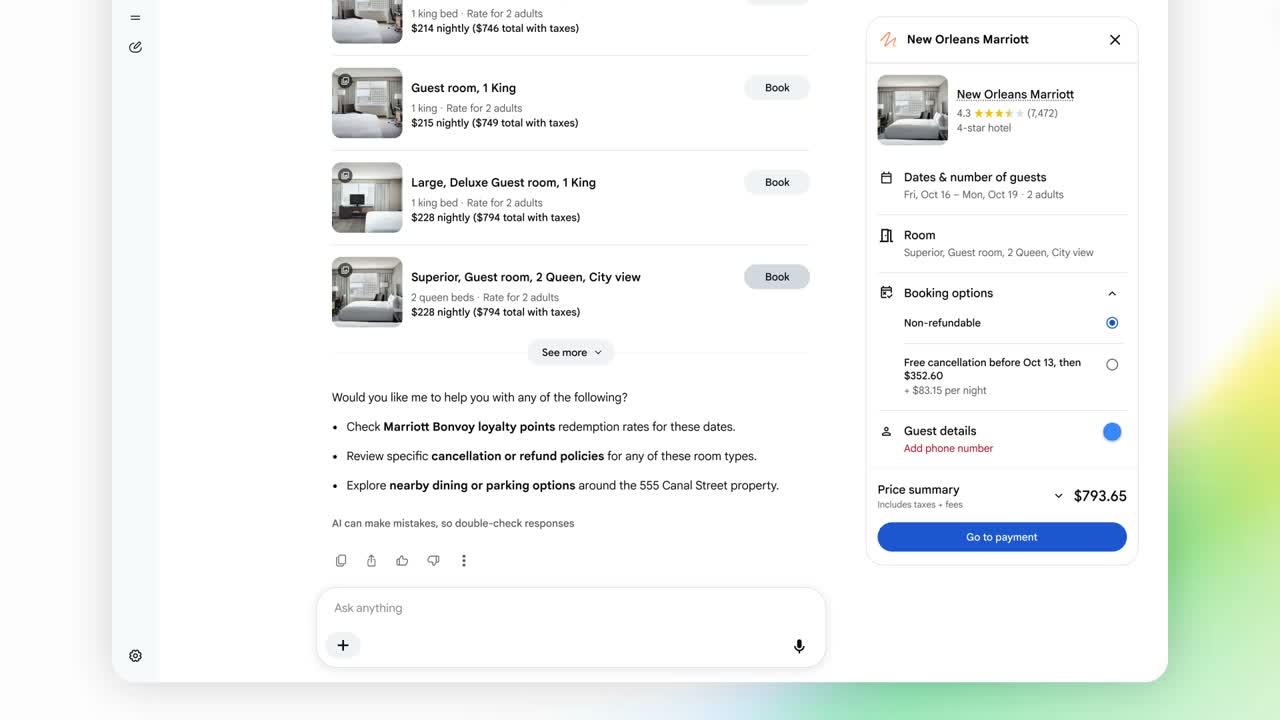 The booking screen: rooms, cancellation terms, price summary, and the payment button, all without leaving the conversation. Credit: Google
The launch began in the US in English, with ten major partners: Booking.com, Choice, Expedia, Hilton, Hotels.com, IHG, Marriott, Priceline, Trip.com, and Wyndham. One important detail Google is careful to emphasize: the hotel or booking platform is the merchant of record and the party providing the service. Google is the front desk, not the agency, a legal and commercial distinction that will recur across the entire world of agentic commerce.
What Works from Israel: Status Table
| Capability | Availability | For Israelis |
|---|---|---|
| Flight price tracking | 180+ countries (EU excluded) | ✅ Works |
| Prices in points and miles | Global | ✅ Works, for supported programs |
| Hotel booking in chat | US, English | ⏳ Not yet, expected to roll out in waves |
Notice the interesting detail in parentheses: EU countries are specifically excluded from price tracking. This is not a bug, it is regulation (the European DMA restricts Google from favoring its own services), and it is a reminder that the agentic future will arrive at different speeds in different markets. Israel, for better or worse, is in the early-adopter group.
Why This Matters Far Beyond Travel
Now for the part that puts this story on a blog about AI for organizations rather than in a travel magazine.
1. Travel is always the canary. When content moved to the internet, travel led. When mobile took over commerce, travel led. This industry, with a fully digital product, dynamic pricing, and high intermediary margins, is always the first testing ground for every interface revolution. What Google is doing today with hotels it will do tomorrow with insurance, cars, restaurants, and every category that involves bookings. This announcement is the template.
2. "Appearing on Google" takes on new meaning. In a world where the booking closes inside the conversation, the search results page stops being the destination. Whoever appears in the AI's answer exists; whoever does not is invisible. And look at the partner list: these are players with perfectly structured data, real-time availability, and mature APIs. That is the entry ticket to the agentic era: machines buy from whoever speaks the language of machines. This work, being the source that AI engines pull from and transact through, is exactly what falls under the heading of GEO, and it moved this week from recommended to mandatory.
3. Google's safety pattern is a lesson for every organization. Even when it lets AI spend money, Google builds the same chain I teach when working with agents: the user confirms every step, cancellation terms are shown before payment, business liability stays with the merchant, and every screen carries the note "AI can make mistakes." An agent with hands needs a safety belt, and that holds for your organization's agents too.
What to Do with This, by Who You Are
- Travelers: Turn on price tracking for your next trip (works from Israel), and get used to planning in conversation rather than across ten tabs
- Businesses in travel and hospitality: Check today where your structured data stands (schemas, availability, prices in feeds). When in-chat booking reaches Israel, anyone not readable by machines will not be on the shelf
- Every other business: Understand that this pattern is coming to your industry, and start building presence in AI answers now, while competitors are still deliberating. My working guide on agents is a good starting point for understanding this world from the inside
The fastest way to turn this understanding into practical capability for your organization: a hands-on AI workshop where your team learns to work with agents on your own processes, or the live intro session for Claude Code on September 16 for individuals, three hours at the end of which you are the one building the agent, not just using it.
Sources: The official Google Blog announcement · TechCrunch coverage · 9to5Google breakdown. The video and images are from official announcement materials, credit: Google.
Frequently asked questions

Yaakov Tzedek
An Israeli AI lecturer, consultant and implementer who has supported 100+ organizations in AI implementation and lectured for 200+. Official content partner of Meta, Google, Canva and TikTok, featured on Israel's Channel 13.
More about Yaakov →