
- Launch date: June 30, 2026, available from day one across all plans.
- API model name: claude-sonnet-5.
- Core capability: An agentic model that plans, uses tools (browser, terminal) and operates autonomously, at a level that until recently required more expensive Opus-tier models.
Sonnet 5 uses a new tokenizer (the same type introduced with Opus 4.7) that improves performance, but the same text may be split into 1.0 to 1.35 times more tokens. The intro pricing ($2/$10 per million) is calibrated so that migrating from Sonnet 4.6 is nearly cost-neutral.
On June 30, 2026, Anthropic launched Claude Sonnet 5, the most agentic model in the Sonnet family to date, with performance approaching Opus 4.8 at a significantly lower price. The model is available from day one across all plans and becomes the new default for Free and Pro users. Here is everything you need to know.
In short (TL;DR)
- Launch date: June 30, 2026, available from day one across all plans.
- API model name:
claude-sonnet-5. - Core capability: An agentic model that plans, uses tools (browser, terminal) and operates autonomously, at a level that until recently required more expensive Opus-tier models.
- Introductory pricing through August 31, 2026: $2 per million input tokens, $10 per million output tokens.
- Standard pricing after that: $3 input, $15 output. For comparison, Opus 4.8 is $5/$25.
- Safety: Lower rates of hallucinations, sycophancy, and unwanted behaviors compared to Sonnet 4.6.
What is Claude Sonnet 5 and what makes it special?
In short: Claude Sonnet 5 is the new generation in Anthropic's Sonnet family, defined by the company as "the most agentic Sonnet model to date." It is built for planning, tool use, and autonomous execution of multi-step tasks, at a level that until recently required larger, more expensive models.
Definition, agentic model: A model that knows not only how to answer questions, but how to complete complex tasks independently: breaking them into steps, invoking external tools (terminal, browser, MCP, APIs), checking its own output, and continuing until the task is finished, without needing step-by-step guidance.
According to Anthropic, the agentic AI era began for many developers with the Sonnet family. The 3.5, 3.6, and 3.7 models were the first to demonstrate impressive capabilities in code and tool use. In recent months, the clearest improvements in agentic capability came from the Opus line. Sonnet 5 is designed to close that gap, and that is precisely the engine behind AI agents and smart automations for businesses.
How does Sonnet 5 compare to Sonnet 4.6 and Opus 4.8?
In short: Sonnet 5 is a significant improvement over Sonnet 4.6 on most important metrics: reasoning, tool use, code, and knowledge work. It approaches Opus 4.8 performance on agentic tasks at a substantially lower price.
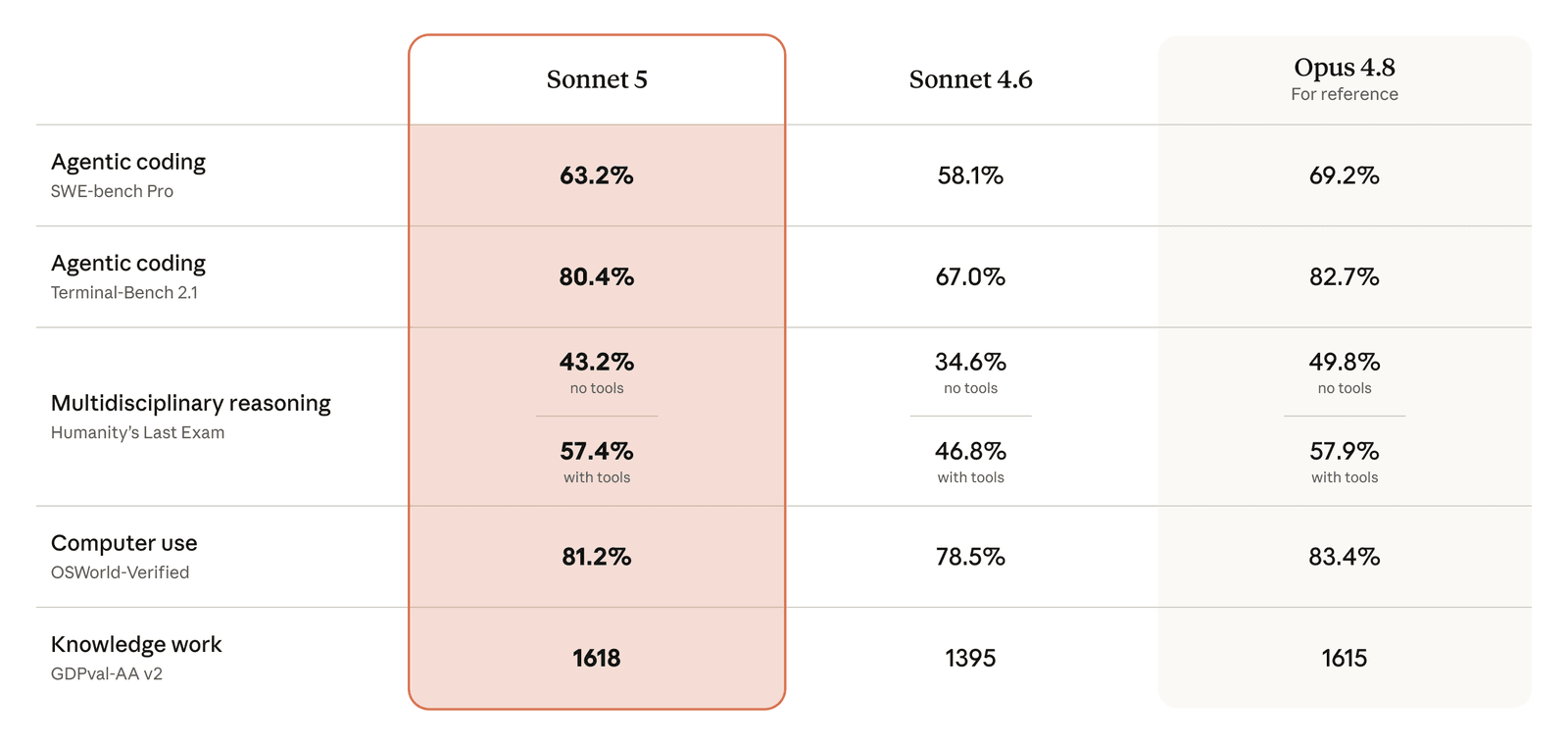
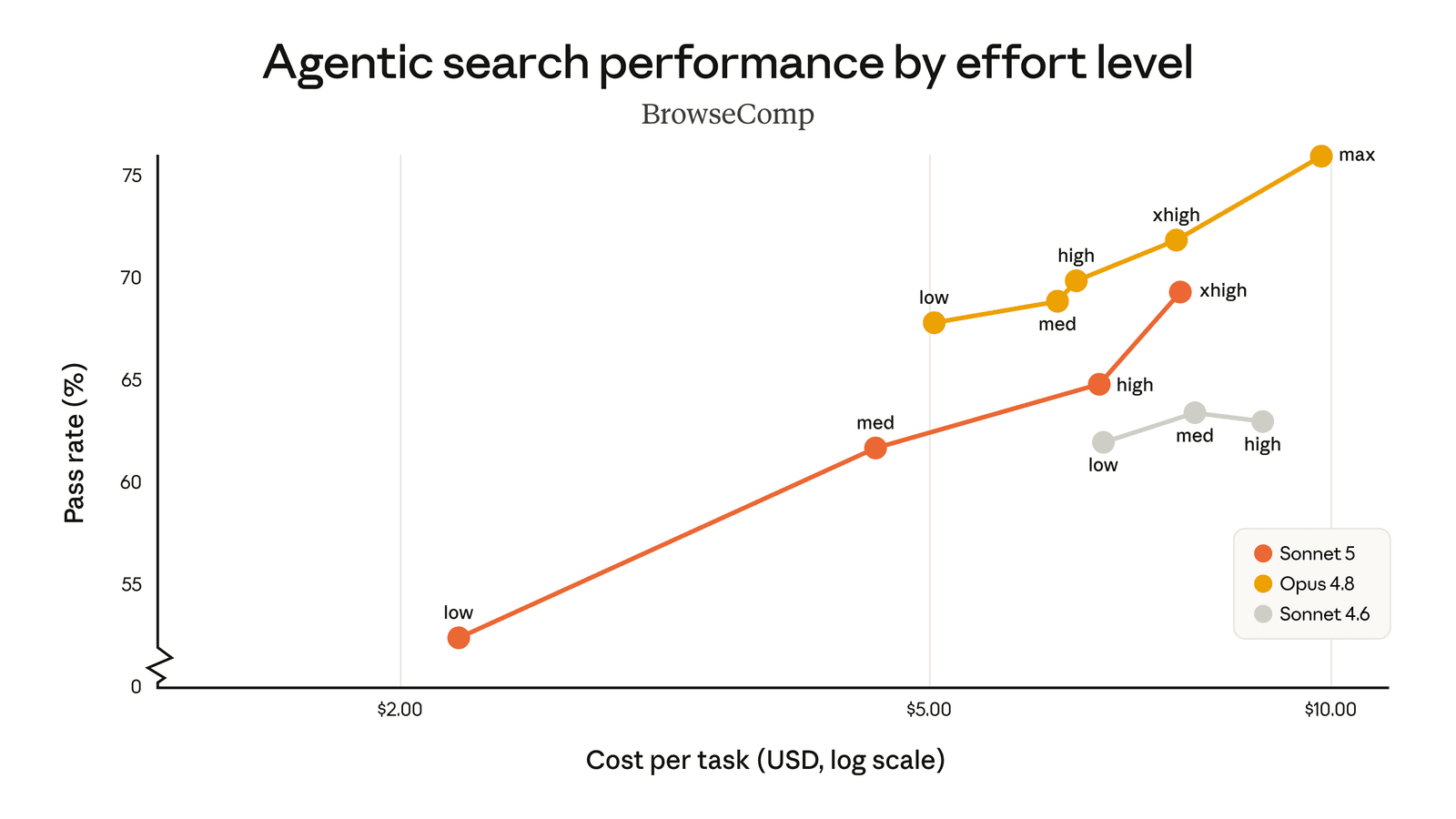
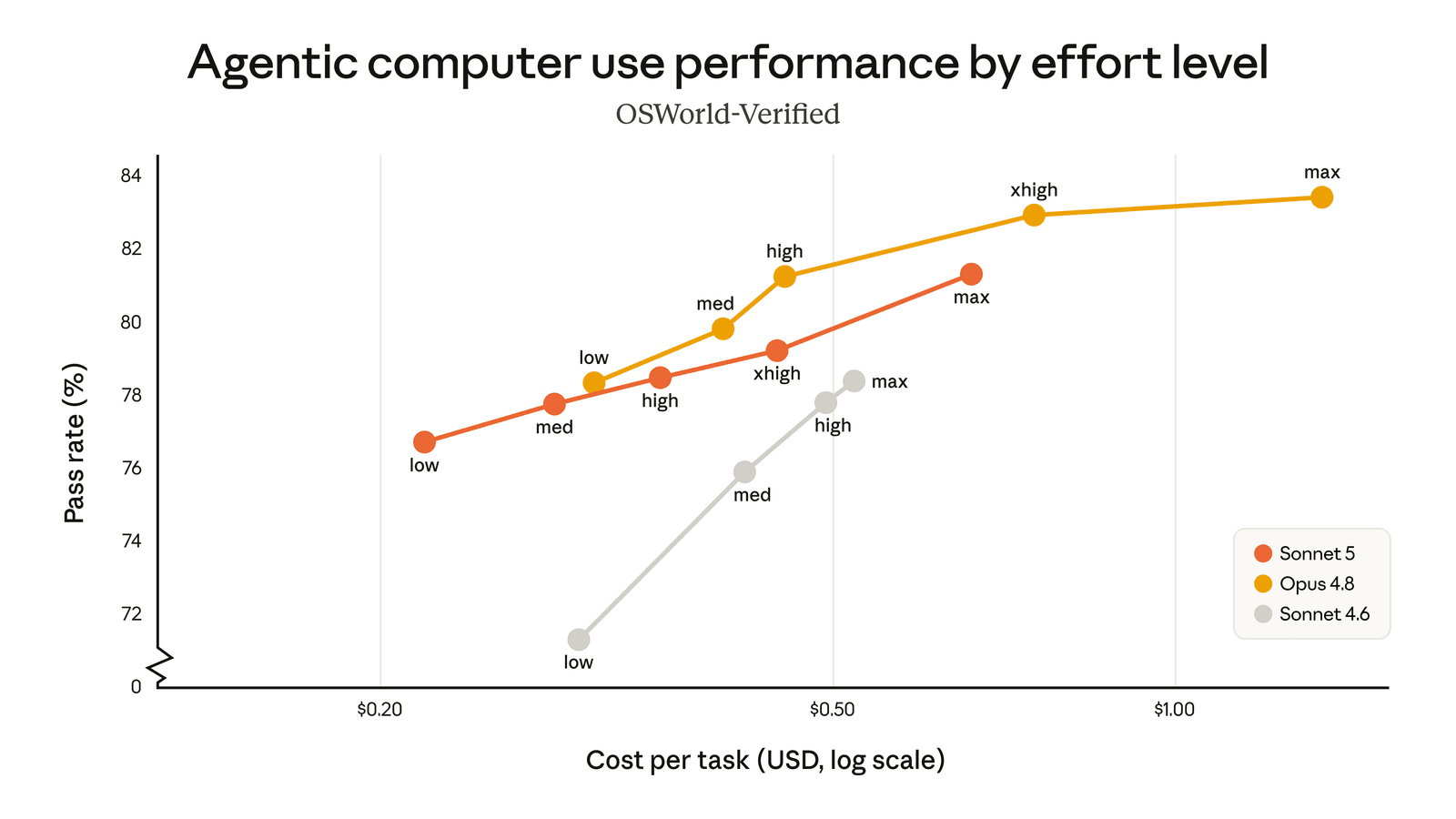
On the agentic benchmark BrowseComp (autonomous web search) and OSWorld-Verified (agentic computer use), Sonnet 5 achieves consistent improvement over Sonnet 4.6 and offers a compelling new price-accuracy operating point. Opus 4.8 still leads on accuracy, but the gap has narrowed dramatically.
Claude Sonnet 5 pricing: how much does it cost?
In short: Introductory pricing through August 31, 2026: $2 per million input tokens and $10 per million output tokens. After that it moves to standard pricing of $3/$15 per million. For comparison, Opus 4.8 is $5/$25.
| Model | Input (per million) | Output (per million) | API name |
|---|---|---|---|
| Claude Sonnet 5 (introductory) | $2 | $10 | claude-sonnet-5 |
| Claude Sonnet 5 (standard, from September 1, 2026) | $3 | $15 | claude-sonnet-5 |
| Claude Opus 4.8 | $5 | $25 | claude-opus-4-8 |
Important to know, new tokenizer: Sonnet 5 uses an updated tokenizer (similar to the one Opus 4.7 introduced) that improves model performance. As a result of this improvement, the same text may tokenize into 1.0 to 1.35 times more tokens, depending on content type. The introductory pricing was set so that migrating from Sonnet 4.6 is roughly cost-neutral.
Where is Claude Sonnet 5 available?
In short: Sonnet 5 is the default model for Free and Pro from day one, and is also available on Max, Team, and Enterprise. For developers: through Claude Code, Claude Platform, Claude on AWS, and Microsoft Foundry. Google Vertex: coming soon.
- Claude.ai: Default model for Free and Pro users.
- Claude Code: For coding work from the terminal (Hebrew guide: Claude in Hebrew).
- Claude Platform (API): Via
claude-sonnet-5. - AWS and Microsoft Foundry (Azure): available at launch.
- Google Vertex: Coming soon.
Sonnet 5 safety: what improved?
In short: Anthropic reports that Sonnet 5 shows lower rates of unwanted behaviors compared to Sonnet 4.6: fewer hallucinations, less sycophancy, better refusal of malicious requests, and improved resistance to prompt injection attacks.
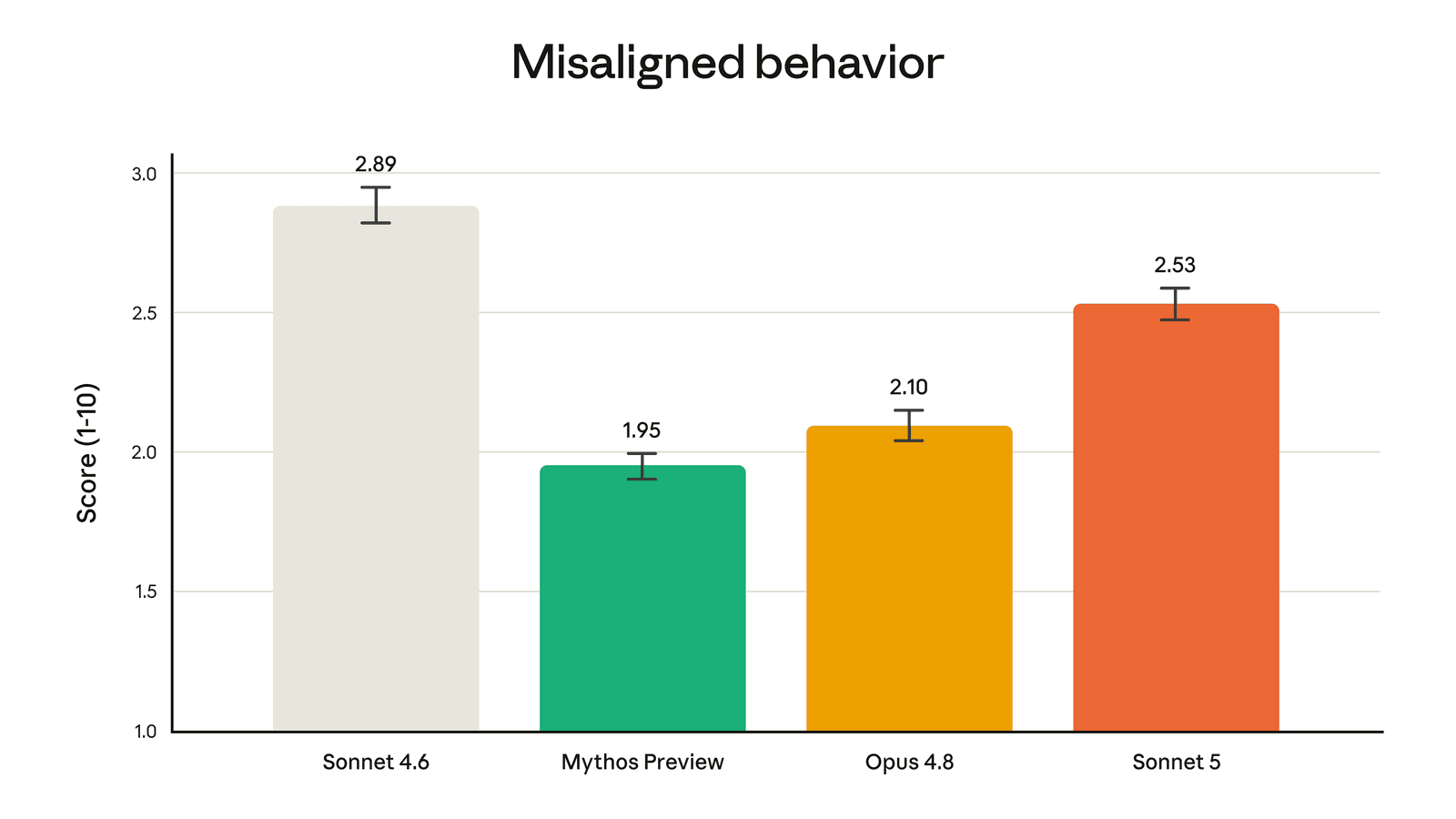
On Anthropic's automated behavioral evaluation, which tests a broad range of misaligned behaviors including complicity in misuse and deception, Sonnet 5 scored lower (meaning safer) than Sonnet 4.6. That said, Opus 4.8 and Mythos Preview still show lower rates than Sonnet 5.
Cyber: what are the capabilities and what are the safeguards?
Sonnet 5 was not deliberately trained on cyber tasks. It is capable of routine, non-harmful cyber tasks, but on benchmarks for potentially dangerous cyber capabilities, such as developing exploits for software vulnerabilities, it performs significantly below Opus 4.8 and Mythos 5.
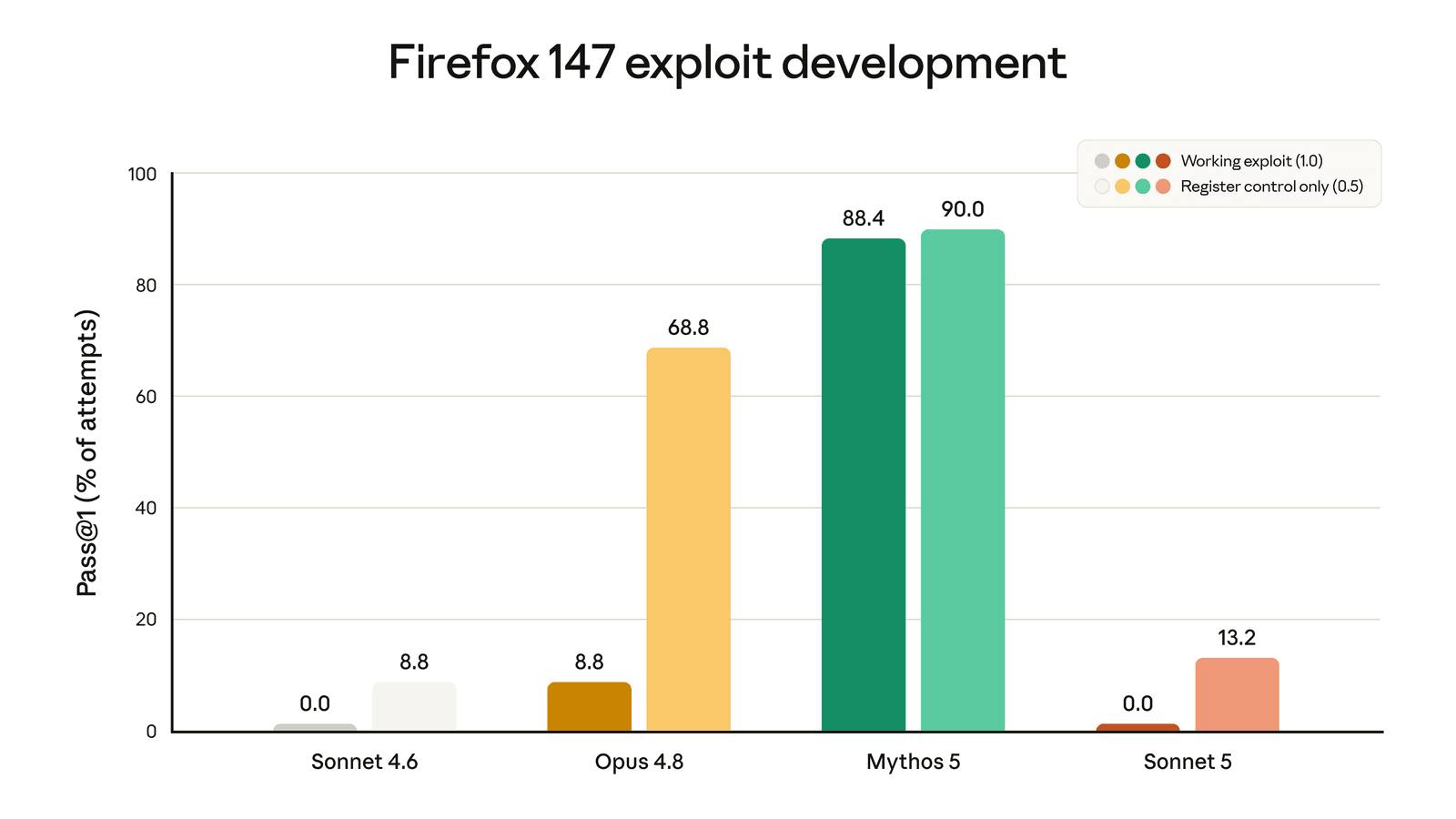
Sonnet 5 never successfully developed a fully working exploit in the evaluation (0.0% success rate), but showed a slightly higher partial-success rate compared to Sonnet 4.6. This change likely stems from improved general capability rather than targeted training. As a result, the model launched with real-time cyber defenses enabled by default, the same defenses present in Opus 4.7 and 4.8.
What do early access partners say?
Anthropic published quotes from teams that worked with Sonnet 5 in early access. The recurring themes: completing tasks all the way through, self-verification without being asked, and attractive price-performance.
"I asked Claude Sonnet 5 to investigate a bug. Without being asked, it wrote a test that reproduced the issue, implemented the fix, then stashed the fix to verify the bug came back without it. All in one pass." Neel Chotai, Rust and software engineer
"We gave Claude Sonnet 5 a two-step task: update account levels in Salesforce and send a launch message to Enterprise contacts. It completed it end to end. Previously this would stall in the middle. For everyday automation, this is not up for debate." Daniel Shepard, senior engineer
Who should switch to Sonnet 5, and who should not?
In short: Worth switching: developers and teams running AI agents on multi-step tasks, and anyone who was using Sonnet 4.6 for code, automation, or knowledge work. Not necessarily worth switching: anyone who needs maximum accuracy on cyber tasks or especially complex research, where Opus 4.8 is still the better choice.
Recommended for Sonnet 5:
- Long-horizon software development: debugging, refactoring, brownfield code.
- Automation agents that communicate with external systems (Salesforce, internal business systems).
- Agentic search and browser and terminal use.
- High-volume research and data analysis, and data agents exploring live databases.
Opus 4.8 may be better for:
- Cyber tasks under reduced regulatory requirements (under Anthropic's cyber program).
- Tasks requiring peak accuracy at very high complexity.
- Workflows where every additional percentage point of accuracy justifies a higher cost.
How do you get started with Claude Sonnet 5?
Anyone already using Claude.ai will receive Sonnet 5 as the default model automatically. Developers connecting via the API can simply swap the model name:
- In API calls, pass the parameter
model: "claude-sonnet-5". - In Claude Code, select Sonnet 5 as the default in settings.
- On AWS / Microsoft Foundry, use the corresponding model identifier on the cloud platform.
- For anyone enrolled in the Cyber Verification Program, access to Sonnet 5 is automatic, no need to reapply.
Want to learn how to build agents and automations on these models? That is exactly what we cover in the Claude Code workshop and enterprise AI implementation, from strategy to code.
The bottom line
Claude Sonnet 5 is a meaningful step forward in the agentic category: consistent improvement over Sonnet 4.6, closing in on Opus 4.8 territory for everyday agentic tasks, and improved safety. For most development and automation teams, it will likely become the new default, especially under the introductory pricing valid through the end of August 2026.
Anyone making heavy use of Claude Code, automation agents, or agents that communicate with external systems (CRM, internal systems, browser) should test Sonnet 5 in their existing workflow and measure the difference in time and cost compared to Sonnet 4.6 and Opus 4.8 on the same tasks.
Frequently asked questions

Yaakov Tzedek
An Israeli AI lecturer, consultant and implementer who has supported 100+ organizations in AI implementation and lectured for 200+. Official content partner of Meta, Google, Canva and TikTok, featured on Israel's Channel 13.
More about Yaakov →