- Anthropic released Claude Fable 5.1 with the same list price but up to 45% lower real-world cost, major jumps in coding and research benchmarks, mid-conversation effort control, and a watermark for regulatory compliance.
The benchmark where Fable 5.1 surprised everyone most is a scientific one: on Terminal-Bench-Science it jumped from 24.7% to 52.6%, more than doubling in under three months. And there is a line you cannot miss at the bottom of Anthropic's announcement page: Made with Fable 5.1 -- the page itself was built with the model it introduces.
Less than three months after Fable 5 changed the conversation on AI models, Anthropic released yesterday (September 1, 2026) Claude Fable 5.1 and its restricted sibling Mythos 5.1. I read the full announcement, cross-referenced the coverage and benchmarks, and here is everything that actually matters.
In short: Same official price, up to 45% cheaper in practice thanks to a 75% reduction in cache read costs. Improvements across all seven core performance benchmarks. Two new capabilities: mid-conversation effort tuning and content provenance watermarking. And full availability from day one, including in Claude Code and the app.
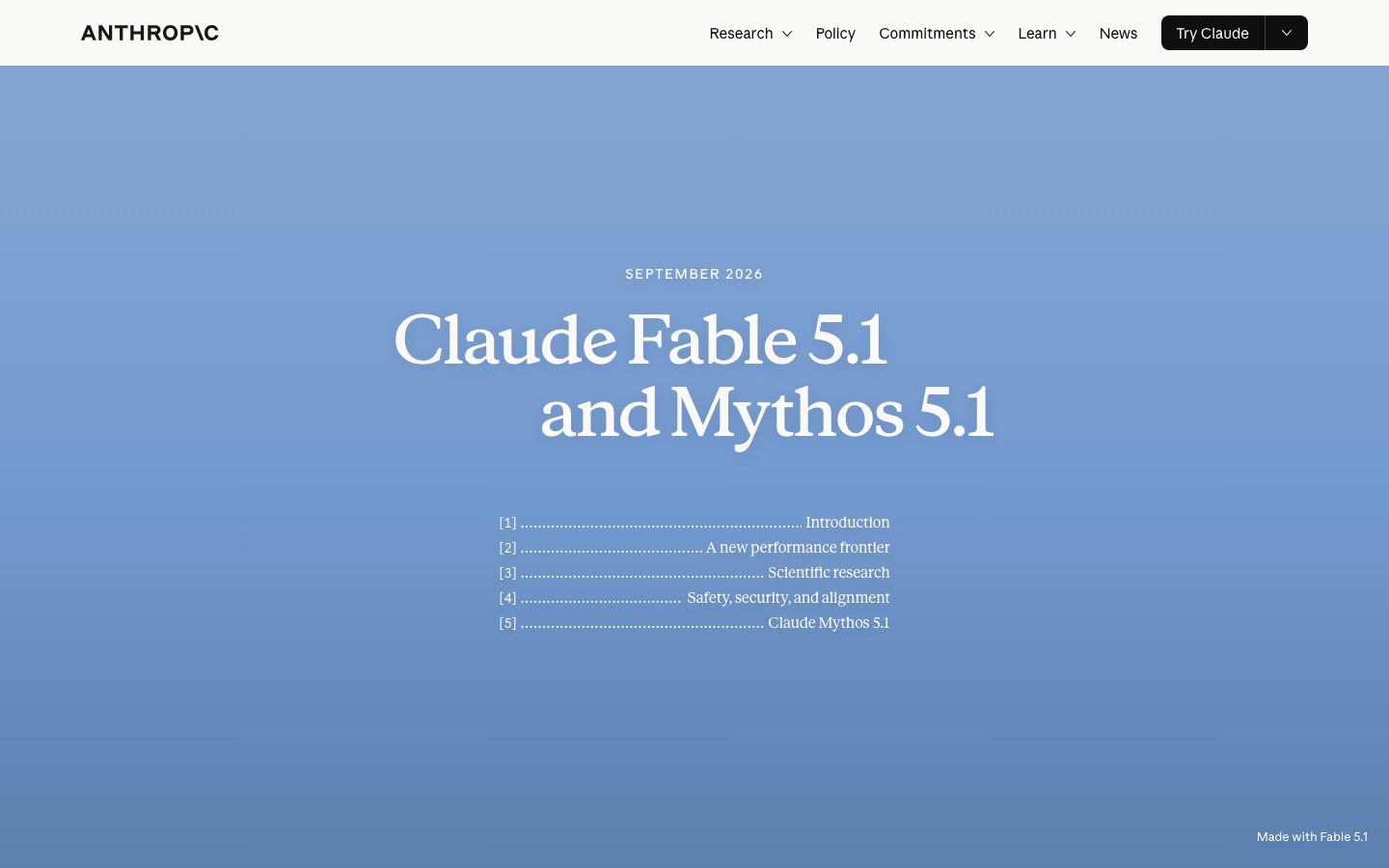 The official announcement page. Note the line at the bottom: "Made with Fable 5.1". Credit: Anthropic
What actually improved? The numbers
Fable 5.1 leads Fable 5 on all seven benchmarks Anthropic published, and in several of them the gap is dramatic:
| Benchmark | Fable 5 | Fable 5.1 |
|---|---|---|
| Terminal-Bench-Science (science tasks in terminal) | 24.7% | 52.6% |
| Terminal-Bench 4.0 (terminal work) | 42.0% | 55.8% |
| AutomationBench (end-to-end automations) | 17.1% | 31.4% |
| GDPval-AA v2 (professional knowledge work) | 1723 | 1853 |
| CursorBench 3.2.0 (code in editor) | 70.5% | 73.4% |
On Humanity's Last Exam, one of the hardest benchmarks around, the model reaches 60.9% without tools and 65% with tools. The practical implication: the tasks that most closely resemble real work, automations, terminal work, and research, are exactly the ones that improved the most.
How much does it cost? The pricing trick
The official price has not moved: $10 per million input tokens, $50 per million output tokens. But cache reads have been cut by 75%, from $1 to $0.25 per million.
Why is this the important part? Because real agents, like Claude Code, repeatedly read the same long context. According to Anthropic, the reduction cuts roughly 25% from a typical workload cost and up to around 45% from heavy agentic workloads. VentureBeat highlights this as the move aimed directly at anyone running agents at scale.
There is a second layer of savings too: at low or medium effort levels, Fable 5.1 achieves results similar to or better than full Fable 5. On the science benchmark, the model at low effort outperformed its predecessor at maximum effort, at roughly a quarter of the cost.
Two new capabilities worth knowing
1. Mid-conversation effort tuning (Effort). Until now, the "thinking" level was set for the entire conversation. Now you can say mid-way through: think hard on this step, then run fast on the next. For anyone building agents and automations this is a real cost-saving tool: high effort only where it is needed.
2. Content watermarking and provenance tracking. Every output receives an invisible watermark, a move that positions Anthropic ahead of the European AI Act. Verification bodies, regulators, and researchers will be able to check through a dedicated API whether content was generated by the model. For organizations worried about forged documents, this is the beginning of an infrastructure-level answer.
What do users see in the app?
Anyone who opened Claude this morning was greeted with this screen:
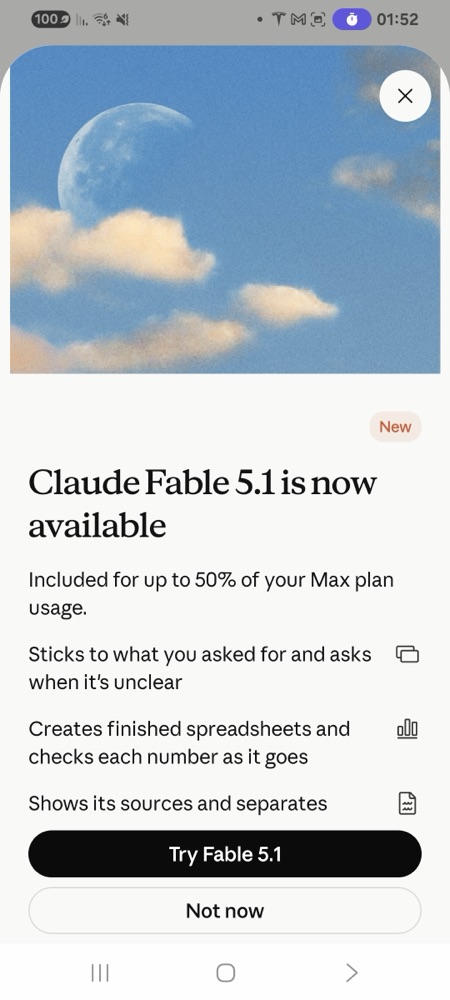 The in-app announcement: Max subscribers get Fable 5.1 for up to 50% of their plan usage. Screenshot: Claude app
The three promises Anthropic chose to present to home users tell the story: sticks to what you asked and asks when unclear, builds finished spreadsheets and checks every number, and shows sources. Less "wow" and more reliability, which is exactly the direction business users have been asking for.
Mythos 5.1: the scientific side that stays behind closed doors
As with the previous generation, Fable and Mythos are the exact same model running at different safety levels, and Mythos 5.1 remains restricted to approved institutions. What it does there is impressive: protein design with success rates of 50% (compared to the typical 10-15% in the field), a topographic map of Venus built from 30-year-old NASA data, and model acceleration of up to 2.5x through GPU kernel writing.
On the safety side, Anthropic reports around 60% fewer false refusals on cybersecurity questions (the model identifies vulnerabilities but does not write exploits) and 85% fewer false refusals on basic biology and medical questions. For anyone who has previously run into strange refusals on perfectly innocent questions, this is a noticeable improvement.
What does this mean for your business?
Three bottom lines:
- Agents have become significantly cheaper. If you have AI workflows running on Claude, check your API bill this month. If you do not have them yet, the economic barrier just got lower.
- Effort levels are a cost management tool. Routine tasks at low effort, heavy decisions at high effort. This is an operational change any organization can implement this week.
- Watermarks are coming to everyone. The infrastructure for content provenance verification is already here, and your organizational AI policy should get familiar with it before regulation makes it mandatory.
Anyone who wants to see all of this working on their own processes rather than in a slide deck: a hands-on AI workshop for your organization, where we build alongside your team on your own systems. And for individuals who want to build themselves, the live intro session for Claude Code on September 16: three hours that end with a real system live in production, on exactly this new model.
Sources: Anthropic's official announcement · VentureBeat on the cache price reduction · MacRumors on safety improvements
Frequently asked questions

Yaakov Tzedek
An Israeli AI lecturer, consultant and implementer who has supported 100+ organizations in AI implementation and lectured for 200+. Official content partner of Meta, Google, Canva and TikTok, featured on Israel's Channel 13.
More about Yaakov →