- New tools scan Reddit for people looking to buy, write a human-sounding reply, and post it from your account. Here is what that means for trust, how to spot an AI-written comment, what Reddit's rules, the FTC, and Israel's Consumer Protection Law say, and what businesses should do instead.
Reddit's authenticity rule explicitly states that you are not required to use your real name. What is prohibited is intentionally misleading others. The problem, in other words, is not anonymity. It is concealing who stands behind a recommendation.
Someone asked on Reddit which tool they should choose. Within minutes they got a warm, personal reply from what sounded like a satisfied user. There is a very real chance no human wrote it.
There are now entire products built on exactly this: they scan threads for buying intent, read community rules, draft a reply that sounds human, and post it from your account. It works, and that is precisely the problem.
In short: AI sales agents on social platforms are already here, and they are good at what they do. The question is not whether the text is helpful, but whether the reader knows that the person recommending something profits from the recommendation. Reddit's rules, the US FTC, and Israel's Consumer Protection Law all agree on the principle: a commercial relationship must be disclosed. Below: how it works, how to spot it, and what to do instead.
What do these tools actually do?
They find people who are asking for a recommendation, write a reply, and post it at a pace that looks human. The clearest example I looked at is Rankhog, a Reddit marketing tool priced at $99 per month per product. According to its website:
- Radar: The tool monitors communities and keywords, including competitor names, skips complaint posts and product launches, and ranks posts by buying intent.
- Drafting: Every draft goes through a "humanizing" step and is checked against community rules, AI detectors, and language that sounds too salesy.
- Posting: The reply goes up from the user's account, through a real browser, at a human pace. You can approve each reply individually, or switch on autopilot.
- Account warming: For users without an established account, the tool "warms" a new account with genuine-looking activity, a little more each day, before it starts promoting anything. A 28-day warm-up costs 25 credits out of a monthly allowance of 100.
- Multiple accounts: You can promote one product with several accounts, and the tool distributes the work "so each one stays natural."
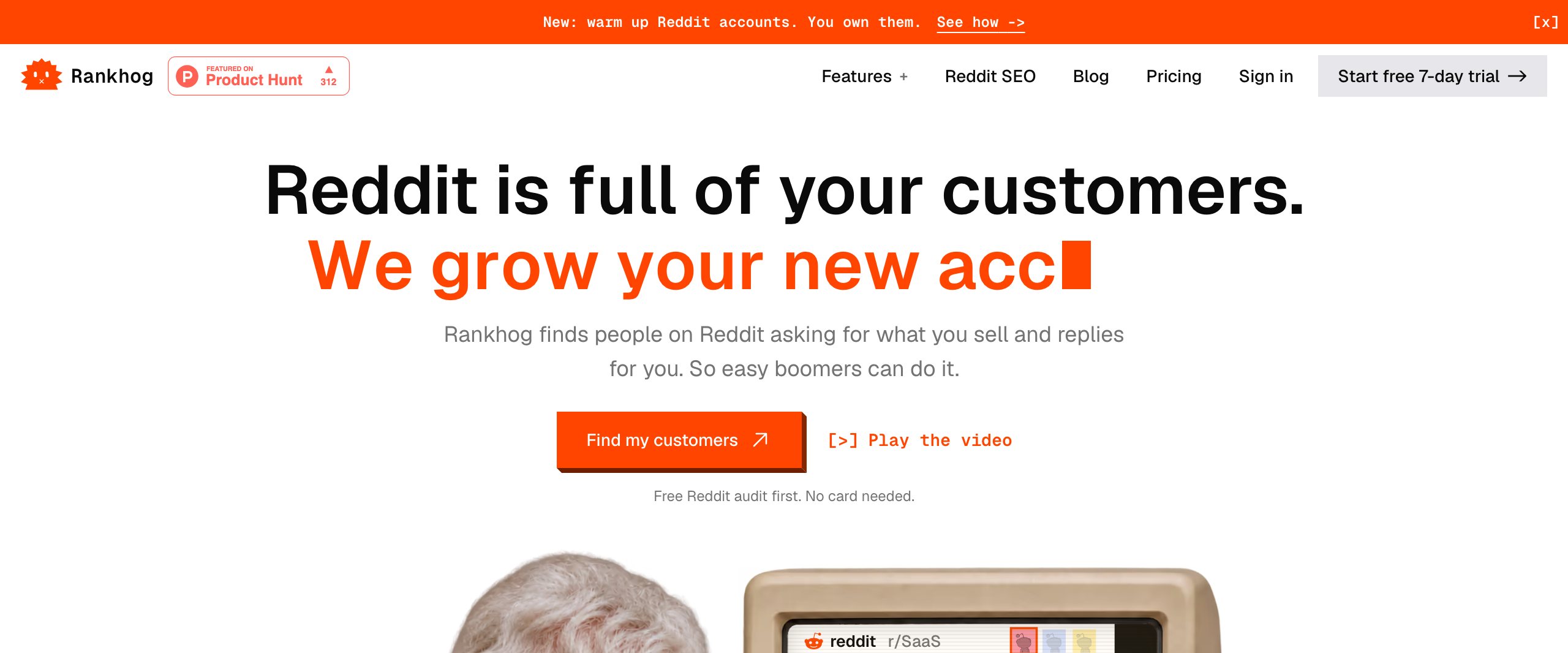 Screenshot: rankhog.com homepage, November 2026
To be fair: Rankhog itself states that no one can guarantee an account will not get banned, offers a "helpful reply with no product mention" mode, and in its own example of a reply that does mention a product, the writer presents themselves as the person who built it. The tool is not some villain's invention. It is a logical outcome of a market where Reddit recommendations rank high on Google and get cited in ChatGPT.
But it is worth paying attention to one gap. In the "no product mention" mode, the example the site shows is a first-person reply, describing a team's personal experience with 200 clients, written by AI. Someone reading that in a thread knows none of this.
Why does this erode trust in online recommendations?
Because all the value of a forum recommendation rests on a single assumption: the person who wrote it has nothing to gain from it. People go to Reddit precisely because they do not trust ads. When the replies themselves become unmarked ads, the shared asset everyone relied on gets depleted.
There is also a cumulative effect. One agent politely chiming in on a thread does not destroy a community. A thousand agents, each running five "warmed" accounts, already shifts what consensus looks like. And answer engines that learn from Reddit keep citing that manufactured consensus downstream.
This connects to something I wrote about in the GEO guide: appearing in ChatGPT answers through genuine content is a legitimate and powerful channel. Appearing there through manufactured consensus is a shortcut that poisons the source.
How do you spot a reply written by an agent?
There is no single proof, but a combination of signals should raise a flag. These tools are explicitly built to bypass AI detectors, so do not rely on "this sounds like ChatGPT." Look for patterns:
- Response time: A detailed reply arriving minutes after a "what do you recommend" post, from an account with no obvious connection to the topic.
- Account history: A relatively young account with generic, pleasant contributions across many communities, and then suddenly a pinpoint recommendation for one specific product.
- A personal story that leads to exactly one conclusion: "We went through the same thing, tried everything, and then found X." The story is vague, the product is specific.
- Repetition: Search the product name on the site. If it appears across dozens of threads, in a similar pattern, from different accounts, that is not a coincidence.
- A follow-up question: Ask for a specific detail (which version, how long, what did not work). A real person answers with details, sometimes awkward ones. A generated reply tends to stay general or not answer at all.
What do the rules and the law say?
Three different rule systems reach the same conclusion: marketing is allowed, hiding the commercial relationship is not.
Reddit's rules. Reddit Rule 2 requires participating authentically in communities where you have a personal stake, and prohibits spam or content manipulation. Rule 5 adds that you do not have to use your real name, but deliberately misleading others is not allowed. On top of these, every community has its own rules, and in many of them self-promotion is banned or restricted.
The United States. The FTC Endorsement Guides (16 CFR Part 255), updated in 2023, state that a material connection between an endorser and an advertiser (payment, a business relationship, or a benefit) must be clearly and conspicuously disclosed when the audience would not expect it. And from October 2024, a separate rule (16 CFR Part 465) bans reviews and testimonials that present an endorser who does not exist, including those created by AI, as well as reviews by company insiders without disclosure of that connection.
Israel. Section 7(c)(1) of the Consumer Protection Law provides that an advertisement that is likely to cause a reasonable person to believe it is not an advertisement will be treated as a misleading advertisement, even if its content is not misleading. In a draft guidance published by the Israeli Consumer Protection and Fair Trade Authority in January 2021, on the subject of online reviews, it was stated that reviews may be misleading if they are presented as impartial but were in fact written by the business or on its behalf.
Neither I nor this article determines whether any specific Reddit reply qualifies as a "review" in the legal sense. That is a question for a lawyer. But the direction of all three frameworks is clear, and anyone building an entire strategy on concealment is building on shaky ground.
So what should you do instead?
Use AI to find the conversations and to draft better, then post under a disclosed identity. The technology itself is excellent. The problematic part is only the concealment. Four principles:
- An identified account. A brand account, or an employee who openly writes "I work at X." In many communities, a transparent and helpful reply from a company representative is received well, and sometimes genuinely appreciated.
- A human approves every reply. An agent can scan, rank, and draft. A real person approves and posts, and handles the follow-up questions.
- An agent that introduces itself. On your own channels (WhatsApp, website chat) an AI sales agent can work extremely well, as long as the person talking to it knows what it is. In the guide to turning a Grok bot into a sales agent I explained in detail how to build one on channels you own.
- Testing before launch. An agent that talks to customers needs to be tested before it goes live. In the experiment where 8 simulated customers tested a WhatsApp sales agent we found 4 mistakes that would have cost sales, and that is exactly the kind of testing worth doing.
What does this mean for your business?
Three bottom lines:
- Online recommendations are becoming suspect. The more businesses use covert agents, the less readers will trust any reply. The advantage will shift to those who are identifiable, consistent, and credible over time.
- The risk is not only legal. A banned account, a thread where someone exposes a reply as generated, a screenshot circulating in a group: any one of these costs more than any lead that reply ever brought in.
- It is worth writing a policy. If your marketing team is already using tools like these, it is better to know now. An AI policy for organizations should include a section on publishing content in the company's name on social platforms, and who approves what.
Want your team to use agents, but the right way?
The gap today is not in the tools, it is in judgment: what you hand off to an agent, what stays with a human, and where the line runs between smart automation and deception. That is exactly what we work on in practical AI workshops for organizations: building agents with your team on your actual workflows, including the rules around them.
And for organizations that want every employee to learn to work with AI at their own pace, there is AI TV for organizations: a subscription for mobile learning, with short courses that are updated continuously.
Sources: Reddit Rules · FTC Endorsement Guides, 16 CFR Part 255 · FTC announcement on the final rule banning fake reviews · Draft guidance from the Israeli Consumer Protection Authority on online reviews, January 2021 · Rankhog website (rankhog.com), checked November 23, 2026
Frequently asked questions
Yaakov Tzedek
An Israeli AI lecturer, consultant and implementer who has supported 100+ organizations in AI implementation and lectured for 200+. Official content partner of Meta, Google, Canva and TikTok, featured on Israel's Channel 13.
More about Yaakov →