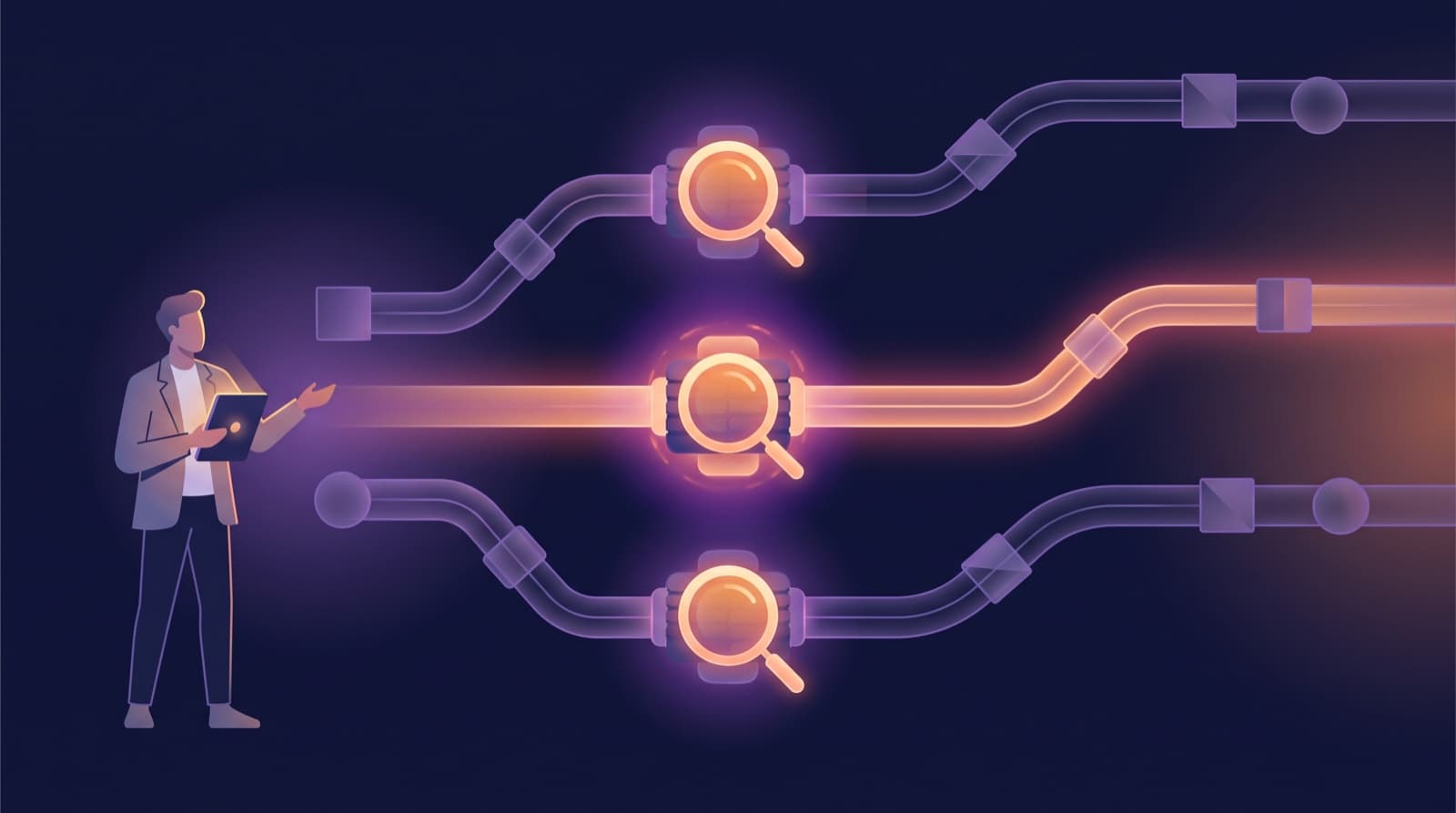
- Process 1: What repeats. A task performed dozens of times a week, with the same structure, by multiple people.
- Process 2: Where work waits for a person. A point where work stops until a specific person is free to respond, approve, or draft something.
- Process 3: Where people copy manually. Information that moves from system to system through human copy-paste.
In most of the organizations I have worked with, the process with the highest return was not the one management pointed to in the first meeting. It was a process nobody had thought about, because it was so routine they had stopped noticing it.
When I walk into an organization that wants to implement AI, the first question I almost always get is "which tool should we use?" That's the wrong question, and it's definitely not the first one to ask. Before the tool, before the policy, and before the licenses, I ask to see three specific processes. Those three processes determine whether the implementation will return its investment within a month or end up as a nice presentation gathering dust in a drawer.
This is exactly the diagnostic process I run in an assessment meeting, and here it is in full so you can run it yourself.
In short
- Process 1: What repeats. A task performed dozens of times a week, with the same structure, by multiple people.
- Process 2: Where work waits for a person. A point where work stops until a specific person is free to respond, approve, or draft something.
- Process 3: Where people copy manually. Information that moves from system to system through human copy-paste.
- Each of the three is evaluated with three simple questions and ranked by return versus effort.
Why three processes and not a comprehensive organizational survey?
Because too broad a mapping is the surest way to never get started. I've seen organizations spend months on a full process survey, come out with a 60-page document, and implement nothing. Three focused processes produce a decision within a week.
There's a political reason too: one visible success is worth more than ten promises. The moment one department shows it's saving six hours a week, the rest of the organization asks to join. That turns the implementation from a management initiative into bottom-up demand.
Process 1: What repeats many times
The question I ask: "What's the task you do most often in a week, where everyone on the team does roughly the same thing?"
It sounds like a trivial question, and the answers almost always surprise management. In customer service it's responding to recurring requests. In finance it's turning a raw report into a summary. In marketing it's adapting the same message to five different channels.
Why this is the first candidate: multiplication. Saving seven minutes on a task that happens 200 times a month is nearly 24 hours of work per month, in a single department. And when a task repeats, there are already plenty of examples of "good output," which is exactly what you need to build a reliable AI process.
How to actually check: Ask everyone on the team to log, over three days, every task that took more than ten minutes. No survey, no interviews, just a list. The patterns jump out immediately.
Process 2: Where work waits for a person
The question I ask: "Where in your process do things stall because you're waiting for someone to be available?"
This bottleneck exists in almost every organization: a manager who needs to approve, a single professional who knows how to draft that particular document, or a specialist everyone sends questions to. When that person is on vacation, half the processes stop.
Why this matters: here AI doesn't save minutes, it clears a bottleneck. A common and effective solution: instead of having the expert write from scratch, a system prepares a first draft based on their knowledge and examples, and they just review and approve. Same person, three times the output, and nothing goes out without a human eye on it.
An important warning: this is also the most politically sensitive point. If the expert thinks you're building a machine to replace them, the implementation will fail quietly. The right approach is to involve them as a partner building their own tool, not as the subject of the project. This is one of the reasons that at this stage a hands-on AI workshop where the team builds things themselves is preferable to a training session where a finished system is presented to them.
Process 3: Where people manually copy information from system to system
The question I ask: "Where do you copy information from one place to another using copy-paste?"
A form that arrives by email and gets typed into a system. A call that gets manually summarized into the CRM. A spreadsheet someone updates because two systems don't talk to each other.
Why this is gold: these processes are well defined, easy to measure, and almost always hated by the people doing them. That means high return and low resistance. It's the perfect pilot, especially for an organization that's still skeptical.
Bonus: these processes expose a deeper problem, the lack of integration between systems, and fixing it delivers benefits beyond the AI context as well.
The three-question filter: does the process fit at all?
Once you have three candidates, each one goes through a quick filter:
| Question | Why it matters |
|---|---|
| Is the output text, a classification, or a summary? | These are exactly the strengths. A binding legal decision or regulatory judgment is not a first-phase candidate |
| Are there existing examples of "good output"? | Without examples there's no standard, and you can't tune the system or measure it |
| Will someone review before it goes out? | A process without a human in the loop in the first phase is an unnecessary risk, even when quality is high |
A process that answers "yes" to all three is an excellent candidate. A process that answers "no" to any one of them isn't disqualified forever, it's just not first.
What do you do with the results?
Rank the three candidates on two axes: expected return versus implementation effort. Pick one, not three. Define the chosen one as a pilot with three numbers written down in advance: how long the process takes today, how long it should take afterward, and when you check.
From here the path is clear: a hands-on workshop where the team builds the solution themselves, and if the process is broader, a full implementation project that includes building, training, and support until it becomes routine. The mistakes worth avoiding along the way are collected in the AI implementation mistakes guide, and I covered the question of who in the organization needs to be trained in the three-level model.
Frequently asked questions
How long does this diagnostic take? In a mid-sized organization, three days of data collection and one two-hour meeting are enough to come out with a chosen candidate and metrics.
Do you need a budget before starting? Not for the diagnostic. Budget is needed at the pilot stage, and it's derived from the chosen process and its scope.
What if management wants to start with a different process? That happens, and it's fine, as long as the process passes the three-question filter. If it doesn't, it's worth investing a meeting to present the numbers before starting.
Does this work in a public-sector organization? Yes, with an additional layer of data security and usage policy. I covered that in the AI implementation guide for public-sector organizations.
The bottom line
Successful AI implementation doesn't start with "which tool should we use," but with "which process in our organization is most worth improving first." These three processes, what repeats, where things wait, and where people copy, give you that answer within a week.
Want me to run this diagnostic in your organization? Get in touch and we'll schedule a short scoping call.
Frequently asked questions

Yaakov Tzedek
An Israeli AI lecturer, consultant and implementer who has supported 100+ organizations in AI implementation and lectured for 200+. Official content partner of Meta, Google, Canva and TikTok, featured on Israel's Channel 13.
More about Yaakov →